
For decades, corporate leadership relied on a fundamental mechanism for growth: the five-year strategic plan. Leaders would gather, forecast the market, allocate resources, and cascade rigid directives down the traditional hierarchy. Yet today, that model is effectively obsolete.
We are operating in a profound VUCA environment—characterized by Volatility, Uncertainty, Complexity, and Ambiguity. In the modern market, competitive advantage is no longer determined by who has the most accurate long-term forecast, but by who has the resilience to pivot in months, or even weeks.
To visualize this paradigm shift, think about the difference between a cargo ship and a speedboat. Traditional companies are built like massive cargo ships. They set a predefined course, and their immense size and functional silos mean they cannot turn easily when an iceberg appears.
Agile companies, on the other hand, are like a fleet of speedboats. They are tethered to the same strategic destination, but they can shift direction instantly to avoid obstacles or seize new market disruption opportunities.
However, to make the transition, corporate leaders must first dismantle a pervasive and dangerous misconception: Agility does not mean chaos.
True enterprise agility involves a profound paradox: the marriage of extreme stability and extreme speed. You cannot achieve dynamic capabilities on the front lines without a stable, unwavering backbone of core values, standard governance, and robust technology platforms.
 |
Author: Jonathan M. Pham |
Highlights
- True organizational agility is a proactive “state of being” (lowercase ‘a’) rather than just following rigid technical frameworks like Scrum (Capital ‘A’). It requires a culture of customer-centricity and the courage to discard processes that no longer add value.
- High-speed response requires a stable foundation. Effective organizations balance Fixedness (a stable structural backbone and core values) with Flexibility (the ability to rapidly reallocate resources and pivot strategies) to avoid chaotic failure.
- Transformation involves moving from traditional “command and control” hierarchies to decentralized, cross-functional networks. This shifts the focus from merely completing tasks (outputs) to delivering genuine customer value (outcomes).
- Successful agility rests on Structure (dual operating systems), Process (standardizing for speed), People (psychological safety and continuous learning), Technology (decentralized data access), and Strategy (adaptive planning based on market sensing).
- Leaders must transition to “servant leadership,” focusing on removing bureaucratic obstacles rather than adding rules. Performance should be measured through leading indicators like Cycle Time and Wait Time rather than just lagging financial data.
What is Organizational Agility?
At its core, organizational agility is a company-wide “state of being” – defined as the speed and effectiveness with which an organization responds to change, detects risk, and creates value. Instead of a temporary defensive posture to survive a crisis, it is a proactive business philosophy designed to outmaneuver competitors.
“Being Agile” vs. “Doing Agile” (Lowercase ‘a’ vs. Capital ‘A’)
A primary reason digital transformations fail is that executives confuse Agile frameworks with agile values.
- Capital “A” Agile: The specific technical frameworks and methodologies (like Scrum, Kanban, or SAFe) originally designed for software development.
- Lowercase “a” agility: The company-wide ability to pivot resources, strategies, and structures. It is described as “who you are” (a growth mindset) rather than “how you do what you do” (a rigid process).
Recently, an echo chamber in the tech industry has declared that “Agile is dead,” citing failed implementations of Scrum. This critique misses the mark. Frameworks act as “training wheels” that help a team at the beginning of their transformation. As the organization matures, it may outgrow these initial systems.
True agility is having the courage to discard a framework that no longer serves the purpose, while retaining the core culture of customer-centricity and rapid iteration. A company can be highly agile without adopting a single Agile software tool.
Difference Between Business Agility and Organizational Agility
While often used interchangeably, there is a distinct structural difference between the two terms:
- Business Agility is outward-facing. It is the result—the ability of the enterprise to compete, innovate, and win in the external market.
- Organizational Agility is inward-facing. It is the internal DNA, structural design, and workforce capability that makes business agility possible.

The Agility Paradox: Speed Requires Stability
According to research from McKinsey, organizational agility is not about constant, chaotic movement. Instead, it is the deliberate balance of two opposing forces: Fixedness and Flexibility.
Without a stable foundation, large companies that try to act like startups fail due to reinvented wheels and unmanaged risk. McKinsey calls it the “$20 Billion Start-up Problem.” If a massive organization decentralizes too many decisions without a stable backbone, it loses its primary competitive advantage (scale).
- Fixedness (Stability): This reduces variability. It includes a stable mandate, core cultural anchor points, and standardized project practices. It acts as the springboard.
- Flexibility (Speed): This allows for the “stretching” of resources to meet new goals, utilizing dynamic teams and rapid capital reallocation.
“The start-up out of someone’s garage can be just fast and agile without a lot of stability. But as soon as you get any sense of size or scale, you cannot be agile without some sense of stability.”
Aaron De Smet, McKinsey
Why is Organizational Agility Important?
The cost of rigidity is total market obsolescence. Yet, a massive “Knowing-Doing Gap” exists in the modern workforce. While 90% of executives believe agility is essential to survival, only 18% of employees feel their organization is actually agile.
The Data-Driven ROI of Agility
Data from McKinsey, the Project Management Institute (PMI), and MIT highlight a staggering return on investment for companies that successfully transition to an agile operating model:
- The 30% Boost: Companies that successfully “go agile” see a 30% increase in operational efficiency, customer satisfaction, and employee engagement.
- Financial Performance: 65% of organizations that successfully transition report improved financial performance. Highly agile companies generate total shareholder returns 50% higher than less agile competitors.
- Project Success Rates: Agile firms are twice as likely to see successful results from new initiatives. They grow revenue 37% faster and generate 30% higher profits compared to low-agility counterparts.
Agile Organization vs. Traditional Hierarchy
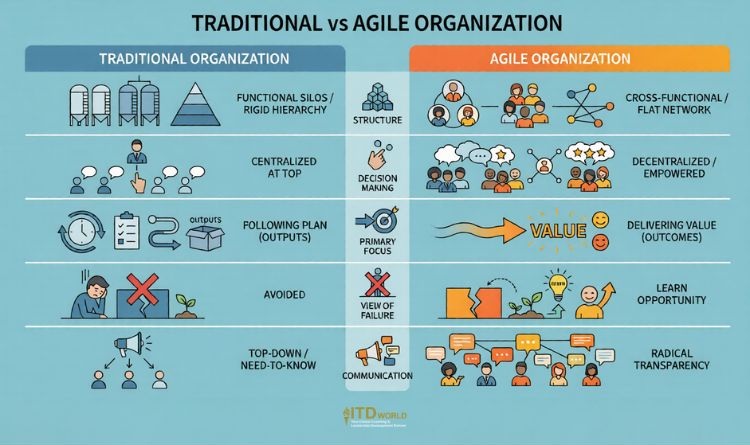
To understand how these financial returns are generated, it’s helpful for us to look at how the operating model fundamentally shifts.
|
Feature |
Traditional Organization |
Agile Organization |
|
Structure |
Functional Silos / Rigid Hierarchy |
Cross-Functional / Flat Networks |
|
Decision Making |
Centralized at the Top |
Decentralized / Empowered Teams |
|
Primary Focus |
Following the Plan (Outputs) |
Delivering Value (Outcomes) |
|
View of Failure |
Something to be avoided or punished |
“Responsive discovery” & opportunity to learn |
|
Communication |
Top-down / Need-to-know basis |
Radical Transparency |
Traditional “command and control” hierarchies suffer from bureaucracy and slow time-to-market. By shifting from outputs (meeting a deadline on a Gantt chart) to outcomes (delivering genuine value to the customer), the agile enterprise effectively expands its “execution capacity”—removing the arbitrary barriers that kill good ideas before they can be tested.
5 Pillars of Organizational Agility
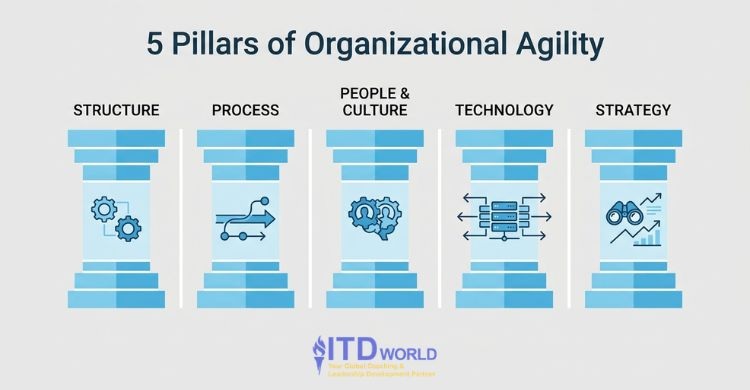
Transforming an enterprise requires pulling specific levers across the entire company. Based on the Scaled Agile Framework (SAFe), McKinsey, and Prosci, we can break down the transition into five actionable pillars as follows.
Pillar 1: Structure (The Dual Operating System)
SAFe advocates for a “Dual Operating System.” You do not need to scrap the traditional hierarchy entirely. Instead, keep the primary hierarchy (the “home” for talent) stable. Alongside it, run a “network” operating system focused purely on value streams.
This network allows for the rapid assembly and disassembly of cross-functional teams. By breaking down departmental silos, you mix diverse skill sets into a single team, minimizing the “bottleneck” of seeking approvals from five different departments to launch one product.
Pillar 2: Process (Standardizing for Speed)
Counterintuitively, agility requires highly standardized practices. In fact, research has revealed that organizations that standardize project and portfolio practices are three times more likely to be highly agile.
Having a common language and set of tools for project management allows an organization to pivot faster because they aren’t “reinventing the wheel” every time a change occurs. The rule is simple: use “light” processes for creative or cognitive work, and “heavy” processes only for routine, high-risk tasks.
Pillar 3: People & Culture (The Learning Machine)
Agile companies are essentially “learning machines.” They utilize constant feedback loops to turn every change or failure into a data point for continuous improvement.
For this purpose, Psychological Safety is non-negotiable. If employees fear failure, they will not experiment, and they will hide risks. Agility is fueled by an environment where everyone feels safe to take calculated risks, challenge superiors, and admit mistakes without fear of retribution.
Read more: Fail Fast, Learn Fast – Turning Friction into Fuel
Pillar 4: Technology (Engineering for Decentralization)
Agility without data is just guesswork. Technology plays a critical role in enabling organizational agility through centralized information and decentralized access.
- Centralizing Information: Using a single digital work hub prevents information silos and ensures radical transparency.
- Decentralized Access: Agility requires giving every team member self-serve access to data (via AI and Data Analytics) so they don’t have to wait for a centralized analytics department to run a report.
- Decoupled Architecture: Establishing technology systems that allow teams to work, deploy, and update software independently without waiting for enterprise-wide release trains.
Pillar 5: Strategy (Market Sensing & Anticipation)
Strategic agility requires a culture of “Market Sensing”—leaders going to where the work happens and building Minimum Viable Products (MVPs) to test ideas before fully committing.
Research into B2B organizations reveals a fascinating “Marketing Planning Paradox.” Intense, rigid, long-term marketing planning actually creates internal friction and resource waste. High performance is achieved through Adaptive Planning, where the organization remains flexible enough to react to the market without being handcuffed by a predetermined, outdated strategy.
The Human Element & Leadership of Cultivating Organizational Agility
A transformation will fail if the top leader is not actively engaged. Agility cannot be delegated solely to the IT department. The human element—how people are led, trained, and managed—is the ultimate bottleneck or catalyst for speed.
Agile Leadership and the “Addition” Trap
When leaders feel uncertain in a VUCA environment, their natural survival instinct is to regain control. To fall into the “Addition Trap,” adding more rules, more reporting processes, and more oversight committees.
True agile leadership requires the exact opposite: taking things away to reduce bureaucracy. Managers need to move toward servant leadership, viewing their primary job as removing obstacles for their teams rather than issuing top-down orders. Functional managers must stop making tactical project decisions (which are often high-visibility and ego-driven) and focus instead on the lower-visibility work of developing employee talent.
The Role of HR in Organizational Agility: “Un-HR”
To become a market disruptor, it is critical that Human Resources transition into “Un-HR” – i.e. moving away from traditional administrative compliance roles to become strategic architects who intentionally induce change.
They must help the organization understand the critical distinction between Capability and Capacity:
- Capability is the ability to do the work (Skill).
- Capacity is the time to do the work (Availability).
A massive failure point in traditional companies is assigning whoever is “available” to a project, rather than who is “skilled.” Truly agile companies treat talent development as a long-term strategic art form, training individuals for the jobs they might have to do in the future.
Learning as the “Fuel” for Agility
According to LinkedIn’s Workplace Learning Report, organizational agility is shifting away from structural design and toward individual skill-building. However, while 89% of organizations believe proactive skill-building is necessary, only 2% have completed large-scale upskilling programs.
To accelerate agility, leaders must tap into the “Individual Motivation Loop.” The most effective way to foster an adaptable workforce is to align the company’s strategic needs with individual career goals.
Additionally, agility requires robust Internal Mobility. Talent should be allowed to flow where it is most useful. The role of executives is to act as “talent scouts” for the entire company, sharing top performers through rotations rather than hoarding them in departmental silos.
Given that those who move to a new internal role within two years have a 75% likelihood of staying at the company, cultivating organizational agility also serves as a premier retention tool.

How to Execute and Scale Organizational Agility
How do you take these theoretical pillars and actually scale them across a legacy enterprise? By dismantling bureaucracies, redesigning workflows, and changing how decisions are made.
Decentralized Decision-Making and “Decision Rights”
One of the lowest-scoring attributes in corporate surveys is “Fast Decision-Making.” Even when companies want to be agile, they are paralyzed by internal approval processes.
Scaling agility requires establishing an Accountability Culture that clearly defines “decision rights.” High-volume, day-to-day decisions must be pushed to the lowest possible level—the autonomous teams closest to the customer. Management should only focus on a low volume of high-stakes strategic decisions.
Silo-Busting Metrics
Many times, silos are accidentally reinforced by the management hierarchy (i.e., who you report to dictates what you care about). To break them, companies need to align decision processes separate from the hierarchy. When different departments—like Sales, Product, and Customer Success—share the exact same target metrics, cross-functional collaboration happens naturally.
Real-World Organizational Agility Examples
- The Microenterprise Model (Amazon & Spotify): Startups are agile by necessity, but as they scale, layers of approval naturally form. To combat this “Startup Trap,” enterprise giants deliberately structure their workforce into small, autonomous “squads.” These act as microenterprises—independent teams within the larger company that handle everything from R&D to delivery, maintaining their “day one” startup energy.
- Structuring for Speed (ANZ Bank): To eliminate delays, ANZ Bank implemented a “Tribe Structure.” Teams are limited to roughly 10 people, and traditional managers are replaced by coaches and product owners. Crucially, hiring is based on adaptability rather than just technical experience.
- The Turnaround (T-Mobile): T-Mobile transformed from a lowest-ranked carrier to a market disruptor through rapid customer-centricity. They executed external changes (eliminating long-term contracts based on customer feedback) and internal changes (scrapping metrics that forced employees to “trap” customers), aligning the whole company around genuine customer satisfaction.
- The Borderless Organization (Unilever): Unilever created the “Unilever Foundry” as an entry point for startups. Instead of trying to innovate everything internally through slow corporate R&D, they partner with faster companies to pilot products, allowing a massive corporation to experiment with the speed of a garage startup.
Read more: New Hire Retention – Strategies, Metrics, and the 90-Day Playbook
Overcoming Barriers to Organizational Agility
- Cultural Inertia: The most common barrier is the “we’ve always done it this way” mindset. The “Agility Gap” occurs when organizations try to change their processes without changing their culture. If the culture remains risk-averse, the new agile processes will eventually stall. Change management frameworks, like the ADKAR Model (Awareness, Desire, Knowledge, Ability, Reinforcement), are vital for guiding individuals through this psychological shift.
- The Sunk Cost Fallacy: A major psychological barrier is the trap of sunk costs. Past expenses must be considered irrelevant when deciding whether to pivot strategy; only future costs and potential value should dictate direction.
- Agile Contracts and Procurement: A massive, hidden blocker to agility resides in Legal and Procurement departments. Rigid, upfront contracts prevent pivoting. For an organization to be truly agile, it has to create flexible vendor contracts that allow for changing requirements mid-project.
- The Hubris Risk: Leadership overconfidence is a silent killer. Those who rely too much on past successes (“we’ve got this”) tend to ignore market signals and waste resources on non-strategic opportunities, failing to iterate based on new data.
Organizational Agility Metrics and KPIs
You cannot manage what you do not measure. However, traditional metrics like Return on Investment (ROI) are “lagging indicators”—by the time you see them, it’s too late to change course. Agile organizations rely on “Innovation Accounting,” using leading indicators and early data-driven outcomes to evaluate if a strategy is working.
To gain a holistic view of performance, organizations should track KPIs across several categories:
- Delivery KPIs (Speed & Flow)
- Wait Time vs. Active Time: In many corporate processes, the actual “work” (active time) is a tiny fraction of the total time it takes to finish a project. The most effective way to speed up a company isn’t making people work faster, but reducing the idle “wait time” between departmental handoffs.
- Cycle Time: The duration from an idea’s conception to a released feature.
- Decision Lead Time: How long it takes to move from identifying a problem to acting on it.
- Quality KPIs (Reliability)
- Defect Density: Rather than just counting bugs, measuring bugs per unit of code helps teams pinpoint specific, fragile areas of the codebase for targeted refactoring.
- Value and Team KPIs (The “Unmeasurable”)
- Outcome vs. Output: Shifting focus from how many features were shipped (output) to what business impact was made (customer acquisition, revenue).
- Team Health: Standard KPIs often fail to capture teamwork and communication. Metrics like Employee eNPS (Net Promoter Score) and Turnover rates are essential proxies for these soft skills. A technically fast team will eventually fail if the culture is toxic and burnout is high.
The Trap of Over-Measurement: Focusing too much on “hard” numbers may cause teams to neglect long-term health. Organizations should use a combination of metrics, setting clear goals before measuring, and ensure a dedicated role—such as a Change Management Office or SAFe Agilist—maintains consistency in how data is compared across the enterprise.
Read more: Brilliant Jerks – How to Handle Toxic “High Performers” in the Workplace
FAQs about Organizational Agility
What are the four forms of organizational agility?
While frameworks vary, enterprise agility is generally broken down into four forms:
- Strategic Agility (sensing market shifts and pivoting the business model).
- Portfolio Agility (dynamic reallocation of funding and resources to high-value areas).
- Operational Agility (speeding up internal processes and time-to-market).
- Leadership Agility (the psychological flexibility of leaders to empower teams and dismantle bureaucracy).
What are the 3 C’s of agile leadership?
Agile leadership is anchored in Communication (radical transparency and centralized information), Collaboration (breaking down silos and fostering cross-functional teamwork), and Commitment (dedication to continuous learning, psychological safety, and viewing failure as responsive discovery).
How does agility improve the customer experience?
Agility inherently requires “Customer-Centricity.” By replacing rigid, year-long master plans with short, iterative feedback loops, teams can pivot to provide what customers actually value in real-time, rather than what executives predicted they would want months in advance. AI and data analytics further allow agile companies to personalize the user experience at scale based on real-time behavior.

Final Thoughts
Agility is not a final destination, a certificate you hang on the wall, or a software tool you install. As product expert Laura Klein notes, “Agility is 80% iteration.” It is a continuous journey of resizing, reshaping, and rethinking how value is created.
The strategic imperative of the 21st century is clear: companies that overlook the importance of adaptability risk harboring a workforce that is anxious, fearful, and highly resistant to change. By establishing a stable backbone, promoting cross-functional teams, and transforming leaders into talent developers, your company would evolve from a slow-moving cargo ship into a disruptive fleet of speedboats.
ITD World provides specialized coaching and training solutions designed to help leaders & organizations secure a competitive advantage – and be equipped to win in today’s dynamic landscape. Contact us today to learn more about our world-class programs!
Other resources you might be interested in:
- Skills-Based Organization: A Blueprint for Agility in a Disrupted World
- Future Ready Organization: 11 Tips to Building One
- Organization Development: Guide to Sustainable OD Practices & Strategies
- Leadership Potential: How to Spot & Cultivate Future Leaders