

In traditional corporate environments, failure is treated like a contagious disease. Timelines are bloated “just in case,” meetings are heavily padded with jargon to deflect accountability, and teams are paralyzed by the pressure to be perfect on the first try. The tragic result? Safe mediocrity at best, and a slow, irrelevant death at worst.
Then comes the counterintuitive battle cry of the modern startup ecosystem: Fail fast.
To the uninitiated executive, the phrase sounds like a celebration of incompetence. Why would any business want to fail? However, to successfully navigate today’s Volatile, Uncertain, Complex, and Ambiguous (VUCA) business landscape, a cognitive shift is non-negotiable. “Failing fast” is simply the most efficient vehicle for speed to insight.
In a world where technology moves faster than human adaptability, a fixed-path strategy (like a static roadmap) is a recipe for disaster. Leaders should rely on a principle-based compass instead. As Mike Tyson has said,
“Everybody has a plan until they get punched in the face.”
Success is not defined by your ability to avoid the punch, but by your organizational agility—how quickly you can adapt, learn from the hit, and get back in the ring.
 |
Author: Jonathan M. Pham |
Highlights
- The “fail fast, learn fast” methodology is a strategic framework derived from systems engineering and Lean Startup principles. It prioritizes rapid experimentation over long-term, expensive perfectionism.
- Instead of spending significant capital and time on a secret project, companies use Minimum Viable Products (MVPs) to test business assumptions early. This allows them to preserve resources by identifying flawed concepts before they lead to catastrophic, high-cost failures.
- Success is found through a Build-Measure-Learn cycle. Making frequent, small adjustments based on real-world data leads to better outcomes than trying to anticipate every flaw upfront.
- Failing fast is not an excuse for poor work; it requires intense discipline. It involves using the scientific method to extract “Return on Failure” (ROF)—analyzing data from setbacks to perform “blameless post-mortems” and ensure the same mistake isn’t repeated.
- For the methodology to work, organizations must foster psychological safety, where employees are not punished for mistakes. Leaders should decouple personal self-worth from project outcomes, treating invalidated hypotheses as valuable data rather than personal flaws.
- The methodology is ideal for complex, shifting domains (like software or marketing) where the cost of a wrong decision is low. However, it should generally be avoided in high-stakes domains (like medicine or aerospace) where a “zero-defect” mentality is required for safety.
What Does Fail Fast Learn Fast Mean?
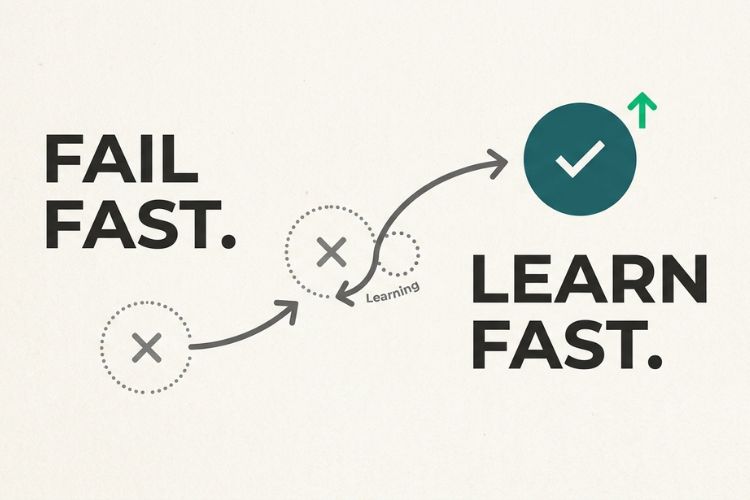
At its core, “fail fast, learn fast” is a strategic framework designed to test business assumptions with minimum viable risk and maximum clarity. It is the practice of identifying flaws in a concept, product, or strategy as early in the development cycle as possible.
Instead of spending two years and $2 million building a product in secret—only to launch and discover nobody wants it—a company might spend two weeks and $2,000 to test the underlying assumption. If the assumption is wrong, the project “fails.” But because it failed early, the company preserves its capital, protects its timeline, and acquires critical data about what the market actually desires.
In this context, failure is a high-speed feedback loop and an essential component of professional Research & Development (R&D).
Origin of the fail fast fail often mantra
While it sounds like a modern Silicon Valley buzzword tossed around in pitch decks alongside “disrupt” and “pivot,” the origin of the mantra is deeply rooted in systems engineering and the Lean Startup methodology.
The concept gained mainstream traction through Eric Ries’s foundational work, which formalized the Build-Measure-Learn feedback loop. It challenged the outdated belief that business success requires a perfect business plan. Accordingly, businesses are essentially a series of untested hypotheses that require immediate, real-world customer validation.
Fail fast methodology in software engineering
The phrase was technically born in the realm of Agile development and software engineering. In coding, a “fail-fast” system is specifically designed to immediately report any condition that is likely to lead to a failure. Rather than allowing a program to continue running with a hidden error—which would eventually cause a catastrophic system crash down the line—the software halts operations the moment a bug is detected.
When applied to business logic, this translates to setting up short development cycles (sprints) with clear goals. Agile teams adopt the methodology to create regular opportunities to assess, adjust, and iterate without losing sight of the overall vision.
Fail Fast vs. Perfectionism
Many unsuccessful initiatives stall because the management seek perfection, driven by the illusion that they have to be right every time. In contrast, great leaders prioritize progress over perfection.
Let us consider a classic design exercise: Two designers, David and Beth, are given the same task of building the longest-flying paper airplane.
-
David (The Perfectionist) relies on mental modeling. He spends his time trying to anticipate every aerodynamic flaw in his head before building. He aims to create a “perfect” plane and tests it only once, at the very end.
-
Beth (The Iterative Designer) adopts a rapid prototyping approach. She builds a rough prototype within 15 minutes and throws it. She observes how gravity and wind affect it, makes adjustments, and tests it many times throughout the process.
The outcome? Beth’s plane flies significantly farther. David’s effort to prevent complications upfront caused analysis paralysis and actually prevented him from having the time to fix the real-world complications that arose during his single test.
The core message is clear: It is better to be fast and flawed than slow and “perfect,” because true perfection is usually found through the iterative process of fixing flaws.
What is the difference between “failing fast” and just doing sloppy work?
A critical misconception is that failing fast means rushing blindly into bad ideas. It does not. Yet there is a massive chasm between failing fast and failing stupid.
Elon Musk, known for implementing the methodology at SpaceX and Tesla, once stated,
“Failure is an option here. If things are not failing, you are not innovating enough.”
However, he never suggested that staying dumb is an option. Every failed SpaceX rocket launch—often broadcasted on live streams—is immediately followed by rigorous forensic analysis, design iteration, and procedural overhauls.
Sloppy work is launching something haphazardly without a mechanism to capture data. Failing fast, conversely, requires intense discipline. It demands data-driven decisions, clear accountability, and a systematic method for capturing and applying lessons learned.
The point is not to crash, but to crash while learning at the speed of relevance.
Read more: Decision Making Framework – How to Eliminate Analysis Paralysis
Why the Fail Fast Methodology Works
The methodology works because it mimics the scientific method. It forces teams to think with a physics approach—reasoning from fundamental truths rather than analogy. When relying on first principles, you test the foundational assumptions of your business rather than blindly copying what competitors are doing.
This is highly effective because learning is best done experientially. As visualized by the “cone of learning,” active experimentation yields much higher retention and understanding than theoretical discussion. Value experimentation over debate; let the market dictate what works.
How to test business assumptions quickly
Not all failures are created equal. You can accelerate learning by breaking your projects down into four specific dimensions, addressing each sequentially:
-
Concept Failure: This occurs when your vision is not viable or desirable, because there is simply no market demand. To detect it, focus entirely on problem-solution fit before building anything. Talk to potential customers, understand their pain points, and validate your unique selling proposition.
-
Design Failure: The concept is sound, but the execution doesn’t meet user expectations—it’s too complex or confusing. This is where design thinking comes into play. Put low-fidelity sketches or wireframes in front of users. Observe their interactions and measure engagement long before writing a line of code.
-
Execution Failure: The design is right, but the implementation is unreliable, buggy, or slow. To avoid it, utilize A/B testing, continuous integration, and beta launches to ensure your product meets quality standards in a live environment.
-
Growth Failure: You have a working product, but you cannot retain or acquire customers cost-effectively. That’s why it’s essential to test your acquisition channels with low-cost experiments (like organic social ads or landing pages) to refine your messaging before scaling the marketing budget.
Benefits of Failing Fast in Business
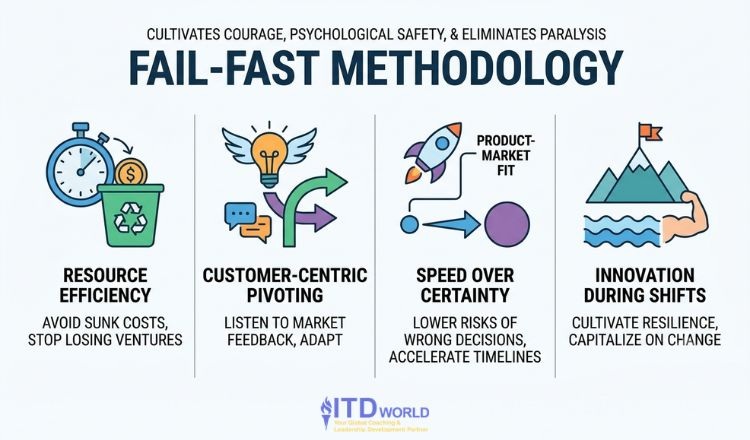
Organizations that embrace rapid iteration cultivate cultures of courage, in which teams feel psychologically safe to offer bold ideas and move without bureaucratic paralysis. When executed correctly, the methodology yields four distinct competitive advantages as follows:
-
Resource Efficiency: It prevents businesses from falling into the sunk cost fallacy—the cognitive bias that compels us to continue investing in a losing proposition simply because we have already invested heavily in it.
-
Customer-Centric Pivoting: Real-time feedback loops allow companies to shift focus rapidly. When a business listens to the market, it can execute a pivot to serve a more lucrative need.
-
Speed Over Certainty: The cost of a “wrong” decision is incredibly low in the early stages of a project compared to post-launch. Making decisions quickly accelerates the timeline to finding true product-market fit.
-
Innovation During Shifts: A fail-fast mindset cultivates resilience. It helps organizations adapt to external shocks and macroeconomic shifts, allowing them to capitalize on changing consumer behaviors while competitors are still drafting approval memos.
Strategies for rapid prototyping and MVP creation
Failing fast requires you to understand the role of a Minimum Viable Product (MVP), which is to test your highest-risk assumptions with the least possible effort.
If you want to launch a new software platform, there’s no need to build the entire backend. You can start with a clickable frontend mockup, or even just a landing page explaining the service, to see if users will actually click “Buy Now.”
Fail fast learn fast examples in startups
-
Ovia Health discovered through an early MVP that their foundational assumption about universal menstrual cycles was completely wrong. By discovering the flaw in the prototype phase, they fixed the algorithm early and prevented a total product failure upon launch.
-
Hue, an AI beauty platform, initially launched as a B2C product. Through organic community testing, they realized consumer acquisition was too difficult to scale. Because they hadn’t burned their capital yet, they smoothly pivoted to a highly successful B2B model.
Advanced Insight: The “Return on Failure” (ROF) Metric
Modern business leaders are beginning to track “Return on Failure.” While ROI determines the financial success of an initiative, ROF measures the capital, time, and brand equity saved by abandoning a doomed idea early.
In addition, with the rise of Generative AI, companies no longer even need physical MVPs to experience their first iterations. Businesses can now simulate market conditions and chat with “synthetic personas” to test value propositions, allowing them to fail within seconds rather than weeks.
Read more: AI in Leadership – Bridging the Gap Between Adoption & Maturity
Failing Fast vs. Scaling Fast
It is crucial to note that failing fast is a phase, not a permanent state. During the early stages (pre-product-market fit), the primary goal is learning and discovery. You want a high frequency of small, low-cost risks.
However, once the model is validated, the business needs to transition to Scaling Fast. At the post-validation stage, the goal shifts to market dominance, requiring substantial investment and a focus on risk mitigation.
How to Build a Fail Fast Learn Fast Culture
You cannot implement an iterative process in a company that fires, demotes, or publicly shames people for making mistakes. The ultimate prerequisite for the methodology is a thriving innovation culture built on trust.
Overcoming the fear of failure
A Global Entrepreneurship Monitor survey found that 49% of people refrain from starting a business specifically due to the fear of failure, which carries over into the corporate world, leading to risk aversion.
To overcome the problem, leaders need to actively help employees decouple their personal self-worth from the worth of their projects. In traditional academic schooling, an unsuccessful test equals a bad grade—a personal flaw. But in business, an invalidated hypothesis is merely data. Leaders must help their teams unlearn their academic conditioning.
Let us think about the origin story of Spanx founder Sarah Blakely. Growing up, her father instituted a daily dinner table ritual. He would look at his children and ask, “What did you fail at today?” If they didn’t have a failure to report, he was audibly disappointed. In doing so, he reframed failure as a requirement for growth rather than a source of shame, training Blakely to take the calculated risks necessary to eventually establish a billion-dollar empire.
Executives should adopt the same “dinner table ritual” in the boardroom. By openly asking staff what they had trouble with at this week, leaders normalize the friction of innovation.
Create psychological safety
Psychological safety is the belief that you won’t be punished or humiliated for speaking up with ideas, questions, concerns, or mistakes.
One highly effective tactic used by agile fintech startups is the implementation of a “Failure Celebration Board.” In this environment, teams transparently discuss what went wrong each month. By bringing failures out of the shadows and into the open, the stigma is removed, allowing the organization to harvest the wisdom of the mistake collaboratively.
Read more: Innovation Coaching – From Abstract Ideas to Scalable Reality
Implementing Fail Fast in Agile Teams
There is an inherent friction in middle management known as the Project Manager’s Paradox. While failure is brilliant for organizational learning, it is often viewed as the “enemy” of the immediate project. In a professional context, it costs money, delays timelines, and frustrates stakeholders. A project manager’s primary mandate is to succeed, not to experiment at the expense of the budget.
To resolve the paradox, agile teams must balance speed with discipline, specifically by utilizing “Borrowed Experience.” A pragmatic leader understands that a team doesn’t have the time or budget to make every single mistake themselves. High-level professionals must supplement their own experiments by voraciously learning from the documented failures of competitors and other industries, avoiding errors that have already been solved.
How to conduct a blameless post-mortem
When a rapid experiment does fail, the team must extract the wisdom it paid for. The greatest mistake an organization can make isn’t the failure itself, but the act of putting it behind them too quickly to save face.
To prevent wasted resources, organizations need to conduct blameless post-mortems (or retrospectives). The focus of these meetings should be strictly on root cause analysis, not finger-pointing.
To ensure the team actually “learns fast,” facilitate the meeting by asking these core questions:
-
What was our initial hypothesis?
-
What actually happened? (Rely strictly on data, not emotion).
-
What worked well that we should carry forward?
-
What didn’t work, and why?
-
What are the actionable insights we will apply to the next iteration?
When Not to Use the Fail Fast Approach
“Fail fast, break things” is a brilliant motto for building a social media app or launching a marketing campaign. Yet it is catastrophic when it comes to building a bridge, performing a medical procedure, or launching a commercial airliner.
Leaders have to differentiate between complex domains (like software and consumer behavior, where the landscape is constantly shifting and rapid iteration is required) and clear/critical domains (like healthcare, aerospace, and deep hardware tech). In high-stakes environments, moving too quickly comes with the risk of human safety, severe compliance breaches, and irreversible reputational damage. In these industries, a “fail-safe” or “zero-defect” mentality is the appropriate standard.
Why the fail fast mantra is misunderstood
Even in appropriate industries, the methodology is frequently abused by companies that forget the “learn fast” half of the equation.
Take Burger King’s launch of “Satisfries” (low-calorie french fries) or Oakley’s attempt to integrate an MP3 player into bulky sunglasses. In both cases, early consumer feedback strongly indicated that the market was not interested. However, because the management was overly committed to their initial vision, they ignored the early failure signals and pushed the products to mass market anyway, resulting in highly public, expensive flops.
Failing fast only yields benefits if leadership possesses the bold humility to accept that their assumptions were wrong and the agility to change course immediately.
Read more: Agility Coaching – Navigating Change & Fueling Business Success
Start Failing Forward Tomorrow
Failing fast is more than just a theoretical concept; it requires a mindset shift supported by systemic changes. If you are a manager or executive looking to implement the methodology tomorrow, try to follow these three steps:
-
Set Learning Goals, Not Just Performance Goals: When launching a new initiative, do not solely define success by revenue or user acquisition. Define what critical piece of market data you intend to learn from the experiment.
-
Define Your “Kill Metrics” Upfront: Before you launch a prototype, agree on the specific metrics that will indicate the idea is failing. If the project hits those metrics, kill it without emotion, so that you may neutralize the sunk cost fallacy before it takes root.
-
Host a “What Did We Learn?” Segment: In your next all-hands meeting, spotlight a recent team failure. Discuss it blamelessly, highlight the money/time saved by catching it early, and praise the team for their transparency.
Success is not built on a lack of mistakes, but on the ability to re-enter the game quickly after a setback. In today’s hyper-competitive market, if you aren’t failing, you aren’t trying anything new.

FAQs
How do you measure the success of a failed experiment?
A failed experiment is highly successful if it generates validated learning. You measure its success by calculating the Return on Failure (ROF)—the amount of future budget, time, and brand equity you saved by abandoning or pivoting away from a flawed assumption early in the process.
Why is “fail fast” essential for innovation and disruption?
Innovation, by definition, requires operating in the realm of the unknown. Because there is no historical data for something entirely new, you cannot rely on past performance. Instead, look to hypothesis testing.
Failing fast allows you to navigate “uncharted jungles” by continuously course-correcting based on real-time environmental feedback, ensuring you find the disruptive breakthrough before your capital runs dry.
ITD World provides specialized coaching and training solutions designed to help leaders & organizations secure a competitive advantage – and be equipped to win in today’s dynamic landscape. Contact us today to learn more about our world-class programs!
Other resources you might be interested in:
- Existential Leadership: From Managing Tasks to Curating Significance
- Leadership Philosophy: How to Define Your True North & Follow It
- 9 Key Leadership Skills for the Future of Work
- Mindfulness and Business: The ROI of Presence
- Brilliant Jerks: How to Handle Toxic “High Performers” in the Workplace