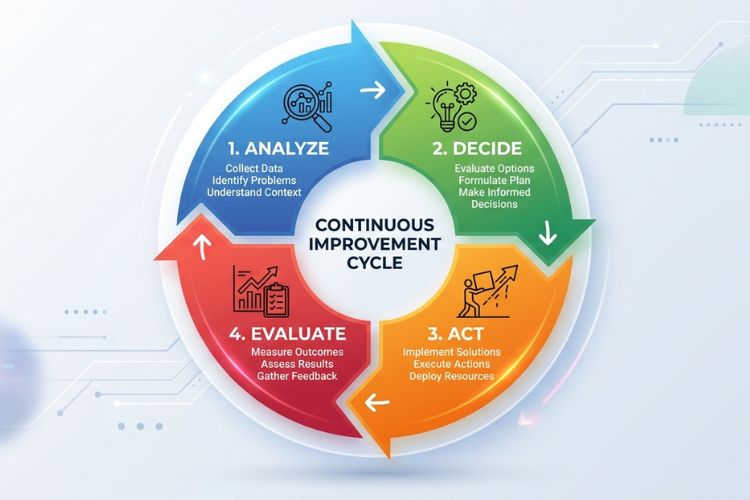
We have all been there. You are sitting in a high-stakes leadership meeting that has been circling the same problem for weeks. The debate is endless, the whiteboards are full, and yet, another hour passes without a clear path forward. Finger-pointing begins, and the dreaded “analysis paralysis” sets in.
If this sounds familiar, your organization is not alone. According to research from McKinsey & Company, executives spend nearly 40% of their time making decisions, yet a staggering 61% admit that more than half of that time is used ineffectively. For an average Fortune 500 company, this inefficiency translates into 530,000 days of wasted managerial effort and roughly $250 million in lost wages annually.
When the stakes are high, relying on “gut instinct” and heuristics fails at scale. To build a resilient, agile organization, leaders must move beyond passive experience and adopt active, systematic approaches.
 |
Author: Jonathan M. Pham |
Highlights
- Frameworks serve as a structural antidote to human psychological flaws. They help leaders avoid “decision fatigue” and common pitfalls like confirmation bias or the sunk cost fallacy by forcing a rational evaluation of data over emotion.
- A primary benefit of these models (such as DACI or RAPID) is eliminating bottlenecks. By clearly defining who is the “Driver,” “Approver,” or “Contributor,” organizations prevent the “loudest voice” from winning and ensure everyone knows who has the final say.
- Not all problems require the same rigor. Reversible decisions should prioritize speed and agility, while irreversible ones require deep, data-heavy strategic planning.
- Different frameworks suit different needs. The OODA Loop is best for volatile, fast-paced environments. Tools like the Decision Matrix or ICE Framework use quantitative scoring to rank options objectively. On the other hand, the Cynefin Framework helps leaders categorize challenges (Simple vs. Chaotic) to determine if they should follow “best practices” or run experiments.
- You cannot always guarantee a successful result, but you can guarantee a successful process. Organizations should judge their choices based on the quality of the decision-making framework used rather than just the short-term outcome.
What is a Decision Making Framework?
A decision-making framework is a structured, logical approach that guides individuals and teams through the process of evaluating options, mitigating risk, and selecting the best course of action. Its main purpose is to subjective “gut feelings” with objective criteria and clear accountability.
Why Are Decision Frameworks Important?
When an organization scales, complexity multiplies. Because human psychology is deeply flawed when faced with overwhelming data and high-pressure stakes, formalizing the decision processes provides a structural antidote to the problem:
Combating decision fatigue & cognitive bias
Every choice you make depletes your mental energy. When leaders suffer from decision fatigue, most default to mental shortcuts (heuristics) that give rise to cognitive biases. Without a structured framework, they easily fall victim to the confirmation bias (seeking data that supports a pre-existing belief) or the sunk cost fallacy (throwing good money after bad).
A framework forces an objective evaluation of variables, replacing emotion with rational choice.
Preventing groupthink & ensuring alignment
In unstructured meetings, the loudest voice or highest title usually wins. Structured frameworks equalize voices by demanding objective criteria and formalizing dissent. By assigning specific roles for proposing, challenging, and analyzing ideas, teams can engage in healthy debate without defaulting to artificial harmony.
Eliminating ambiguity & bottlenecks
What happens when a team lacks a clear decision-making framework? The answer is predictable: massive bottlenecks, a severe lack of accountability, and a glacial time-to-market. Frameworks eliminate the toxic “Who is supposed to approve this?” conversation by making roles painfully clear.
A critical shift in perspective: As noted in Stoic philosophy, you cannot guarantee a successful outcome, but you can guarantee a successful process. A good decision can still yield a bad outcome due to market volatility. However, judging your choices solely by the result leads to confusion. A framework ensures that your focus remains on process over mindset, providing equanimity regardless of the short-term result.
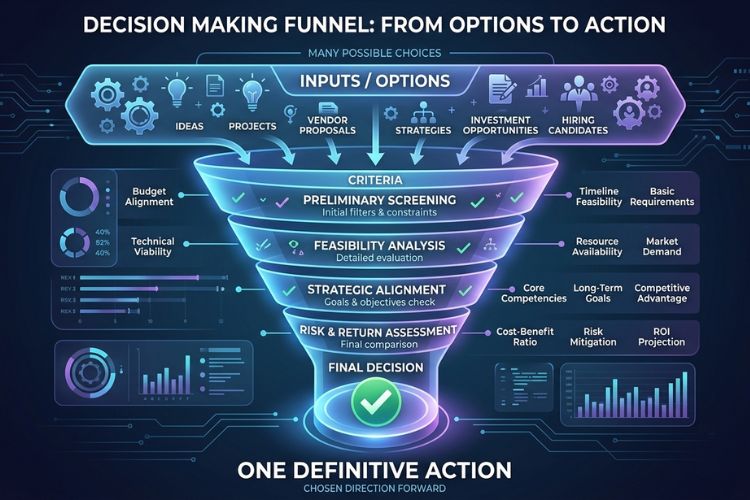
How to Choose the Right Decision Making Framework
There is no “one-size-fits-all” solution; that being said, a good rule of thumb is to evaluate the speed, risk, and complexity of the problem. A powerful heuristic for this is Jeff Bezos’s Revolving vs. One-Way Doors concept:
- Reversible (Two-Way Doors / Type 2): These are decisions that can be easily undone. For these, speed and agility should be the top priority. Do not wait for 100% of the data; act when you have 70% to iterate quickly.
- Irreversible (One-Way Doors / Type 1): These decisions require deep strategic planning, exhaustive risk assessment, and heavy resource allocation. They demand cautious deliberation and robust, data-heavy frameworks.
Ultimately, the executive sponsor or project lead should be responsible for choosing the framework before the team begins analyzing the problem.
Top Decision-Making Frameworks in Action
Below are a few of the most powerful frameworks used by high-growth startups and Fortune 500 enterprises, categorized by their best use cases.
For role clarity & accountability
When decisions require cross-functional collaboration, ambiguity regarding who has the final say will kill momentum.
DACI vs RACI Framework
The RACI matrix (Responsible, Accountable, Consulted, Informed) is an excellent project management tool for mapping general execution. However, when it comes to making the call, DACI is typically the best strategic decision making models for executives.
- Driver: The person managing the process, corralling stakeholders, and collating data.
- Approver: The one person who makes the final decision. This turns the role from a passive rubber-stamp into an active decision-maker.
- Contributors: Subject-matter experts who provide input. They have a voice, but not a vote.
- Informed: Those affected by the decision who need to know the outcome. No voice, no vote.
Best use case: High-stakes product launches, cross-departmental strategy shifts, and overcoming consensus traps.
RAPID Decision Making Process
Developed by Bain & Company, the RAPID model is heavily utilized by large enterprises to clear bottlenecks.
- Recommend: The person proposing the solution.
- Agree: Stakeholders who must approve the recommendation (usually legal or compliance).
- Perform: The people responsible for implementation.
- Input: Those providing essential information.
- Decide: The sole decision-maker who commits the organization to action.
Best use case: Organizations where decision authority has become decentralized and murky, leading to analysis paralysis.
For agility & fast-paced environments
The OODA Loop
Developed by U.S. Air Force Colonel John Boyd, the OODA Loop is one of the most effective agile decision making frameworks for software teams and e-commerce brands navigating volatile markets.
- Observe: Gather real-time data (e.g., website traffic, competitor pricing, sprint velocity).
- Orient: Analyze the data to understand its meaning. This is where you apply mental models to make sense of the landscape.
- Decide: Formulate a hypothesis and select a course of action.
- Act: Execute the decision swiftly. The loop immediately restarts as you observe the results of your action.
Best use case: Competitive, dynamic environments where the goal is to outmaneuver the competition by iterating faster than they can.
For prioritization & objective evaluation
When there are multiple viable options and limited resources, you need tools that enforce objective criteria.
The Decision Matrix (Pugh Matrix)
A decision matrix is a quantitative approach that removes emotional bias.
Steps to create one:
- List your options (e.g., Software Vendor A, B, and C).
- Define your evaluation criteria (e.g., Cost, Usability, Integration).
- Assign weights to each criterion based on importance (must equal 100%).
- Score each option against the criteria, multiply by the weight, and calculate the final score.
Best use case: Complex procurement choices or hiring decisions where multiple weighted variables must be compared objectively.
Cost-Benefit Analysis (CBA)
While a Decision Matrix is best for comparing multiple options, a CBA is ideal for evaluating the absolute financial viability of a single strategic pivot. It weighs the total expected benefits against the total expected costs. (including the opportunity cost of not taking an alternative path)
The Modified ICE Framework
Popularized for growth hacking, ICE stands for Impact, Confidence, and Ease. It is one of the premier decision making frameworks for product managers dealing with bloated backlogs.
- Impact (1-20 scale): How much will this move the needle? (Weighting this heavier prevents low-impact “easy” tasks from winning).
- Confidence (1-10 scale): How certain are you that you can execute this?
- Ease (1-5 scale): How simple is it to implement?
Best use case: Feature prioritization and marketing campaign selection.
For navigating complexity & uncertainty
The Cynefin Framework
Created by Dave Snowden and Mary E. Boone, Cynefin is a sense-making device that categorizes challenges into domains, proving that “best practices” do not work in complex environments.
- Clear/Simple: Clear cause and effect. Action: Sense, Categorize, Respond (Apply best practices).
- Complicated: Requires expert analysis to find the right answer. Action: Sense, Analyze, Respond (Apply good practices).
- Complex: Unpredictable, emergent patterns where no right answer exists upfront. Action: Probe, Sense, Respond (Run safe-to-fail experiments).
- Chaotic: Crisis mode with no discernible patterns. Action: Act, Sense, Respond (Establish order immediately).
Best use case: Navigating unprecedented market shifts, PR crises, or entering entirely unknown markets.
Read more: Leading Through Uncertainty – How to Navigate Turbulent Times
The 10/10/10 Rule
When emotions are running high, this framework (popularized by Suzy Welch) creates necessary psychological distance. Ask yourself how you will feel about the decision in:
- 10 minutes?
- 10 months?
- 10 years?
Best use case: Highly personal leadership decisions, rebranding initiatives, or major personnel changes.
How to Implement a Decision Making Framework in a Team
Knowing the models is only half the battle; the true challenge lies in execution. Putting the framework into practice without it feeling like oppressive corporate bureaucracy requires change management.
-
Start small to overcome resistance
Do not roll out the RAPID model for a company-wide reorganization on day one. Instead, introduce a lightweight framework—like a Decision Matrix—during a routine marketing meeting. Provide examples of decision making frameworks in action specific to your industry so the team can see the immediate reduction in friction.
-
Document assumptions with the ladder of inference
Reducing cognitive bias in business decisions requires making your invisible thoughts visible. The Ladder of Inference (developed by Chris Argyris) visualizes the mental steps we take from observing data to taking action. When stakeholders disagree, do not argue over the final conclusion. Rather, ask them to “walk down the ladder” by asking:
- “What data did you focus on?” and
- “What assumptions did you make to get to that conclusion?”
Doing so turns conflict into collaborative problem-solving.
-
Secure stakeholder buy-in
To ensure alignment, the “rules of the game” need to be established first. Before debating what to do, agree on how the decision will be made. Specify who the “Approver” (DACI) or the “Decider” (RAPID) is upfront.
When people know their specific role, territorial behavior and ego-protection vanish.
-
Separate process from outcome
How can you make data-driven decisions a permanent part of your culture? The answer is to schedule quarterly reviews. Evaluate if the process was sound, regardless of whether the outcome was successful.
- Did you gather the right data?
- Did you assess the risk accurately?
Refining the process is key to cultivating an enduring, agile organization.
Read more: 360-Degree Feedback – From Theory to Action
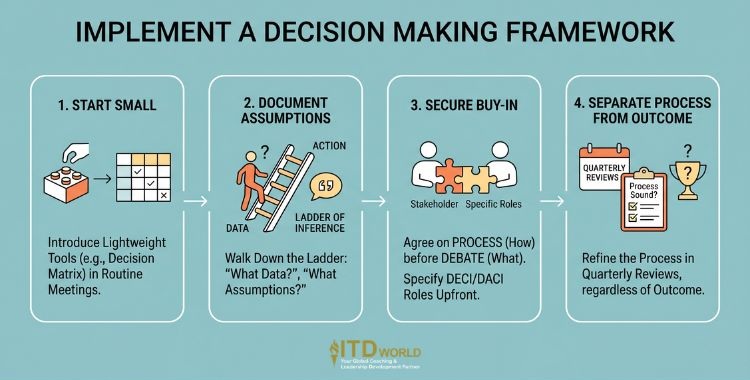
How to implement a decision framework in a team
FAQs
What are the most popular decision-making frameworks?
The most widely used models in business include the DACI and RAPID frameworks (for role clarity), the OODA Loop (for agility), the Decision Matrix and Cost-Benefit Analysis (for prioritization), and the Cynefin Framework (for navigating complex, unprecedented environments).
What is the difference between a mental model and a decision-making framework?
A mental model (like First Principles or Inversion) is a cognitive tool that shapes how you perceive and understand a problem. A decision-making framework (like DACI or a Pugh Matrix) is the actionable, step-by-step process you follow to execute a choice based on that understanding.
Which framework is best for fast, high-stakes decisions?
The OODA Loop (Observe, Orient, Decide, Act) is the best framework for fast-paced, high-stakes environments. It prioritizes rapid iteration and continuous adaptation to real-time data, making it ideal for agile software teams and competitive markets.
Which framework is best for complex, multi-stakeholder projects?
The DACI framework (Driver, Approver, Contributors, Informed) or the RAPID model (Recommend, Agree, Perform, Input, Decide) are ideal for complex projects. They eliminate bottlenecks by clearly defining who provides input versus who has the ultimate authority to make the final call.
Final Thoughts
The most effective executive is not the smartest person in the room; they are the one with the best systems. Instead of trying harder or debating longer, they learn to utilize the correct structural tool for the specific problem at hand. By building a mental library of the above mentioned frameworks, you empower your organization to scale, delegate effectively, and navigate ambiguity with confidence.
Do not try to implement all of them tomorrow. Pick one—e.g. the DACI framework for your next cross-functional project, or the Modified ICE model for your product backlog—and watch how quickly clarity transforms into speed!
ITD World provides specialized coaching and training solutions designed to help leaders & organizations secure a competitive advantage – and be equipped to win in today’s dynamic landscape. Contact us today to learn more about our world-class programs!
Other resources you might be interested in:
- HR Competency Model Analysis: Elevating HR Practices for Success
- Leadership Philosophy: How to Define Your True North & Follow It
- 12 Golden Leadership Principles for Attaining Excellence