
In large organizations, fragmented communication and endless alignment meetings frequently create “collaboration drag”—a systemic inefficiency that costs companies millions in lost productivity, missed deadlines, and stifled innovation. Overcoming this requires a transition from merely managing isolated tasks to managing organizational value. Successful cross-functional collaboration vs. traditional teams represents this shift, demanding an operational overhaul that replaces outdated, autonomous departments with a unified, strategic framework.
 |
Author: Jonathan M. Pham |
Highlights
- Unlike traditional functional teams that pass work sequentially like a relay race (creating bottlenecks), cross-functional collaboration involves diverse departments working simultaneously to ensure technical and financial feasibility from day one.
- This model helps companies adapt quickly to market shifts and remote work isolation while developing “T-shaped” employees—specialists who gain a broad understanding of the entire business, leading to better leadership readiness and retention.
- Success requires dismantling “silos” caused by competing departmental incentives, jargon-filled communication, and middle managers who may feel they are losing authority over their teams.
- Effective collaboration relies on clear “contracts,” role clarity tools like RACI charts (Responsible, Accountable, Consulted, Informed), and aligning incentives through shared OKRs (Objectives and Key Results) rather than isolated department metrics.
- To prevent an “information chase,” teams must utilize a centralized tech stack—including project management platforms and digital headquarters—to maintain a single source of truth and automate routine status updates.
What is Cross-functional Collaboration?
Cross-functional collaboration is the deliberate process of bringing together professionals from different internal departments (like HR, Engineering, and Sales) to work simultaneously toward a shared organizational goal, rather than passing work sequentially between silos.
Examples:
- Product & Engineering: Uniting UI designers, backend developers, and product managers during sprint planning, so that what is beautifully designed is also technically feasible within the timeline.
- Sales & Marketing: Instead of operating in a vacuum, Marketing works with Sales to map out the exact customer journey, identify precisely where deals stall in the pipeline, and develop highly targeted enablement materials to unblock revenue.
- Cost reduction initiatives: Operations, IT, and Finance leads coming together to audit the company tech stack, identifying redundant software licenses, and negotiating master vendor contracts to lean out operations.
Rethinking Organizational Dynamics: Differences Between Functional & Cross-functional Teams
Improving cross-functional collaboration begins with distinguishing it from traditional organizational structures.
- Functional teams
Functional teams operate sequentially. Work is treated as a baton passed in a relay race—for example, R&D designs a product, passes it to Marketing for promotion, who then passes it to Sales.
This sequential model is a breeding ground for bottlenecks. If Sales discovers the product doesn’t meet customer demands, the entire process must rewind, costing precious time and resources.
- Cross-functional teams
Cross-functional teams (CFT), on the other hand, operate simultaneously. They consist of professionals with varying educational backgrounds and departmental expertise who tackle a problem collectively from day one. Rather than a relay race, CFTs function like a puzzle, where every piece is required concurrently.
Example: In a functional relay-race model, if Software Engineering builds a feature over three months and then hands it to Marketing, Marketing might realize the feature lacks a user-friendly interface to build a campaign around—forcing the product back to square one. In a cross-functional puzzle model, the Marketer is in the room during the software’s design phase, ensuring marketability is baked into the code from day one.
| Feature | Functional Teams |
Cross-Functional Teams (CFT)
|
| Workflow Style | Sequential: Like a relay race; work is passed from one hand to another. |
Simultaneous: Like a puzzle; all pieces are worked on concurrently.
|
| Problem Solving | Reactive: Issues are found late (e.g., Sales finding a flaw in an R&D design). |
Proactive: Experts from all areas tackle the problem together from day one.
|
| Communication | Siloed: Information stays within departments until the “hand-off.” |
Integrated: Knowledge is shared instantly across different expertise levels.
|
| Risk Factor | Bottlenecks: If one stage fails, the entire process must rewind. |
Complexity: Requires high-level coordination and clear project structure.
|
| Structure | Organic/Fixed: Based on departmental hierarchy. |
Project-Based: Deliberate, formal teams with a specific end goal.
|
Cross-functional collaboration vs. traditional teams
It is important to distinguish between organic collaboration (spontaneous, informal interdepartmental communication) and project-based collaboration (structured, formal initiatives with defined start and end dates). While both are necessary, breaking down deeply ingrained silos requires the deliberate assembly of project-based teams.
Why is Cross-functional Collaboration Important in Today’s Workplace?
Great discoveries and improvements invariably involve the cooperation of many minds.
Alexander Graham Bell
The modern business landscape is defined by rapid market shifts and complex customer demands. An Agile methodology, therefore, is no longer just for software development; it has now become an organizational imperative. (in fact, a recent Gartner survey revealed that 63% of HR leaders are already utilizing agile methods and principles) When teams from various disciplines collaborate in real-time, they are better equipped to evaluate financial, technical, and market constraints instantly, bypassing weeks of bureaucratic approval cycles.
At the same time, the permanence of remote and hybrid work environments has exacerbated the risk of “tunnel vision.” Without physical proximity, employees naturally default to engaging only with their immediate peers. Deliberate cross-functional collaboration ensures alignment across disparate locations, which means a distributed workforce can remain connected to the broader company vision rather than retreating into isolation.

Importance of interdepartmental teamwork
Benefits of cross-functional teams
Alone we can do so little; together we can do so much.
Helen Keller
- Faster innovation
When varying perspectives are brought together, you naturally invite diversity of thought. A software engineer and a customer success representative would look at the same product through entirely different lenses. This combination gives rise to “non-traditional” solutions that a single department would never conceive independently.
- Reduced rework & streamlined operations
Given that alignment happens at the project’s inception, misinterpretations can be caught before execution begins. Evaluating constraints early drastically reduces duplicate work and expensive post-launch fixes.
- Employee growth & retention
By exposing specialists to the broader mechanics of the business, organizations develop “T-shaped” employees—professionals who possess deep expertise in their specific discipline (the vertical bar of the T) as well as a broad, capable understanding of how other departments function (the horizontal bar). This multifaceted skill development plays a crucial role in increasing engagement and leadership readiness.
Read more: Diversity in the Workplace – How It Fuels Success
- Improved customer experience
A company’s internal culture is ultimately reflected in its external customer experience. Customers can easily detect departmental silos when they receive mixed messaging from Marketing, contradictory pricing from Sales, and disjointed troubleshooting from Support.
Unifying these functions ensures a cohesive Go-To-Market (GTM) strategy. When product development is actively informed by sales feedback, and marketing campaigns are built in tandem with customer success insights, the result is profound synergy. The customer can now enjoy a seamless, frictionless journey because the internal teams have already ironed out the operational wrinkles.
Challenges of Cross-functional Collaboration
Despite the clear benefits, transitioning to a collaborative model is fraught with barriers. In fact, research published in the Harvard Business Review reveals that 75% of cross-functional teams are actually dysfunctional. This is usually driven by a wide array of barriers, including
- Structural barriers: According to the Project Management Institute (PMI), a change in organizational priorities is the leading cause of project failure (accounting for 41% of failed projects). When a marketing manager’s bonus is tied to lead volume, yet a sales manager’s bonus is tied to lead quality, conflict is inevitable. Furthermore, role ambiguity (unclear decision-making authority) often results in “too many cooks in the kitchen”.
- Operational barriers: Utilizing scattered documents and disconnected messaging platforms would result in an “information chase.” When teams cannot find the latest version of a file or do not know the current status of a deliverable, momentum dies.
- Linguistic barriers: Every department develops its own acronyms and jargon. When IT speaks in technical specs and Finance speaks in margin projections, pervasive miscommunication leads to project stagnation.
Dismantling departmental silos requires psychological awareness from leadership. Often, leaders make the mistake of forcing collaboration without acknowledging team identity – which triggers “group sovereignty” defenses, where teams self-silo to protect their perceived value and autonomy. As such, executives must publicly reaffirm a functional team’s unique expertise while integrating their efforts into the larger initiative.
Additionally, addressing the psychology of middle-management is also critical. Mid-level managers frequently resist cross-functional initiatives because delegating top talent to a shared project feels like losing control over their departmental “empire.” Effective change management, therefore, requires coaching these executives to view interdepartmental projects not as a threat to their authority, but as a mechanism to amplify their department’s organizational impact.
Read more: Self-awareness in Leadership – The Foundation for Growth
How to overcome a “silo mentality” in a company
Cross-functional Collaboration Guide: How to Build a Successful Team
Strategies for interdepartmental communication & execution
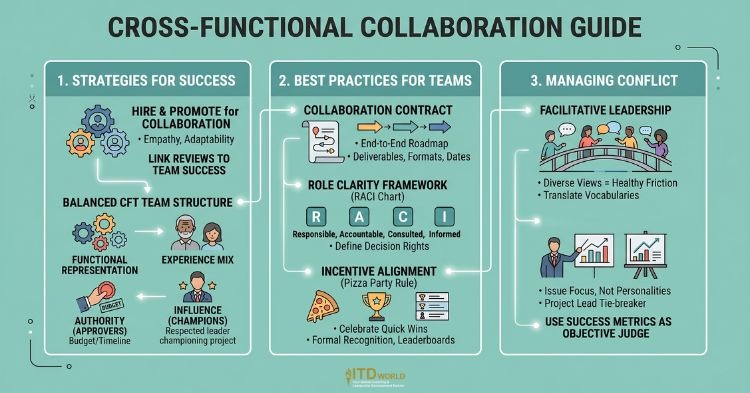
The foundation of effective collaboration begins before a team is even assembled. It requires strategic workforce planning:
- Hire and promote for a collaborative mindset
Not everyone thrives in a dynamic environment. Organizations should aim to recruit individuals who demonstrate empathy and adaptability, as well as explicitly tie performance reviews to team success rather than just individual metrics.
- Cross-functional team structure examples
A winning team roster must be carefully balanced. Instead of merely pulling whoever is available, a high-performing CFT should ensure a blend of:
-
- Functional representation: Delegates from every department touched by the project.
- Experience mix: Seasoned veterans who are well aware of historical context, paired with newer team members who come with fresh, unburdened perspectives.
- Authority: Stakeholders with the actual power to approve budgets and timelines.
- Influence: Respected, informal leaders capable of championing the project’s adoption across the broader company culture.
Read more: Mentoring – Guide to Establishing a Win-Win Relationship
Best practices for cross-functional teams
Once the team is assembled, execution relies on transparent frameworks:
- The collaboration contract
Instead of relying on assumptions, try to create an explicit, end-to-end roadmap before work begins. This contract defines exactly what deliverables are required, in what format, and by when.
- Role clarity frameworks
To eliminate bottlenecks, it’s crucial that a RACI Chart (defining who is Responsible, Accountable, Consulted, and Informed) or a DACI matrix (Driver, Approver, Contributor, Informed) be deployed, so as to establish clear decision rights and prevents project stagnation.
Example: In a software launch, the Developer is Responsible for coding, the Product Manager is Accountable for the final release, Legal is Consulted on data compliance, and the Sales Team is simply Informed of the launch date. This completely eliminates the friction of unauthorized personnel trying to veto decisions.
- Gamification & incentive alignment
Utilize the “Pizza Party Rule“—employees are far more likely to engage when they understand what is in it for them. Celebrate “quick wins” publicly, utilize leaderboards, and formally recognize collaborative success to sustain high morale throughout lengthy projects.
Read more: How to Build High-performing Teams
Managing conflict in cross-functional projects
Conflict resolution in a cross-functional setting requires a shift toward facilitative leadership. Project leaders must view friction as a normal, healthy byproduct of diverse viewpoints rather than a personal attack.
A dedicated cross-functional leadership approach involves “translating vocabularies” between departments and focusing strictly on the issue at hand, rather than the personalities involved. When priorities clash, the project lead acts as the ultimate tie-breaker, utilizing the project’s predefined success metrics as the objective judge for all decisions.
Read more: Intent vs Impact in the Workplace – How to Close the Gap
How to improve cross-functional collaboration
How Leaders Can Encourage Cross-functional Alignment on Shared Goals
For people to work together, leaders cannot pay them to work apart. Rather, they need to systematically align departmental objectives with high-level company visions.
One effective way to establish shared goals is through the implementation of OKRs (Objectives and Key Results). Instead of assigning a functional KPI (e.g., “Engineering must ship three features”), try to come up with a project-centric objective (e.g., “Increase user retention by 15%”). Under this framework, Engineering, Design, and Marketing are all evaluated on the outcome (retention) rather than their individual output (code, mockups, or ad copy).
This ensures complete transparency. Now every team member can see exactly how their specific daily tasks roll up into the “big picture.” Organizations operating at the highest levels often establish a “Center of Excellence” to continually audit these shared targets, ensuring that functional managers do not silently revert to evaluating team members based on isolated departmental metrics.
Read more: Leading With Impact – Translating Your Presence Into Performance
The Role of Technology in Cross-functional Collaboration
In large organizations, intent without infrastructure is useless. Relying on disorganized email threads and local hard drives will kill collaboration instantly. Technology, therefore, serves as the central nervous system of a CFT, providing a “Single Source of Truth.” Furthermore, strategic workflow automation can handle routine status updates and handoffs, preserving the team’s mental energy for high-level, specialized problem-solving.
Ideally, an effective tech stack should include:
- All-in-one project management: Platforms like Asana, Monday.com, or ClickUp provide visual task management (Kanban boards and Gantt charts) that keep schedules and dependencies visible to everyone.
- Digital headquarters (Team chat): Tools like Slack or Microsoft Teams is great for replacing chaotic email threads. Best practices dictate using clearly named public channels (e.g., #project-launch-q3) so anyone in the company can find relevant context without having to ask for permission.
- Visual & AI collaboration: Advanced tools like Mural AI allow remote teams to cluster brainstormed ideas, map out market impacts, and auto-summarize meetings for stakeholders who could not attend.
While tools are great, relying on too many disconnected platforms would create walled gardens. Therefore, it is crucial that IT and HR audit their tech stack to ensure teams aren’t hiding in their own specific software ecosystems, which inadvertently reinforces “tunnel vision”.
Read more: AI in Leadership – Bridging the Gap Between Adoption & Maturity

FAQs
How do you break down organizational silos?
Silos are dismantled by aligning incentives. For leaders, their role is to replace departmental KPIs with shared OKRs, establish cross-functional project teams, and implement centralized project management software to ensure transparent communication across the entire company.
How do you manage cross-functional collaboration in a remote or hybrid environment?
Remote environments exacerbate the risk of miscommunication. As such, strict, documented digital communication protocols are necessary. Teams must clearly distinguish between synchronous work (live Zoom meetings reserved for complex decision-making and relationship building) and asynchronous work (Slack updates and Jira comments utilized for routine status tracking). This respects diverse time zones and protects deep-focus work time.
How do you measure the success of a cross-functional project?
Success cannot be managed if it is not measured. Beyond simply hitting a project deadline, project management leaders need to track Key Performance Indicators (KPIs) that reflect collaborative health.
Essential metrics include project cycle times (the speed at which work moves from ideation to delivery without returning for rework), the reduction in redundant operational tasks, and internal employee engagement scores. Finally, effective stakeholder management should be evaluated through regular retrospectives—surveying executive sponsors to ensure the team’s output maintained strategic alignment with board-level expectations.
Read more: 60 Collaboration Quotes for Success

Final Thoughts
No longer a trendy corporate buzzword, cross-functional collaboration has now become the fundamental operational engine of the modern, competitive enterprise. It represents the crucial evolution from managing isolated tasks to architecting comprehensive organizational value.
When leaders commit to providing clear structural frameworks like RACI, deeply integrated technological tools, and an empathetic culture that celebrates diversity of thought, they strip away “collaboration drag.” The result is an agile, resilient organization where the collective output is vastly greater than the sum of its departmental parts.
ITD World provides specialized coaching and training solutions designed to help leaders & organizations secure a competitive advantage – and be equipped to win in today’s dynamic landscape. Contact us today to learn more about our world-class programs!
Other resources you might be interested in:
- HR Transformation: Future-Proof People Strategy
- Leadership Culture: The DNA of Organizational Success
- Leadership Development: A Mission-critical Strategic Function
- Leading Gen Z: From Boardroom Cliché to Human-centric Management
- Skills-Based Organization: A Blueprint for Agility in a Disrupted World