
In the modern corporate landscape, employees are interrupted every 11 minutes, task-switch every 47 seconds, and typically have a mere 24 minutes a week (which means only 1% of their typical workweek) to dedicate to professional development. As such, traditional long-form e-learning is losing the battle against these shrinking attention spans and hyper-busy schedules. Now is the time for Learning and Development (L&D) professionals to switch the focus to microlearning – a strategic, science-backed methodology built for immediate knowledge retention and exactly-when-needed performance support.
 |
Author: Jonathan M. Pham |
Highlights
- Microlearning is an instructional approach that delivers focused, “bite-sized” content units (typically 2–10 minutes) designed to teach a single objective. It leverages Cognitive Load Theory by respecting the brain’s limited working memory and uses spaced repetition to combat the “forgetting curve,” moving information from short-term to long-term memory.
- While macrolearning (traditional workshops/certifications) is essential for cultivating deep foundational knowledge or mastering complex new disciplines, microlearning is best used for reinforcing that structure, providing “just-in-time” support, and lowering the “resistance to start” that often leads to procrastination.
- The methodology is particularly effective for deskless and remote workers who need to access training on mobile devices during their daily workflow.
- Effective microlearning follows the “One Concept Rule” and is integrated into platforms employees already use (like Slack or Teams). It should be avoided for highly complex subjects or sensitive HR topics that require deep empathy and nuance.
- Modern Learning Experience Platforms (LXPs) use AI to identify individual skill gaps and deliver personalized learning paths. Success is measured not just by completion rates, but by correlating training with tangible performance outcomes, such as increased sales or reduced safety incidents.
What is Microlearning?
In corporate training, microlearning is a highly focused instructional approach that breaks complex information down into highly focused, bite-sized units of content (usually spanning two to ten minutes). Each unit is designed to teach a single, specific objective, allowing learners to absorb and apply knowledge quickly without disrupting their daily workflow.
The Science Behind Microlearning
To understand why this methodology has transformed modern L&D, it’s essential that we first look at the cognitive psychology and biology of how adults process new information.
Cognitive Load Theory & Brain capacity
Developed by educational psychologist John Sweller, Cognitive Load Theory posits that our working memory has severe limitations. The human brain can effectively process only about four to seven “chunks” of new information at any given time. When individuals are forced to sit through a comprehensive 60-minute eLearning module packed with new software protocols, company policies, and theoretical frameworks, they quickly reach cognitive overload. Their working memory acts like a sponge that can hold no more water; any additional information simply spills away.
Bite-sized learning respects this biological limit. By isolating a single concept, skill, or idea, it allows the learner to absorb, process, and encode the information without mental fatigue.
Combating the “Forgetting Curve”
Even if one successfully processes information during a training session, retention remains a massive hurdle. In the late 19th century, psychologist Hermann Ebbinghaus formulated a concept called “Forgetting Curve“; accordingly, human beings naturally forget up to 80% of newly acquired knowledge within a month if it is not actively reviewed.
Microlearning directly combats this phenomenon through a technique known as spaced repetition. Rather than cramming information into a single annual training event, organizations can deliver short, repeated bursts of content over several weeks. This consistent reinforcement forces the brain to recall the information, effectively moving it from fleeting short-term memory into durable long-term knowledge retention.
In fact, recent industry data shows that microlearning and spaced repetition can boost long-term knowledge retention by anywhere from 25% to 60% compared to traditional macro-courses.
The psychology of engagement & “resistance to start”
Beyond memory, there is a distinct psychological advantage to brief content: it significantly lowers the barrier to entry.
In behavioral psychology, “resistance to start” is a major factor in procrastination. When an employee sees a mandatory compliance course labeled “Duration: 90 Minutes,” their immediate instinct is to put it off until Friday afternoon. Conversely, a module labeled “Duration: 3 Minutes” feels effortless. It fits neatly into the stolen pockets of time throughout the day—while waiting for a Zoom meeting to start, or during a quick coffee break. This psychological ease helps increase voluntary engagement dramatically.
Read more: Creating Psychological Safety in the Workplace for Sustainable Growth
Microlearning vs. Macrolearning Differences
A common misconception among L&D teams is that short-form content is meant to completely replace traditional training. In reality, effective workforce education relies on understanding the distinct difference between microlearning and macrolearning, and knowing when to deploy each.
Defining Macrolearning
Macrolearning—typically referred to as “traditional learning”—involves deep, comprehensive study. These are your half-day workshops, multi-week leadership development programs, and extensive online certifications.
Macrolearning is essential for establishing foundational knowledge, understanding complex organizational systems, and mastering entirely new disciplines. If you are teaching a graphic designer how to code in Python from scratch, you need macrolearning.
Comparing the two approaches
While macrolearning is about building the foundation, microlearning is about reinforcing the structure.
| Feature | Macrolearning | Microlearning |
| Objective | Tackles broad, multi-faceted concepts |
Targets a singular, actionable performance goal
|
| Duration | Typically spans 30 minutes to several hours |
Strictly capped at around 10 minutes (though 2 to 5 minutes is considered the sweet spot)
|
| Application | Typically scheduled well in advance |
Used for just-in-time learning, allowing an employee to pull up a quick tutorial at the exact moment they need to execute a task
|
The blended ecosystem
The most sophisticated instructional design strategies do not pit these two against each other; rather, they are woven into a blended learning ecosystem. For example, a company might use a macrolearning approach for a two-day managerial retreat (teaching the deep theory of conflict resolution), and then deploy a microlearning strategy over the next six months (sending weekly two-minute scenario-based quizzes) to ensure those managers actually apply the concepts on the floor.
To put it simply, use macro for the deep dive, and micro for the daily reinforcement.

Benefits of Microlearning for Adults
The transition toward shorter content is not merely a trend to appease shifting attention spans; there are actually robust data to back it up. From the C-suite evaluating budgets to the deskless worker on the front lines, bite-sized learning offer various benefits that cannot be ignored.
Efficiency: Time & cost savings
Traditional course creation is notoriously sluggish and expensive. In fact, developing a comprehensive, hour-long training module can take upward of 70 to 100 hours of instructional design work, involving extensive storyboarding, professional voiceovers, and complex software programming.
By contrast, working on a targeted five-minute micro-module is up to 300% faster and costs 50% less to produce. This rapid development cycle allows L&D teams to be agile, updating materials instantly as company policies or market conditions change. Furthermore, it saves the company money in lost productivity, as team members no longer need to abandon their daily workflows for extended periods to fulfill training requirements.
Skyrocketing engagement & completion rates
Return on Investment (ROI) in training is heavily dependent on whether employees actually finish the courses. Long-form eLearning tends to suffer from abysmal completion rates, sometimes hovering around 30% when not strictly mandated.
Micro-courses, due to their low barrier to entry and highly relevant nature, consistently boast completion rates of 80% to 90%. When content is concise, relevant, and visually engaging, employees view it as a helpful tool rather than an administrative burden.
Empowering remote & deskless workers
One of the methodology’s most notable benefits is its natural synergy with mobile learning (m-learning). A significant portion of the global workforce—retail associates, warehouse staff, healthcare professionals, and field technicians—does not sit behind a desk. As such, traditional LMS platforms tethered to desktop computers simply do not serve them.
Micro-content optimized for smartphones empowers these deskless workers to access a crucial safety update or a new product brief directly from the warehouse floor or retail backroom.
Driving continuous learning
Historically, corporate training was an episodic event—a yearly seminar or quarterly compliance push. Today, businesses require a culture of continuous learning to stay competitive. Delivering small, daily or weekly nuggets of knowledge transforms training from an isolated chore into a daily habit of self-improvement, fostering an agile workforce that is constantly upskilling.
When NOT to Use Microlearning
Despite its various benefits, bite-sized content is not a universal panacea. Knowing when NOT to use it is just as crucial as knowing how to implement it.
- Complexity issues & deep expertise
You cannot teach someone to perform open-heart surgery, architect a cloud network, or understand the nuances of macroeconomic theory via three-minute videos. Highly technical, foundational, or intensely complex subjects require deep, uninterrupted focus and comprehensive study. Attempting to force complex, interconnected systems into isolated, tiny chunks would strip away essential context, leaving the learner confused.
- The risk of fragmentation
This is the most common pitfall for novice instructional designers. If a learner receives dozens of disconnected five-minute modules, they may develop “Swiss cheese knowledge”—they know isolated facts but lack the overarching mental model to connect them.
The solution lies in rigorous curriculum design. Individual nuggets must be intentionally threaded together, often categorized under broad learning paths, so the employee clearly understands how a specific two-minute module fits into the larger picture of their career development.
- Brand & tone mismatch
Certain topics demand a level of gravity and interpersonal dialogue that short digital content cannot provide. For example, serious HR interventions—such as in-depth diversity, equity, and inclusion (DEI) workshops, severe workplace harassment training, or complex change management discussions during corporate layoffs—require nuance, empathy, and active debate. Gamifying these subjects with a three-minute animated quiz is likely to come across as tone-deaf, dismissive, and culturally damaging.
Top Microlearning Content Formats (plus Examples)
Key content formats
- Short-form video: This includes micro-lectures, whiteboard animations, or direct screen-recordings. Videos are highly effective for demonstrating physical tasks or software navigation (e.g., a two-minute screencast on how to process a refund in a new POS system). An online video editor can also help teams quickly create, edit, and update these bite-sized learning videos.
- Interactive quizzes & flashcards: Rooted deeply in the science of spaced repetition, these gamified elements are perfect for testing knowledge recall. They force the brain to retrieve information, strengthening neural pathways.
- Infographics & job aids: Sometimes, the best learning intervention isn’t a course at all. A highly visual, one-page PDF outlining keyboard shortcuts or a flow-chart for troubleshooting IT issues serves as perfect point-of-need support.
- Podcasts & audio snippets: Audio is the ultimate multitasking format. Short, five-minute leadership insights can be consumed while one commutes, exercises, or walks the dog.
Microlearning examples for businesses
- Using microlearning for employee onboarding
Instead of overwhelming a new hire with a massive binder on day one, progressive companies make use of mobile-friendly drip campaigns. Specifically, a new team member might receive a two-minute welcome video from the CEO on Monday, a quick interactive quiz about company core values on Tuesday, and a brief infographic detailing the IT helpdesk process on Wednesday.
- Compliance training
Annual legal and safety training is notoriously dry. Companies are now swapping out exhausting two-hour lectures for weekly, three-minute interactive scenario modules. By spacing compliance training out over the year, organizations dramatically increase actual adherence to safety protocols rather than just checking a legal box.
- Sales performance support
Imagine a pharmaceutical sales rep sitting in their car, minutes before walking into a doctor’s office. They don’t have time to review a 40-page product manual. However, pulling up a 90-second video on their smartphone that highlights the three key differentiators of a new drug provides the exact competitive edge they need right in the flow of work.
- User-Generated Content (UGC)
A new modern trend is leveraging internal Subject Matter Experts (SMEs). Rather than waiting for the L&D department to produce polished content, a top-performing software engineer can record a raw, two-minute Loom video explaining a coding workaround and share it instantly with their team.
Read more: 10 L&D Trends to Help Your Workforce Thrive

How to Create a Microlearning Strategy: Step-by-Step Guide
-
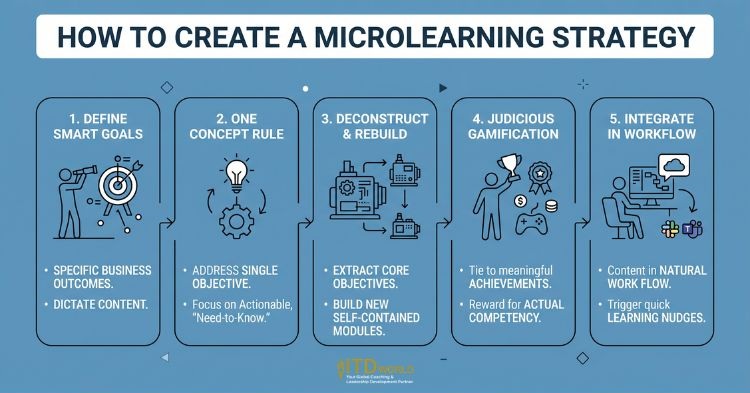
Define SMART business goals
Never create content simply for the sake of having a modern library. Every module must be tied to a specific business outcome.
It’s recommended that you use the SMART framework (Specific, Measurable, Achievable, Relevant, Time-bound). Instead of a vague goal like “improve customer service,” the objective should be “reduce average customer support call handling time by 15% over the next quarter.” Being specific is key to dictating exactly what the micro-content should address.
-
Apply best practices for microlearning instructional design
The golden rule of bite-sized instructional design is the “One Concept Rule”; accordingly, each module must address strictly one learning objective. If your module tries to teach a sales rep how to open a call, handle objections, and close the deal, it is no longer microlearning—it is just a rushed macro-course.
Additionally, designers must “skim the fat.” Cut out long-winded introductions, historical backgrounds, and “nice-to-know” trivia. Focus exclusively on the actionable, “need-to-know” behaviors.
-
Convert long-form training into microlearning
One of the most frequent questions from L&D leaders is how to repurpose legacy content. One of the biggest mistakes is simply taking a 60-minute PowerPoint presentation and slicing it into twenty 3-minute videos. If you do that, the narrative will feel disjointed, and the pacing will be ruined.
Instead, deconstruct the long-form course to extract the core learning objectives. Then, build entirely new, self-contained modules from scratch around those objectives. For instance, an hour-long seminar on cybersecurity might be converted into a one-page infographic on password hygiene, a two-minute video on identifying phishing emails, and a gamified quiz simulating a cyber-attack.
-
Leverage gamification judiciously
Gamification—the use of points, badges, and leaderboards—is an amazing tool for driving employee engagement. However, it needs to be tied to meaningful achievements. Awarding a digital badge for simply clicking “next” on a video only breeds cynicism. Instead, use gamified scenarios where learners must make choices that impact a simulated outcome, rewarding them for demonstrating actual competency and behavioral change.
Read more: Employee Engagement in the Digital Age
-
Implementing microlearning in the workplace
The most brilliantly designed module is useless if employees can’t find it. Implementing microlearning in the workplace requires putting the content directly in the person’s natural flow of work.
Rather than forcing staff to log into a clunky, separate corporate portal, modern L&D teams push content through the platforms employees already use daily. Triggering a quick learning nudge via Slack, Microsoft Teams, or an automated email ensures the training meets the learner exactly where they are.
Technology, AI, and Measurement
As of now, the technological landscape of workplace education has evolved dramatically from basic web portals to highly intelligent, predictive ecosystems.
Best microlearning platforms and software
What makes a good microlearning platform? The ideal software must prioritize a mobile-first user experience, seamless searchability, and robust backend analytics.
These days, organizations are increasingly shifting away from the traditional Learning Management System (LMS)—which is historically built for compliance tracking and hosting massive, linear courses—and instead adopting the Learning Experience Platform (LXP).
An LXP mimics the intuitive, consumer-grade interfaces of platforms like Netflix or Spotify. It allows learners to scroll through personalized content feeds, search for specific answers, and rate the modules they consume. Dedicated microlearning apps for corporate training—such as Disprz, EdApp, and Axonify—take this a step further by utilizing push notifications, daily quizzes, and offline mobile access, ensuring that deskless and frontline workers are fully integrated into the corporate learning culture.
The role of AI in upskilling & reskilling
Artificial Intelligence has transitioned from a buzzword to the core engine of modern L&D due to its ability to solve the scalability issue of personalized training. By analyzing an individual’s role, past performance data, and quiz scores, AI algorithms can instantly identify specific skill gaps. The system can then auto-generate personalized learning paths, pushing a targeted three-minute video to a manager who specifically struggles with giving feedback, while skipping content they have already mastered.
At the same time, AI is streamlining content creation, helping instructional designers instantly generate localized (multilingual) subtitles, write quiz questions, and summarize long-form documents into bite-sized study guides.
On the other hand, modern L&D professionals are using Generative AI (GenAI) – not just for personalization, but for content extraction. AI tools can now ingest a dry, 40-page Standard Operating Procedure (SOP) PDF and instantly output a 5-day microlearning drip campaign (complete with flashcards and scenario quizzes).
Read more: Soft Skills in the Age of AI – How to Grow in the 21st Century
Measuring ROI & effectiveness
To measure the ROI of microlearning programs, L&D leaders need to move past vanity metrics like simple “completion rates” and look at actual business impact.
- First, assess engagement and knowledge retention: Are employees voluntarily accessing the content? Are their scores on spaced micro-assessments improving over time?
- Second, tie the learning data directly to performance outcomes. For instance, if a specific three-minute module on a new upselling technique was pushed to the retail team, correlate the completion of that module with the point-of-sale data over the following month.
When L&D can definitively show the C-suite that a localized training burst resulted in a tangible spike in sales or a distinct drop in workplace safety incidents, the training department transforms from a cost center into a documented revenue driver.
FAQs
How long should a microlearning module be?
While the maximum limit is generally considered to be around 13 to 15 minutes, the ideal and most effective length is between 2 and 5 minutes. The true measure of its length, however, is not the clock, but the objective: it should be exactly as long as necessary to convey one specific concept—no more, no less.
What is the difference between nanolearning and microlearning?
Nanolearning is incredibly brief—usually under two minutes—and is utilized for instant, in-the-moment nudges or immediate tips (like a quick tooltip explaining a software button). Microlearning, on the other hand, ranges from 3 to 10 minutes and is structured to reinforce actual skill development and long-term behavioral change.
Can microlearning replace traditional training?
No. It is a complementary tool, not a total replacement. Foundational concepts, complex academic theories, and deep cultural onboarding still require the structured, in-depth approach of traditional macrolearning. Micro-content is best utilized to support, reinforce, and refresh that foundational knowledge over time.
Is microlearning only for Gen Z?
This is a pervasive myth. Data consistently shows that Millennials, Gen X, and Baby Boomers equally prefer mobile-friendly, bite-sized learning. The desire for flexible, respectful, and time-efficient training is driven by busy adult schedules and modern corporate demands, not generational demographics.
Read more: Leading Gen Z – From Boardroom Cliché to Human-centric Management

Final Thoughts
In today’s hyper-accelerated, interrupt-driven corporate environment, an organization’s most precious resource is its employees’ time. Microlearning honors that resource. By aligning instructional design with the biological realities of cognitive load and the forgetting curve, businesses can deploy training that is not only faster and cheaper to produce, but exponentially more effective. It shifts the paradigm of corporate education from a dreaded, annual compliance marathon into a dynamic, daily habit of continuous improvement and immediate performance support.
For Learning and Development professionals looking to future-proof their workforce, the path forward is clear. You do not need to overhaul your entire curriculum overnight.
Just start small. Audit your existing long-form materials, identify one piece of “low-hanging fruit”—e.g. a dense onboarding manual or a repetitive customer service process—and pilot your very first bite-sized module today.
When you empower your people to learn in the flow of work, you don’t just build a smarter team; you are contributing to an agile, resilient, and high-performing enterprise.
ITD World provides specialized coaching and training solutions designed to help leaders & organizations secure a competitive advantage – and be equipped to win in today’s dynamic landscape. Contact us today to learn more about our world-class programs!
Other resources you might be interested in:
- Talent Transformation: Building a High-performing Workforce
- Future Ready Organization: 11 Tips to Building One Capable of Adapting to Industry Trends
- AI in Leadership: Bridging the Gap Between Adoption & Maturity
- Leadership Journey: How to Grow as a Leader at Every Stage