
In a fast-paced business environment, spending weeks analyzing why a problem happened is a luxury many leaders cannot afford. Traditional management training heavily emphasizes root-cause analysis—diagnosing the deficit, dwelling on the past, and unpacking the history of a failure before attempting to fix it. But what if the solution has nothing to do with the problem?
This is where Solution-Focused Coaching (SFC) comes into play. Rather than acting as an archeologist digging into past mistakes, the coach acts as a facilitator of future possibilities.
For modern executives, HR professionals, and team leaders, mastering SFC means spending less time untangling interpersonal drama and more time executing tangible, positive behaviorism.
 |
Author: Jonathan M. Pham |
Highlights
- Unlike traditional coaching that analyzes past failures (“Problem Island”), SFC focuses on building a bridge to “Solution Island,” using future-oriented language to shift the brain from a defensive state to creative problem-solving.
- By bypassing the stress-triggered limbic system and activating the Prefrontal Cortex, SFC leverages neuroplasticity and positive emotions to help clients forge new neural pathways and boost motivation through “small wins.”
- SFC operates on the core belief that the client is an “expert” in their own life who is already whole and resourceful; the coach’s role is to uncover existing capabilities rather than providing direct advice or fixing “deficits.”
- Coaches can use specific tools like the Miracle Question (visualizing success), Scaling (measuring progress from 1-10), and the OSKAR framework to break complex issues into manageable “baby steps” and measurable behavioral shifts.
- In the workplace, SFC fosters psychological safety and efficiency by reframing complaints into goals and focusing on “exceptions”—moments where the problem isn’t occurring—to replicate success quickly.
What is Solution-Focused Coaching? (The Shift from Problem to Potential)
Solution-focused coaching is an adaptation of Solution-Focused Brief Therapy (SFBT), developed in the late 1970s by Steve de Shazer and Insoo Kim Berg at the Milwaukee Brief Family Therapy Center. They discovered, through empirical observation, that analyzing the complexity of a problem often entrenched the client further into it.
As such, they came up with a methodology based on constructivist theory and positive psychology. The core belief is simple but profound: the coachee is already whole, inherently resourceful, and the true “expert” in their own life and role. The coach’s job is not to provide advice, but to uncover the client’s existing capabilities.
The Neuroscience of SFC: Why It Works
The effectiveness of solution-focused coaching is deeply rooted in how the human brain functions:
-
Bypassing the Limbic System
Traditional problem analysis (“Why did your team miss this deadline?”) tends to trigger a threat response in the brain’s limbic system. High stress shuts down creative thinking and forces the individual into defensiveness.
SFC intentionally avoids deep-diving into the problem, keeping the limbic system calm and activating the Prefrontal Cortex—the brain’s center for executive function, planning, and decision-making.
-
Harnessing Neuroplasticity
The brain has a remarkable ability to reorganize itself. By consistently asking future-oriented questions, coaches allow clients to forge new neural pathways, shifting default thought patterns from anxiety to proactive construction.
-
Leveraging the Broaden-and-Build Theory
Proposed by psychologist Barbara Fredrickson, this theory explains that positive emotions “undo” the cardiovascular effects of stress and broaden our “thought-action repertoires.” A positive coaching environment boosts serotonin, while goal-setting and small wins trigger dopamine, resulting in a biological loop of motivation.
Fostering Psychological Safety
In the corporate world, the adoption of SFC translates directly into psychological safety. When leaders shift away from a diagnostic approach—which inevitably feels like pointing fingers—and move toward collaborative solution-building, teams feel safe to experiment, share ideas, and admit when they are stuck.

Solution-Focused Coaching vs. Problem-Solving: Key Differences
A helpful metaphor for understanding this transition is visualizing two distinct locations: “Problem Island” and “Solution Island.”
Traditional coaching spends 80% of the session exploring Problem Island—how the client got stranded there, who is to blame, and how deep the sand is. Solution-focused coaching acknowledges the current location but spends 80% of the time building a bridge to Solution Island.
One of the most impactful tools for facilitating the move is the Tense Shift. Highly skilled solution-focused leaders intentionally use the past tense when discussing the problem, and the present or future tense when discussing the solution.
-
Problem-talk: “I understand that the client was frustrated and the timeline felt impossible.”
-
Solution-talk: “What are we doing right now to regain their trust, and what will success look like next week?”
This subtle linguistic trick implies that the problem is already behind them and the solution is actively being reached.
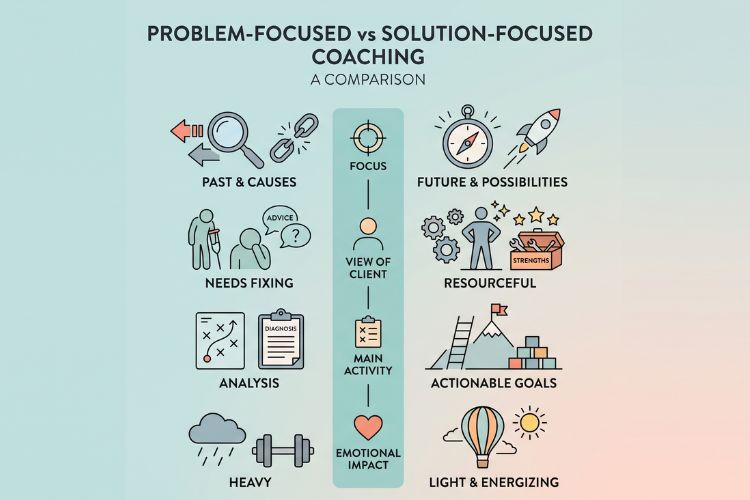
| Feature | Traditional / Problem-Focused Coaching | Solution-Focused Coaching (SFC) |
| Focus | Past and root causes (“Why did this happen?”) | Future and possibilities (“How do we move forward?”) |
| View of Client | Deficit model: Needs fixing, healing, or advice. | Resourceful: Possesses internal strengths and answers. |
| Main Activity | Diagnostic approach and problem analysis. | Solution construction and actionable goal-setting. |
| Emotional Impact | May feel “heavy” and increase defensiveness. | Feels “light” and energizing; increases self-efficacy. |
Note: SFC is sometimes compared to Appreciative Inquiry (AI). While both are positive psychology frameworks, AI is typically used as a macro-level organizational development tool built on storytelling, whereas SFC is generally a micro-level, one-on-one intervention concerned with fast, measurable behavioral shifts.
4 Essential Tools in the Solution-Focused Coaching Toolkit
Practicing SFC is akin to the work of a Miyadaiku—ancient Japanese carpenters who built incredibly strong temples without the use of nails or screws. Instead of using force or coercion, they made parts fit seamlessly through precise, deliberate carving. In coaching, your questions serve as the carving tools.
Here are four essential question types to master.
-
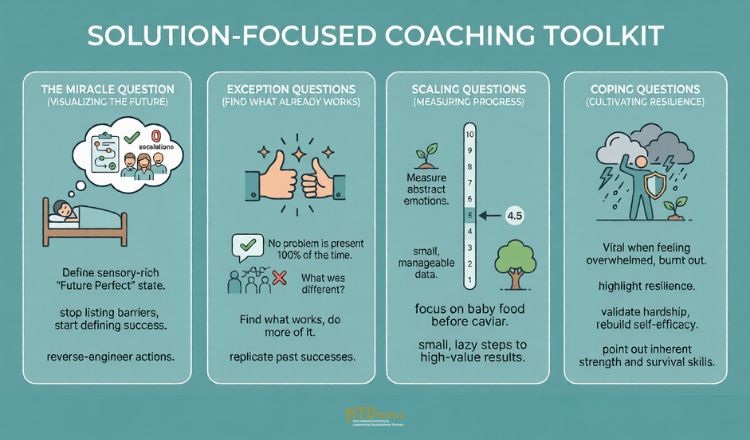
The Miracle Question (Visualizing the Future)
The hallmark of the Milwaukee school, the Miracle Question is a creative visualization exercise designed to bypass the analytical, resistant brain.
-
The Question: “Imagine that while you are asleep tonight, a miracle happens and this complex project management issue is completely solved. Because you are asleep, you don’t know it happened. When you wake up tomorrow, what will be the very first sign that tells you the miracle occurred? What else will you notice?”
-
The Application: This tool is exceptional for executive development. It forces the leader to stop listing systemic barriers and start defining a sensory-rich “Future Perfect” state. By describing specific, observable behaviors (e.g., “My inbox has zero escalations,” or “The daily stand-up lasts exactly 15 minutes and ends with laughter”), the coach and client can reverse-engineer the required actions.
Read more: Innovation Coaching – From Abstract Ideas to Scalable Reality
-
Exception Questions (Finding What Already Works)
A central tenet of SFC is the Rule of Exceptions: no problem is present 100% of the time. There are always moments when the issue is less severe or entirely absent.
-
The Question: “Tell me about a time in the past month when this communication breakdown with your vendor didn’t happen, or wasn’t quite as bad. What was different about that interaction?”
-
The Application: Identifying past successes proves to the coachee that they already possess the tools to succeed. If an employee notes that a meeting went well because they sent an agenda beforehand, the coach simply encourages them to replicate that exact behavior. Find what works, and do more of it.
-
Scaling Questions (Measuring Progress)
Scaling turns abstract, overwhelming emotions into concrete, manageable data.
-
The Question: “On a scale of 1 to 10—where 1 is the worst it’s ever been, and 10 is the ultimate goal we just described—where are you right now?”
-
The Application: The magic of scaling lies in the follow-up. If a client says they are at a “4,” do not ask them how to get to a 10. Try something like, “What would it take to move from a 4 to a 4.5?”
In other words, it’s about embracing “strategic simplicity.” Small, achievable steps bypass the fear of massive change. In the coaching world, this is often called moving from “baby food to caviar”—small, lazy steps toward a solution tend to turn into high-value results.
-
Coping Questions (Cultivating Resilience)
There will be sessions where a client feels they are at a “zero” – feeling overwhelmed, burnt out, and unable to visualize a miracle. This is where coping questions become vital.
-
The Question: “Given how incredibly stressful this merger has been, how have you managed to keep your team from falling apart entirely? How did you even manage to show up to this meeting today?”
-
The Application: Coping questions highlight resilience in the face of struggle. They validate the client’s hardship while simultaneously pointing out their inherent strength and survival skills, subtly rebuilding their self-efficacy.
Bonus Technique: The 10-Second Silence
When you ask a profound solution-focused question, the client may respond with, “I don’t know.” Do not immediately rescue them with a suggestion; just stay completely silent for 10 seconds. This “productive silence” transfers the responsibility of change back squarely onto the client, forcing them to do the mental work of finding their own solution.
A Step-by-Step Guide to a Solution-Focused Coaching Session
To put these tools into practice, many business coaches rely on structured frameworks. While the GROW model (Goal, Reality, Options, Will) is highly popular, it features a “Reality” phase where clients frequently get bogged down complaining about their current state.
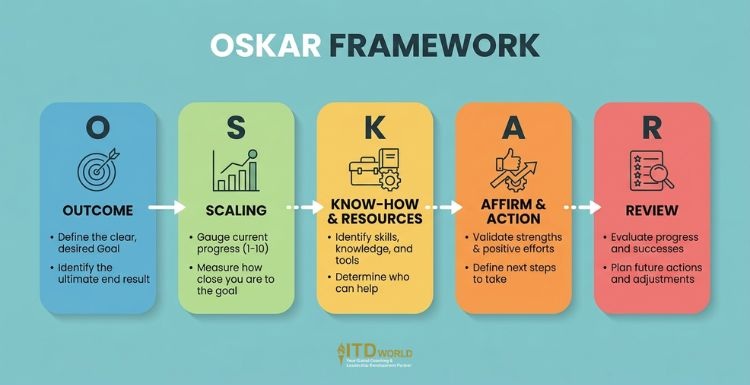
Instead, SFC utilizes the strictly forward-looking OSKAR framework:
-
Outcome: Establish the “Best Hope.” Define exactly what success looks like for today’s specific conversation. (“What needs to happen in the next 45 minutes for you to feel this was a valuable use of your time?”)
-
Scaling: Use a 1-10 scale to measure the current standing regarding that outcome.
-
Know-how and Resources: Identify what the client is already doing well. If they are at a 4, ask what resources, skills, or past experiences are keeping them at a 4 rather than a 0.
-
Affirm and Action: Explicitly affirm the client’s strengths and resilience. Then, identify the single most achievable “baby step” (the N+1) they can take this week.
-
Review: In the follow-up meeting, reflect on what has improved.
The EARS Method for Follow-Up Sessions
When you meet with the employee a week later, use the EARS method to maintain momentum:
-
Empathy: Validate their hard work and any frustrations.
-
Ask: “What has been better since we last spoke?” (Hunt for positive data).
-
Reflect: Mirror the positive changes back to them to reinforce their capability.
-
Summarize: Encapsulate the progress and set the next micro-goal.
Why Leaders Need a Strengths-Based Approach in the Modern Workplace
Empirical studies (originating from SFBT) boast an 86% success rate with an average of only three sessions. Because the focus is incredibly narrow—looking only at what is possible and within grasp—SFC operates with high efficiency. For modern managers, it means less time spent in circular coaching conversations and more time executing goals.
Strengths-Based Coaching for Agile Teams
SFC is highly compatible with Agile methodologies and Quality Improvement (QI) cycles. Both frameworks rely on the assumption that change is inevitable and iterative.
When a team is stalled by complexity (“The new software integration is too complicated, it’s impossible”), a solution-focused coach uses the “Give it a Go” technique. By moving the thinking away from permanent, sweeping changes and toward micro-testing, the coach bypasses organizational fear.
Example: In a medical clinic struggling with overwhelming patient wait times, the staff felt paralyzed by the complexity of the issue. The manager utilized SFC to ask, “Could we test a new intake process for just one physician, for just a few patients tomorrow?” The team agreed to a small-scale PDSA (Plan-Do-Study-Act) cycle. By scaling the problem down, the manager moved the team from problem-paralysis to experimental action.
Read more: Organizational Agility – How to Scale with Speed
Validation Through Reframing
Leaders will inevitably face complaining and resistance. A solution-focused leader doesn’t argue; they reframe it to highlight a hidden value or opportunity. If a team member complains, “We absolutely do not have the time to do this extra reporting,” a traditional manager is likely to give a lecture about time management. A solution-focused one, however, would reframe:
“I hear you. It sounds like urgency and efficiency are top priorities for you right now. How can we streamline this so it respects your time?”
In doing so, they validate the employee’s feelings while steering the conversation back to productivity.
⚠️ Limitations in the Workplace
While SFC is an impactful tool, leaders have to remain pragmatic about where it doesn’t work:
-
Manager as Judge: Unlike an external executive coach or therapist, a manager must eventually evaluate performance and ensure business needs are met. If a deadline is an emergency, direct instruction needs to override coaching curiosity.
-
Intentional Misbehavior: Coaching is designed for motivated those who are simply stuck. Toxic workplace behavior, harassment, or intentional disregard for company policy requires clear HR intervention and direct feedback, not exception questions.
FAQs
Can solution-focused coaching be used for Performance Improvement Plans (PIPs)?
Yes, highly effectively. Traditional PIPs are typically viewed as punitive, backward-looking documents detailing everything an employee did wrong (the deficit model). By applying SFC, a manager transforms the PIP into a collaborative, forward-looking roadmap.
- Using the Miracle Question, the manager and employee define what a successful 30 days looks like.
- Using Scaling, they break that 30-day goal down into daily, manageable N+1 micro-actions.
Because the employee helps co-create the solution, their buy-in and self-efficacy dramatically increase.
How do you handle an employee who refuses to see the positive and stays stuck in “problem-talk”?
Then it’s time to use “Strategic Past-Tapping” alongside the Coping Question. You cannot force a highly frustrated employee to instantly visualize a perfect future; doing so can feel dismissive of their pain. Let them vent briefly, but actively listen for “hidden seeds” of resilience. If they say, “Everything is failing,” ask, “Despite everything failing around you, how did you manage to get this specific report done so accurately?” Validate their struggle, anchor them in that small success, and pivot toward the next micro-step.
Read more: Brilliant Jerks – How to Handle Toxic “High Performers” in the Workplace

Final Thoughts: Start with Just One Notch
Mastering solution-focused coaching does not require you to ignore the realities of business challenges. Instead, it is an exercise in strategic simplicity, captured beautifully by the SIMPLE acronym:
-
Solutions – focus here, not on problems.
-
In-between – look at the interactions where change happens.
-
Make use of what is there – leverage existing resources.
-
Possibilities – focus on future potential.
-
Language – keep it constructive and grounded.
-
Every case is different – avoid “one-size-fits-all” prescriptions.
You do not need to overhaul your entire leadership style overnight. Just take the 1-Question Challenge: Commit to asking just one solution-focused question in your next 1-on-1 meeting.
Instead of asking, “Why are we behind schedule?” try, “What is one thing that is working well right now that we can do more of?”
By consistently focusing on finding what works and amplifying it, not only will you accelerate the team’s goal attainment, but you will also cultivate a culture of resilience, creativity, and relentless forward momentum.
ITD World provides specialized coaching and training solutions designed to help leaders & organizations secure a competitive advantage – and be equipped to win in today’s dynamic landscape. Contact us today to learn more about our world-class programs!
Other resources you might be interested in:
- 10 Common Coaching Challenges: Navigating Difficult Scenarios
- Coaching Philosophy: How to Craft One That Defines Your Impact
- 5 Executive Coaching Goals Leaders Need
- Coaching Culture: Building a Blueprint for Organizational Growth
- Human Centered Leadership: The Importance of a ‘People First’ Mindset