

It is a universal leadership dilemma. Firing an underperforming, difficult employee is an easy decision that only requires basic progressive discipline and a standard transition plan. However, what do you do when your top-performing salesperson—the rainmaker bringing in millions—or your “10x” software engineer who single-handedly shipped your latest product, happens to be destroying team morale?
It is an agonizing situation. For many founders, HR directors, and management teams, the immediate instinct is to look the other way. We excuse their abrasive behavior because the sheer output they generate seems indispensable. We tell ourselves that their technical brilliance outweighs their interpersonal failings.
But that is a dangerous miscalculation.
The conversation around this specific archetype was permanently shifted by the famous Netflix Culture Deck, where co-founder Reed Hastings popularized a straightforward mandate: “Do not tolerate brilliant jerks. The cost to teamwork is too high.” Accordingly, no matter how much talent an individual possesses, the “toxic tax” they levy on a team is never worth the investment.
As a leader, you have to remember one absolute truth: what you tolerate becomes your company culture. By allowing a toxic high-performer to stay unchecked, you are implicitly telling the rest of your organization that human decency is optional if your metrics are high enough. Productivity does not excuse toxicity.
 |
Author: Jonathan M. Pham |
Highlights
- A brilliant jerk is a high-output employee who is often tolerated because they seem indispensable. However, they differ from neurodivergent employees or “friendly incompetents” because they specifically weaponize their intellect to hoard power or diminish others.
- While managers fear losing a top revenue generator, the “net ROI” of a jerk is usually negative. Their “blast radius” includes high turnover, lower engagement among peers, and the creation of “toxic debt” that destroys the employer brand.
- Leaders should act as “Reality Advisors” by using 360-degree reviews to expose the jerk’s “manage-up/kick-down” behavior. Effective intervention involves tying behavior to compensation and systematically de-risking the jerk’s role through forced knowledge transfer.
- High performers should frequently audit themselves for “Special-itis”—the belief that their speed or intelligence exempts them from professional respect. True leadership is defined by the ability to “bring people along” rather than finishing the race alone.
- The most effective solution is a “pre-emptive strike” during hiring by screening for red flags like gossip or territorial control. Using a Performance vs. Values matrix ensures that high results never justify low values, and termination is recommended if coaching fails to protect the team’s psychological safety.
What Does the Term “Brilliant Jerks” Mean?
A brilliant jerk is an employee who possesses rare, highly valuable technical skills or top-tier revenue-generation abilities, but exhibits toxic, abrasive, or bullying behavior. They are often viewed as indispensable to the company’s output, which makes managers hesitant to discipline their negative impact on teamwork.
The Anatomy of a Brilliant Jerk
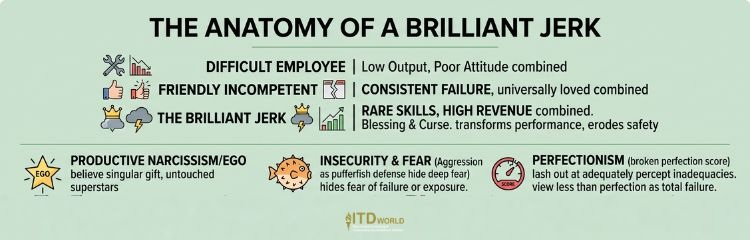
Dealing with arrogant high performers requires distinguishing between an employee who is simply “difficult” and a true “brilliant jerk.”
A difficult employee is characterized by low output or chronic incompetence combined with a poor attitude. On the other hand, the brilliant jerk in the workplace possesses rare, highly technical skills or top-tier revenue-generation capabilities. They are a “blessing” and a “curse” at the same time; on form, they truly transform performance and elevate the sense of possibility. But unchecked, they erode psychological safety.
(Note: It is also vital to distinguish them from the “friendly incompetent”—the employee who is universally loved but consistently fails to deliver results. Neither extreme is sustainable.)
The Two Flavors of the Jerk
Not all brilliance-fueled toxicity is the same. Broadly, workplace bullies with high IQs fall into two distinct categories:
- “Alice” (The Selfless Jerk)
Alice is honest, incredibly direct, and deeply cares about the success of the company. However, she is mean-spirited and abrasive. She views social niceties as a total waste of time compared to finding the “right” technical solution. She tackles the unglamorous work and doesn’t care about personal glory, but her communication style leaves a wake of offended egos.
Alice is a “grey area.” Because her primary goal is company success, she can, most of the time, be salvaged through behavioral coaching.
- “Bob” (The Selfish Jerk)
Bob is a careerist with delusions of grandeur. He lacks empathy and views everyone else as either a tool to be used or an obstacle to be crushed. He creates high-profile projects for personal glory but leaves the “dirty work” to juniors. He gatekeeps information, gaslights his victims, and uses intimidation to make himself indispensable.
While Alice might be debatable in a startup environment, Bob is a company killer and must never be tolerated.
Unpeeling the Psychological “Onion”
To manage these individuals, leaders need to understand the psychological root causes driving their behavior. Often, emotional intelligence (EQ) is entirely absent, replaced by defense mechanisms.
- Productive Narcissism/ Ego: These people genuinely believe they are a singular gift to the firm. They view themselves as untouchable superstars who do not have to play by the rules of mere mortals.
- Insecurity and Fear: Aggression typically acts as a “pufferfish” defense mechanism. They inflate their hostility to hide a deep-seated fear of failure or exposure.
- Perfectionism: They view anything less than 100% perfection as a total failure and lash out at others’ perceived inadequacies.
A Crucial Modern Caveat: Neurodiversity vs. Toxicity
Aside, it is vital that managers do not to confuse neurodivergent traits with malicious “jerk” behavior. An employee on the autism spectrum, for example, might lack social polish, miss unwritten social cues, or communicate with blunt directness. However, this is very different from a brilliant jerk.
The distinction lies in intent and power dynamics. A jerk weaponizes their intellect to diminish others and hoard power. A neurodivergent employee simply processes the world differently. Coaching, therefore, must be tailored accordingly.
Read more: Cognitive Diversity in the Workplace – The Secret Ingredient for High-performance Teams
The Hidden Math & True Cost of Brilliant Jerks (The “Blast Radius”)
Why do companies tolerate brilliant jerks? The answer usually comes down to short-term financial fear. Managers are afraid that if the top salesperson leaves, revenue will plummet. If the lead engineer is fired, the product roadmap will stall.
But that is a flawed equation. Keeping a toxic high performer is akin to a “junk food diet.” The team experiences a temporary, fast high from the person’s immense productivity, yet it inevitably leads to an organizational “hangover.”
When you factor in the “blast radius” of their behavior, the net ROI of a brilliant jerk is almost always negative.
The $240,000 Simulation and “TCA”
Let’s move beyond anecdotal complaints and look at financial quantification. What is the “Total Cost of Assholes” (TCA)? TCA includes increased absenteeism, the immense cost of recruiting replacements for those who quit in frustration, and the active sabotage that occurs when a team works against the jerk’s projects.
Consider a simulation run by Walker Advertising to calculate productivity loss. They used a simple formula to prove the business case to their executive board:
Assume anyone working directly under or alongside a toxic high-performer is 50% less engaged.
Formula: (Annual Salary of Direct Report A + B + C) × 0.50 = Estimated Productivity Loss.
In one mock simulation, a single brilliant jerk costing the company $240,000 in lost productivity across their direct reports. This metric translates a nebulous “bad vibe” into a hard financial liability. Not to mention, turnover costs an average of 6 to 9 months of an employee’s salary.
Replacing a toxic employee can save a company up to three times that individual’s salary in avoided turnover.
The Structural and Cultural Damage
Beyond the spreadsheet, brilliant jerks inflict deep structural wounds on your company culture:
- The Ceiling Effect (Innovation Casualty): Those people are innovation killers. When one of them dominates a room via skepticism or shaming, the rest of the team stops trying to be their best. They stop sharing ideas because they know those ideas will be mocked or stolen. The loss isn’t just in current morale; it is the future value of all the ideas that never get voiced.
- The Mimicry Effect: Bad behavior is as contagious as good behavior. Junior employees may start acting like bullies because they observe that management rewards the toxic individual’s behavior, which makes them falsely believe that bullying is what “brilliance” looks like.
- The “Bucked” Executive (Fear-Based Culture): If promoted to leadership, a toxic high-performer is an unqualified disaster. They create widespread fear. If a department head is so toxic that their name becomes a verb for abuse (e.g., leaving a meeting feeling “bucked”), you have systemic leadership failure.
The “Toxic Debt” Principle
Think of brilliant jerks in terms of “Toxic Debt”—much like technical debt in software engineering. You can take a shortcut now by keeping the jerk to hit Q3 targets, but the interest on that debt compounds daily. Eventually, the debt comes due in the form of mass employee turnover / attrition and a shattered employer brand that makes recruiting top talent impossible.
How to Manage Brilliant Jerks
“Fire them immediately” is easy advice to give, but incredibly hard to execute in the real world when client contracts or product launches are on the line. Handling a toxic high-performer requires strategic management and an airtight HR framework.
-
Multisource Intel and Diagnosis
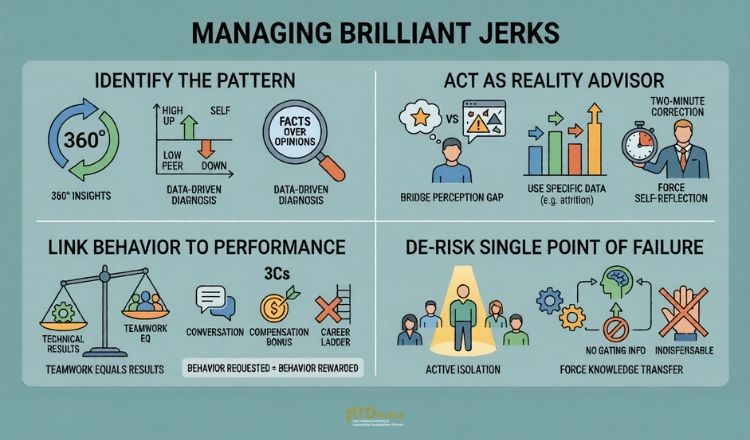
Toxic high-performers are typically highly adept at “managing up.” They are charming to senior leadership while being absolute monsters to their peers and direct reports (the “kiss-up and kick-down” dynamic). Therefore, a manager cannot unilaterally identify a bully based solely on their own interactions.
360-degree reviews are especially helpful here. Look for the specific data pattern: one with incredibly high self-ratings and high supervisor ratings, but consistently low peer and downward ratings.
Caveat: Apply the “Trust, but Verify” rule. Seek facts, not just opinions. Ensure that your “jerk” is not actually just a highly competent, confident employee being targeted by mediocre, threatened teammates trying to take the wind out of their sails.
Read more: Soliciting Feedback – Key to a Building a Better Workplace
-
Act as the “Reality Advisor” (The Intervention)
Many brilliant jerks suffer from a massive blind spot. They are not entirely malicious; they are simply delusional. Because they process information faster, they use phrases like “I don’t suffer fools gladly” as a shield for being abrasive.
Your job as a manager is to act as a Reality Advisor – bridging the gap between their self-perception and the company’s reality.
- Confront the behavior, not the person: Use specific data, not generalizations. Speak their “currency.” To move a jerk, quantitative proof is necessary. Show them the data of their destruction: high attrition rates in their department, low engagement scores, and specific HR complaints.
- The Two-Minute Correction: Rather than insulting them, force self-reflection through questions. If they publicly humiliate a colleague, pull them aside and ask: “Is it your intent to make my staff unproductive?” and “Can you tell them what they need to know in a way that leaves them motivated?”
- Feedforward vs. Feedback: Instead of just litigating past mistakes, use “feedforward” discussions. Focus on the results the person wants to achieve (power, glory, success) and explicitly show them how their current toxic behavior is the primary barrier preventing them from getting those rewards.
-
Tie Behavior to Performance (The “3Cs” of Consequences)
Radical candor and soft behavioral coaching are useless if your company’s reward systems continue to signal that financial results are all that matter. As executive coach Kim Scott notes: Behavior rewarded is behavior requested. If you give a massive bonus to a top-performing bully, you are begging for more bullying.
To create real consequences, implement the 3Cs:
- Conversation Consequences: Direct, immediate feedback about the behavior.
- Compensation Consequences: Using raises and bonuses as leverage.
- Career Consequences: Halting promotions or terminating employment.
Look to Atlassian’s “Anti-Jerk” system as the gold standard. They explicitly designed their performance management system to ensure teamwork is equal to results. If peers report a lack of collaboration, that employee receives a bad rating and loses financial bonuses, regardless of whether they crushed their sales or engineering KPIs.
By formally tying emotional intelligence (EQ) and collaboration to compensation, you remove the “gray area” where technical brilliance usually hides.
-
Active Isolation and De-Risking (The Safety Net)
What if you absolutely cannot fire them today because they hold the company hostage with niche knowledge? In that case, try to de-risk the single point of failure.
- Active Isolation: Isolate them from the broader team and clients. Use them only for their distinct insights while “translating” their work through others to minimize their “toxic shadow.”
- Forced Knowledge Transfer: Systematically force them to cross-train others and document their processes. Do not allow them to gatekeep information. The goal is to systematically remove their “indispensable” status so management can regain leverage. Remember: the graveyard is full of indispensable people.
Self-Reflection: A Guide FOR the High-Performer
Up to this point, we have mostly discussed from the employer’s perspective. But what if you yourself are the high-performer? How do you ensure you are balancing employee performance and company culture without crossing the line into toxicity?
If you frequently find that your colleagues are “too slow,” or if you often arrive at the finish line alone, maybe it’s time for you to audit your own behavior. Awareness is the antidote to becoming a brilliant jerk.
Eliminate “Special-itis”
Many high-performers are raised on comparative praise—told their entire lives they are smarter, faster, or more gifted than their peers. You need to acknowledge and accept your gifts without believing you are inherently better or more special than others.
A lack of humility breeds dismissiveness. Superiority often leaks out through eye rolls, heavy sighs, or sharp rebuttals. If someone suggests an idea you find trite, simply say “Thank you” and stop there.
Read more: Gratitude in Leadership – From Words to Actions
Speed vs. Patience: Stop the Interjections
Given that most brilliant thinkers process information rapidly, they tend to interrupt to save time or rebut a point before the speaker is finished. But you have to remind yourself that allowing others to finish their thoughts is not about efficiency – but a matter of basic professional respect and remaining open to being surprised. Wait for the person to finish.
The “3 Steps Ahead” Trap
Brilliant individuals often tune out of meetings because they have already solved the problem in their heads days ago. However, true leadership requires “bringing people along”, which only happens in real-time, present-moment conversations. If you are a visionary who runs so fast that you leave your entire team in the dust, you haven’t actually succeeded as a leader; you have just isolated yourself.
The Mirror Effect
A fascinating psychological framework suggests that if a specific brilliant jerk in your office consistently “ticks you off,” it might be a subconscious reflection of your own repressed tendencies. That’s why it’s essential to audit your own thoughts for “jerk instincts.” Recognizing these instincts within yourself—without judgment—is the key to unleashing your brilliance for the good of the team, rather than for disruption.
Pre-Emptive Strikes & Culture Building as the Solution to Brilliant Jerks
The most effective way to manage a brilliant jerk is to never hire one in the first place. Systemic toxicity is always a failure of leadership at the very top. To protect the team, it’s crucial that the organizational mindset be shifted from reactive management to proactive cultural defense.
Flip the 75/2 Rule
A common leadership failure is spending 75% of management time dealing with “non-stars” and difficult employees, and only spending 2% of time vetting new hires. Flip this percentage. Hire much more slowly and carefully to avoid bringing jerks into the fold.
The Performance vs. Values Matrix
Popularized by former GE CEO Jack Welch, this matrix is the ultimate tool for core values alignment. Specifically, employees are evaluated on two axes: Performance (results) and Values (behavior).
- High Performance / High Values: Your stars. Promote them.
- Low Performance / High Values: Give them a second chance and training.
- Low Performance / Low Values: Easy decision. Fire them.
- High Performance / Low Values: The Brilliant Jerk. Jack Welch’s rule was clear: Fire them. If you don’t, you destroy the trust of the rest of the matrix.
The Arianna Huffington Rule: Spotting Early Warning Signs
Arianna Huffington’s philosophy is simple: “No brilliant jerks allowed.” She advocates for a pre-emptive strike during the interview process. Be on the lookout for these three telltale signs when interviewing candidates:
- The “Secret” Sharer: Toxic high-performers use confidential information as social currency. If a candidate tries to build rapport by gossiping or sharing “privileged” data from a past employer to create an “us vs. them” dynamic, it is a massive red flag for a lack of boundaries.
- Negative Problem-Finding (Without Solving): Brilliant jerks love to play “devil’s advocate” by highlighting every potential pitfall to sound like the smartest person in the room. However, they rarely offer constructive solutions. Their goal is to stifle enthusiasm, not to improve the outcome.
- Territorial Control: They speak about past roles as if it were their own kingdom. They show signs of being overly rigid, refusing to delegate, and resisting approaches that weren’t their idea.
Read more: Integrity in Leadership – Without It, Nothing Matters
The Remote and Hybrid Work Challenge
In today’s modern workplace, screening for culture fit vs. culture add has become much more complex. In remote environments, brilliant jerks tend to hide their behavior away from the eyes of management. They don’t yell in the boardroom; instead, they send demeaning private Slack DMs, passive-aggressively withhold resources via email, or dominate Zoom calls by muting others.
As such, leaders must actively monitor digital communication health and establish safe, anonymous reporting channels so remote staff feel safe flagging “superstar” bullying.
The “Rapid Exit” (When to Terminate Brilliant Jerks)
Let’s say you have confronted the behavior. You have put them on a Performance Improvement Plan (PIP) backed by meticulous documentation. You have provided emotional intelligence coaching.
But what if they still won’t change?
If a brilliant jerk refuses to adapt, it’s time to move to the final step of the playbook: The Rapid Exit. Delaying the termination only allows the toxicity to seep deeper into the company’s foundation.
Adult-to-Adult Conversations
The transition doesn’t have to be explosive. Using principles from Transactional Analysis, aim for an “adult-to-adult” conversation rather than a “parent-to-child” scolding. Be radically transparent. Explain clearly that the business measures its success by its values as much as its revenue, and that their behavior is culturally incompatible.
Often, when faced with this unbending reality, the person will take responsibility and leave of their own accord because they realize they can no longer get their own way.
Exit with Dignity
If you must formally fire them, do it quickly and respectfully. A five-minute meeting is usually enough. Do not debate or rehash the past. Offer outplacement services to help them transition, ensuring the exit is incredibly professional.
The “Win-Win” Exit and the Sigh of Relief
Many leaders lose sleep over firing their top rainmaker. But historically, these terminations often result in a “win-win.”
When you remove the jerk, you protect the work. Firing them is akin to a “mercy killing” for your company culture. The moment they are gone, you will hear a collective “Sigh of Relief” from your existing team. Your good employees will respect the organization infinitely more for taking a stand. Not to mention, a culture known for protecting its people’s wellbeing will quickly become a magnet for new, highly collaborative, top-tier talent.
FAQs
Who coined the “no brilliant jerks” rule?
The “no brilliant jerks” rule was popularized by Reed Hastings, co-founder and former CEO of Netflix. He included the mandate in the highly influential Netflix Culture Deck, stating that the cost to teamwork is too high to tolerate toxic high-performers.
Why are brilliant jerks so dangerous to company culture?
These people are dangerous because their presence degrades psychological safety, leading to the “Ceiling Effect” where collaborative employees stop sharing ideas out of fear of being mocked. Furthermore, if leadership tolerates their behavior, it signals to the rest of the company that toxicity is acceptable as long as you hit your metrics, which ultimately drives high turnover.
Can a brilliant jerk be coached to change?
Yes, but only if they exhibit self-awareness and genuinely care about the company’s success (the “Selfless Jerk” archetype). Coaching requires confronting them with hard data about the damage they cause, tying their behavior directly to their compensation, and explicitly teaching them the emotional intelligence (EQ) skills they lack. If they are purely selfish and refuse to adapt, they cannot be coached and must be terminated.

Final Thoughts
If you find yourself creating a structural gymnastics routine—reorganizing teams, changing reporting lines, or building physical barriers just to “hide” an employee or shield others from their wrath—you have already lost the battle.
High performers with a dash of sass bring great energy to a team. A little hot sauce adds flavor. But a brilliant jerk is a ghost pepper. It doesn’t add flavor; it only causes pain.
Such a person is a “me-first” player on a “we-first” team. No matter how many lines of code they write, or how many millions they close in Q4, the cost to teamwork is simply too high to justify the individual brilliance.
What you choose to tolerate is the culture you choose to build. Choose wisely.
ITD World provides specialized coaching and training solutions designed to help leaders & organizations secure a competitive advantage – and be equipped to win in today’s dynamic landscape. Contact us today to learn more about our world-class programs!
Other resources you might be interested in:
- Ego in the Workplace: The Hidden ‘Evil’ Behind Team Dysfunctions
- Always-on Culture: How the Availability Trap Erases Profits
- Leadership Potential: How to Spot & Cultivate Future Leaders
- Building High-performing Teams: Power Up Your People for Success
- High-performance Culture: A Blueprint for Driving Excellence