

Employee turnover is a quiet crisis that drains organizational resources, disrupts team morale, and erodes institutional knowledge. While many leaders view retention as an abstract human resources challenge, the financial reality paints a starker picture: hiring is expensive, but losing a new hire in month two is financially devastating.
According to Gallup, low employee engagement costs the global economy an estimated $8.8 trillion. On a micro level, replacing an employee costs between 50% to 200% of their annual salary. When factoring in the hard costs of recruitment, training, and lost productivity, it is estimated that replacing a single new hire costs a company between $7,500 and $28,000.
That being said, the paradigm of talent management is shifting. No longer a reactive metric evaluated during annual reviews or exit interviews, retention has now become a proactive, high-stakes business strategy. Most early attrition is simply an onboarding problem wearing a retention disguise. The battle for talent is won or lost in the first 90 days, and securing an employee’s loyalty starts long before their first official day of work.
 |
Author: Jonathan M. Pham |
Highlights
- A primary reason new hires quit is the “bait-and-switch,” where the daily reality doesn’t match the interview promises. To prevent this, companies must ensure the “psychological contract” is honored by aligning job descriptions with actual daily tasks.
- High-turnover often occurs during “pre-boarding”—the gap between signing an offer and the start date. Engaging candidates early with welcome gifts, intro videos, and ready-to-go tech setups prevents them from “ghosting” for other offers.
- Retention is driven by social integration, not administrative forms. Successful onboarding focuses on “emotional tone” and human connection in the first week, using “work buddies” and peer mentors to reduce the isolation that leads to early exits.
- To move past the “danger zone,” employers should use structured 30-60-90 day plans that move from cultural context to “quick wins” and eventually full autonomy. This provides the clear growth path that modern workers, particularly Gen Z, demand.
- Rather than waiting for exit interviews when it’s already too late, managers should conduct “Stay Interviews” at 30 and 60 days to uncover friction points, check expectations, and ensure the employee feels heard.
Top Reasons Why New Hires Quit in the First 90 Days
To fix a leaky bucket, it’s essential to first understand where the holes are. When new hires quit within the first three to six months, it is rarely due to a sudden shift in career aspirations. Typically, it is the result of systemic friction points and unmet expectations.
The Psychological Contract and “Role Shock”
The hiring process creates an unspoken “brand promise” between the employer and the candidate. When the daily reality of the job does not match the interview description—a scenario known as “role shock” or the bait-and-switch—trust is immediately shattered. Currently, up to 40% of employees report experiencing an expectation mismatch.
- Example: A candidate is hired for a “Strategic Marketing Manager” role, promised autonomy and creative control. Upon starting, they find their days consumed by manual data entry and micromanagement. The psychological contract is broken, leading to an almost immediate intent to quit.
The Accountability Vacuum and Poor Management
Often, the “New Hire Experience” falls through the cracks of organizational silos. Recruitment handles the hiring phase, HR processes the compliance paperwork, and frontline managers oversee the daily output. But who owns the employee’s holistic integration?
This accountability vacuum leaves new hires feeling abandoned. Given that 82% of workers would consider quitting because of a bad manager, leadership support is not a luxury; it is the linchpin of the candidate experience.
The “Runner” Phenomenon and Workplace Isolation
In high-turnover industries, there is a phenomenon known as “Runners”—employees who quit during their first lunch break or after just one day. This is rarely a reflection of the individual’s work ethic. Approximately 19.5% of early leavers cite a lack of connection as their primary reason for exiting. Employees, particularly remote workers facing onboarding fatigue and loneliness, do not just quit companies; they quit isolation.
The Speed of Culture Shift and Skill Stagnation
Post-pandemic candidate patience is at an all-time low. If a company’s internal culture is chaotic, new hires spot it within 48 hours. Not to mention, modern employees demand growth. In fact, over 25% of Gen Z workers cite a lack of learning opportunities as their number one reason for quitting early. If they do not feel they are developing marketable skills in the first few months, they will look elsewhere.
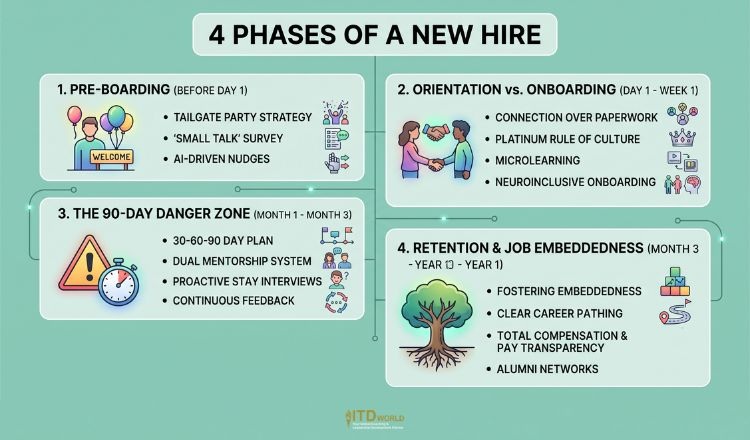
4 Phases of a New Hire
Phase 1: Pre-Boarding (The Forgotten Phase)
The period between a candidate signing their offer letter and their official start date is known as the “Silent Window.” For many companies, this time is characterized by total radio silence. Yet, it is a high-risk zone for new hire ghosting. Up to 61% of candidates will consider a different job offer if they are ignored by their new employer during this gap.
Using pre-boarding to reduce new hire ghosting is about establishing momentum and mitigating first-day anxiety.
The “Tailgate Party” Strategy
Treat pre-boarding like building hype for a major event. This phase should be used to send immediate “membership signals” that affirm the person’s decision to join your team. Actionable steps include:
- Sending Welcome Swag: A simple company mug, t-shirt, or notebook sent to their home makes the transition feel real and celebratory.
- Leadership Welcome Videos: A short, authentic video from the CEO or department head humanizes the executive team and builds immediate rapport.
- Early Logistics: Ensure laptops, software access, and email accounts are set up a week in advance. Nothing signals “we aren’t ready for you” more than a new hire spending their first three days staring at a blank screen waiting for IT support.
The “Small Talk” Data Survey
Send a lighthearted “Get to Know You” questionnaire during the pre-boarding phase. Ask about their favorite coffee order, preferred working styles, hobbies, and how they like to be recognized. Managers can use this data to have their favorite coffee waiting on their desk on Day 1, instantly making the employee feel seen as a person rather than a resource.
AI-Driven Nudges and Automated Touchpoints
To ensure consistency without overwhelming the hiring manager, implement automated HR workflows. A sequence of brief, weekly emails—such as a guide to the neighborhood around the office, a breakdown of the dress code, or an overview of the company’s core values—keeps the candidate warmly engaged.
Phase 2: Orientation vs. Onboarding (Day 1 to Week 1)
A common corporate pitfall is conflating orientation with onboarding.
- Orientation is a one-time administrative event. It is filling out tax forms, reviewing the employee handbook, and completing compliance checklists.
- Structured Onboarding is a months-long emotional, social, and professional integration process.
Currently, only 12% of employees think their company does a great job at onboarding. Most programs are simply “parades of compliance forms” that entirely ignore the emotional tone of starting a new job.
Connection Over Paperwork
The first day should be engineered around human connection, not administrative bureaucracy.
- Perform a round of introductions and a facility tour before sitting the new hire down to fill out insurance forms.
- Establish an emotional tone of “You belong here” before the “You are a number” paperwork begins.
- Show them how their specific role ties directly to the broader company mission.
The Platinum Rule of Culture
While the Golden Rule promotes treating people based on how you want to be treated, the Platinum Rule is about how they want to be treated. It requires combating the toxic, antiquated mindset where veteran employees refuse to learn a new hire’s name until they have “survived” three months.
Empathy must supersede apathy. Create an inclusive environment where questions are welcomed, not penalized.
Combatting Information Overload via Microlearning
New jobs are inherently stressful. Bombarding a new hire with eight hours of dense operational presentations leads to “brain fog” and early burnout. Instead, utilize microlearning—training modules kept under 10 minutes. Breaking down complex systems into digestible, searchable resources increases knowledge retention by 50% and prevents the overwhelming feeling of incompetence that drives early attrition.
Neuroinclusive Onboarding Practices
Recognize that not all employees process information identically. High-retention cultures provide diverse learning materials: visual aids, written step-by-step guides, and hands-on kinesthetic training. Offering quiet spaces to decompress or providing a written agenda for the first week reduces cognitive load and fosters an environment of true psychological safety.

Phase 3: The 90-Day Danger Zone (Month 1 to Month 3)
Research from Brandon Hall Group shows that a structured onboarding program improves new hire retention by 82% and time-to-productivity by 70%. The first three months represent the ultimate window to “re-recruit” your hire and secure their long-term commitment.
How to Create a 30-60-90 Day Onboarding Plan
It’s essential to move away from “one-size-fits-all” training and implement structured, phased milestones – so as to ensure absolute clarity on what success looks like.
- First 30 Days (Connection & Context): The focus is on learning the company culture, understanding the product/service, and building relationships. Goals should revolve around meeting key stakeholders and shadowing peers.
- Days 31-60 (Impact & Trust): The focus shifts to execution. The employee should be given manageable tasks to secure early “quick wins”, cultivate confidence and prove their value to the team.
- Days 61-90 (Independence & Future Visualization): The employee begins taking on full responsibilities. This is the time to bridge the gap toward long-term development, discussing future goals and granting workplace autonomy.
The Dual Mentorship System
Assigning mentors is critical, but the best practice is to separate roles to prevent bottlenecking and burnout:
- The Work Buddy: A peer tasked with answering day-to-day, low-stakes questions (“Where do we find the brand assets?”, “How do I format this report?”). Doing so provides a safe space for the new hire to raise questions they might be too intimidated to ask their boss.
- The Career Mentor: A senior leader (ideally outside of the employee’s direct chain of command) who provides guidance on long-term career pathing, networking, and navigating organizational politics.
Proactive Stay Interviews
Most organizations wait for an exit interview to find out why a top performer is unhappy—by which point, it is too late. High-retention organizations conduct Stay Interviews at the 30-day and 60-day marks. These are dedicated one-on-one sessions aimed at uncovering friction points before they become dealbreakers.
- Example Questions: “Is this role what you expected it to be when you interviewed?”, “What is one tool or resource you don’t have that would make your job easier?”, “Do you feel your ideas are being heard?”
Continuous Feedback and The Managerial Ripple Effect
Retention is inextricably tied to management quality. Do not wait for an annual review to provide feedback. Implement continuous feedback loops consisting of praise, constructive guidance, and active listening.
Organizations should train leaders specifically on how to manage new hires, providing them with the necessary tools, timing, and automated nudges to meet their team’s needs rather than just hitting production quotas.
Phase 4: Long-Term Retention & “Job Embeddedness” (Month 3 to Year 1)
Once a new hire survives the initial 90-day danger zone, the strategy shifts from integration to long-term loyalty building. The goal is to maximize the investment made during recruitment.
Fostering “Job Embeddedness”
Beyond simply liking their daily tasks, people stay at companies because they become embedded in a web of social and professional connections. When an individual feels a deep sense of community, leaving the company feels like a personal loss, not just a career pivot. This social architecture is incredibly valuable; in fact, 53% of workers would willingly trade 6% of their salary for stronger ties with their colleagues. Companies can take advantage of it by encouraging cross-departmental projects, peer recognition programs, and dedicated team-building initiatives.
Clear Career Pathing and Internal Mobility
Money keeps people in their seats, but growth keeps them in the company. If an employee cannot visualize their future at your organization, they will visualize it somewhere else. Hence, a clear “career pathing” roadmap should be provided. In fact, organizations with high internal mobility—where team members can move between departments, take on liaison roles, or utilize tuition reimbursement—experience significantly lower turnover.
Give top talent autonomy; let them suggest their own solutions to problems and recommend process changes. When an employee feels like an architect of the company’s success, they are far less likely to walk away from a system they helped build.
Total Compensation and Pay Transparency
While culture is vital, compensation is foundational. However, it is not always about paying the absolute top of the market. It is about transparency and perception. If an employee perceives an unfair pay gap (even if one does not exist), their intent to stay drops by 16%.
Regularly benchmark pay against market rates, explain the “why” behind compensation structures, and offer modern, flexible benefits. For small businesses that cannot compete with corporate salaries, offering unique perks like Health Reimbursement Arrangements (HRAs), guaranteed scheduling flexibility, and robust mental wellness programs can effectively tip the scales.
The “Boomerang” Strategy and Alumni Networks
It is important to acknowledge a modern reality: even with a flawless employee value proposition (EVP), some people will eventually leave. Life demands change, or employees may wish to pivot entirely. Departing individuals should be treated with the same respect and enthusiasm as new hires.
A graceful exit process preserves the employer brand and leaves the door open for “Boomerang” employees—highly skilled workers who leave, gain new experiences, and eventually return to your organization because they miss the healthy culture.
New Hire Retention Metrics: How to Calculate and Track Success
You cannot improve what you do not measure. However, retention should be viewed as a diagnostic tool—a “pulse check” or symptom of organizational health, rather than the root cause of business problems.
Calculating the True New Hire Retention Rate
A common mathematical pitfall is calculating annual retention rates based only on employees who stayed the entire year. This creates a “Hidden Issue” trap that masks short-term churn (people who joined and quit within the same 12-month window).
To find your true new hire retention rate without the noise of long-term staff, use the following refined formula for a specific cohort (e.g., all hires made in Q1):
((Remaining Original Staff from Cohort ÷ Starting Headcount of Cohort) x 100 = New Hire Retention Rate %)
The Myth of 100% Retention
While a 90% retention rate is generally considered a strong benchmark across most industries (with sectors like Retail and Hospitality skewing lower, and Finance and Tech skewing higher), striving for 100% retention is actually detrimental. Zero turnover means you are likely retaining unengaged or underperforming staff, which blocks career paths for your high performers and drags down overall productivity. Healthy organizations require a small degree of intentional turnover.
Essential KPIs to Monitor
Beyond the baseline retention rate, HR and business leaders should track:
- Time-to-Productivity (or Time-to-Proficiency): How quickly does a new hire reach full output and start “paying for themselves”? Faster ramp-up times indicate highly effective structured onboarding and excellent resource provisioning.
- eNPS (Employee Net Promoter Score): Measured via pulse surveys, this metric tracks whether your new hires would actively recommend your company as a great place to work.
- Absenteeism as a Lead Indicator: Track unexplained absences or frequent sick leave in the first few months. This is often the very first behavioral red flag of a “quiet quitter” who is disengaged and preparing to leave.
FAQs on New Hire Retention
What are the 5 C’s of retention?
The 5 C’s represent the core pillars of a healthy workplace that compel people to stay: Compensation (fair and transparent pay), Culture (a psychologically safe and inclusive environment), Career (clear paths for growth and skill utilization), Communication (transparent leadership and robust feedback loops), and Care/Connection (empathy, wellness support, and peer bonding).
What is the 70 30 rule in hiring?
In the context of retention, the 70/30 rule suggests that hiring managers should spend 70% of the interview listening and only 30% talking. Doing so ensures you deeply understand the candidate’s true motivations, career goals, and cultural alignment, preventing the “role shock” that leads to early attrition.
(It can also refer to hiring candidates who meet 70% of the hard technical skills, knowing you can train them, provided they possess 100% of the required soft skills and cultural alignment).
How do you build connections and retain remote new hires?
Remote workers face a high risk of isolation; hence, companies should not be afraid of over-communicating. Implement virtual peer learning, schedule non-work-related “watercooler” video calls, assign remote work buddies, and ensure clear, written documentation for all processes so remote hires never feel lost or cut off from the team’s institutional knowledge.

Final Thoughts
Employee retention does not start at the one-year anniversary; it begins the moment an offer letter is signed. Transitioning from an administrative, piecemeal onboarding process to an orchestrated, experience-driven journey requires intentionality, empathy, and structure.
By focusing on pre-boarding engagement, mitigating first-week information overload, implementing a rigorous 30-60-90 day development plan, and fostering genuine human connection, organizations can dramatically reduce the financial bleed of early turnover.
Your employees are your ultimate competitive advantage. Treat their integration not as a cost of doing business, but as the most vital investment your organization can make.
ITD World provides specialized coaching and training solutions designed to help leaders & organizations secure a competitive advantage – and be equipped to win in today’s dynamic landscape. Contact us today to learn more about our world-class programs!
Other resources you might be interested in:
- Talent Acquisition: Strategies & Insights for Success
- Talent Philosophy: A Guide to Unlocking Workforce Potential
- Succession Planning: Securing the Future of Your Business
- Identifying High Potential Employees: How to Spot the Force Multipliers