
For the past century, the pace of business change was relatively manageable. From the invention of the typewriter to early mainframes, leaders could rely on long-term strategic planning, rigid hierarchies, and historical precedent. And yet today, we exist in a VUCA environment (Volatility, Uncertainty, Complexity, Ambiguity) driven by exponential technological growth, artificial intelligence, global instability, and shifting remote work dynamics.
According to recent data from LinkedIn Learning, adaptability is now the top skill one needs to succeed, outranking even technical expertise. Yet, a startling number of executives are still trying to navigate this new, shifting terrain using a map that no longer matches reality.
When the terrain changes, traditional top-down, command-and-control leadership officially becomes obsolete. Organizations can no longer rely on a single visionary at the top to have all the answers. Modern survival requires a complete shift in how we view authority, problem-solving, and team mobilization.
This is where the adaptive leadership framework by Ronald Heifetz becomes essential. More than just a reaction to a crisis, it is a permanent operating discipline designed to enable organizations to thrive when there is no pre-existing playbook.
 |
Author: Jonathan M. Pham |
Highlights
- Adaptive Leadership is a framework developed by Ronald Heifetz and Marty Linsky, which redefines leadership as a collective process of navigating change rather than a top-down exercise of authority.
- The framework’s core is distinguishing between Technical Problems (clear issues solvable by experts/protocols) and Adaptive Challenges (messy, systemic issues that require people to change their values, habits, and mindsets). Misdiagnosing an adaptive challenge as a technical one is the most common cause of leadership failure.
- Adaptive leadership mirrors biological evolution through a three-step cycle: Preserving core values that still work, Discarding outdated legacy processes (“DNA”) that no longer serve the environment, and Innovating to create new capacities for growth.
- Leaders must act as guides who “regulate distress.” This involves creating a “holding environment” where there is enough pressure (heat) to motivate change and prevent complacency, but not so much that the organization collapses into panic or paralysis.
- A critical behavioral pillar is the ability to move between the “dance floor” (daily operations and relationships) and the “balcony” (a high-level perspective used to identify systemic patterns and the “big picture”).
- People don’t resist change, they resist loss (of status, competence, or identity). Effective adaptive leaders manage this loss empathetically while “giving the work back to the people,” shifting the responsibility for finding solutions from the leader to the collective team.
What is Adaptive Leadership? (Definition & Origins)
At its core, adaptive leadership is a practical framework that shifts the leader’s role from a “fixer” who provides answers to a “guide” who facilitates collective growth. It replaces fixed hierarchies with collaborative problem-solving.
Ronald Heifetz and the Harvard Kennedy School Framework
The concept was developed and popularized by Dr. Ronald Heifetz and Marty Linsky through their work at the Harvard Kennedy School, most notably detailed in their 1994 seminal book, Leadership Without Easy Answers.
Heifetz and Linsky introduced a radical paradigm shift: “Leading without authority.” In their model, leadership is not a job title, a personality trait, or a position of power. It is a social process and an observable activity – the act of mobilizing people to tackle tough challenges and thrive.
The Evolutionary Biology Lens
To truly understand adaptation in business, executive coaches typically look to evolutionary biology. Successful adaptation in organizations mirrors biological evolution through a three-step cycle:
-
Preserve: Keep the organizational “DNA” (the core values, heritage, and purposes) that still works.
-
Discard: Radically get rid of the “DNA” (legacy processes, outdated products, or long-standing relationships) that no longer serves the current environment.
-
Innovate: Create new capacities and arrangements that allow the system to flourish in new ways.
The Myth of the “Broken” System
A foundational concept in adaptive coaching is the realization that dysfunctional organizations are not actually “broken.” Every system is perfectly aligned to produce the exact results it is currently getting. The current setup serves the people in power, which is precisely why they resist change. To change the results, simply applying a band-aid is not enough; the fundamental alignment of the system needs to be changed.

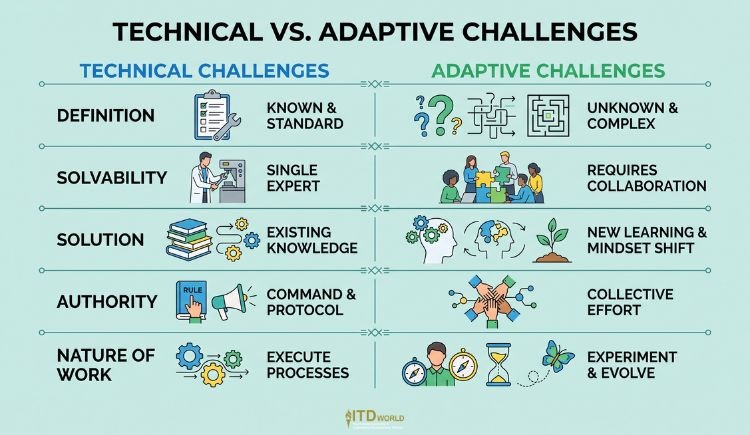
Technical Problems vs. Adaptive Challenges: What’s the Difference?
A central tenet of the model is distinguishing between two distinct types of organizational hurdles. Misdiagnosing these is cited by Heifetz as the single most common failure in modern leadership.
Technical Challenges
These are clear, well-defined problems that can be solved using existing knowledge, established protocols, and expert authority.
-
Example: A critical software bug crashes your e-commerce checkout. You hire an IT specialist who applies a known patch. The problem is resolved.
-
Resolution: Apply existing expertise and standard operating procedures.
Adaptive Challenges
These are messy, complex, and ambiguous issues with no known solution. They cannot be solved by a single expert. They require the people involved to shift their values, beliefs, habits, and long-term strategies.
-
Example: A hospital is experiencing systemic physician burnout, or a legacy tech company has to transition its culture to survive an AI disruption.
-
Resolution: Requires diverse input, time, “new learning,” and a fundamental shift in organizational culture.
The Danger of “Technical Masquerading”
When leaders face an adaptive challenge, the discomfort may drive them to look for a quick out. They throw “technical fixes” (like a new software tool or a superficial restructuring) at an “adaptive problem” (like a lack of trust or psychological safety). Because the root cause is never addressed, the problem persists, the workforce becomes cynical, and morale plummets.
| Feature | Technical Challenges | Adaptive Challenges |
| Definition | Standard, known, and easy to define. | Complex, ambiguous, and hard to define. |
| Solvability | Can be fixed by a single expert or team. | Requires collaboration from everyone involved. |
| Solution Type | Clear solutions based on existing knowledge. | Requires “new learning” and shifts in mindset. |
| Authority | Solved by command and existing protocols. | Requires the collective effort of the team. |
| Nature of Work | Executing known processes. | Experimenting, discovering, and evolving. |
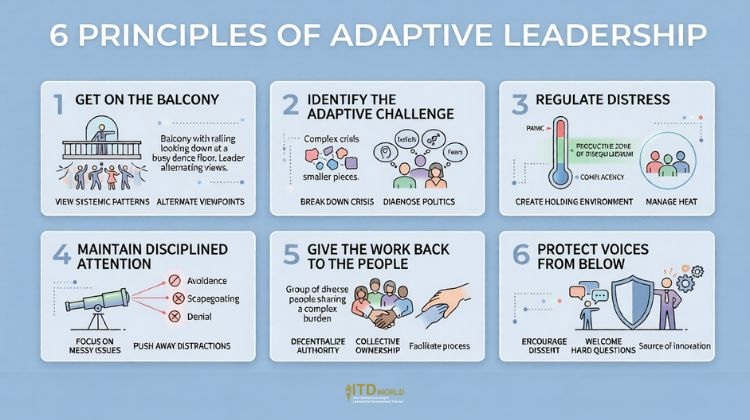
The 6 Core Principles of the Adaptive Leadership Framework
To navigate a complex system, the framework outlines six behavioral pillars – mechanical levers an executive has to pull to initiate systemic change.
-
Get on the Balcony
This is the classic adaptive leadership metaphor. Leaders must constantly alternate between two viewpoints: “The dance floor” (engaging in daily operations, building relationships, and observing how work actually happens) and “The balcony” (stepping back mentally or physically to see the “big picture” and identify systemic patterns). If you never leave the dance floor, you will be consumed by frenetic activity and miss the broader market threats.
-
Identify the Adaptive Challenge
Before acting, a leader has to unbundle massive, overwhelming crises into smaller, digestible pieces centered on the values at stake. Specifically, it’s important to diagnose the political landscape. Who are the stakeholders? What do they believe in? Above all, what are the hidden alliances and what are people afraid of losing?
-
Regulate Distress (Create a Holding Environment)
Change is deeply uncomfortable. As such, it’s essential to create a holding environment—a psychologically safe but challenging space where people can debate hard truths.
The leader’s job is to keep the “heat” in the Productive Zone of Disequilibrium. The pressure should be high enough to motivate action and overcome complacency, but low enough to prevent the system from “boiling over” into panic or shutting down entirely.
-
Maintain Disciplined Attention
When change gets hard, organizations naturally engage in “work avoidance.” Teams will resort to denial, scapegoating, attacking individuals, or pretending the problem is merely technical to avoid discomfort. The adaptive leader must possess the discipline to counteract these distractions and continually redirect the team’s focus back to the actual, messy issues at hand.
-
Give the Work Back to the People
In a top-down model, the leader carries the entire burden of problem-solving. But in the adaptive model, the responsibility is shifted back to the team at a rate they can handle. By decentralizing authority, you replace the “divide and conquer” mindset with collective ownership.
The leader’s role is not to provide the answer, but to facilitate the collective process of finding one.
-
Protect Voices from Below
Organizations often, naturally, try to silence dissenters. However, the people who ask the “hard, frustrating questions” or challenge the status quo are often informal leaders in their own right. Because they operate outside formal positions of authority, they have the freedom to provoke.
An adaptive leader’s job is to protect these voices, as they are frequently the primary source of innovation and necessary rethinking.
Key Characteristics of an Adaptive Leader
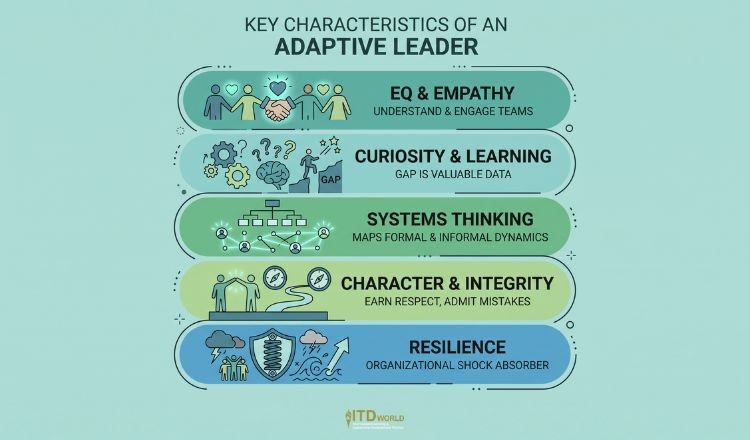
Moving the theory into daily practice requires a highly specific set of human traits, including:
-
Emotional Intelligence (EQ) & Empathy: You are dealing with people’s hopes, dreams, values, and fears, which cannot be managed with cold logic alone. High EQ is essential for gaining “buy-in” from multidisciplinary teams during a crisis.
-
Grounded Curiosity & Continuous Learning: Experience may actually become a liability if it prevents one from updating their “mental map.” Adaptive leaders view the gap between “what I expected” and “what happened” not as a failure, but as highly valuable data.
-
Systems Thinking: The ability to understand both the formal organization chart and the informal “under-the-surface” dynamics.
-
Character & Integrity: Earning respect through transparency, as well as having the humility to admit mistakes and self-correct when a strategy isn’t working.
-
Resilience: The capacity to maintain team morale and focus during intense disruptions, acting as the “shock absorber” for the organization.
Adaptive Leadership vs Transformational Leadership (And Others)
To fully understand the framework, it helps to see how it compares to other popular leadership methodologies taught in corporate training.
-
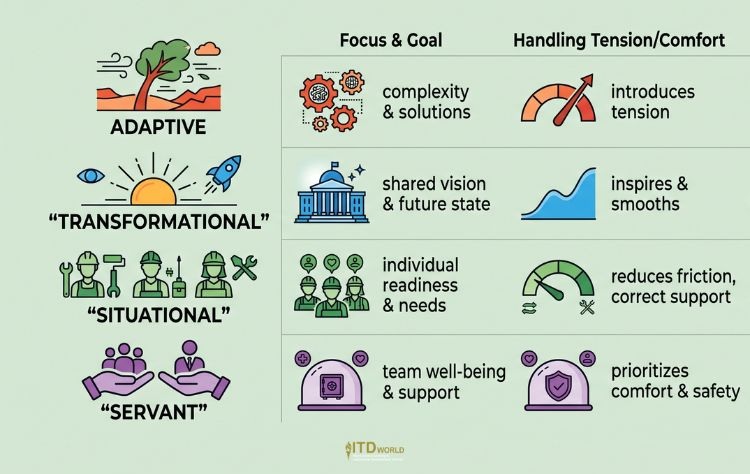
Adaptive vs. Transformational: Transformational leadership focuses on proactively creating a specific future. It relies heavily on a charismatic leader inspiring followers toward a grand, shared vision. Adaptive leadership, by contrast, is more diagnostic. It’s about addressing current friction, mobilizing collective problem-solving, and managing the psychological loss associated with change.
-
Adaptive vs. Situational: Situational leadership requires the manager to adapt their style based on the employee’s readiness and skill level. Adaptive leadership requires the organization to adapt to the environment’s complexity and market disruption.
-
Adaptive vs. Servant Leadership: Both are highly follower-centered. However, Servant Leadership prioritizes the employee’s holistic well-being above all else. Adaptive Leadership is willing to introduce “productive tension” and temporary discomfort if it is necessary for the survival of the organization.
| Leadership Style | Core Focus | The Ultimate Goal | Handling Tension / Comfort | The Core Question |
| Adaptive | Current friction, environment complexity, & market disruption. | Mobilize collective problem-solving to survive and thrive. | Introduces tension; willing to cause temporary discomfort for growth. | “What hard changes must we make to survive?” |
| Transformational | A grand, shared vision of the future. | Proactively create a specific, inspired future state. | Inspires & motivates; minimizes friction through a powerful vision. | “Where are we going, and how can we build it together?” |
| Situational | Individual employee readiness and skill level. | Match management style to the worker’s current needs. | Reduces friction by giving the employee the exact right amount of support. | “What does this specific employee need from me right now?” |
| Servant | Holistic well-being and growth of the team. | Support and elevate the employee above all else. | Prioritizes comfort and safety to foster a deeply supportive culture. | “How can I serve you so you can do your best work?” |
Key takeaway:
Adaptive leadership is the only framework here that explicitly views stress and friction as tools rather than problems to be solved. While the others focus on smoothing the path forward (via vision, tailored management, or deep support), it pushes teams into the “productive zone of discomfort” so the organization may evolve.
How to Build an Adaptive Organizational Culture
A leader cannot be adaptive in a vacuum. The organization’s underlying culture must support agility, for which change management strategies focused heavily on human psychology are non-negotiable.
Focus on Loss, Not Change
As surprising as it may seem, people do not actually resist change. If you offer someone a sudden promotion and a massive pay raise, they will embrace that instantly. What people actually resist is loss.
When applying adaptive leadership in times of crisis, one needs to identify exactly what people are afraid of losing: Is it their status? Their competence in a familiar software? Their professional identity? Their comfort?
True organizational agility is achieved by empathetically managing that sense of loss.
Establish the “Anchor and the Sail”
The most effective organizations integrate two seemingly opposing forces: stability and flexibility.
-
The Anchor (Vision): The “why” and the core purpose of the organization must remain constant, so as to ensure a sense of safety.
-
The Sail (Execution): The “how”—the tactics, strategies, and daily decisions—should remain entirely flexible, adjusting rapidly as new data emerges from the market.
Distributed Adaptability
Organizations built on rigid hierarchies tend to view distributed decision-making as a threat to competence. Cultivating an adaptive culture means moving away from “command and control” and empowering teams to handle pivots locally. Give employees the “decision rights” to run micro-experiments.
In a complex environment, speed should be prioritized over perfection. Waiting for a 100% perfect solution often renders the solution irrelevant by the time it is deployed.
Examples of Adaptive Leadership in the Workplace
- The Airbnb Pandemic Pivot (Business Agility)
During the COVID-19 pandemic, global travel halted, presenting a monumental threat. Instead of applying a technical fix (like merely cutting marketing budgets), Airbnb’s leadership recognized an adaptive challenge. They observed a shift in human behavior: people wanted to escape crowded cities but stay within driving distance. As such, they decentralized their strategy, pivoted the entire platform to focus on long-term local rentals, and implemented contactless check-ins. In doing so, they turned a potential collapse into a sustainable operation.
- The Kodak Cautionary Tale (Diagnostic Failure)
Kodak, on the other hand, is the ultimate example of a lack of adaptive capacity. They possessed the technical solution to their impending crisis—they actually invented the first digital camera prototype in 1975. However, the leadership failed to navigate the challenge. They were unable to manage the loss of their highly profitable, century-old film-based identity. They protected the status quo instead of leading their workforce through the necessary cultural evolution.
- Addressing Health Equity (Healthcare Niche)
In modern healthcare, addressing systemic issues like health equity or community resistance to treatments cannot be solved by top-down medical mandates. Adaptive healthcare leaders break down silos, enlist diverse community voices, and use active listening to address the “wicked problems” of economic marginalization, turning patients into partners in the care process.
How to Develop Adaptive Leadership Skills (The Daily Toolkit)
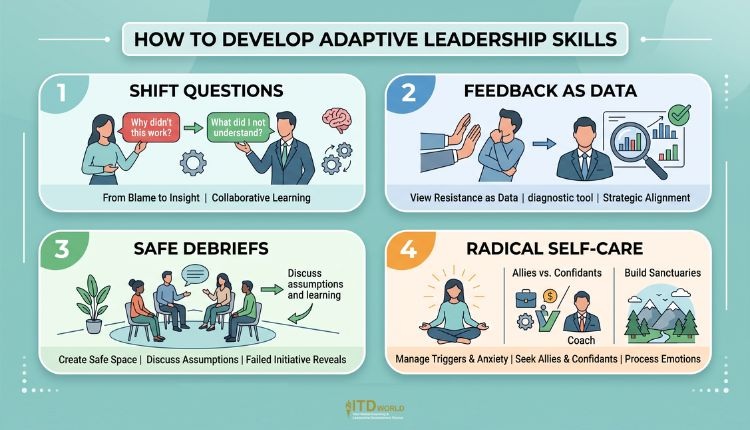
Transitioning into an adaptive leader requires a shift in daily habits and communication styles. Here is a practical toolkit for executive development:
-
Shift Your Questioning Framework
Move away from authoritative interrogations. Change the question “Why didn’t this work?” (which triggers defensiveness and blame) to “What did I not understand about this situation?” (which triggers insight and collaborative problem-solving).
-
Treat Feedback as Data, Not Defiance
When faced with internal resistance or pushback, the natural human urge is to defend your position. An adaptive leader views resistance as a diagnostic tool. Instead of arguing, ask, “What are they seeing that I am not?”
Resistance highlights exactly where uncertainty lives or where strategic alignment has broken down.
-
Implement “Safe Debriefs”
Create physical and temporal spaces for your team to discuss what a failed initiative revealed about the company’s underlying assumptions, rather than being concerned about on who made the mistake.
Read more: Fail Fast, Learn Fast – Turning Friction into Fuel
-
Practice Radical Self-Care
The root of the word “leader” (leit) historically referred to the person carrying the flag into battle—the one most likely to face the danger first. Adaptive leadership is emotionally and physically taxing. Hence, it’s important to manage your own triggers and anxieties so you do not project them onto the team.
-
Know the difference between Allies and Confidants: Allies share your business goal but may abandon you if the political cost becomes too high. Confidants are people (usually coaches or mentors outside the organization) who help you process your emotions and fears without judgment.
-
Build Sanctuaries: Create physical or mental spaces dedicated solely to restoring your energy and returning to your core values.
The Challenges and Pitfalls of Adaptive Leadership
While highly effective, implementing this framework is akin to “rocking the status quo,” which comes with distinct speed bumps.
Comfort with Authority & Culture Clash
The biggest hurdle is, many times, the leaders themselves. Persuading executives accustomed to traditional, authoritative behavior to relinquish control is incredibly difficult. Not to mention, employees are conditioned to want a “fixer.” When a leader admits they don’t have the answer and returns the work to the people, teams may feel frustrated or unsupported, interpreting empowerment as a lack of competence.
The Risk of Decision Paralysis
Because adaptive leadership relies heavily on inclusivity, inviting every voice, and unbundling issues, there is a risk of overthinking. Without clear “decision rights,” increased dialogue may sometimes lead to prolonged, agonizing debates rather than bias for action.
The Danger of Martyrdom
There is a great temptation to take on all the organizational heat yourself to protect your team – and become a “martyr” as a result. Shielding people from change prevents them from developing the very resilience they need for the future. Your job, therefore, is to distribute the responsibility, allowing the team to feel the necessary friction required for growth.
FAQs
Can adaptive leadership be taught, or is it an innate trait?
It can absolutely be taught. Unlike the outdated “Great Man Theory” which suggests leaders are born, adaptive leadership is rooted in behavioral science. It is a daily practice, a set of observable activities, and a diagnostic mindset that any professional can cultivate through coaching and intentional repetition.
Is adaptive leadership suitable for every situation?
No. If a building is on fire, you do not call a town hall meeting to crowdsource diverse perspectives; you use command-and-control authority to evacuate.
Adaptive leadership is specifically reserved for complex, novel challenges where the problem is ambiguous, and the solution requires the organization to learn new ways of operating.
Final Thoughts
In an era defined by exponential change, the ultimate goal of a business is not merely to “survive” disruption, but to build an organization that is actually strengthened by the pressure of pivoting.
Traditional leaders wait for the storm to pass; adaptive ones recognize that leadership is the skill of navigating through the storm so that others have a path to follow. By mastering the art of the balcony and the dance floor, diagnosing the true nature of your challenges, and having the courage to give the work back to your people, you can transform uncertainty from a threat into your greatest competitive advantage.
ITD World provides specialized coaching and training solutions designed to help leaders & organizations secure a competitive advantage – and be equipped to win in today’s dynamic landscape. Contact us today to learn more about our world-class programs!
Other resources you might be interested in:
- Human Centered Leadership: The Importance of a ‘People First’ Mindset
- Leadership Excellence: Moving From Manager to Multiplier
- Creative Leadership: Trigger Innovative Approaches for Results