
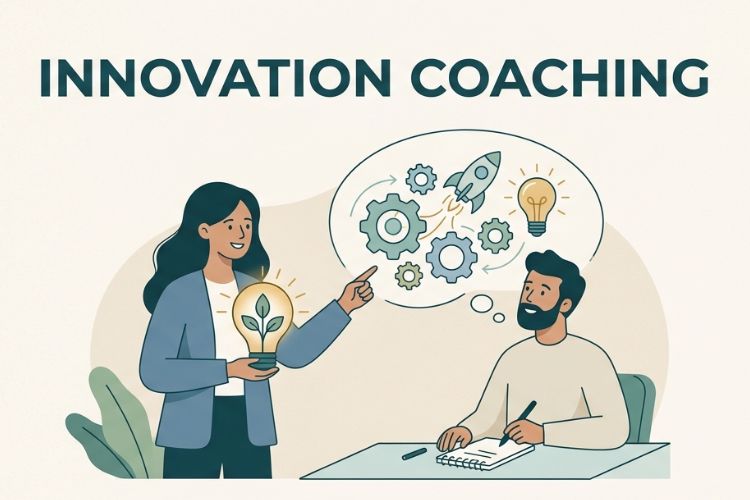
The modern corporate landscape is facing a survival crisis. The average lifespan of an S&P 500 company has plummeted from 33 years to just 15-20 years, and over 50% of the Fortune 500 from the year 2000 no longer exist. Their disappearance was not because they lacked capital, but mostly because they failed to innovate.
While executives universally accept the reality of “innovate or die,” a staggering 90% of corporate innovation initiatives end up unsuccessful. The average cost of a single initiative reaching the scaling phase is $1 million, making the financial and opportunity costs of these failures catastrophic. This widespread dilemma occurs because organizations mistakenly treat innovation as an erratic spark of genius rather than a disciplined, repeatable business system. They focus heavily on processes and frameworks while completely ignoring the people expected to execute them.
 |
Author: Jonathan M. Pham |
Highlights
- Unlike traditional business consulting, innovation coaching focuses on capability building by teaching teams how to navigate discovery, foster creative problem-solving, and bridge the gap between abstract ideas and scalable market realities.
- Coaches prioritize psychological safety to dismantle institutional “innovation killers”—such as the fear of failure and rigid status quo bias—transforming the workplace into an environment where risks are treated as data points for growth.
- Through rigorous frameworks such as Design Thinking and Lean Startup, coaches help move teams beyond brainstorming into iterative prototyping.
- While external coaches are valuable for navigating major transitions or stagnation, the ultimate goal is to develop internal “Catalysts” who can sustain an innovation culture long after the external engagement ends.
- Innovation coaching is evaluated through “uncommon” metrics—such as the ratio of failure-to-learning and innovation velocity—rather than traditional quarterly revenue, which often prematurely stifles early-stage ideas.
What is Innovation Coaching?
Innovation coaching is a specialized, mentorship-based partnership designed for professionals and organizations to master the tools, mindsets, and actions required to turn messy, half-formed concepts into profitable, scalable realities. An innovation coach acts as a “human cheat code,” providing the structural support necessary to bridge the execution gap and transform a company’s collective ability to maintain a competitive edge.
What an Innovation Coach Is (and Isn’t)
Innovation Coach vs. Business Consultant
The most critical distinction lies in capability building. Traditional management consultants are hired to provide solutions; they hand over a fish. An innovation coach, conversely, teaches a team how to fish.
Relying solely on external consultancies is typically too expensive to scale and can result in a dangerous loss of core competencies. When outsourcing your problem-solving, you fail to build internal “organizational muscle.” Coaches work alongside your teams, shifting the focus from simply delivering a project to transferring creative problem-solving and strategic thinking skills that remain long after the engagement ends.
Difference Between Agile Coaching and Innovation Coaching
While these two frequently work in tandem, their focal points differ significantly. Agile coaches are mainly concerned with delivery—ensuring the team builds the product right using agile frameworks like Scrum or Kanban. Innovation coaches, however, focus on discovery—figuring out what to build, why, and verifying whether it actually solves an unmet customer need.
To put it simple, Agile optimizes the timeline; innovation the value.
Coaching vs. Workshops (The “Bootcamp Hangover”)
Organizations frequently try to spark creativity through short-term workshops. Unfortunately, these often result in a “bootcamp hangover.” Teams leave high-energy sessions filled with ideas, only to immediately hit the realities of corporate bureaucracy, software procurement delays, and innovation silos.
Coaching is a long-term, continuous integration that guides teams through these institutional roadblocks, ensuring that abstract ideas survive the journey to deployment.
Creativity vs. Innovation
Creativity is the generation of a novel idea. Innovation is the “next level” execution—taking that novel idea and turning it into a tangible, value-adding solution that achieves market traction.
Read more: Solution-Focused Coaching – Techniques, Questions, and Frameworks
The Process of Innovation Coaching
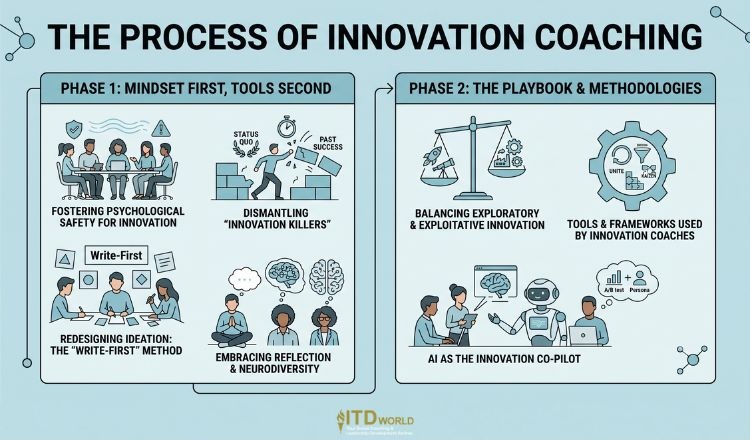
Phase 1: Mindset First, Tools Second
Before a coach ever introduces a canvas or a testing framework, they need to address the corporate culture. If you introduce new tools into a toxic environment, your efforts are likely to end up futile.
Fostering Psychological Safety for Innovation
The primary responsibility of an innovation coach is to act as a cultural architect, whose role is to transition the organization from a rigid fear of failure toward a true growth mindset.
In many corporate structures, teams exhibit a “fear of discovery”—they hide the results of failed experiments because the truth that a legacy product lacks value is too painful for management to handle. Coaches introduce techniques like the Post-Mortem Analysis, which shifts the focus from assigning blame to identifying root causes.
By treating failures as necessary data points, teams learn to “fail smarter” and take the calculated risks required for breakthroughs.
Read more: Coaching Culture – Building a Blueprint for Organizational Growth
Dismantling the “Innovation Killers”
Leaders often face invisible mental roadblocks that stifle progress. A coach helps teams identify and dismantle these barriers:
-
Status quo bias: The innate human preference to keep things the way they are.
-
Inertia & Gatekeeping: The reflexive rejection of new ideas (“that’s not how we do things here”) or sales teams blocking access to customers out of fear of disrupting current relationships.
-
Past Success as a Barrier: Previous wins tend to keep leaders grounded in past paradigms, preventing them from looking at evolving future states.
Redesigning Ideation: The “Write-First” Method
Traditional verbal brainstorming is notoriously flawed. It fights basic human psychology, falling victim to immediate judgment, fixation on the first idea mentioned, and dominance by a few loud voices.
To combat this, coaches employ specific techniques for facilitating ideation sessions, one of which is the “Write-First” method. Instead of talking, the meeting begins with solitary writing. Participants write their ideas on cards independently before anyone speaks. This guarantees introvert inclusion, ensuring quieter team members get equal airtime and preventing groupthink.
Embracing the “Reflection Gap” and Neurodiversity
Innovation is impossible without reflection. Coaches teach leaders the PAUSE method, recognizing that the best ideas often come after a day or two of incubation rather than inside a pressured conference room. In addition, they also actively foster neurodiversity. By creating environments that support neurodivergent thinkers (such as those with ADHD or Autism), organizations can unlock unparalleled lateral thinking, pattern recognition, and unconventional problem-solving—turning cognitive diversity into a massive competitive advantage.
Read more: 6 Benefits of DEI in the Workplace
Phase 2: The Playbook and Methodologies
Once the cultural foundation of psychological safety is established, the coach introduces the structural engines of innovation.
Balancing Exploratory and Exploitative Innovation
Exploratory innovation focuses on search, discovery, and high-risk experimentation to find entirely new markets. Exploitative innovation, on the other hand, is about refining and adjusting existing products within the current market.
With innovation coaching, leaders learn to manage the tension between these two, ensuring the company does not abandon its core business while searching for the next disruption.
Tools and Frameworks Used by Innovation Coaches
To move the success rate of new initiatives from the baseline 10% up to 50% or higher, coaches rely on rigorous, proven methodologies.
-
Design Thinking Coaching Techniques: Human-centered design is critical, but it frequently fails when the “framing is too large.” Coaches help teams aggressively narrow the solution space, forcing them to focus on deep customer empathy and specific pain points rather than broad, un-testable concepts.
-
Lean Startup Methodology & Rapid Prototyping: To avoid the trap of spending millions before validating an idea, coaches implement iterative prototyping. Taking inspiration from companies like Tesla, teams learn to test and refine ideas in real-time, embracing a “time-to-learn” metric over immediate perfection.
-
UNITE Models: Instead of just fixing a standalone value proposition, advanced coaches use holistic integration models to connect the value proposition directly to the business model and the day-to-day operating structure.
-
Continuous Improvement (Kaizen): Borrowing from Toyota’s manufacturing excellence, coaches empower every employee to stop the proverbial assembly line to fix a problem, making ideation an everyday requirement rather than a highly sequestered management task.
AI as the Innovation Co-Pilot
In the contemporary landscape, AI has become an indispensable tool. Forward-thinking coaches are now training teams to embed Generative AI and collaborative tools (like Miro) into their everyday workflows.
From running synthetic A/B tests to rapid persona generation and mapping market gaps, AI dramatically accelerates time-to-market and helps teams visualize concepts at unprecedented speeds.
Read more: AI in Leadership – Bridging the Gap Between Adoption & Maturity
Build vs. Buy: Integrating Coaching into the Enterprise
When to Hire an External Coach
External coaches are ideal for companies at the beginning of their transformation or those experiencing specific “red flags.” You should look outward when:
-
Stagnation has set in: Growth has flatlined, and internal leadership lacks the objective perspective to see why.
-
Major Transitions: The company is undergoing messy structural shifts, like mergers or acquisitions.
-
Leadership Drift: Executives are setting high-ambition targets but openly admit they lack the frameworks to achieve them.
An external coach brings absolute neutrality. They are immune to corporate politics, unburdened by “how we’ve always done it” biases, and bring cross-pollinated best practices harvested from multiple industries.
How to Build an Innovation Culture in the Workplace (Internal Coaches)
To truly achieve scalability and innovation maturity, organizations need to eventually move away from external reliance and develop a “bench” of internal coaches. These internal “Catalysts” help teams navigate the intrapreneurship paradox: the tension between being entrepreneurial (fast, risky) and navigating corporate reality (slow, bureaucratic).
However, companies must avoid the “Best Thinker Fallacy.” The best innovators, ironically, often make terrible coaches. Being a “star” practitioner doesn’t automatically mean a person has the patience, active listening, or facilitation skills to empower someone else.
Effective internal coaches are expected to possess a demonstrable mastery of methods and a genuine passion for helping others succeed. Their role is to act as “Diplomatic Hand Grenades”—capable of challenging a team’s preconceived ideas and holding up a mirror to their progress without being aggressive or humiliating.
The 6-Step Coaching Lifecycle
-
Assessment: Diagnosing current culture, bottlenecks, and lack of alignment.
-
Goal Setting: Defining what a successful outcome looks like (e.g., new product lines, faster deployment).
-
Strategy Design: Building a custom blueprint that works with the organization’s existing architecture, not against it.
-
Active Support: Providing hands-on facilitation, customized training, and empowerment.
-
Monitoring: Adjusting tactics based on real-world, agility-focused feedback.
-
Handover: The coach intentionally steps back once the internal team possesses the skills to sustain momentum independently.
Read more: 5 Executive Coaching Goals Leaders Need
The Leader as Coach: Shifting Management Paradigms
For executives and managers reading this, you do not need a formal title to adopt a coaching stance. All it requires is that you move away from traditional command-and-control management toward a transformational leadership style.
The Pro-Athlete Analogy
Consider professional athletes. A champion golfer has specialized coaches for putting, swinging, and health. Similarly, corporate leaders need to realize that they cannot be experts in everything. To overcoming resistance to new ideas at work, leaders need to act as facilitators who guide their teams, much like an athletic coach refines a player’s inherent talent.
The Power of Inquiry
A leader acting as a coach shifts their approach from providing the “right answers” to asking powerful questions. Every coaching conversation is an opportunity for innovation if approached with curiosity. Instead of dictating a path forward, try asking your team:
-
“What would an ideal solution look like if we had zero resource constraints?”
-
“How can we reframe the problem to uncover new perspectives?”
-
“Whose perspective in this company have we not heard yet?”
-
“What are the potential unintended consequences of this pivot?”
Micro-Coaching in the Flow of Work
Innovation coaching doesn’t always require formal, hour-long closed-door sessions. Leaders can engage in “micro-coaching”—taking 10 to 15 minutes during a weekly standup or via an asynchronous digital whiteboard to unblock a team, challenge an assumption, or facilitate cross-functional collaboration. Doing so makes innovation an everyday habit rather than an extracurricular activity.
How to Measure the ROI of Innovation Coaching
Traditional financial KPIs (like immediate quarterly revenue) are often the wrong metrics for early-stage innovation. Judging a nascent idea by mature financial standards will kill it prematurely. That’s why it’s important to track outcomes & execution through uncommon metrics:
-
Innovation Velocity: How fast does your team move from a raw idea to a tested implementation?
-
The Failure-to-Learning Ratio: Are your teams failing and stopping, or are they extracting data from failures to iterate successfully?
-
Volume of Action: Track the number of prototypes built, customer interviews conducted, and assumptions tested.
-
The “North Star” Metric: A single, unifying measure (e.g., “reduced customer onboarding time”) that keeps every innovation project aligned with the larger corporate mission.
Ultimately, the Return on Innovation (ROI) from coaching manifests in accelerated time-to-market, massive reductions in wasted capital on unviable products, and vastly improved employee retention. (Studies show that 69% of workers would leave their current job for a more innovative company; innovation is a primary tool in the war for talent).
FAQs about Innovation Coaching
What makes a good innovation coach?
A strong innovation coach possesses a blend of high emotional intelligence, “comfort with chaos,” pattern recognition, and robust facilitation skills. They remain neutral, avoid dictating solutions, and use targeted, open-ended questions to guide teams toward their own breakthroughs.
Innovation coaching for startups vs. enterprises: What is the difference?
For startups, coaching is heavily focused on Lean Startup principles—running rapid experiments to find product-market fit and avoid costly scaling mistakes. For enterprises, it leans mostly on change management, breaking down corporate silos, navigating internal politics, and transitioning rigid hierarchies toward agile, human-centered design.
Read more: 12 Leadership Coaching Topics to Drive Lasting Transformation
Why do successful companies need innovation coaching?
Even highly successful companies suffer from “status quo bias” and an over-reliance on past successes. Innovation coaching acts as an objective, structural lifeline that prevents stagnation, ensuring the organization continuously adapts in an era of exponential technological change.
ITD World provides specialized coaching and training solutions designed to help leaders & organizations secure a competitive advantage – and be equipped to win in today’s dynamic landscape. Contact us today to learn more about our world-class programs!
Other resources you might be interested in:
- The Future of Coaching: Tech-Driven, Human-Centered
- Team Coaching: Guidelines for Building High Performance Groups
- 7 Types of Coaching in the Workplace: A Practical Guide
- Fail Fast, Learn Fast: Turning Friction into Fuel
- Brilliant Jerks: How to Handle Toxic “High Performers” in the Workplace