
Every organization eventually faces a “leadership time bomb.” It starts with a sudden, high-stakes departure—a retiring CFO, a poached CEO, or a top-performing Director who abruptly leaves for a competitor. If your executive team’s first instinct is to panic, assemble an emergency committee, and rely on an expensive external search firm, your organization is sitting on a critical vulnerability.
Heavy reliance on external executive hiring is, in many ways, an admission of failure. While bringing in outside talent may occasionally provide a necessary injection of new perspectives, relying on it as a primary talent strategy leaves companies at the mercy of rising recruitment costs, severe talent shortages, and high turnover at the top. External hires tend to lack a holistic understanding of your company’s unwritten culture, making their transition risky and, quite often, unsuccessful.
The antidote to the above-mentioned crisis is bench strength—a reliable pool of internal talent ready to step up. Waiting to train a leader until a vacancy appears is a losing strategy. Today’s most resilient organizations treat leadership development not as an administrative HR chore, but as a core business system.
 |
Author: Jonathan M. Pham |
Highlights
- Unlike traditional succession planning, a leadership pipeline is a proactive system that builds broad leadership capacity across the entire firm through continuous learning journeys.
- As leaders move through “passages” (e.g., from managing self to managing others, or from functional to business manager), they must fundamentally shift their skills, how they apply their time, and what they value in their work.
- A major risk in talent management is promoting high-performing technical “doers” into management roles without ensuring they can transition to “enablers.” Failure to make this mental shift “clogs” the pipeline, as managers continue to do technical work instead of coaching their teams.
- Robust pipelines prioritize experiential learning. Development is broken down into 70% on-the-job experience (stretch assignments), 20% social learning (mentoring and sponsorship), and 10% formal training (relevant workshops).
- The health of a pipeline is measured by business results rather than training attendance. Key performance indicators include high internal promotion rates, reduced vacancy duration for critical roles, and the retention of high-potential employees.
What is a Leadership Pipeline?
A leadership pipeline is a structured, methodological approach to developing a mass of talent ready to step into critical roles at any level, at any time. It recognizes that leadership is a fluid journey, ensuring that an organization has individuals at every stage of readiness—from those who are two to three years away from managing a team to those ready to step into the C-suite tomorrow.
Leadership Pipeline vs. Succession Planning
Traditional succession planning is typically a reactive, role-specific exercise. It looks like a dusty binder on an HR director’s shelf, answering narrow questions like, “Who takes over for the CEO if she leaves?” It relies on static lists, or “talent pools,” which mistakenly imply that a group of people is simply waiting on a bench at a fixed level of readiness.
A leadership pipeline, conversely, is strategic and broad. Instead of asking who replaces one specific person, it asks, “How do we build leadership capacity across the entire firm?” It functions as a talent supply chain. The goal is to create continuous learning journeys that keep people moving fluidly from one end of the pipe to the other, actively preparing them for the distinct challenges of their next organizational level.
Ram Charan’s Leadership Pipeline Model Explained
To establish a robust pipeline, organizations need a theoretical framework to map development. The gold standard in talent management is the six-passage model outlined in The Leadership Pipeline by Ram Charan, Stephen Drotter, and James Noel.
The core premise is that leadership is not a single, static skill set. What makes a person successful at one level (e.g., an individual contributor) is fundamentally different from what makes them successful at the next (e.g., managing others).
Every time a leader is promoted through a “passage” in the pipeline, they are expected to make a fundamental shift in three specific areas:
- Skills: The new capabilities required to execute the job.
- Time Application: A new way of managing one’s calendar (e.g., spending time coaching instead of doing technical tasks).
- Work Values: Changing what one believes is important (e.g., valuing the success of subordinates more than personal accolades).
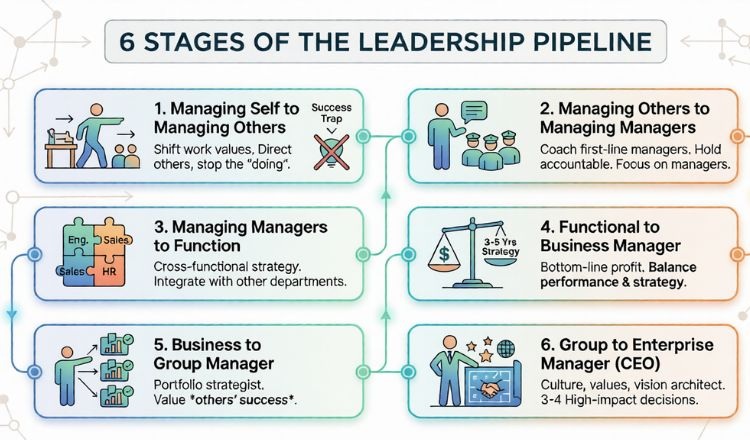
6 Stages of the Leadership Pipeline
- Managing Self to Managing Others: This is often the most dangerous transition. High-performing individual contributors must stop being the “doer.” If they fail to shift their work values, they will fall into the “Success Trap”—continuing to do the technical work that made them famous rather than achieving results through others.
- Managing Others to Managing Managers: Leaders must divest from individual tasks entirely. Their new primary focus is identifying, holding accountable, and coaching first-line managers, instead of managing the frontline work themselves.
- Functional Managers (Managing Managers to Function): The leader now have to manage unfamiliar areas. For example, a VP of Engineering needs to consider how their department integrates with Sales or HR, adopting a long-term, cross-functional strategy.
- Functional to Business Manager: This passage requires a massive shift to bottom-line (profit) accountability. The leader is expected to balance short-term quarterly results with three-to-five-year strategic goals.
- Business to Group Manager: At this level, the leader becomes a portfolio strategist. A fascinating distinction here is that while a Business Manager values their own unit’s success, a Group Manager must place an emphasis on the success of other people’s businesses. If they compete with their subordinates for the “lion’s share of credit,” they stifle organizational growth.
- Group to Enterprise Manager (CEO): The Enterprise leader is the architect of the “soft side” of the company—its culture, values, and vision. Their success is determined not by daily operational execution, but by three or four high-impact, visionary decisions per year.
Context-Specific Exception: The Founder’s Trap
For startup founders, the pipeline acts differently. In a corporate environment, a promotion tells you when to change behaviors. But a founder’s title remains “CEO” from day one, even as the company scales from 5 to 500 employees. Founders tend to suffer from a “Transition Blind Spot,” failing to realize they need to move from Passage 1 to Passage 4. In these environments, events like fundraising often act as a forced evolution—demanding the founder delegate technical tasks and adopt the time application of a true enterprise leader.
Why is Building a Leadership Pipeline Important?
- The Mathematics of Leadership
If you lead a unit of 20 people, 95% of the output belongs to your team, not you. If an executive is still “doing” and not “enabling,” they are mathematically capping the potential of their entire team. A pipeline ensures leaders leave old habits behind so the organization may scale.
- Preserving the “Collective Brain”
Internal mobility and promotion drastically reduce the risk of lost institutional knowledge. For example, think about NASA during the transition out of the Apollo era. For them, succession planning was a matter of life-and-death safety. To prevent losing the unique genius of their aging engineers, they utilized shadowing roles and oral histories so the next generation could “stand on the shoulders of giants.” Internal hires understand the unspoken operational realities of a company, leading to much smoother transitions.
- Employee Retention and the Total Rewards Connection
Today’s top talent demands continuous development. Data consistently shows that over 90% of people would stay at a company longer if it invested in their career progression. A healthy pipeline provides clear visibility into internal mobility.
When high-potential employees (HiPos) see a transparent, supported path to the top, they are far less likely to be poached.
- The “Checkers vs. Chess” Advantage
Ultimately, treating leadership as a business system rather than a happy accident creates a sustainable competitive advantage. A robust leadership pipeline allows a company to play “strategic chess,” proactively aligning talent with long-term business goals, while competitors are stuck playing “reactive checkers,” scrambling to plug gaping holes in their organizational chart.

How to Build a Robust Leadership Pipeline
-
Define Success Profiles and Identify “Linchpins”
Before assessing talent, it’s essential to define what success looks like. Move away from generic corporate competencies and create specific “Leadership Success Profiles” for each level. What does a successful functional manager do differently than a successful frontline manager? Link these expectations directly to tangible business outcomes.
At the same time, do not restrict your pipeline to the C-suite. Look deeper into your organizational chart and org design to identify “linchpin” positions. These are critical roles—often at the middle-management level, such as plant managers or regional sales directors—that are absolutely essential for long-term operational health. Building a pipeline for these linchpins ensures deeper bench strength early on.
-
Identify High-Potential Employees (HiPos) Objective
A major pitfall in talent management is confusing high performance with leadership potential – which is known as the “Salesperson Trap.” Being a top individual contributor (like a star salesperson) requires a completely different skill set than leading a high-performing sales team.
To identify true HiPos, it is recommended that organizations rely on objective data to remove executive “gut feel” and bias in promotion.
- The 9-Box Grid: Use this classic tool to map out your talent pipeline. The X-axis measures current performance, while the Y-axis measures future potential (such as emotional intelligence, learning agility, and strategic thinking). Those in the top-right quadrant are prime candidates for pipeline acceleration.
- Organizational Network Analysis (ONA): To supplement the 9-Box Grid, modern organizations use ONA to visualize communication and collaboration patterns – so as to reveal who actually influences others and acts as a cultural hub, regardless of their official job title.
-
Targeted Development via the 70:20:10 Framework
Leadership is built through experience, not just in corporate classrooms. A robust pipeline utilizes the 70:20:10 model for targeted development:
- 70% Experiential: The most underutilized part of development is real-world problem-solving. Use job rotation and stretch assignments intentionally designed to push candidates out of their comfort zones. For example, pharmaceutical giant Eli Lilly adopts the “Double Win” approach: tasking emerging leaders with solving actual, pressing company problems, simultaneously vetting their skills while generating business value.
- 20% Social: This involves continuous feedback, peer learning, and coaching. Incorporate “Coaching Circles” where emerging leaders advise one another. At the same time, it is essential move beyond basic mentorship to sponsorship—where senior executives actively champion and put their own political capital on the line to secure high-visibility roles for a candidate.
- 10% Formal: Structured training programs and workshops. However, these must be “Capability-Based Learning Labs,” directly tied to actual operational challenges facing the company so the learning is immediately relevant.
-
Create Individual Development Plans (IDPs)
Development needs to be integrated into the flow of work. If leadership training feels like an extra burden on top of a “real” job, it will fail. Work with candidates to draft IDPs that clearly map out which skills, time applications, and work values they need to shift over the next 12 to 18 months. Attach specific stretch assignments to these goals so the employee is practicing leadership while executing daily operations.
-
Conduct Talent Reviews and Maintain Transparency
A pipeline is not a “set it and forget it” tool. Implement regular, candid talent reviews involving HR and senior business leaders to evaluate readiness.
Maintain a “middle-ground” approach to transparency. Modern employees perform better when they know where they stand. Let your HiPos know they have been identified for leadership tracks to keep them engaged. However, you don’t necessarily need to reveal exactly how high they rank on a 9-Box Grid, which helps prevent complacency or ego issues.
Challenges & Pain Points: Why Leadership Pipelines Fail
Even with a strong blueprint, executing a talent strategy is notoriously difficult. CHROs and CEOs need to proactively guard against several structural and psychological roadblocks.
- The Peter Principle and the Leadership Vacuum
The Peter Principle states that people are promoted to their level of incompetence. It happens when companies reward stellar technical competencies with management titles, without verifying if the employee possesses the soft skills required to lead. The result is a leadership vacuum: the company loses its best technical worker and gains a terrible manager. Enforcing the pipeline model—which mandates that promotion readiness is based on demonstrating next-level skills, not just past performance—is the ultimate defense against the problem.
- The “Roger Jones” Phenomenon
It is a common corporate trap to rely on a single superstar. If “Roger” is listed as the primary backup for five different critical roles, you don’t have a pipeline; only a single point of failure. If Roger takes a job at a competitor, the entire succession plan collapses. Companies, therefore, need to ensure their talent pool is wide and not stretched too thin.
- Siloed Talent and Hoarding
A healthy pipeline requires internal talent mobility. However, a common barrier is mid-level managers who “hoard” their best employees because they want their own department’s output to remain stable. To fix it, organizations must normalize ambition, making it culturally safe for a team member to say, “I want to grow and move to another department” without being viewed as disloyal. In addition, the company should actively reward managers who successfully develop and export talent to other areas of the business.
- The “Blocked Pipeline”
When a manager skips a passage—for instance, moving to a senior director role without ever truly learning to value coaching others—they “clog” the pipeline. They will continue to hold their subordinates accountable for technical work rather than leadership, stifling the development of everyone below them. If a candidate fails to make the mental transition despite coaching and support, they need to be removed from the leadership track to maintain integrity.
How to Measure the Health of Your Leadership Pipeline
A leadership pipeline is successful only when it moves from capability to measurable business impact. If you are only measuring “vanity metrics,” such as how many people attended a seminar or how highly they rated the speaker, you are running a training activity, not a strategic business system.
To accurately measure the ROI of your pipeline, adopt a multi-level measurement hierarchy:
- Learning: Skill acquisition (Do they understand the new concepts?).
- Behavior: Application on the job (Are they changing their time application?).
- Performance: Impact on team productivity (Is the output of their unit increasing?).
- Business Impact: Enterprise-wide metrics.
At the executive level, HR and Talent Management professionals should track three primary KPIs as follows:
- Internal Promotion Rate: The ultimate proof of a successful pipeline. Healthy organizations aim for high internal hire rates for critical roles. (e.g. industry leaders like Dow Chemical aim for an internal hire rate of 75–80%) If you are constantly hiring from the outside for senior roles, your pipeline is broken.
- Vacancy Duration (Time-to-Fill for Leadership Roles): A highly effective metric is tracking the “vacancy duration.” Calculate how much shorter it takes to fill a critical role when an internal “pipeline hire” is used compared to the months it typically takes for an external executive search. The money saved in executive search fees and lost productivity translates directly to ROI.
- Retention Rate of Top Talent: Track the attrition rate specifically among your identified “future leaders” (your top-right 9-Box quadrant). A strong pipeline paired with a competitive rewards system should drastically lower the turnover rate of your most valuable assets.

FAQs
What role do mentorship and sponsorship play in a leadership pipeline?
While both are vital to the 20% “social learning” aspect of development, they serve different functions. Mentorship involves a senior leader providing advice, feedback, and a safe sounding board for a junior employee to discuss skill gaps and transitions.
Sponsorship, however, is action-oriented. A sponsor uses their executive influence to actively advocate for a high-potential individual, putting their own reputation on the line to secure high-visibility stretch assignments and promotions for their protégé.
Can small and medium businesses (SMBs) build a leadership pipeline?
Absolutely. While a massive global enterprise might have thousands of employees moving through six distinct passages, an SMB can adapt the pipeline framework to a smaller scale. For an SMB, the focus shifts heavily toward identifying “linchpin” roles and cross-training.
Because SMBs cannot afford to have a deep bench of redundant employees, they must focus on learning agility—grooming agile functional leaders who understand the whole business and are able to wear multiple hats if a key player unexpectedly departs.
How do you ensure diversity and inclusion within your leadership pipeline?
Pipelines fail when they rely on subjective “gut feelings” for promotion, as it inevitably triggers affinity bias (leaders promoting individuals who look, think, and act like them). To ensure DEIB (Diversity, Equity, Inclusion, and Belonging), companies should use objective data, like the 9-Box Grid and ONA, strictly tethered to defined “Success Profiles.” Furthermore, they should audit their stretch assignments to ensure marginalized talent is receiving equal access to the high-stakes projects required to prove their leadership readiness.
Read more: 6 Benefits of DEI in the Workplace

Final Thoughts
The transition from a reactive succession plan to a proactive pipeline represents a profound shift in organizational maturity. It requires moving away from the belief that leaders are simply “born” or easily bought on the open market, and embracing the reality that leadership is a supply chain that needs to be meticulously managed, monitored, and optimized.
Great succession management ultimately requires a culture of candor. Executives must be willing to honestly differentiate between high and low potential, prioritize the truth over politeness, and invest heavily in the development of their teams. By defining clear transitions, utilizing targeted experiential development, and holding the organization accountable to hard metrics like internal promotion rates, you can defuse the leadership time bomb.
ITD World provides specialized coaching and training solutions designed to help leaders & organizations secure a competitive advantage – and be equipped to win in today’s dynamic landscape. Contact us today to learn more about our world-class programs!
Other resources you might be interested in:
- Leadership Branding: Crafting an Inspiring Personal Identity
- Leading With Impact: Translating Your Presence Into Performance
- Leadership Excellence: Moving From Manager to Multiplier
- Leadership Philosophy: How to Define Your True North & Follow It
- Upskilling and Reskilling: A Sustainability Framework for the AI Era