
Exceptional leadership is not a destination; it is a continuous journey of growth, adaptation, and intellectual curiosity. In today’s rapidly evolving marketplace, relying on outdated paradigms is the fastest route to obsolescence. To build resilient organizations, executives and entrepreneurs need to constantly sharpen their strategic thinking and decision-making capabilities.
One way to elevate your business acumen is by studying the foundational texts and modern classics written by top industry minds. Whether you are formulating a new corporate vision, struggling to execute key initiatives, or striving to cultivate a high-performance culture, the right insights can spark transformative organizational change.
Below, we have curated a comprehensive list of the best business strategy books every leader should read, categorized by their distinct strategic focus.
 |
Author: Jonathan M. Pham |
Best Books on Foundational Business Strategy and Competitive Advantage
A robust strategy is the bedrock of any successful enterprise. These foundational books dive deep into how organizations can carve out a unique market position, achieve a sustainable competitive advantage, and make the critical leap from mediocrity to excellence.
-
Competitive Strategy: Techniques for Analyzing Industries and Competitors by Michael E. Porter
Overview: Considered the gold standard of business strategy literature, Porter’s seminal work introduces the renowned “Five Forces” framework for analyzing industry profitability, alongside three generic strategies: cost leadership, differentiation, and focus.
Why You Should Read It: It completely changed how CEOs and academics view market competition. Understanding Porter’s theories is a non-negotiable prerequisite for anyone involved in corporate strategy or business planning.
Key Takeaway: Strategy is fundamentally about choosing to be deliberately different from your competitors to deliver a unique mix of value.

-
Playing to Win: How Strategy Really Works by A.G. Lafley & Roger L. Martin
Overview: Co-authored by the former CEO of Procter & Gamble and the former Dean of the Rotman School of Management, this highly practical book demystifies strategy by distilling it into five interconnected choices: What is our winning aspiration? Where will we play? How will we win? What capabilities must be in place? What management systems are required?
Why You Should Read It: It moves strategy out of the realm of abstract theory and into a simple, actionable playbook. It’s perfect for leaders seeking a clear, step-by-step framework to guide their organizational planning sessions.
Key Takeaway: True strategy is about making hard choices and accepting trade-offs, rather than trying to be everything to everyone.

Best business strategy books
-
Good to Great: Why Some Companies Make the Leap… and Others Don’t by Jim Collins
Overview: Based on a rigorous five-year research project, Collins identifies the key determinants that enable average companies to transition into exceptional, long-lasting market leaders. The book introduces iconic concepts like the “Hedgehog Concept,” the “Flywheel effect,” and “Level 5 Leadership.”
Why You Should Read It: It bridges the gap between organizational behavior and strategic management, proving empirically that strategic discipline—rather than mere market circumstance—drives long-term greatness.
Key Takeaway: Greatness is not a function of circumstance; it is largely a matter of conscious choice and unyielding discipline.

-
The Art of Strategy: A Game Theorist’s Guide to Success in Business and Life by Avinash K. Dixit & Barry J. Nalebuff
Overview: This book applies the complex mathematics of game theory to everyday business negotiations, competitive pricing, and corporate maneuvers. It translates academic concepts into accessible strategic principles.
Why You Should Read It: Business strategy rarely happens in a vacuum. Your competitors will react to your moves. Through the authors’ sharing, you will learn how to anticipate competitor responses, think several steps ahead, and design “win-win” scenarios or competitive traps.
Key Takeaway: Success is deeply intertwined with your ability to predict and influence the strategic behaviors of others.

Top Corporate Strategy Books for Innovation and Growth
What got you here won’t get you there. When facing technological shifts and saturated markets, businesses must innovate or die. The following books introduce brilliant frameworks for scaling businesses, disrupting markets, and finding uncontested space.
-
The Innovator’s Dilemma: When New Technologies Cause Great Firms to Fail by Clayton M. Christensen
Overview: Christensen’s masterpiece explains how outstanding companies can do everything “right”—listen to their customers, invest heavily in R&D, protect their margins—and still lose market leadership to disruptive new technologies.
Why You Should Read It: It is vital for executives navigating rapid technological changes. It teaches you how to identify disruptive threats early and when it is necessary to abandon traditional, profitable practices to secure future survival.
Key Takeaway: Sometimes the very management practices that have allowed a business to become successful will ultimately become the cause of its demise.

-
Blue Ocean Strategy: How to Create Uncontested Market Space and Make the Competition Irrelevant by W. Chan Kim & Renée Mauborgne
Overview: Rather than battling competitors for a shrinking profit pool in existing industries (bloody “red oceans”), the authors propose creating new, uncontested market spaces (“blue oceans”) through “Value Innovation”—simultaneously pursuing differentiation and low cost.
Why You Should Read It: It offers a massive paradigm shift. For leaders exhausted by relentless price wars and razor-thin margins, this book provides the toolkit to rethink your business model entirely and render the competition irrelevant.
Key Takeaway: The best way to beat the competition is to stop trying to beat the competition.

Best business strategy books
-
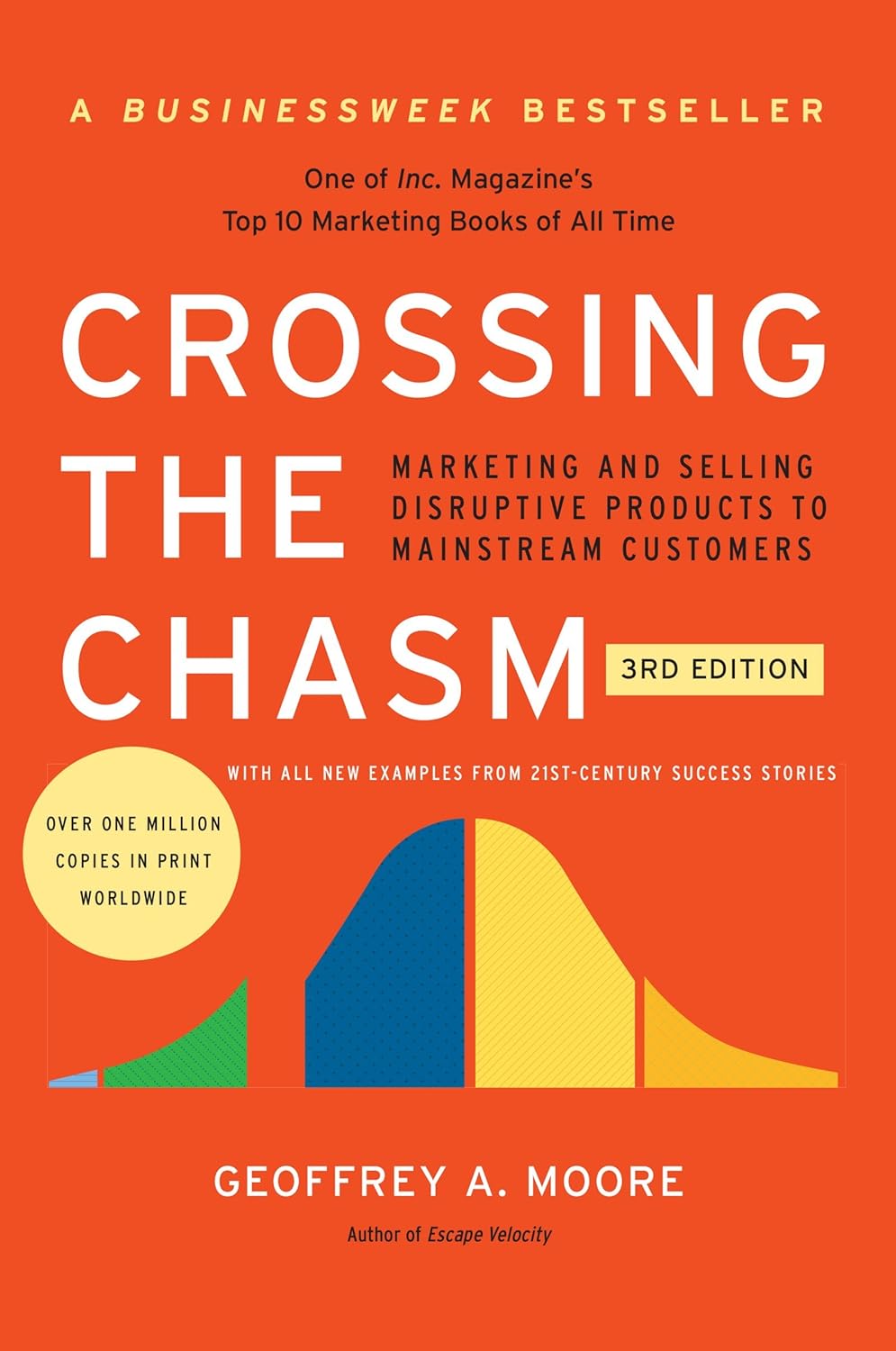
Crossing the Chasm: Marketing and Selling High-Tech Products to Mainstream Customers by Geoffrey A. Moore
Overview: Moore identifies a massive “chasm” in the Technology Adoption Life Cycle between the early adopters (visionaries) and the early majority (pragmatists). The book details strategies for successfully bridging this gap to achieve mainstream market success.
Why You Should Read It: If you are an entrepreneur or executive in the B2B tech space or launching an innovative new product line, this is your definitive marketing and sales strategy bible.
Key Takeaway: Marketing to pragmatic mainstream buyers requires a fundamentally different strategic approach than selling to tech-savvy early adopters.
Read more: Innovation Coaching – From Abstract Ideas to Scalable Reality
Must-Read Books on Strategic Execution and Operational Excellence
A brilliant strategy is entirely useless if it cannot be executed. Many organizations fail not because their plans are flawed, but because their operational follow-through is weak. These books are dedicated to the critical discipline of getting things done.
-
Execution: The Discipline of Getting Things Done by Larry Bossidy & Ram Charan
Overview: Authored by a former Honeywell CEO and a legendary management consultant, this book argues that execution is the unglamorous but essential missing link between aspirations and results. It focuses on linking a company’s three core processes: people, strategy, and operations
Why You Should Read It: It serves as a reality check for leaders who prefer “big picture” thinking but avoid the gritty details. As argued by the authors, execution must be a core component of a company’s culture, driven deeply by the leadership team.
Key Takeaway: Execution is not just a tactic; it is a discipline and a system that must be deeply embedded into the very fabric of an organization.

-
The 4 Disciplines of Execution: Achieving Your Wildly Important Goals by Chris McChesney, Sean Covey, & Jim Huling
Overview: This book provides a proven formula for executing strategic priorities in the midst of the “whirlwind”—the urgent, day-to-day tasks that consume our time. The four disciplines are: Focus on the Wildly Important, Act on Lead Measures, Keep a Compelling Scoreboard, and Create a Cadence of Accountability.
Why You Should Read It: Strategy often dies because employees are too busy doing their day jobs. Through the book, managers are introduced to a tangible operating system to keep their teams hyper-focused on executing strategic goals despite daily distractions.
Key Takeaway: By narrowing your focus to a few “Wildly Important Goals” (WIGs) and measuring the leading indicators, you can guarantee breakthrough results.

Best business strategy books
-
Measure What Matters: How Google, Bono, and the Gates Foundation Rock the World with OKRs by John Doerr
Overview: Legendary venture capitalist John Doerr reveals how the system of Objectives and Key Results (OKRs) helped tech giants like Google and Intel achieve explosive, sustainable growth.
Why You Should Read It: OKRs are the ultimate tool for strategic alignment. If you want to ensure that from the CEO down to the newest hire, everyone’s daily efforts are mathematically linked to the company’s grand strategy, you must understand this framework.
Key Takeaway: Ideas are easy; execution is everything. Transparent, measurable goals foster incredible organizational focus and agility.

Books to Improve Strategic Leadership and Team Excellence
Strategy is performed by people. Without emotionally intelligent, disciplined, and cohesive leadership, even the best business plans will fracture.
-
12 Disciplines of Leadership Excellence: How Leaders Achieve Sustainable High Performance by Brian Tracy & Peter Chee
Overview: In this powerful collaboration, bestselling author Brian Tracy and global coaching expert Dr. Peter Chee debunk the myth of the “born leader.” They break down leadership into 12 masterable disciplines—including Clarity, Control, Character, Competence, Courage, and Caring.
Why You Should Read It: Perfect for executives engaged in coaching and personal development. The book blends high-level organizational strategy with deep, individual character-building. It provides straightforward principles to transform yourself into an uplifting, high-performing leader capable of driving long-term organizational success.
Key Takeaway: Great leaders are made, not born. Achieving excellence requires intentional, daily discipline across both your personal character and professional capabilities.

-
The Advantage: Why Organizational Health Trumps Everything Else In Business by Patrick Lencioni
Overview: Lencioni posits that the single greatest competitive advantage in business isn’t strategy, finance, or technology—it is organizational health. His book presents a four-discipline model: Build a Cohesive Leadership Team, Create Clarity, Overcommunicate Clarity, and Reinforce Clarity.
Why You Should Read It: Many leaders obsess over the “smart” side of business (strategy, marketing) and ignore the “healthy” side (culture, team dynamics). Lencioni’s book proves that a healthy organization will ultimately figure out the right strategy, but a dysfunctional one will ruin even the best-laid plans.
Key Takeaway: Minimal corporate politics and maximal operational clarity are the hallmarks of an invincible organization.

Best business strategy books
-
Primal Leadership: Unleashing the Power of Emotional Intelligence by Daniel Goleman, Richard Boyatzis, & Annie McKee
Overview: The authors explore the indispensable role of Emotional Intelligence (EQ) in leadership. They explain how a leader’s emotional state creates “resonance” or “dissonance” within an organization, directly impacting the bottom line.
Why You Should Read It: If you are navigating a massive strategic pivot or merger, the emotional toll on your workforce is immense. This book provides leaders with the psychological toolkit to manage organizational anxiety and inspire teams during stressful transitions.
Key Takeaway: A leader’s fundamental task is emotional. If they fail in this primal task of driving emotions in the right direction, nothing else they do will work as well as it could.

-
Leaders Eat Last: Why Some Teams Pull Together and Others Don’t by Simon Sinek
Overview: Drawing on biology, anthropology, and military history, Sinek explores how building a “Circle of Safety” within an organization cultivates trust, causing employees to naturally protect the business and advance its strategy.
Why You Should Read It: It completely redefines the concept of executive privilege. For organizations suffering from silos, internal competition, or high turnover, Sinek’s book offers a profound corrective roadmap.
Key Takeaway: When leaders sacrifice their own comfort for the protection of their people, their people will give everything they have to execute the leader’s vision.

Turn Strategic Knowledge into Action
Reading business strategy books is an incredible first step—but knowledge only becomes power when it is successfully applied. Bridging the gap between knowing the theory and implementing it seamlessly in your unique organizational environment is often the hardest part of a leader’s job. This is where a dedicated partnership with a training expert makes all the difference.
ITD World provides specialized coaching and training solutions designed to help leaders & organizations secure a competitive advantage – and be equipped to win in today’s dynamic landscape. Contact us today to learn more about our world-class programs!
Other resources you might be interested in:
- 20 Best Coaching Books: Level Up Your Life
- Leadership Brand Statement Examples to Elevate Your Career
- 60 Business Strategy Quotes: From Planning to Profit
- Purpose-driven Leadership: Moving Beyond Profit
- Business Process Transformation: Strategies for Success
- Fail Fast, Learn Fast: Turning Friction into Fuel