
There is a critical disconnect in corporate talent management today. Research shows that organizations with strong leaders experience twice the revenue and profit growth of their competitors. High-potential employees (HiPos) are the primary drivers of this growth, delivering up to 91% more value to an organization than their peers. Yet, despite the massive ROI potential, 70% of HiPo programs fail to deliver a return on investment.
Why is the failure rate so alarmingly high? According to industry data, five out of six HR managers are dissatisfied with their program results because their identification processes are fundamentally flawed. Too often, companies confuse current high performance with future leadership potential. They reward today’s output with tomorrow’s leadership roles, resulting in wasted investment, high turnover, and a stagnant leadership pipeline.
To future-proof an organization, it is crucial that executives and HR professionals look beyond technical skills to evaluate cognitive agility, drive, and emotional intelligence.
 |
Author: Jonathan M. Pham |
Highlights
- High Potential employees (HiPos) are those who consistently exceed current job requirements and possess the learning agility, aspiration, and emotional intelligence to grow into future leadership roles. They act as “force multipliers” who significantly boost team productivity.
- A critical mistake organizations make is equating high performance with high potential. While high performers excel as individual experts in their current jobs, HiPos focus on broader organizational influence, thrive in ambiguity, and shift their focus from individual success to empowering others.
- To eliminate bias, organizations should make use of data-driven tools. These include evaluating the CQ (Cognitive), DQ (Drive), and EQ (Emotional) quotients, utilizing 360-degree feedback and psychometric tests, mapping employees using the 9-Box Grid, and leveraging Organizational Network Analysis (ONA) to spot quiet, informal leaders.
- Because HiPos master tasks quickly and are high turnover risks if bored, they require bespoke development plans such as job rotations, high-stakes stretch assignments, and mentorship. To prevent burnout and disengagement, organizations must provide autonomy, clear career pathways, and opportunities to innovate without micromanagement.
What is a High Potential Employee (HiPo)?
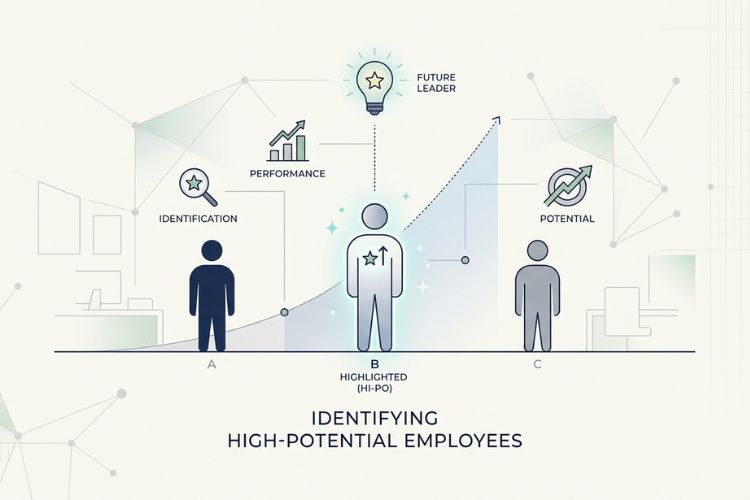
A High Potential employee (HiPo) is an individual who consistently exceeds their current job requirements but, more importantly, possesses the disposition, aspiration, and capacity to grow into broader leadership and strategic roles. They are not just your best workers today; they are the future architects of your organization.
To understand the value of these individuals, we have to look at the 80/20 Rule of Productivity. Accordingly, the top 20% of a company’s workforce is often responsible for 80% of its total output. Identifying and nurturing this top tier is, therefore, a financial and operational necessity.
Why is Identifying High Potential Employees Crucial for Succession Planning?
Investing in HiPos yields transformative business outcomes:
-
The Force Multiplier Effect: HiPos represent only the top 3% to 5% of a company’s workforce, yet they act as “force multipliers” who boost the productivity of those around them by 5% to 15%. They elevate the entire team’s output.
-
Lower Turnover: Organizations that correctly recognize and develop HiPos see a 31% lower turnover rate.
-
Risk Mitigation: The financial risk of losing top talent is severe. Losing a top performer and having to replace them may cost a company between 0.5x to 3.5x their annual salary.
-
The Referral Pipeline: HiPos act as talent magnets. Engaged, high-performing future leaders naturally attract other top-tier talent from their networks, increasing the overall “talent density” of the organization.
High Performance vs High Potential Employees
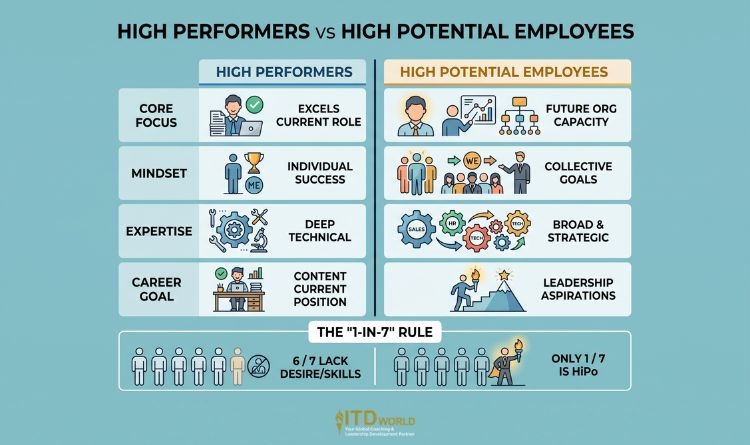
The most significant mistake organizations make in talent strategy is equating current performance with future potential. To build a robust leadership pipeline, leaders have to make a clear distinction between High Performance and High Potential. In fact, according to the “1-in-7 Rule”, only one in seven high performers is actually a High-Potential employee.
High Performers
High performers are your reliable experts and workhorses. They excel at task execution, meet deadlines consistently, and deliver exceptional results within their current job descriptions. They possess deep technical expertise and are essential to your company’s daily operations. However, high performers may lack the desire, adaptability, or interpersonal skills required to move into complex leadership roles. As such, they are often perfectly content—and best utilized—in their current positions.
Example: A star software engineer who consistently writes flawless code and meets every product deadline is a high performer. However, if they prefer working independently and have no interest in mentoring juniors or managing project budgets, they are not the ideal option for a VP of Engineering role.
High Potential Employees
HiPos, on the other hand, demonstrate the capacity to handle future complexity. They possess a broader scope of competence. While a high performer focuses on what they deliver today, a HiPo is concerned with who they can become and their influence on the company tomorrow.
A critical differentiator is the mental shift from “Me” to “We.” Unlike high performers who typically care about individual success, a HiPo transitions away from worrying solely about their own output to empowering, mentoring, and aligning others to achieve collective organizational goals. They seek broad expertise over deep, narrow expertise, intentionally taking on stretch projects outside their comfort zone to understand how different parts of the business connect.
Read more: How to Build High-performing Teams
| Attribute | High Performers (Reliable Experts) | High Potential Employees (HiPos) |
| Core Focus | Today’s Output: Excel at executing tasks within their current role. | Tomorrow’s Influence: Capacity to handle future organizational complexity. |
| Mindset | “Me”: Driven by individual success and outstanding personal results. | “We”: Mentors, empowers, and aligns others toward collective goals. |
| Expertise | Deep & Narrow: Possess deep technical skills and specialized knowledge. | Broad & Strategic: Seeks cross-functional knowledge and steps outside comfort zones. |
| Career Goal | Content and best utilized in their current position. | Driven by who they can become and long-term leadership. |
| The “1-in-7 Rule” | 6 out of 7 high performers lack the desire/skills for complex leadership. | Only 1 in 7 high performers is actually a HiPo. |
Characteristics of High Potential Employees
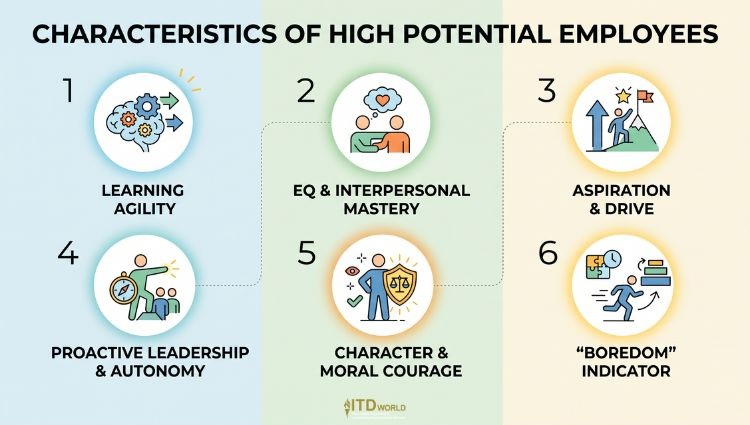
Beyond basic job descriptions and performance KPIs, true HiPos share a distinct psychological and professional profile. While technical mastery gets them in the door, these five characteristics dictate how far they can climb.
-
Learning Agility (The “North Star”)
Perhaps the single most important indicator of leadership readiness, it refers to the ability to absorb new information quickly, apply lessons from the past to entirely new, uncertain challenges, and pivot when circumstances change. In a shifting business landscape, agility in uncertainty is a non-negotiable trait. HiPos do not just survive change; they thrive in it.
How to measure learning agility in employees: Look for “pivot stories” during behavioral interviews. Ask candidates, “Tell me about a time you had to learn something new quickly under pressure, and your initial approach failed.” Look for those who actively seek out feedback and view criticism as a tool for improvement.
Read more: Fail Fast, Learn Fast – Turning Friction into Fuel
-
Emotional Intelligence (EQ) & Interpersonal Mastery
While behaviors like strategic thinking are vital, EQ is the interpersonal “glue” required for leadership. HiPos are emotionally intelligent, naturally adept at resolving workplace conflicts, and display high self-awareness. They are aware of how their behavior impacts others and are able to navigate complex organizational dynamics. As a result, they often act as “informal leaders.” You will notice that teammates naturally turn to them for guidance or collaboration, even if they don’t hold a formal management title.
-
Aspiration and Drive
A HiPo must actually want to lead – i.e. they are driven by an intrinsic motivation to succeed and a genuine investment in the overall mission. They treat company success as a personal win and are willing to take calculated risks to achieve it. Unlike average workers who work just enough to get the next paycheck, HiPos have a hunger for stretch assignments and a proactive desire to climb the hierarchy.
-
Proactive Leadership and Autonomy
HiPos require minimal direction. They are solution-oriented professionals who spot and tackle problems before being asked. They gravitate toward unassigned tasks that benefit the organization and show the ability to “look around corners” to anticipate value.
A unique trait of a HiPo is predictive initiative—the ability to predict company needs before they are explicitly articulated by management.
-
Character and Moral Courage
A measurable leadership construct is moral courage—the willingness to do what is right even at a personal cost. HiPos display integrity, humility, and emotional maturity. They make positive changes immediately after a critique and maintain consistent good behavior even when they think no one is watching.
-
The “Boredom” Indicator (A Counter-Intuitive Trait)
A unique sign of a HiPo is that they tend to get bored easily. Given that they possess high cognitive flexibility, they master their current technical tasks much faster than their peers. If a highly capable employee seems restless or is constantly asking “why” things are done a certain way (seeking to understand business logic, not to challenge authority), they are likely a HiPo starving for a more complex challenge.
How to Identify High Potential Employees in the Workplace
Spotting potential is a gamble that only pays off if you move past gut feelings and adopt a systematic, objective framework. Identifying high potential employees in the workplace requires moving away from the “50/50 roll of the dice” typical of standard promotions and relying on multi-method, data-driven strategies.
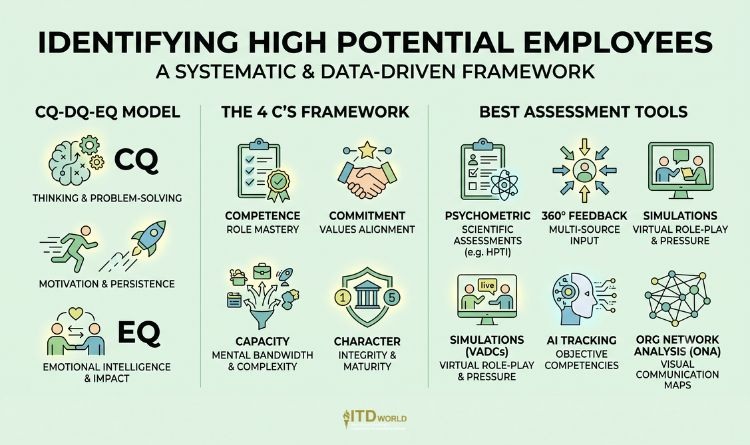
The CQ-DQ-EQ Identification Model
To remove subjectivity, organizations should evaluate employees across three specific quotients:
-
Cognitive Quotient (CQ): How an individual processes information, thinks strategically, and solves problems under ambiguity. Can they step back to see a manager’s perspective?
-
Drive Quotient (DQ): Their motivation, energy, and persistence. Do they apply their energy to develop others and amplify organizational results, or just their own?
-
Emotional Quotient (EQ): Their interpersonal impact. Can they channel insights to influence stakeholders and deliver difficult messages with courage?
The 4 C’s Framework
For a quicker shorthand in talent review meetings, managers may evaluate based on the 4 C’s:
-
Competence: Mastery of the current role (the baseline requirement).
-
Commitment: Alignment with company values and the desire to stay.
-
Capacity: The mental bandwidth to handle more stress and complexity.
-
Character: Integrity and emotional maturity.
Best Assessment Tools for Identifying Future Leaders
Organizations should never rely on a single metric or a single manager’s opinion. Instead, a mix of tools should be considered:
-
Psychometric Testing: Tools like the High Potential Trait Indicator (HPTI) involve scientific assessments to measure conscientiousness, risk approach, and ambiguity acceptance, ensuring that promotions are scientific and bias-free.
-
360-Degree Feedback: Relying solely on a direct manager’s perspective leaves blind spots. Gathering input from supervisors, peers, and direct reports reveals a full view of an individual’s “soft” leadership skills and influence without authority.
-
Simulated Realities (VADCs): Virtual Assessment and Development Centers (VADCs) are fully online programs that simulate traditional, in-person assessment centers. They use role-playing exercises and live tasks to observe how employees think on their feet and handle pressure in real-time.
Read more: Virtual Reality in Training and Development
Cutting-Edge Insight: AI and ONA
Identification is rapidly moving away from managerial nomination. Forward-thinking businesses are now using AI-driven systems to track competencies objectively. Additionally, Organizational Network Analysis (ONA) can be used to analyze internal communications (metadata from emails/chats) to visually map out the true “advice hubs” within a company. This helps leadership mathematically identify the informal leaders that teammates lean on for support, uncovering talent that a biased manager might overlook.
Read more: AI in Leadership – Bridging the Gap Between Adoption & Maturity
Identifying high potential employees
Using the 9-Box Grid for Identifying High Potential Employees
The 9-Box Grid is the gold standard framework used in talent review meetings and succession planning to segment employees into nine distinct groups. It helps HR and executive teams visualize their talent pool and allocate training budgets effectively.
The grid maps individuals along two axes:
-
X-Axis (Horizontal): Current Performance. Measures past and present results (Low, Moderate, High).
-
Y-Axis (Vertical): Future Potential. Measures the capacity and agility for future growth (Low, Moderate, High).
Mapping the Talent
When placing employees on the grid, distinct profiles emerge that dictate your talent strategy:
-
High Performance + Low Potential (The “Workhorses”): Located in the bottom-right corner, these are your reliable experts. They are essential to daily operations, but promoting them to management could be disastrous. They should be rewarded with bonuses and deep-skill training, but not executive coaching.
-
Moderate Performance + High Potential (The “Rough Diamonds”): Located in the top-left or top-middle, these individuals have the psychological markers of leadership but may be in the wrong role or lack specific technical training. They require mentorship and department rotations.
-
High Performance + High Potential (The “Stars”): Located in the top-right corner, these are your true HiPos. This small percentage of your workforce is where the majority of your leadership development, executive coaching, and succession planning budgets need to be focused.
A Word of Caution: The 9-box grid is only as good as the data entered into it. If “Potential” is judged subjectively by a manager’s gut feeling, the grid becomes a map of bias. Always populate the Y-axis using data from psychometric tests and 360-degree feedback. In addition, keep an employee’s exact “box” placement confidential, as labeling a top performer as “Low Potential” can be incredibly demotivating and cause an immediate flight risk.
Read more: Talent Development – Building Your Future Workforce
Common Mistakes When Identifying High Potential Talent
Despite good intentions, managers routinely make critical errors when identifying top talent, leading to the misallocation of resources and the loss of diverse future leaders.
The Halo Effect & The Danger of “Loud” Talent
Managers frequently fall victim to unconscious bias, assuming that an employee with a great, outgoing personality is naturally a great leader. The “Halo Effect” causes them to let one positive trait (like charisma) mask critical shortcomings in strategic thinking or resilience. If an organization only promotes the most vocal or outgoing individuals, it risks missing substance and stifles diversity.
Ignoring the “Silent” HiPo
Following the point above, high potentials tend to hide in quieter, low-key team members who simply “get it” and execute without fanfare. These individuals do not actively lobby for promotions, but they possess deep learning agility and serve as the quiet backbone of their teams. Failing to identify these hidden gems is a severe business risk; if they feel their growth path is blocked by louder colleagues, they will quietly disengage and leave for a competitor.
The “Gravitas” Myth
Traditional labels are highly misleading. In fact, it is not uncommon for senior leaders to dismiss an early-career, non-traditional employee because they lack executive “gravitas” – only for objective behavioral assessments to later reveal the person has elite Cognitive Quotient (evaluating complex industry scenarios) and Drive Quotient (leading peer mentorship initiatives).
Relying on subjective labels like “gravitas” creates barriers for talented individuals who haven’t had equitable access to elite mentorship or sponsorship early in their careers.
The “Stretch Role” Paradox
Statistics show that 46% of HiPos fail when placed in new roles. However, this is rarely a failure of the person themselves, but of the management. Organizations frequently assume that because someone is a HiPo, they can instantly succeed at anything. They throw them into highly visible stretch assignments without providing a roadmap, psychological safety, or coaching.
High potential does not equal instant competence; it simply means the speed of learning will be faster if supported correctly.
Read more: Brilliant Jerks – How to Handle Toxic “High Performers” in the Workplace
Best Practices for High Potential (HiPo) Programs: Strategy & Management
Identifying HiPos is only half the battle. Given that these people are ambitious and highly capable, they are at an extreme risk of “jumping ship” if they feel stagnant. In fact, 55% of HiPos will drop out of a program or leave the company if their engagement drops. Retention, therefore, requires a bespoke, proactive support system.
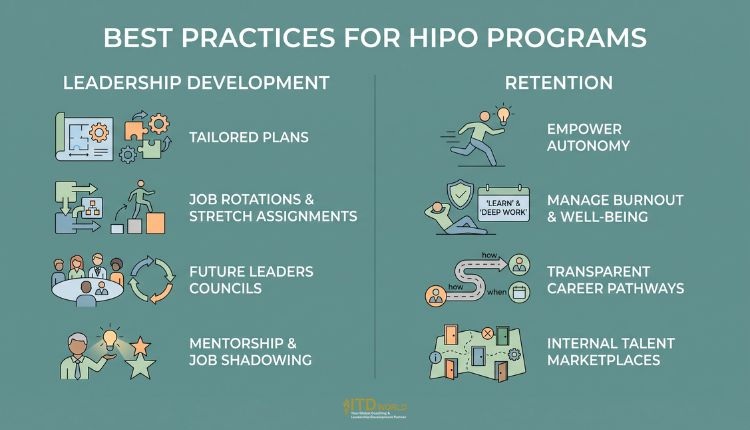
Creating a Leadership Development Plan for HiPos
Development programs have to be tailored to the individual’s specific personality and career aspirations while aligning with the organization’s strategic goals.
-
Stretch Assignments and Job Rotations: HiPos learn best by doing. Theoretical classroom training is rarely enough. Move them through different departments to build a comprehensive view of the business. Assign them projects that force them to step outside their comfort zones and tackle complex issues usually reserved for senior management.
-
Future Leaders Councils: Create a rotating group of rising stars who work on real, high-stakes strategic initiatives—not just “make-believe” projects. Doing so gives them exposure to high-level decision-making and C-suite executives. (crucial: remember to rotate these members annually to prevent the creation of an “exclusive inner circle” that damages company morale)
-
Job Shadowing and Mentorship: Pair HiPos with seasoned leaders to transfer institutional wisdom. Breaking down hierarchical barriers and allowing them to observe senior leaders before taking the reins is one of the most effective developmental tools available.
How to Retain High Potential Employees
-
Provide Autonomy: High potentials need to feel trusted to innovate. They require minimal direction to achieve an end goal. Micromanaging a HiPo is the fastest way to drive them to a competitor.
-
Burnout Management: Because these employees are incredibly capable, organizations tend to pile work onto them. (which is a terrible mistake) Managers must actively monitor their stress levels and provide “psychological safety” to keep them from burning out before they actually reach executive leadership. Explicitly schedule “deep work” and learning time into their week.
-
Transparent Career Pathways: HiPos need a clear “line of sight” for their careers. Map them to specific future leadership roles. If they cannot see exactly how and when they can move up, their ambition will force them to look elsewhere.
-
Internal Talent Marketplaces: Modern organizations are shifting away from rigid promotion tracks by facilitating “lateral moves” and internal gig-economy platforms. Allowing a HiPo to dedicate 10-20% of their time to a cross-functional project keeps their work exciting, broadens their skill set, and retains their curiosity without requiring an immediate hierarchical promotion.
FAQs: Navigating the Complexities of Top Talent
Should you tell an employee they are “high potential”?
Yes, but with careful communication. Telling one that they are on a HiPo track increases retention, builds loyalty, and motivates them to tackle complex stretch assignments. However, it is essential that you attach clear expectations to this designation. Make it clear that “High Potential” is a developmental track that requires continuous growth and feedback, not an immediate entitlement to a promotion or a guarantee of an executive title.
How do you develop a high potential employee without burning them out?
HiPos have a natural tendency to take on too much because they are driven and crave challenges. To prevent burnout, managers must actively audit their workload. Instead of just adding new leadership responsibilities on top of their day-to-day tasks, practice “strategic subtraction”—delegate their lower-level tasks to others to free up their bandwidth.
Aside from that, make sure to foster an environment of psychological safety where they feel comfortable admitting when a stretch assignment is overwhelming without fearing it will ruin their career trajectory.
Final Thoughts
The cost of misidentifying talent is steep. When organizations reward past performance with future leadership roles, they risk losing great workers and gaining poor managers. True succession planning is not just an administrative task of filling vacancies; it is the strategic creation of a lasting corporate legacy.
To build a resilient, future-proof organization, leaders must shift their focus from what an employee is doing today to what they are capable of learning tomorrow. By implementing objective, data-driven identification tools—like the CQ-DQ-EQ model, 360-degree feedback, and the 9-box grid—and pairing them with robust, rotational development plans, organizations can capture the massive ROI that true High-Potential employees offer.
Your future leaders are already in your building; your job is to give them the room to fail, the tools to grow, and the challenges that stretch them.
ITD World provides specialized coaching and training solutions designed to help leaders & organizations secure a competitive advantage – and be equipped to win in today’s dynamic landscape. Contact us today to learn more about our world-class programs!
Other resources you might be interested in:
- Talent Philosophy: A Guide to Unlocking Workforce Potential & Driving Success
- HR Competency Model Analysis: Elevating HR Practices for Success
- Purpose-driven Leadership: Moving Beyond Profit
- Leading Gen Z: From Boardroom Cliché to Human-centric Management
- Organizational Agility: How to Scale with Speed