

The modern workplace is in a constant state of linguistic evolution. Over recent years, viral terms like “quiet quitting” have dominated corporate discourse, sparking debates about employee boundaries and work-life balance. However, a darker equivalent has simultaneously taken root in the corporate consciousness: quiet firing.
 |
Author: Jonathan M. Pham |
Highlights
- Quiet firing is a passive-aggressive management strategy where employers intentionally create a stagnant, isolating, or unrewarding environment to pressure an employee into resigning voluntarily, thereby avoiding formal termination or coaching.
- Common signs include “ghosting” (canceling 1-on-1s and withholding feedback), stagnant pay and promotions, task deprivation (assigning menial work), and the sudden, aggressive documentation of minor flaws to build a “weaponized” case for dismissal.
- The phenomenon is inextricably linked to “quiet quitting”; when managers withdraw support, employees often respond by doing the bare minimum, creating a reciprocal cycle of neglect that destroys team morale and shifts extra workloads onto high-performing staff.
- The practice is often fueled by managerial cowardice—specifically a lack of emotional intelligence to handle difficult conversations—and a “cost-saving” illusion where companies try to avoid paying severance or unemployment benefits.
- Beyond eroding workplace culture, quiet firing can be legally classified as constructive dismissal, giving employees grounds to claim benefits or sue for discrimination if the neglect is motivated by bias or retaliation.
What is Quiet Firing?
Quiet firing is a passive-aggressive management tactic where employers intentionally make a job so unrewarding, isolating, or stagnant that an employee feels forced to resign. Rather than having the difficult conversation required to formally terminate an underperformer—or invest the necessary time to coach them—managers systematically withdraw support, effectively starving the individual of the resources they need to succeed or feel valued.
A New Name for an Old Practice
While the media popularized the term in the wake of the 2021 “Great Resignation,” human resources professionals and organizational psychologists know that quiet firing is not a new phenomenon. It is simply a modern label for the age-old practice of “managing someone out” or “silent sacking.”
Historically, managing out involved making working conditions overtly unpleasant. Today, it is characterized by the deliberate absence of management. It relies on strategic neglect—withholding opportunities, coaching, and feedback—to achieve the same result as a formal termination, minus the immediate confrontation.
The surge in the term’s popularity reflects a generational shift. Millennials and Gen Z professionals have a notably lower tolerance for “paying their dues” in silence. Their demand for transparent communication and radical candor has forced companies to reckon with passive-aggressive management behaviors that older generations may have simply accepted as standard corporate politics.
Global Parallels & The Shift to Digital
The sentiment behind quiet firing and employee disengagement is not limited to Western corporate culture. It mirrors global burnout movements, such as China’s “Lying Flat” (tang ping) or the more recent “Let it rot” (bai lan), which arose as direct responses to grueling, unrewarding work cultures.
In the modern context, the shift to remote and hybrid work has acted as a primary catalyst for quiet firing. The digital-first environment inadvertently makes exclusion easier. When managers have less daily face-to-face contact with their teams, it is remarkably simple to let certain team members fade into the background. Digital barriers allow critical performance conversations to slip through the cracks, leading to workplace isolation that might have been impossible to hide in a traditional, in-person office.
Return-to-Office (RTO) Mandates as a Covert Tactic
One of the most structural forms of quiet firing today operates at the policy level. Data from BambooHR revealed that nearly 25% of VPs and C-suite executives, alongside 18% of HR professionals, admitted they specifically hoped for voluntary turnover when implementing strict Return-to-Office (RTO) mandates.
Example: A company enforces a rigid five-day RTO policy, knowing full well that a specific cohort of working parents or geographically distant employees will be unable to comply. Instead of executing formal layoffs and paying severance, the policy is used to force voluntary resignations. This is policy-driven quiet firing at scale.
Quiet Quitting vs. Quiet Firing: A Vicious Cycle
To fully grasp the impact of quiet firing, it is essential to contrast it with its employee-driven counterpart: quiet quitting. While distinct, the two are inextricably linked in a cycle of mutual disengagement.
The Reciprocal Loop of Disengagement
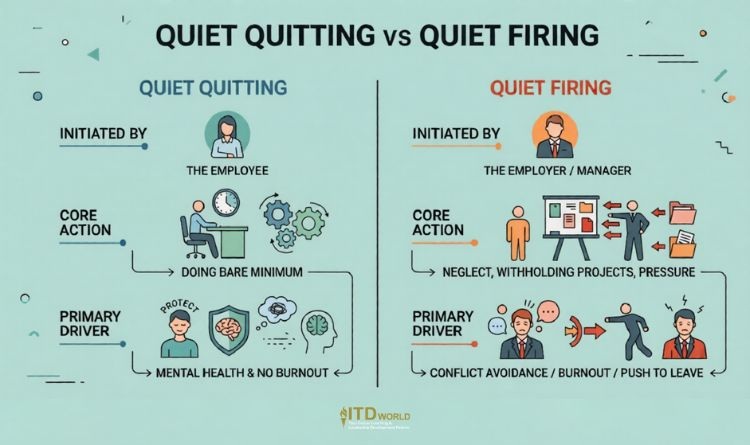
Quiet quitting occurs when an employee actively decides to do the bare minimum required by their job description, stripping away discretionary effort to protect their mental health and prevent burnout. Quiet firing, on the other hand, is initiated by the employer as a form of neglect or aggressive pressure.
These behaviors typically feed off one another. When an employee feels unsupported and quietly quits, a conflict-avoidant manager may respond not with coaching, but by withholding further projects and allowing them to stagnate. Conversely, if a manager initiates quiet firing by ignoring an employee, that employee will inevitably recognize the futility of their efforts and quietly quit in response.
The “Managerial Quiet Quitting” Link
A critical insight for executive coaches is that managers themselves are often burned out. Research indicates that a vast majority of the variance in team engagement is directly attributable to the quality of the manager. When a leader becomes overwhelmed and “quiet quits” their own leadership responsibilities, their direct reports inevitably suffer. The manager withdraws from their role, resulting in a lack of leadership, care, and attention. The team is subsequently “quiet fired” by default, creating a systemic failure across the organization.
| Attribute | Quiet Quitting | Quiet Firing |
| Initiated By | The Employee | The Employer / Manager |
| Core Action | Doing the bare minimum; stripping away discretionary effort. | Neglecting the employee, withholding projects, or applying aggressive pressure. |
| Primary Driver | Protecting mental health and preventing burnout. | Conflict avoidance, managerial burnout, or an intentional push to make the employee leave. |
Quiet quitting vs Quiet firing
7 Undeniable Signs You Are Being Quiet Fired
Because quiet firing relies on omission rather than commission, it can be incredibly difficult to identify. Employees frequently experience a slow erosion of status, leading to imposter syndrome as they wonder if they are imagining the shift in dynamics.
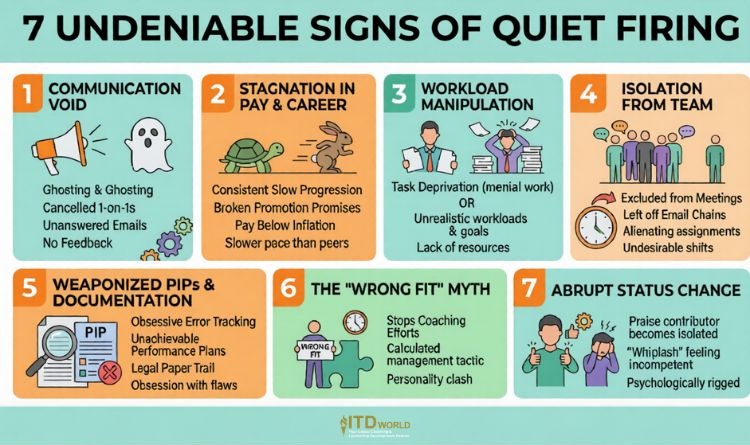
Here are seven major signs of the practice.
-
The Communication Void and “Ghosting”
The most prominent red flag is a sudden and sustained drop-off in communication, which typically manifests as the frequent cancellation of 1-on-1s, unanswered emails, and a lack of constructive feedback.
Example: A team member asks for input on a major presentation. Instead of critique or praise, they receive “crickets”—a non-response or a vague, dismissive “it was fine.” A manager who stops providing feedback has, most of the time, already decided the employee is no longer part of the team’s future.
-
Career and Compensation Stagnation
Quiet firing heavily relies on financial and professional stagnation. This is frequently described using the “Hare and Tortoise” metaphor: if an employee’s pay raises consistently do not match inflation, or if their career progression moves at a “tortoise” pace compared to the “hare” pace of their peers, it is a clear signal of devaluation.
Another common tactic is the “Promised Promotion” trap—a manager frequently promises advancements but consistently fails to follow through, manipulating the employee to stay “on the hook” while slowly marginalizing them.
-
Task Deprivation vs. Unrealistic Workloads
Managers use workload manipulation in two distinct ways to manage people out. The first is task deprivation—sidelining the employee from important, high-visibility work and leaving them with menial, meaningless tasks that fall well below their skill set (under-utilization).
The second is the opposite—setting the employee up to fail by assigning unmanageable workloads, unrealistic deadlines, and refusing to provide the necessary resources to accomplish the goals.
-
Social and Professional Isolation
Exclusion is a powerful psychological tool. Employees being quietly fired are systematically removed from the social and operational fabric of the team. They may be uninvited from key strategic meetings, left off important email chains, or physically/operationally alienated (e.g., assigning them to undesirable shifts that prevent interaction with organizational leadership).
-
The “Documentation Station” & Weaponized PIPs
If a manager who was historically casual about performance suddenly begins obsessively documenting every minor flaw, it is a major warning sign. This behavior often leads to a weaponized Performance Improvement Plan (PIP). While PIPs are theoretically designed to help struggling employees succeed, in a quiet firing scenario, they are engineered to be unachievable—serving merely as a legally sound paper trail for an inevitable termination.
-
The “Wrong Fit” Myth
When a manager decides a team member is a “wrong fit,” they may stop attempting to coach them entirely. The “wrong fit” label is frequently used as a calculated management tactic, sometimes triggered by nothing more than a personality clash or a desire to replace the individual with cheaper labor, rather than actual incompetence.
-
The “Whiplash” Effect
Quiet firing often induces severe psychological distress due to its abruptness. An employee may go from being a highly praised contributor to feeling entirely incompetent and isolated within a few months. This whiplash creates a psychological burden, leading the person to believe they “just can’t hack it,” when in reality, the environment was intentionally rigged against them.
Why Do Managers Resort to Quiet Firing? (The Cowardice Factor)
Understanding why managers utilize this destructive tactic is crucial for organizational development. It rarely stems from malice; in fact, it is almost always rooted in systemic skill deficiencies.
Conflict-Avoidance and the Peter Principle
Many instances of quiet firing are prime examples of the “Peter Principle“—where high-performing individual contributors are promoted into management positions based on technical prowess rather than emotional intelligence. These new managers lack managerial courage. Having direct, honest conversations about poor performance is uncomfortable.
Because they lack the coaching skills to navigate these difficult dialogues, they default to conflict avoidance. They simply ignore the problem, hoping the employee will take the hint and leave.
The “Cost-Saving” Illusion
From a corporate perspective, quiet firing is sometimes quietly sanctioned by HR departments looking to minimize operational friction. Terminating an employee formally involves severance pay, increased unemployment insurance premiums, potential legal liabilities, and the bad public relations associated with layoffs.
By making the environment unbearable enough that the employee resigns voluntarily, the company bypasses these financial and administrative burdens.
The Developmental Dodge
Developing an underperforming employee takes time, energy, and resources. By effectively ghosting them, managers avoid the time-consuming process of creating and executing a genuine development plan. They view quiet firing as a pragmatic “shortcut,” which allows them to dedicate their bandwidth to high performers or their own tasks.
The Impact of Quiet Firing on Company Culture
The “Canary in the Coal Mine”
Quiet firing is mostly never a hidden process; the entire team observes the behavior. When a company tolerates passive-aggressive management, it acts as a “canary in the coal mine” for a toxic workplace culture. It erodes psychological safety across the board.
If high-performing employees witness a peer being systematically isolated and ignored, they naturally lose trust in leadership, knowing that they themselves could easily be next if they fall out of favor. This destroys morale and severely damages the employer’s brand, making it incredibly difficult to recruit and retain top talent.
The Workload Transfer Trap
When managers isolate an underperforming employee and strip them of their duties, that work does not simply disappear. It is inevitably transferred to the remaining team members. The result is a paradoxical and highly destructive secondary problem: the high-performing staff become frustrated, overworked, and eventually burn out because they are forced to carry the weight of the peer who is being quietly fired.
A Wasted Investment
For leaders, quiet firing is ultimately a massive waste of their own time and organizational resources. The mental energy and time spent actively avoiding, alienating, and maneuvering around an employee is a net loss for the company. That time could have been productively spent on legitimate performance management, strategic growth, or properly transitioning the person out of the business with dignity.

The Legal and Ethical Risks: Is Quiet Firing Constructive Dismissal?
Beyond the moral failure, quiet firing carries significant legal risks. What begins as poor management can quickly cross the line into actionable workplace discrimination.
Understanding Constructive Discharge (Constructive Dismissal)
Legally, quiet firing closely aligns with the doctrine of “constructive discharge” (or constructive dismissal). This occurs when an employer makes working conditions so intolerable, unrewarding, or hostile that a reasonable person would feel compelled to quit.
In the eyes of the law, a resignation under these circumstances is not considered truly voluntary; it is treated exactly as if the employee had been formally fired. If an individual can prove constructive discharge, they may be entitled to unemployment benefits and severance, entirely negating the employer’s “cost-saving” motivations.
Discrimination and Retaliation
Quiet firing becomes explicitly illegal if the mistreatment is motivated by bias against protected characteristics (such as age, race, gender, religion, or disability). In addition, it is highly illegal if used as a form of retaliation—for example, isolating or stripping duties from an employee because they engaged in protected activities like whistleblowing, reporting workplace harassment, or requesting medical leave.
The “At-Will” Nuance
Many managers operate under the misconception of “at-will” employment, believing that because they can terminate an employee for almost any reason, they are also free to manage them however they see fit. However, “at-will” is not a license to discriminate. If an employer uses quiet firing tactics, the legality of the situation hinges entirely on the motivation behind the mistreatment.
If a company provides a legal-sounding excuse for marginalizing an employee, but documentation reveals it to be “pretextual” (a false excuse hiding an illegal motive), they will face severe legal consequences.
What Should You Do If You’re Being Quiet Fired? (For Employees)
For professionals who suspect they are on the receiving end of this “dirty” tactic, it is recommended that you adopt a strategic “play offense” approach instead of reacting emotionally.
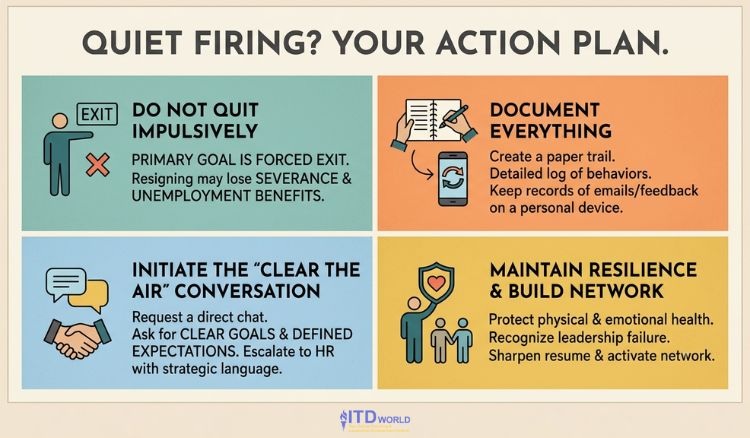
Do Not Quit Impulsively
The primary goal of quiet firing is to force a voluntary exit. Resigning impulsively plays directly into the employer’s hands and may forfeit your eligibility for severance packages or unemployment benefits.
Document Everything (Create a Paper Trail)
Documentation is your strongest defense. Maintain a detailed, timestamped log of exclusionary behaviors, role changes, canceled meetings, and instances of being bypassed for projects. Keep records of emails and feedback on a personal device to establish a clear pattern of conduct. This paper trail is vital should you need to pursue a claim for constructive dismissal or negotiate an exit settlement.
Initiate the “Clear the Air” Conversation
Do not remain silent. Advocate for yourself by requesting a direct, honest conversation with your manager. Ask specifically for clear goals, defined expectations, and documented reasons for any role changes.
Coaching Tip: Use the “Hero” framing. Approach your manager stating that you want to be “part of the company’s growth” and ask for their mentorship to get back on track. Many managers respond better to feeling like a savior than an adversary.
If the manager remains unresponsive, escalate to HR using strategic language. Using the term “constructive dismissal” signals that you are aware of your rights regarding unilateral changes to your job terms, which typically forces HR to take the matter seriously.
Maintain Mental Resilience and Build a Network
Protect your physical and emotional health by decoupling your self-worth from the job. If the environment remains toxic, you should recognize that quiet firing is a failure of leadership, not necessarily a reflection of your competence. Just begin external preparation: sharpen your resume, activate your external network, and prepare to transition to an organization that values supportive leadership.
How HR Leaders Can Identify and Eliminate Quiet Firing
For organizations committed to maintaining a healthy culture, HR and executive leadership must proactively identify and eradicate quiet firing practices.
Spotting the Signs with “People Analytics”
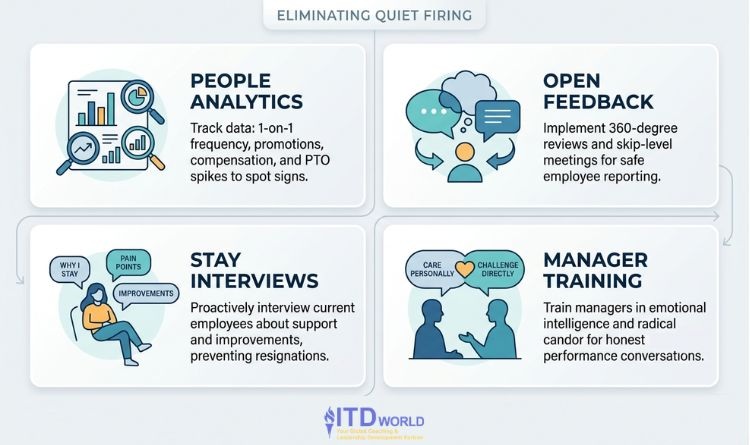
These days, HR no longer has to rely solely on workplace hearsay; they can leverage people analytics to spot the objective footprints of quiet firing. By tracking data such as the frequency of documented 1-on-1s, comparing promotion and compensation velocities among peers, and monitoring sudden spikes in PTO usage or sick leave within specific teams, it becomes much simpler to flag managers who are silently withdrawing from their reports.
Implementing 360-Degree Reviews and Skip-Level Meetings
To combat “rogue” managers operating in silos, organizations should institute 360-degree reviews and regular skip-level meetings. Doing so provides team members with a structured, psychologically safe mechanism to bypass a toxic direct manager and provide feedback to higher-level leadership. These processes act as a vital early-warning system for passive-aggressive management.
The Power of “Stay Interviews”
Companies traditionally rely on exit interviews to understand turnover. By the time an exit interview occurs, the damage is already done.
As such, HR should conduct “stay interviews” instead. By proactively asking currently engaged employees why they stay, what their pain points are, and how management can improve, organizations can identify unsupportive leadership behaviors before they escalate into a cycle of resignations.
Training Managers for Difficult Conversations
The ultimate solution to quiet firing is comprehensive management training. Organizations need to stop promoting top individual contributors without providing them with the necessary leadership coaching. Managers must be trained in the principles of radical candor—learning how to care personally while challenging directly. When leaders possess the emotional intelligence and courage to hold honest, early, and documented performance conversations, the need for passive-aggressive avoidance evaporates.
The goal is to shift the organizational paradigm from covert neglect to transparent, collaborative goal-setting.
FAQs
Is quiet firing considered workplace harassment?
It can be, depending on the severity and motivation. While poor management alone isn’t legally defined as harassment, if the quiet firing tactics involve systematic bullying, intimidation, or are targeted at an employee based on protected characteristics (race, gender, age), it crosses the line into illegal workplace harassment and actionable discrimination.
What should you do if your boss completely ignores you?
If your boss is “ghosting” you, first attempt proactive communication. Formally ask for a 1-on-1 to discuss your capacity and request feedback on your current projects. If they continue to deflect, document these attempts meticulously. Seek out cross-departmental advocates or higher-level leadership for guidance, and begin assessing external job opportunities, as prolonged silence is a definitive sign of an untenable work environment.
Final Thoughts
Far more than a trending buzzword, quiet firing is a profound failure of organizational leadership. When managers use isolation and neglect to drive people out, they bypass their professional duty to lead. The resulting damage—plummeting retention rates, a fractured workplace culture, and heightened legal risk—far outweighs the temporary discomfort of managing an underperforming employee directly.
To build teams that thrive, organizations must replace cowardice with courage. This requires a systemic commitment to transparency, robust management training, and a zero-tolerance policy for passive-aggressive leadership.
If your organization is struggling with management communication gaps, high turnover, or disengaged teams, investing in leadership development is the first step.
ITD World provides specialized coaching and training solutions designed to help leaders & organizations secure a competitive advantage – and be equipped to win in today’s dynamic landscape. Contact us today to learn more about our world-class programs!
Other resources you might be interested in:
- Upskilling and Reskilling: A Sustainability Framework for the AI Era
- Brilliant Jerks: How to Handle Toxic “High Performers” in the Workplace
- New Hire Retention: Strategies, Metrics, and the 90-Day Playbook
- Internal Talent Mobility: Strategies for Scaling Beyond the Ladder
- Fail Fast, Learn Fast: Turning Friction into Fuel