
In the modern corporate landscape, organizations invest aggressively in talent acquisition and onboarding. Human Resources departments spend countless hours optimizing the first 90 days of a new hire’s journey to ensure they feel welcomed, aligned, and productive. Yet, when an employee decides to leave, that white-glove treatment abruptly vanishes.
For most companies, a resignation triggers an administrative checklist. The focus immediately shifts to risk mitigation and compliance: reclaiming company laptops, revoking server access, conducting a standardized exit interview, and signing Non-Disclosure Agreements (NDAs).
But what if this approach is costing your company millions of dollars in lost opportunities?
By viewing resignation as a termination of value, businesses forfeit the lifetime value of an employee. Forward-thinking CEOs and HR leaders are realizing that employee offboarding is just as important as onboarding. As such, they are adopting a reangled approach to departures—one that shifts the focus from administrative housekeeping to strategic relationship-building.
In other words, it’s about treating departing team members not as defectors, but as future clients, referral partners, and lifelong brand advocates.
 |
Author: Jonathan M. Pham |
Highlights
- Companies should shift from “administrative” offboarding (focusing on logistics and protection) to “strategic” offboarding, which treats departing employees as lifelong assets rather than lost resources.
- Behavioral psychology suggests that employees judge their entire tenure based on how it ends. A cold, transactional departure can sour years of good work, whereas a supportive exit turns employees into lifelong brand ambassadors.
- Treating exits as an “evolution” rather than an “end” creates a pipeline for high-quality rehiring. Furthermore, former employees often become future clients, industry decision-makers, and a primary source of B2B leads.
- The traditional exit interview is typically defensive and unhelpful. Instead, “Transition Interviews” should focus on the future—asking how the company can support the employee’s next step and how to maintain a collaborative partnership.
- Successful strategic offboarding requires a tactical approach, including celebrating departures publicly on LinkedIn, establishing active alumni networks (e.g., Slack or LinkedIn groups), and offering referral bonuses to former staff.
- Strategic offboarding is a growth pillar that can be tracked through specific KPIs, such as the Boomerang Rate (percentage of rehires) and Alumni-Generated Pipeline (revenue from former employee referrals).
The Flaw of Traditional Offboarding (Moving Beyond Laptops and NDAs)
The traditional approach to employee departures is rooted in the industrial era, where loyalty was defined by lifetime employment, and leaving a company was viewed as an act of disloyalty. Consequently, standard offboarding processes were designed purely for the company’s protection.
The result is a stark contrast between administrative offboarding vs strategic offboarding. The former is concerned with the end of a transaction. The psychological impact on the departing employee is typically cold, sterile, and alienating. Even one who loved working at your company for five years can leave with a sour taste in their mouth if their final two weeks are treated as a logistical burden.
In behavioral psychology, there is a concept known as the Peak-End Rule, which states that people judge an experience largely based on how they felt at its peak and at its end, rather than an average of every moment. If the end of an employee’s tenure is transactional and dismissive, that is the memory they will carry into the marketplace.
Strategic offboarding flips the above-mentioned dynamic. Instead of compliance, it focuses on community. Instead of viewing the exit as “The End” (removing the person from the system), it frames the departure as “The Evolution” (graduating an employee into the wider industry ecosystem).
By moving beyond laptops and NDAs, you protect your initial investment in that talent and extend their value far beyond their final paycheck.

Rethinking Offboarding: Why Former Employees are Your Most Valuable Future Assets
The Boomerang Effect: Rehiring Top Talent
A “boomerang employee” is a professional who leaves an organization, gains new skills and perspectives elsewhere, and eventually returns to work for their former employer. In a highly competitive talent market, these individuals are incredibly valuable.
First, the cost of acquiring them is a fraction of a traditional hire. Second, their time-to-productivity is exponentially faster, given that they already understand your company culture, systems, and internal politics. Finally, they bring back fresh competitive intelligence and enhanced skill sets acquired during their time away.
However, top talent only returns if the door was left wide open. An offboarding process that makes one feel celebrated and respected lays the psychological groundwork for their eventual return.
Driving B2B Leads and Client Referrals
Your former employees are stepping into new roles, often within your very industry. They will become decision-makers, budget-holders, or key influencers at other organizations. If they leave your company as a brand ambassador, they become an embedded sales representative for your services.
Example: Let’s say a mid-level manager who leaves a B2B coaching firm to become the VP of HR at a Fortune 500 company. When that VP needs to hire executive coaches for their new leadership team, who will they call? Naturally, they will be driven to call the firm that trained them, respected them, and celebrated their transition.
Departing employees can, therefore, generate massive business leads, provided that the post-employment engagement remains positive and active.
Employer Branding Defense: Protecting Your Reputation on Glassdoor
In today’s digital talent marketplace, your employer brand is largely dictated by your former staff. Prospective hires trust Glassdoor reviews, LinkedIn commentary, and informal reference checks far more than they trust your corporate career page.
An employee who experiences a harsh, dismissive offboarding is highly motivated to leave a scathing review. Conversely, one who feels supported during their transition will champion your brand.
Using offboarding to boost employer branding is a defensive and offensive strategy; it shields you from reputational damage while simultaneously acting as a magnet for new top-tier talent.

Reimagining the Final Conversation: From Exit Interviews to Transition Partnerships
If the goal is to turn a departing employee into an ambassador, we need to confront an uncomfortable truth: the traditional exit interview is broken.
Standard exit interviews are typically conducted by HR in the final days of employment. They are designed to extract data: Why are you leaving? What did you dislike about your manager? Were you compensated fairly?
This format is inherently flawed because departing team members are rarely incentivized to be completely honest. Fearing burned bridges, most offer sanitized, diplomatic answers (“I just found a better opportunity”). As a result, the company gains no actionable insight, and the person feels interrogated rather than supported.
Asking the Right Questions: Frameworks for the Transition Interview
To cultivate an ongoing relationship, it’s essential that the “Exit Interview” be replaced with a “Transition Interview.” A transition interview shifts the focus from the past (what went wrong) to the future (how we can collaborate).
It is still important to gather constructive feedback, but the tone must be collaborative. This is essentially a “stay interview” for an alumni context. Consider incorporating these forward-looking questions into your final discussions:
-
“As you step into your new role, how can we support your next step?”
-
“What skills did you develop here that you are most excited to use in your new position?”
-
“Who in our organization would you like to stay connected with, and how can we facilitate that?”
-
“Looking at your new company, are there any immediate partnerships, vendor relationships, or synergies we could explore between our two organizations?”
-
“How would you prefer we keep in touch with you as part of our alumni network?”
By asking these questions, you implicitly communicate that the relationship is evolving, not ending. You position your organization as a lifelong career ally.
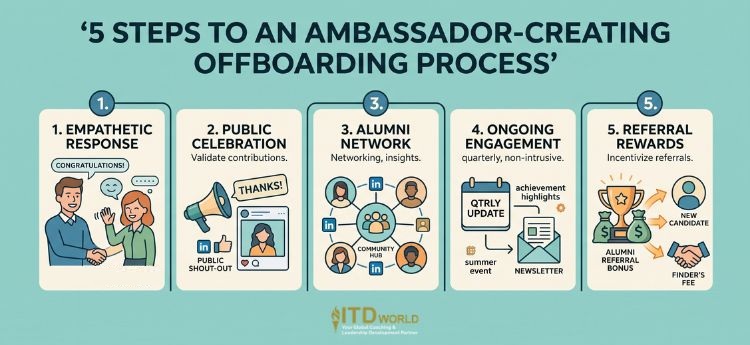
5 Steps to Build an “Ambassador-Creating” Offboarding Process
Understanding the philosophy of the Alumnus Strategy is the first step. Executing it requires a systematic, tactical approach. Here are the five steps for strategic employee offboarding.
-
Master the Empathetic Resignation Response
The ambassador lifecycle begins the precise moment an employee hands in their notice. The initial reaction of their direct manager sets the psychological anchor for the entire offboarding period.
If a manager reacts with frustration, panic, or passive aggression, the relationship is instantly damaged. Leaders, therefore, need be trained to respond to resignations with immediate congratulations and empathy.
Example Response: “I am genuinely sad to lose you, but I am thrilled for your career. This sounds like an incredible opportunity for you. Let’s talk about how we can make your final two weeks a seamless transition so you can start your new role refreshed.”
-
Celebrate the Transition Publicly
Nothing signals a healthy company culture more than an organization that publicly celebrates the advancement of its people—even when they are advancing elsewhere.
Instead of hiding an employee’s departure, acknowledge it. Have team leaders post a public social media shout-out (especially on LinkedIn) thanking the departing person for their contributions and wishing them success in their new role.
-
Why this works: It validates the employee, stroking their professional ego and locking in their loyalty. Simultaneously, it acts as a brilliant piece of employer branding. Prospective candidates seeing that post will think, “This is a company that truly cares about the career trajectory of its people.”
-
Establish an Active Corporate Alumni Network
If you wish to maintain a referral network, you need a centralized hub. The good news is, you do not need to be a global consulting firm to have an employee alumni network.
Create a dedicated “Corporate Alumni Community” on LinkedIn or a private Slack channel. Invite departing employees to join this group as part of their transition process. Frame it as an exclusive club where former workers can network with one another, share industry insights, and access resources.
-
Maintain Continuous, Non-Intrusive Contact
An alumni network dies without ongoing post-employment engagement. You need to implement a continuous feedback loop and communication strategy.
A good idea is to send out a quarterly alumni newsletter. This should not be a corporate press release; it should highlight alumni achievements (e.g., “Congratulations to former account manager Sarah for her recent promotion at Company X”), provide valuable industry insights, and highlight open roles at your company. Additionally, invite local alumni to company summer barbecues, holiday parties, or exclusive webinars. Keep your brand top-of-mind without being burdensome.
-
Implement an Alumni Referral Reward Program
Turn your goodwill into a measurable talent and client pipeline. Extend your internal employee referral bonus program to your alumni network.
If a former employee refers a candidate who gets hired, pay the alumnus the standard referral bonus. If possible, take it a step further: if an alumnus refers a new B2B client to your coaching or training firm, offer them a finder’s fee, a commission, or complimentary access to your premium leadership training programs.
By financially or experientially incentivizing your alumni, you activate them as a highly motivated, external sales and recruiting force.
Measuring the Success of Your Strategic Offboarding
In business coaching, we operate by the maxim: What gets measured gets managed. To ensure your Alumnus Strategy is actually working, it is recommended that HR and executive leadership track specific Key Performance Indicators (KPIs) associated with transition management:
-
Boomerang Rate: The percentage of your annual hires who are returning former employees.
-
Alumni-Referred Hires: The number of new employees successfully sourced through recommendations from your alumni network.
-
Alumni-Generated Pipeline: The total revenue or number of new client leads directly attributed to referrals from former staff.
-
Alumni Network Engagement: The growth rate and active participation levels within your corporate alumni LinkedIn group or Slack channel.
-
Employer Brand Sentiment: The qualitative improvement of reviews on platforms like Glassdoor, specifically tracking mentions of management support and company culture.
When you can tie concrete revenue and reduced hiring costs to your offboarding process, it ceases to be an HR administrative task and becomes a recognized pillar of corporate growth.
Changing the Paradigm: Resignation is an Evolution, Not an End
The modern talent lifecycle is no longer linear. The old paradigm dictated that when an employee resigned, their value to the company dropped to zero. But the new paradigm—the Alumnus Strategy—recognizes that one’s value can actually multiply after they leave your payroll.
By treating departing team members as future clients, partners, and ambassadors, you create a self-sustaining ecosystem of goodwill. You lower your recruiting costs through boomerang hires, increase your sales pipeline through organic referrals, and build a prestigious employer brand that attracts top-tier talent.
Offboarding is the final step in brand advocacy. Make sure your final impression is just as powerful, respectful, and strategic as your first!
ITD World provides specialized coaching and training solutions designed to help leaders & organizations secure a competitive advantage – and be equipped to win in today’s dynamic landscape. Contact us today to learn more about our world-class programs!
Other resources you might be interested in:
- Upskilling and Reskilling: A Sustainability Framework for the AI Era
- HR Metrics: Measuring Human Capital for Business Success
- Brilliant Jerks: How to Handle Toxic “High Performers” in the Workplace
- Leadership Pipeline: Moving Beyond Reactive Succession Planning
- Internal Talent Mobility: Strategies for Scaling Beyond the Ladder
- Quiet Firing: The Toxic Workplace Trend Ruining Company Culture