
In today’s volatile labor market, organizations are facing a paradigm shift that is fundamentally altering how they build, manage, and sustain their workforces. With external hiring increasingly “frozen,” job openings shrinking, and the half-life of technical skills plummeting to a mere 2.5 years, the traditional instinct to look outward for fresh talent is no longer a sustainable business practice. Companies are suffering from the lingering hangover of the “Great Resignation,” grappling with exorbitant recruitment costs, and facing a stark reality: a staggering 51% of employees are quietly eyeing the exits, driven primarily by a feeling of stagnation in their current roles.
The solution to the above-mentioned multifaceted crisis is not a louder external marketing campaign or a more aggressive headhunting strategy. The most resilient organizations are realizing that their greatest asset is already on the payroll. By shifting focus to an internal talent mobility strategy, businesses can effectively bridge critical skills gaps, drastically reduce turnover, and foster a dynamic, future-proof workforce.
 |
Author: Jonathan M. Pham |
Highlights
- Internal mobility is no longer just about upward movement. It includes lateral moves to break silos, project-based “gigs” for experiential learning, and even “de-acceleration” (step-downs) to support employee well-being or career pivots.
- Internal hiring is significantly more efficient than external recruiting. Furthermore, employees who move internally tend to stay at the company for much longer than those who remain in one role.
- Instead of waiting for a “perfect” external candidate, savvy companies hire internal “near-matches” who possess 70–80% of the required skills. These employees are often more adaptable and better cultural fits than external hires.
- A major barrier to mobility is managers who hide top performers to protect their own team’s output. Successful strategies solve this by incentivizing managers to become “talent exporters,” rewarding them when their team members move to other departments.
- Effective programs utilize AI-driven talent marketplaces to map skills and “shadow abilities,” ensure transparency so managers can’t act as gatekeepers, and provide personalized feedback to rejected internal candidates to prevent them from leaving the company.
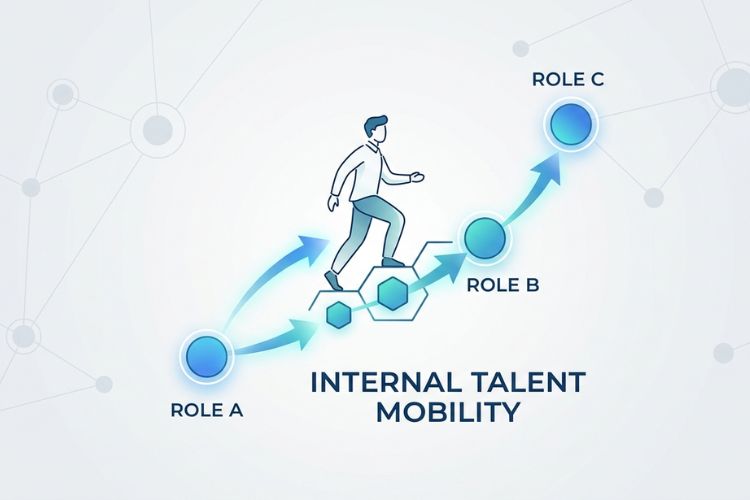
What is Internal Talent Mobility? (Moving Beyond the Corporate Ladder)
At its core, talent mobility (or internal mobility) is the strategic, facilitated movement of employees across different roles, projects, departments, and even geographic locations within the same organization.
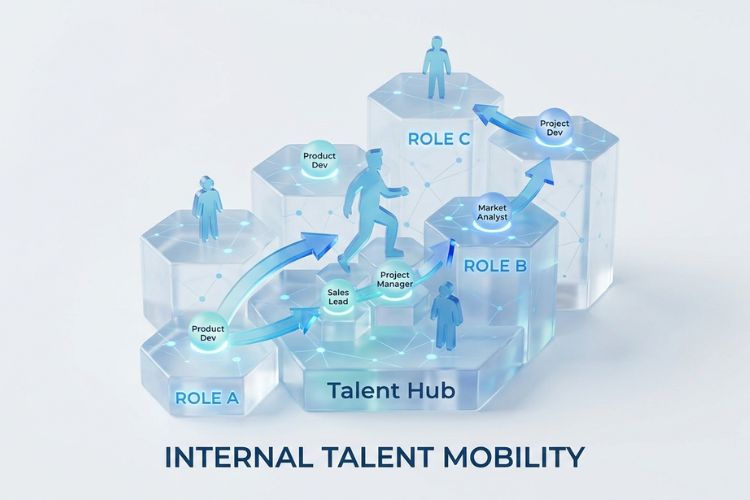
Historically, career progression was viewed through the rigid lens of the “corporate ladder.” You started at the bottom, and success meant waiting for the person above you to leave so you could take their place. Today, this linear model is effectively obsolete. Modern internal talent movement is better visualized not as a ladder, but as a “climbing wall” or a multi-directional career pathways lattice.
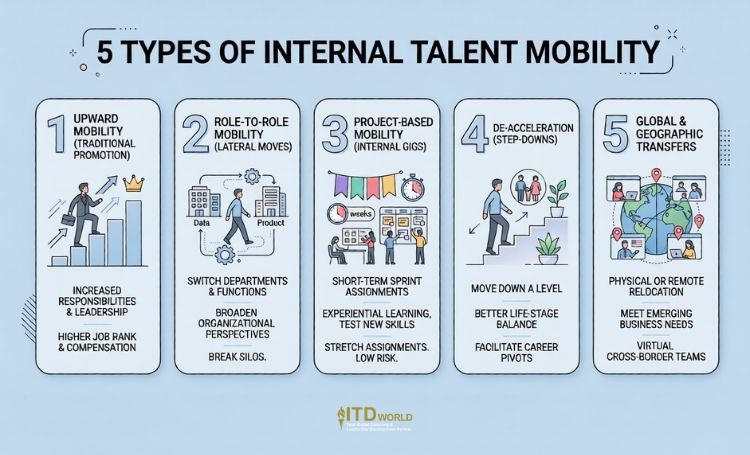
Types of Internal Talent Mobility
-
Upward Mobility (The Traditional Promotion)
This is the classic vertical move to a higher job class with increased responsibilities, leadership expectations, and compensation. While still a vital component of succession planning, relying solely on upward mobility creates bottlenecks. There are only so many senior leadership slots available, and if upward is the only way to grow, top performers will eventually “spill over” into the external job market when they hit a ceiling.
-
Role-to-Role Mobility (Lateral Moves)
Lateral moves involve transitioning an employee to a different function or department with a similar level of seniority and pay. These moves are crucial for broadening one’s organizational understanding and breaking down departmental silos. For instance, moving a high-performing Data Analyst into a Product Management role allows them to gain fresh, cross-functional perspectives without requiring an immediate change in corporate rank.
-
Project-Based Mobility (Internal Gigs and Stretch Assignments)
Perhaps the most innovative trend in modern HR is the rise of gig work (internal), which involves short-term, cross-functional sprint assignments—lasting anywhere from a few hours a week to 12 weeks. Internal gigs give team members the chance to contribute to high-impact projects outside their daily scope without permanently changing their job description. This facilitates “experiential learning,” enabling staff to test-drive new skills in a low-risk environment.
-
De-acceleration (Step-Downs)
Unlike many corporate philosophies that focus strictly on climbing, forward-thinking organizations recognize “de-acceleration” or moving a level below as a highly valid form of mobility. Step-downs are often utilized to help employees find a better life-stage balance (e.g., returning from parental leave, dealing with personal matters) or to facilitate a total career pivot where the individual needs to learn foundational skills in a completely new discipline.
-
Global and Geographic Transfers
This entails physical or remote relocation to suit emerging business needs. With the rise of remote-first project modeling, global transfers can happen virtually, allowing teams to gather across borders to set the stage for a project and execute it from their respective locations.
The “Alumni/Boomerang” Extension
An often-overlooked facet of talent mobility is how you handle the people who do leave. By fostering a culture that deeply values internal growth and handles transitions gracefully, you turn departing employees into lifelong brand ambassadors. These individuals are highly likely to become “boomerang” employees—returning to your organization years later, bringing upgraded skills and valuable external market intelligence with them.
Why Internal Talent Mobility is Your Best Defense Against Employee Turnover
The business case for internal mobility is irrefutable. Companies that fail to prioritize internal career development are paying a massive “Cost of Inaction.” According to industry data, large enterprises lose an average of $400,000 annually due to the compound costs of recruiting, onboarding, and training new external hires.
When you shift your strategy inward, the transformation in efficiency, cost savings, and employee loyalty becomes profound.
Massive Efficiency Gains and Cost Savings
The inefficiency of the external hiring market is staggering. By contrast, internal sourcing is a streamlined powerhouse. Data shows that it takes, on average, only 4 internal applications to result in a successful hire, compared to an exhausting 36 applications from external job boards.
Financially, internal recruiting costs approximately 60% less than external hiring. You eliminate agency fees, premium advertising costs, and the massive overhead associated with external onboarding. Not to mention, internal hires offer a “Speed to Power” advantage. Given that they already understand the company culture, the internal politics, and the proprietary software systems, internal movers hit full productivity 50% faster than external hires, who typically face an eight-month learning curve.
Drastic Retention Improvements
The link between career development and retention is ironclad:
-
The “Tenure Gap”: Research from 150 million job transitions reveals a massive difference in corporate loyalty. Employees who make at least one internal move stay a median of 8.1 years, compared to just 5.8 years for those who stay in one spot. Simply allowing a transition grants an organization an extra 2.3 years of retention per employee.
-
The 54% Retention Rule: Over half (54%) of an employee’s decision to stay with their current employer is directly tied to whether they believe the company actively contributes to their professional development.
-
The 10x Rule: The risk of flight is highest among your most capable people. Those who feel their skills are being underutilized are 10 times more likely to be actively looking for a new job than those who feel their talents are properly deployed.
Read more: New Hire Retention – Strategies, Metrics, and the 90-Day Playbook
The Shift to “Near-Match” Hiring
One of the most critical philosophical shifts driven by internal mobility is the abandonment of the “perfect fit” illusion. In the past, hiring managers would leave a role open for months, waiting for a magical external unicorn who possessed 100% of the required skills. Yet today, skill requirements are moving targets.
Savvy organizations are adopting a “near-match” strategy. They look inward to find dynamic individuals who possess 70-80% of the required competencies, alongside a proven track record of adaptability and cultural alignment. Because these internal “near-matches” are already in a state of learning and adapting, they are actually better equipped to pivot when business priorities change than an external candidate hired for a highly specific, static skill set.
To put it simply, internal mobility actively closes the skills gap by turning your existing workforce into a malleable, continuously learning entity.
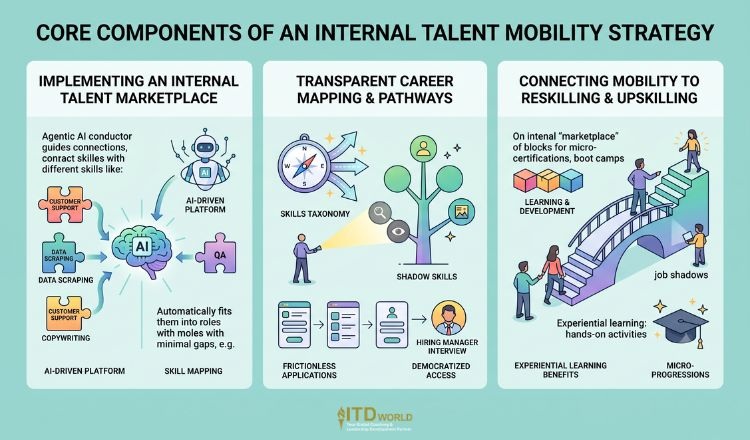
Core Components of a Successful Internal Talent Mobility Strategy
To move from “wishing” for a fluid workforce to actually operating one, organizations need to establish an internal talent mobility framework, which requires moving past traditional HR functions and embracing modern technology, transparency, and continuous learning.
Implementing an Internal Talent Marketplace
The foundation of a modern strategy is the talent marketplace. Leading organizations have abandoned manual spreadsheets and ad-hoc managerial recommendations in favor of centralized, AI-driven platforms. A successful marketplace operates on the “Four Ps”: Purpose, Plan, Programme, and Platform.
These platforms utilize Agentic AI—artificial intelligence that acts not just as a search bar, but as a co-strategist. In an enterprise of 10,000 employees with 300 different job positions, there are upwards of 3 million potential job-fit combinations. Human HR teams cannot calculate this.
AI, however, can rapidly map “skill adjacencies” to uncover hidden matches. For example, it might identify that a Customer Support specialist possesses 80% of the skills required for a junior Quality Assurance (QA) engineering role, automatically recommending the match and bypassing human oversight and unconscious bias.
Read more: AI in Leadership – Bridging the Gap Between Adoption & Maturity
Transparent Career Mapping and Pathways
For an internal mobility program to thrive, it’s critical to declare the death of the rigid “Job Description.” Organizations are transitioning toward a skills taxonomy—a structured, comprehensive map of the capabilities required across the entire enterprise.
This skills-based architecture relies on identifying “Shadow Skills.” Often, employees acquire high-level capabilities outside of their official work duties (e.g., a marketing copywriter who is secretly a highly proficient data scraper). By utilizing self-evaluations, peer-validated assessments, and AI skill inference (which analyzes one’s project output to infer unspoken abilities), companies can build a truly accurate inventory of their human capital.
Transparency also mandates frictionless applications. If an employee has to jump through the same grueling hoops as a stranger off the street, the system is broken. Internal applicants should be able to “skip the screen”—bypassing initial recruiter calls to move directly to hiring manager interviews. Career mapping must be democratized, allowing every person, regardless of their current rank, to view open roles, available mentorships, and project gigs without their direct manager acting as an information gatekeeper.
Connecting Mobility to Reskilling and Upskilling
Mobility without education is a recipe for failure. Your internal mobility framework needs to be intrinsically linked to your Learning and Development (L&D) initiatives. Reskilling (training an employee for a completely different role) and upskilling (teaching advanced skills for their current trajectory) provide the bridge between one’s current capabilities and their future ambitions.
To achieve this, it is vital that companies modernize their benefits. Traditional tuition assistance programs are notoriously underutilized, often sitting at a 1-2% usage rate because they are siloed and difficult to navigate. Forward-thinking HR leaders are converting these budgets into an internal “marketplace” of micro-certifications, boot camps, and tailored coursework that align directly with the company’s future needs (like AI integration or cybersecurity).
At the same time, L&D needs to shift from solitary video watching to experiential learning. Mentorships, job shadowing, and democratization of opportunity ensure that employees are learning by doing. This is particularly vital for Gen Z and Millennial workers, who view career progression not as a destination reached every five years, but as a continuous series of “micro-progressions.” They expect daily learning and transparent pathways; if you do not provide them, your competitors will.
The “Talent Hoarding” Problem: How to Get Managers on Board
You can purchase the most sophisticated AI talent marketplace in the world, but if the company culture is broken, your mobility strategy will fail. The single greatest obstacle to is, many times, not budget or technology, but middle management.
A staggering 69% of HR leaders identify managerial “talent hoarding” as the primary barrier to internal mobility. Talent hoarding occurs when direct managers deliberately block or discourage their top performers from moving to other departments. From the manager’s perspective, it is a logical survival tactic. If their bonus, performance review, and daily stress levels are entirely dependent on their team’s output, why would they willingly give away their best player?
To overcome the above-mentioned problem, there needs to be a fundamental shift in leadership psychology and performance metrics.
Shift Mindsets and Redesign Incentives
You cannot tell a manager to share talent while continuing to penalize them for temporary drops in team productivity. Internal mobility must be treated as a strategic tradeoff. Specifically, the manager KPIs need to be adjusted so that they are actively, financially, and professionally rewarded for “exporting” talent.
Innovative companies have introduced the “Talent Exporter” metric. During annual reviews, managers are praised and compensated based on how many of their team members were promoted or successfully moved to other parts of the organization. When leadership is incentivized to develop talent for the entire company rather than just their silo, hoarding behavior rapidly dissipates.
Implement Utilization Tracking
Managers tend to justify hoarding by claiming their team is perpetually “at capacity” and cannot spare anyone for a cross-functional project. HR can combat this through utilization tracking tools that provide transparent, data-driven visibility into a person’s current workload. By proving that a top performer actually has 15% bandwidth available, HR can gently force the manager’s hand, ensuring the employee gets the chance to participate in internal gig work.
The “Scout” Analogy
In professional sports, scouts are celebrated for finding brilliant, under-the-radar players and funneling them into the big leagues. Likewise, managers should be trained to see that a fluid workforce is an advantage. When a manager becomes known across the company as a leader who accelerates careers, they will naturally attract the most ambitious, high-performing internal talent to their own team in the future.
They may lose a star today, but they gain the pick of the litter tomorrow.
Rethinking Growth: The Power of Lateral Moves and Stretch Assignments in an Internal Talent Mobility Strategy
To truly embed mobility into the corporate DNA, the “One Direction” myth has to be broken. For long, employees have been conditioned to believe that if they are not moving up, they are failing. As a business leader or coach, part of your job is to reframe the narrative and prove that horizontal growth is just as valuable as vertical ascension.
The ROI of Lateral Moves
Statistically, lateral moves are an incredibly powerful retention tool. Employees who make a lateral move still have a 62% chance of staying with the company over the long term (compared to 70% for those who receive a vertical promotion).
Lateral moves act as a pressure valve for “career spillover.” When traditional senior slots are occupied, sideways moves keep high performers engaged, challenged, and learning, preventing them from seeking stimulation at a competitor.
Institutional Knowledge as Currency
When employees participate in job rotations or lateral transfers, they don’t just learn new skills; they carry specialized, departmental knowledge with them. This process acts as a human bridge, fostering “knowledge cross-pollination.” A team member moving from Customer Success to Product Development brings invaluable, frontline insights regarding user pain points directly to the engineers. Doing so breaks down toxic departmental silos and leads to highly creative, holistic problem-solving.
Read more: Brilliant Jerks – How to Handle Toxic “High Performers” in the Workplace
The Internal Gig Economy and Stretch Assignments
For those who are hesitant to commit to a permanent role change, stretch assignments, secondments, and cross-functional projects offer the perfect middle ground. This “internal gig economy” allows a team member to dedicate 10 hours a week to a different department for a three-month sprint. They build their “career capital,” diversify their resume, and help the company tackle specific, short-term challenges without requiring a headcount restructure.
The Internal Employer Brand
A crucial, often-missed insight: You have to market your internal roles with the same vigor and branding that you use for external candidates. There is currently a massive visibility gap in the corporate world, with over 50% of employees stating they are completely unaware that internal opportunities even exist. If your lateral moves and gig opportunities are hidden in a clunky intranet portal, they will not be utilized.
Over-communicate these opportunities via internal newsletters, town halls, and dedicated Slack/Teams channels. Highlight “success stories” of those who took lateral moves and thrived. Sell the internal journey.
How to Build the Program (Internal Talent Mobility Strategy Template & Examples)
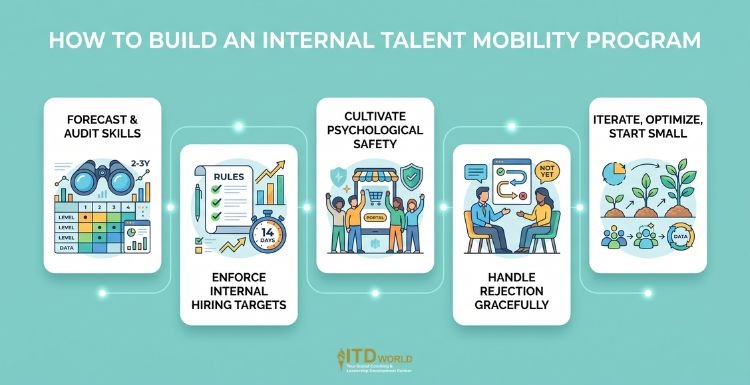
Transitioning from a static hierarchy to a fluid talent ecosystem requires a structured, deliberate approach. Here is a 5-step playbook that organizations can adopt to come up with successful internal talent mobility programs.
-
Forecast and Audit Skills
You cannot move talent effectively if you don’t know what you have and what you will need. Begin with a gap analysis to forecast the skills your business will require in the next 2-3 years. Next, conduct a comprehensive skill audit of your current workforce. Utilize visual skills matrices—databases that cleanly map out your organization’s competencies, proficiency levels, and active certifications. This gives TA leaders a dashboard view of the “internal wealth” at their disposal.
-
Mandate Internal Hiring Targets
Human nature defaults to the path of least resistance, and for many recruiters, posting a job on LinkedIn is easier than untangling internal department politics. To promote behavioral change, leadership must set mandatory internal hiring targets. Enforce a policy where all open requisitions must be posted internally for 14 days before going public. Track a “Time Since Last External Hire” metric at the executive level to ensure managers aren’t defaulting to expensive external searches when qualified internal candidates are available.
-
Cultivate Psychological Safety
An internal mobility program is dead on arrival if employees are terrified of their manager’s reaction. An effective internal talent movement requires deep psychological safety. Team members should feel completely secure raising their hands for new challenges, exploring the talent marketplace, and interviewing for other teams without fear of professional retaliation, being labeled “disloyal,” or losing their current standing.
For HR, their role is to establish clear, documented “rules of engagement” that protect the individual’s confidentiality during the exploratory phases of internal mobility.
-
Handle Rejection with Grace
This is the most sensitive touchpoint in the entire mobility lifecycle. Research indicates a “Double Risk” associated with internal hiring: a rejected internal candidate is more than twice as likely to leave the company compared to an employee who never applied at all. If an internal applicant is met with silence, generic automated emails, or a lack of actionable feedback, they will immediately update their external resume.
To prevent the problem, it is recommended that organizations mandate personalized feedback loops. Hiring managers should sit down with rejected internal candidates, explain exactly what skill gaps prevented them from getting the role, and immediately partner with L&D to create a tailored upskilling plan so the employee is ready for the next opportunity. The “No” should always be framed as a “Not yet.”
-
Iterate, Optimize, and Start Small
“Work toward better, not perfect.” Do not attempt an enterprise-wide overhaul on day one. Start by implementing micro-mobility: launch a pilot program focused strictly on project-based gigs or cross-functional mentorships. Gather data, track timestamps to identify workflow bottlenecks, and adjust your approach based on company culture.
4 Metrics to Measure Your Internal Talent Mobility Strategy’s ROI
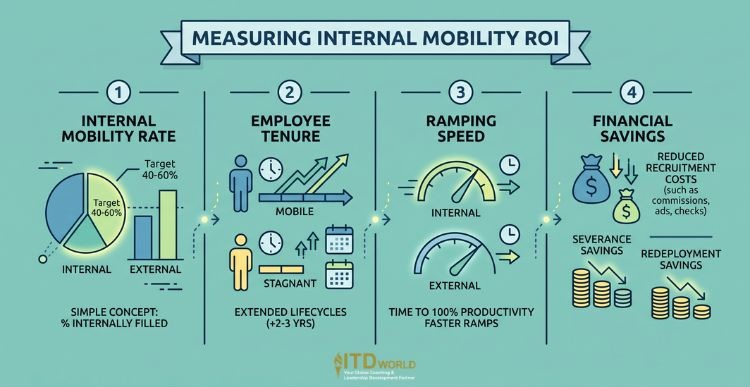
To secure continuous executive buy-in, it’s essential that HR and coaching professionals speak the language of the C-suite: data and financial returns. Tracking the right KPIs ensures your strategy is an engine for growth, not just an HR experiment.
- Internal Mobility Rate
This is your baseline diagnostic. What percentage of your total open roles are being filled from within versus external recruitment? If your internal mobility rate is hovering below 20%, your external hiring dependency is too high. Best-in-class organizations aim to fill 40% to 60% of their critical roles internally.
- Employee Tenure and Retention Rates
Segment your retention data. Track the average tenure of employees who have engaged in internal mobility (whether vertical, lateral, or gig-based) versus those who have remained stagnant in a single role. When you can prove to the CFO that your mobility program is extending average employee lifecycles by two to three years, the program pays for itself.
- Time to Productivity (Ramping Speed)
Ask hiring managers to track how long it takes a new hire to reach 100% capacity. Compare the data of external hires against internal movers.
- Financial Savings (Cost per Hire and Severance)
Calculate the hard dollars saved. Tally up the reduction in external recruiter commissions, job board advertising, and external background checks. In addition, look at redeployment savings.
Final Thoughts
The era of relying solely on the external market to buy your way out of talent shortages is over. In a business landscape defined by rapid technological disruption and shifting economic realities, your organization’s survival depends on its agility.
Internal talent mobility is the ultimate strategic “win-win.” Organizations that implement robust, skills-based mobility frameworks benefit from massive reductions in hiring costs, faster deployment of talent, and the preservation of irreplaceable institutional knowledge. Simultaneously, employees are empowered with autonomous career pathing, profound psychological safety, and a clear, long-term future without ever having to leave the building.
It is time to stop searching for external unicorns and start cultivating the “near-matches” already on your payroll. By designing a culture where movement is expected, rewarded, and seamless, you turn your existing workforce into your most powerful, resilient competitive advantage.
ITD World provides specialized coaching and training solutions designed to help leaders & organizations secure a competitive advantage – and be equipped to win in today’s dynamic landscape. Contact us today to learn more about our world-class programs!
Other resources you might be interested in:
- Talent Acquisition: Strategies & Insights for Success
- Talent Philosophy: A Guide to Unlocking Workforce Potential
- 6 Benefits of DEI in the Workplace