

In today’s highly competitive business landscape, relying on “gut feeling” to manage your workforce is no longer enough. Your people are the most valuable asset. That being said, how do you measure the true impact of your human capital on the bottom line?
The answer lies in HR metrics. Whether you are a startup founder, an HR director, or a seasoned corporate leader, understanding and tracking human resources KPIs (Key Performance Indicators) is critical.
 |
Author: Jonathan M. Pham |
Highlights
- HR metrics transition the HR department from an administrative role to a strategic business partner by providing data-driven insights into culture, budgets, and long-term business goals.
- These metrics should be measured across four main categories: recruitment (efficiency/cost), retention (stability), engagement (productivity/morale), and development (ROI/growth).
- Organizations must align data tracking with specific business objectives, utilize visual dashboards for trend analysis, and take proactive steps to address issues revealed by the data.
What Are HR Metrics and Why Do They Matter?
HR metrics are quantifiable measurements that help evaluate the efficiency, effectiveness, and impact of an organization’s human resources practices. While HR was once viewed primarily as an administrative function, modern workforce analytics have elevated it to a strategic partnership within the executive suite.
Tracking HR metrics allows business leaders to:
-
Identify underlying issues in company culture before they escalate.
-
Justify HR budgets and investments in training and development.
-
Make informed, data-driven decisions regarding hiring, firing, and promotions.
-
Align human capital strategies with overarching business objectives.

The Most Important HR Metrics to Track
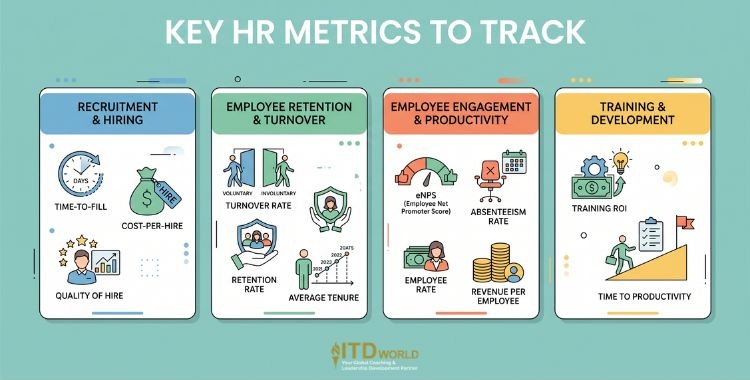
To establish a comprehensive HR dashboard, it is best to categorize your data into four distinct pillars. Here are the top examples of HR metrics and KPIs your business should monitor:
-
Recruitment and Hiring Metrics
Attracting top talent is expensive and time-consuming. Tracking recruitment metrics ensures your hiring process is both efficient and effective.
-
Time-to-Fill: The number of days between the approval of a job opening and the candidate accepting the offer. A high time-to-fill is a strong indicator of an inefficient hiring process or uncompetitive compensation.
-
Cost-per-Hire: The total cost of hiring divided by the number of new hires. This includes advertising, recruiter fees, and interview time.
-
Quality of Hire: Often measured by a new employee’s performance rating and tenure during their first year.
-
Employee Retention and Turnover Metrics
High turnover can devastate a company’s bottom line and team morale. Monitoring the following metrics helps you understand workforce stability.
-
Turnover Rate: The percentage of employees who leave the organization during a specific period. It is crucial to separate voluntary turnover (employees quitting) from involuntary turnover (firings/layoffs).
-
Retention Rate: The percentage of employees who remain with the company over a given period.
-
Average Tenure: The average length of time employees stay with your company, providing a clear picture of long-term loyalty.
-
Employee Engagement and Productivity Metrics
Engaged employees are generally more productive, innovative, and customer-focused.
-
Employee Net Promoter Score (eNPS): A simple survey asking people how likely they are to recommend your company as a place to work on a scale of 1 to 10.
-
Absenteeism Rate: The rate of unexcused absences. Chronic absenteeism is often an early warning sign of burnout or a toxic work environment.
-
Revenue per Employee: Calculated by dividing total company revenue by the current number of employees. This serves as the basis for assessing overall workforce productivity.
-
Training and Development Metrics
For organizations committed to growth, measuring the impact of upskilling is vital.
-
Training Return on Investment (ROI): The financial return gained from training programs compared to the cost of those programs.
-
Time to Productivity: How long it takes a new hire or a recently promoted employee to reach full productivity. Effective onboarding and coaching drastically reduce this time.
How to Measure HR Effectiveness in Your Organization
Knowing what to track is only half the battle; measuring HR effectiveness requires a strategic approach:
-
Align with Business Goals: Do not track metrics just for the sake of having data. If your company’s current goal is rapid expansion, prioritize recruitment metrics. If profitability is the goal, focus on retention and productivity instead.
-
Utilize an HR Dashboard: Implement HR software that centralizes your talent management data. A visual dashboard makes it easy to spot trends at a glance.
-
Take Actionable Steps: Data is useless without action. If your eNPS score drops, it is time to initiate leadership interventions or team coaching to unearth the root causes.
Read more: Employee Performance Checklist – A Framework for High-Impact Reviews
FAQs
What are the best HR metrics for small businesses?
Small businesses should care more about foundational metrics that impact cash flow and culture. The most important HR metrics to track for smaller teams include cost-per-hire, voluntary turnover rate, and revenue per employee.
How does HR analytics improve business performance?
HR analytics transforms raw employee data into actionable insights. By identifying patterns—such as why top performers leave or which training programs yield the highest ROI—leaders are better equipped to make strategic changes that reduce costs, boost morale, and ultimately increase profitability.
How often should we review our HR metrics and KPIs?
While data should be continuously collected via your HR dashboard, a monthly review by the HR team is recommended to catch short-term trends (like sudden spikes in absenteeism). A comprehensive review with the executive team should occur quarterly to ensure human capital strategies remain aligned with business objectives.
Can coaching actually improve employee retention?
Absolutely. A primary reason employees leave a company is poor management. Leadership coaching equips managers with the communication, empathy, and strategic skills needed to lead effectively, which has been proven to significantly improve retention and overall engagement scores.
How Business Coaching and Training Can Improve Your HR Metrics
If your HR dashboards are displaying high turnover, low engagement, or poor training ROI, the missing link is often leadership capability and employee development.
Investing in professional business training and corporate coaching directly impacts your HR metrics. Executive coaching enables leaders to cultivate the emotional intelligence required to foster inclusive, engaging work environments—naturally lowering voluntary turnover rates. In addition, targeted team training equips your workforce with the competencies they need to increase their revenue-per-employee and decrease time-to-productivity.
By partnering with an experienced training and coaching provider, you empower your people to perform at their best, turning your HR metrics from a source of stress into a competitive advantage.
ITD World provides specialized coaching and training solutions designed to help leaders & organizations secure a competitive advantage – and be equipped to win in today’s dynamic landscape. Contact us today to learn more about our world-class programs!
Other resources you might be interested in:
- HR Competency Model Analysis: Elevating HR Practices for Success
- HR Transformation: A Step-by-Step Guide to Building a Future-Proof Workforce
- Building KPIs & Metrics that Truly Matter & Drive High Performance
- Talent Philosophy: Unlocking Workforce Potential
- How AI is Revolutionizing the Employee Experience (EX)