
The way people search for information is changing rapidly. Traditional search engines are no longer the only option for finding answers online. AI-powered search tools can summarize information, answer questions in natural language, and generate reports in seconds. For casual users, this often feels like a major improvement.
For developers, researchers, analysts, and organizations that rely on data accuracy, however, the conversation is more complicated. The goal is not always to get a quick answer. Sometimes the goal is to find every relevant source, monitor changes over time, or build datasets that can support business decisions.
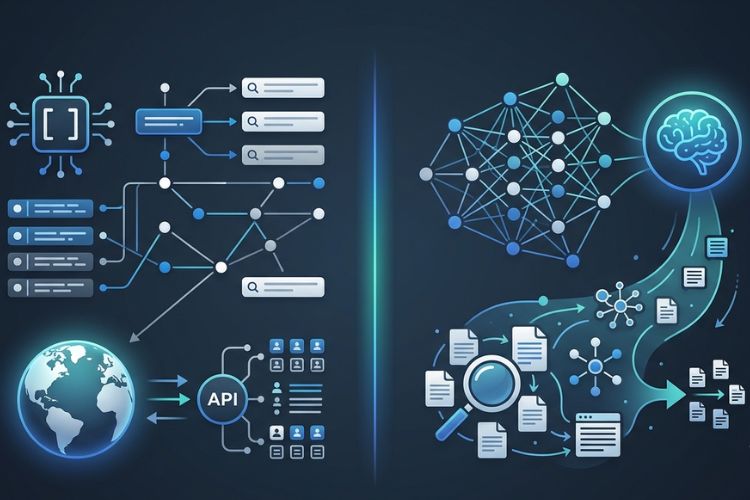
That distinction explains why web search APIs and AI search tools continue to serve different purposes. While both help users access information from the web, they are built on fundamentally different assumptions about what a successful search looks like.
This article explores the strengths, limitations, and ideal use cases of each approach.
What Is the Difference Between a Web Search API and an AI Search Tool?
At a high level, AI search tools focus on delivering answers. They typically accept a natural language query and generate a summarized response based on information gathered from multiple sources.
A web search API works differently. Instead of producing a final answer, it returns search results, metadata, documents, URLs, and other structured information that developers can process programmatically.
Think of it this way:
-
AI search tools prioritize convenience.
-
Web search APIs prioritize access to data.
The distinction becomes especially important when applications require transparency, traceability, or large-scale information gathering.
Why Do Developers Still Use Web Search APIs?
Many organizations need more than a summarized answer. They need the underlying data.
For example, an investment firm tracking startup funding rounds may want every relevant article, press release, and company announcement. A supply chain team monitoring factory disruptions needs complete event coverage, not just a summary of major incidents.
This is where a detailed comparison becomes valuable. AI search tools can help users understand a topic quickly, but web search APIs give developers direct access to the information required to build custom workflows, monitoring systems, research platforms, and intelligence products.
Rather than asking an AI to interpret the data first, developers can retrieve raw information and decide how it should be analyzed.
How Do AI Search Tools Work?
Most AI search tools follow a similar process:
-
Receive a natural language query.
-
Search a collection of web pages or indexed content.
-
Select a subset of relevant documents.
-
Use a language model to generate a response.
-
Present the answer in conversational form.
This approach is highly effective when users need quick explanations.
Questions such as:
-
“What happened in the semiconductor industry this week?”
-
“Why are shipping costs increasing?”
-
“What are the latest AI regulations in Europe?”
can often be answered within seconds.
The challenge is that users rarely see everything the system found. The model typically selects a limited number of sources before generating an answer.
That creates potential gaps in coverage.
Why Does Recall Matter?
One of the most important concepts in search technology is recall.
Recall measures how many relevant results a system finds compared to the total number that exist.
If a search system retrieves 90 out of 100 relevant documents, its recall is 90%.
For casual searches, missing a few results may not matter.
For business intelligence, compliance monitoring, investment research, cybersecurity investigations, or regulatory tracking, missing information can create significant risks.
Imagine monitoring product recalls, legal disputes, data breaches, or mergers and acquisitions. Missing a single event could lead to incomplete analysis or delayed decision-making.
This is one reason many enterprise teams continue to rely on specialized search APIs designed for broad coverage rather than simple answer generation.
What Are the Advantages of AI Search Tools?
AI search tools offer several benefits:
Faster Information Consumption
Users receive summarized answers instead of reviewing dozens of documents manually.
Natural Language Interaction
Queries can be conversational rather than keyword-based.
Reduced Research Time
For exploratory research, AI tools can provide useful context very quickly.
Better Accessibility
Non-technical users often find conversational interfaces easier to use than traditional search systems.
These strengths make AI search ideal for learning, brainstorming, and general knowledge discovery.
What Are the Advantages of Web Search APIs?
Web search APIs offer a different set of benefits.
Access to Original Sources
Developers can retrieve documents, metadata, URLs, publication dates, and other structured information directly.
Custom Analysis
Organizations can build their own ranking models, filters, dashboards, and workflows.
Transparency
Users can inspect source material rather than relying entirely on generated summaries.
Automation
Search results can feed downstream systems automatically, including analytics platforms, knowledge graphs, monitoring tools, and AI agents.
Dataset Creation
One of the most powerful capabilities is generating datasets that did not previously exist.
For example, a company could search for:
-
Warehouse fires in Europe during a specific quarter
-
Pharmaceutical acquisitions in a given year
-
Cybersecurity incidents affecting healthcare providers
-
Product recalls involving a particular supplier
Instead of receiving a summary, the organization can create a structured dataset for analysis.
Which Approach Is Better for AI Agents?
As AI agents become more common, this question becomes increasingly important.
An AI agent responsible for monitoring regulations, tracking competitors, or identifying emerging risks cannot rely solely on summaries.
Agents need reliable access to information sources.
Many modern AI systems therefore combine both approaches:
-
A web search API gathers information.
-
The AI model analyzes the results.
-
The agent takes action based on the findings.
In this workflow, search serves as the data layer, while AI serves as the reasoning layer.
Separating these responsibilities often produces more reliable outcomes than relying on generated answers alone.
What About Monitoring and Continuous Search?
Traditional searches are reactive.
A user asks a question and receives results.
Many business use cases require something different: continuous monitoring.
Examples include:
-
Tracking regulatory changes
-
Monitoring supplier disruptions
-
Following funding announcements
-
Detecting cybersecurity incidents
-
Watching competitor activity
Running manual searches repeatedly is inefficient.
Search APIs can automate this process by continuously monitoring topics and returning newly discovered information as it appears.
For analysts and intelligence teams, this can be more valuable than a one-time search result.
The best search is often the one users no longer need to perform manually because the system continuously tracks relevant developments.
When Should You Choose an AI Search Tool?
AI search tools are usually the better option when:
-
You need a quick answer.
-
You are learning a new topic.
-
You want a concise summary.
-
You are conducting early-stage research.
-
Precision matters more than complete coverage.
For many everyday use cases, AI search delivers an excellent user experience.
When Should You Choose a Web Search API?
A web search API is typically the better choice when:
-
You need access to source data.
-
You are building AI applications.
-
You require high recall.
-
You need structured outputs.
-
You want to automate monitoring workflows.
-
You are creating datasets for analysis.
-
Transparency and traceability are important.
These requirements are common across industries such as finance, cybersecurity, healthcare, compliance, logistics, and market intelligence.
What Does the Future Look Like?
The future is unlikely to belong exclusively to either AI search tools or web search APIs.
Instead, the most effective systems will combine both.
Search infrastructure will continue gathering information from across the web. AI models will continue improving their ability to interpret, summarize, and reason over that information.
The organizations that gain the most value will be those that treat search and AI as complementary technologies rather than competing ones.
Search provides the evidence.
AI provides the interpretation.
Together, they enable entirely new workflows that were difficult or impossible only a few years ago.
Conclusion
The debate between web search APIs and AI search tools is not really about which technology is better. It is about choosing the right tool for the job.
AI search tools excel at delivering fast, understandable answers. They reduce the effort required to learn about a topic and help users navigate large amounts of information.
Web search APIs excel at providing access to the underlying data. They support automation, monitoring, structured analysis, and large-scale information gathering.
For developers and analysts, the key question is not whether an AI can answer a question. It is whether the system can find, verify, and organize all of the information needed to support confident decisions.
As organizations increasingly build AI-powered products, research platforms, and monitoring systems, access to comprehensive and structured web data may become just as important as the intelligence used to analyze it.
Note: The content on this article is for informational purposes only and does not constitute professional advice. We are not responsible for any actions taken based on the information provided here.