
The coaching industry is undergoing a profound structural shift. For decades, one-on-one coaching has been the gold standard for executive development. However, while deeply impactful, the traditional individualized model faces undeniable limitations: a strict scalability ceiling for the practitioner and a significant budget ceiling for the organization.
This is where group coaching comes into play. Rather than merely a “budget” version of private coaching, it is a distinctly powerful methodology that harnesses collective intelligence, peer accountability, and psychodynamic awareness to drive behavioral change.
 |
Author: Jonathan M. Pham |
Highlights
- Unlike team coaching (pre-existing groups) or masterminds (peer-led brainstorming), group coaching is a facilitated learning environment where individuals with diverse backgrounds but shared goals work through a specific curriculum. It leverages action learning sets and external accountability to drive personal and professional growth.
- The model democratizes professional development for organizations by making coaching accessible to mid-level staff; provides clients with “The Mirror Effect” (learning from others’ breakthroughs); and allows coaches to scale their income by decoupling their earnings from billable hours.
- Success relies on “Compression Equals Value,” focusing on short, high-impact programs (6–8 weeks) rather than overwhelming clients with excessive content. Effective sessions follow a repeatable rhythm, often utilizing a “Hot Seat” format where 2–3 members receive deep coaching while the rest of the group learns through observation.
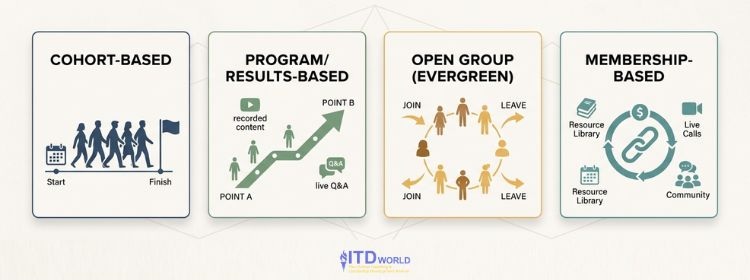
- Coaches can choose from four primary structures: Cohort-Based (shared start/end dates), Program-Based (scalable, start-anytime), Open/Evergreen (ongoing enrollment), or Membership (recurring access). The Results-Based Cohort is typically the best entry point for those transitioning from 1-on-1 coaching.
- The coach acts as a “manager of dynamics” rather than a lecturer, establishing psychological safety through strict confidentiality and clear standards. They must navigate the “High School Effect”—where participants project personal biases onto the group—by encouraging members to use peer triggers as tools for self-reflection.
What is Group Coaching?
At its core, group coaching is a collaborative learning environment where individuals with similar goals work toward personal or professional growth within a facilitated group setting. It relies on action learning sets, where participants tackle real-world challenges through structured inquiry and peer support.
To understand why the model is so effective, it’s helpful to look at behavioral psychology. According to author Gretchen Rubin’s “Four Tendencies” framework, approximately 41% of people are “Obligers” – who inherently struggle with self-accountability, yet thrive when external expectations are placed upon them. Group coaching serves as the ultimate environment for this demographic, turning peer presence into a natural, powerful motivator.
Group Coaching vs. Team Coaching vs. Masterminds
-
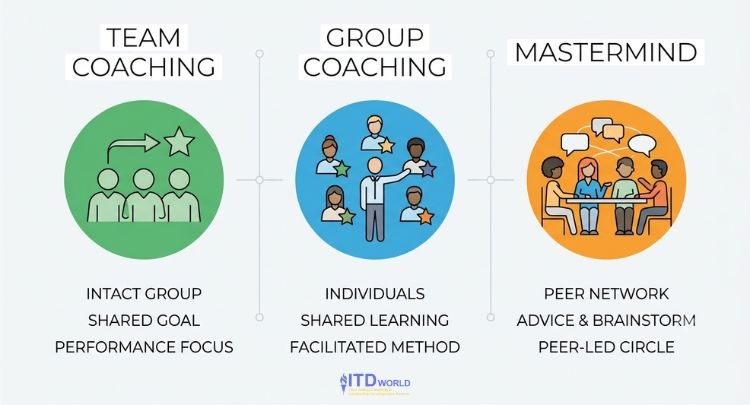
Team Coaching: This intervention is for an intact, pre-existing entity (like a regional sales team or a C-suite executive board) working toward a single, shared goal. The focus is on enhancing the collective performance and systemic synergies of that specific unit.
-
Group Coaching: This involves individuals—typically strangers from different departments or entirely different companies—who have different personal aims but are brought together by a shared learning theme. For instance, a cohort of first-time managers from different industries coming together to learn delegation skills.
-
Mastermind Groups & Mentoring Circles: A mastermind is primarily a peer-led advice circle focused on networking and brainstorming. Group coaching, conversely, is guided by a trained coach-facilitator who navigates a specific curriculum and utilizes certain methodologies to draw out insights, rather than just giving advice.
| Aspect | Team Coaching | Group Coaching | Masterminds & Mentoring Circles |
| Participants | An intact, pre-existing unit (e.g., a specific C-suite board or sales team). | Individuals/strangers from different teams, departments, or companies. | Peers (often entrepreneurs or professionals at a similar career stage). |
| Core Goal | Achieving a single, shared organizational objective and building systemic synergy. | Achieving individual personal aims tied together by a shared learning theme. | Networking, brainstorming, and crowd-sourcing solutions to individual hurdles. |
| Facilitation Style | Coach-facilitated: Focuses on group dynamics, collective performance, and unit systems. | Coach-facilitated: Uses a specific curriculum and coaching methodologies to draw out insights. | Peer-led: Focuses on mutual advice, accountability, and collaborative problem-solving. |
| Primary Value | Enhanced alignment, reduced friction, and collective performance of the unit. | Scalable skill acquisition (e.g., new managers learning delegation) and shared reflection. | Deep networking, diverse perspectives, and community support. |
Team coaching vs Group coaching vs Mastermind
The Business Case: Top Benefits of Group Coaching
Transitioning to a cohort-based coaching model offers a “win-win-win” scenario. It provides systemic value to the sponsoring organization, psychological value to the client, and economic value to the coach.
For Organizations: The Corporate Catalyst
Companies traditionally reserve coaching for the upper echelons of leadership due to high costs. Group coaching democratizes access to development, enabling them to offer high-level training to mid-level management and high-potential individual contributors.
Not to mention, when professionals from distinct divisions are brought together, it effectively breaks down departmental silos. This fosters cross-functional collaboration and “systemic awareness”—enabling employees to realize how their individual decisions impact the broader corporate ecosystem.
For the Client: The Power of Peers
The value of the group format is exponentially higher than solo learning due to the ability to leverage collective intelligence. Key psychological benefits include:
-
The “Shadow” Benefit (The Mirror Effect): When one member presents a specific challenge and others offer feedback, the advisors often realize that their own advice applies directly to their own lives. One person’s breakthrough frequently solves another one’s silent struggle.
-
Social Proof and Shared Humility: Leadership may feel isolating. Seeing peers navigate and overcome similar obstacles is great for cultivating individual confidence. It requires shared humility, allowing participants to learn from diverse perspectives rather than relying solely on the coach’s expertise.
For the Coach: Scaling with Intention
Many talented professionals leave the coaching industry due to unsustainable hours and unpredictable income. Moving to a group model decouples time from income.
Veteran business coaches note that when a coaching practice hits $1 million in revenue, roughly 40% usually comes from group programs. By the time that business scales to $5 million, that number often jumps to 80%. It provides predictable revenue, streamlines scheduling, and prevents practitioner burnout.
The 4 Primary Group Coaching Business Models
Before writing a curriculum, you need to decide how the program will be delivered. There are four primary models, each with distinct advantages:
-
Cohort-Based: Everyone starts and finishes together at a set date. This builds the highest level of community intimacy and is excellent for piloting a new concept. However, it relies on high-pressure enrollment deadlines.
-
Program/Results-Based: A predefined schedule moving clients from Point A to Point B, but clients can sign up and start whenever (often using recorded materials and live Q&As). This is highly scalable and makes it possible for the founder to eventually hire subordinate coaches to run the curriculum.
-
Open Group (Evergreen): Participants can join or leave at any time. It removes the pressure of launch deadlines, but naturally results in lower community cohesion and varying levels of completion.
-
Membership-Based: Clients pay a recurring fee for continuous access to a community, resources, and live calls. This is best for long-term support and establishing a stable base of repeat customers.
For most coaches transitioning from 1-on-1 work, the Results-Based Cohort is the optimal starting point. It ensures the highest results and is the easiest to eventually automate.
How to Structure a Successful Group Coaching Program
Building a scalable development program requires rigorous planning. The most successful coach-facilitators operate less like motivational speakers and more like instructional designers.
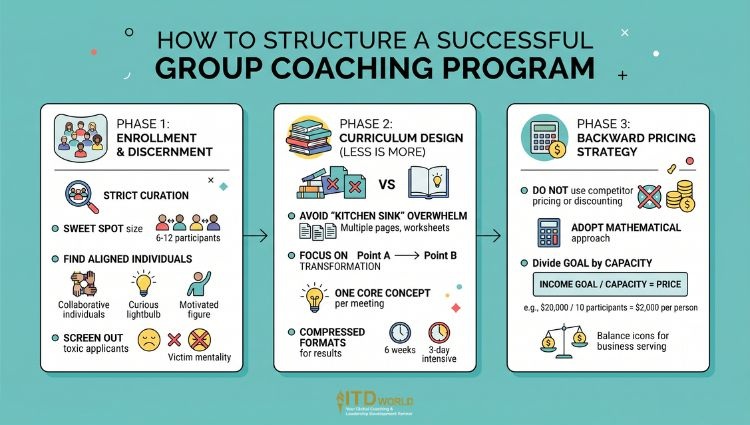
Phase 1: Radical Discernment & Enrollment
Your program is only as strong as the people in the room. Unlike 1-on-1 coaching, where you are able to adapt entirely to the client, a group requires strict curation. The “sweet spot” for a cohort is typically 6 to 12 participants, which is enough to ensure a diversity of perspectives without losing the personalized touch.
When curating the cohort, look for “aligned” individuals who are collaborative, curious, and motivated. Don’t be afraid of screening out applicants stuck in a victim mentality, as a single toxic participant can derail the group consensus.
Read more: Brilliant Jerks – How to Handle Toxic “High Performers” in the Workplace
Phase 2: Curriculum Design (The Paradox of Less is More)
A common pitfall in curriculum design is the “Kitchen Sink Trap.” In an effort to increase the perceived value of the program, coaches throw in dozens of modules, hundreds of worksheets, and endless reading lists, which would backfire most of the time. Clients leave not because the content is bad, but because they feel overwhelmed and guilty for “not using everything.”
Compression Equals Value: Contrary to popular belief, longer is not always better. Compressed formats—such as a highly focused 6-week program or an immersive 3-day intensive—often carry higher perceived value because they promise faster, tangible results. Engagement naturally tends to dip after six to eight weeks in a group setting; structure your duration accordingly.
Identify the specific transformation (Point A to Point B) and stick to one core concept per meeting.
Phase 3: The “Backward” Pricing Strategy
When pricing a group program, many practitioners make the mistake of looking at competitor pricing or simply discounting their 1-on-1 rate. Instead, it is recommended that you adopt a backward mathematical approach based on your business goals:
-
Income Goal: How much revenue do you need the cohort to generate? (e.g., $20,000)
-
Impact Capacity: What is the ideal maximum number of participants for the group dynamic? (e.g., 10 people)
-
The Result: Divide the goal by the capacity ($20,000 / 10 = $2,000 per person).
This legacy approach ensures that the program serves your business and lifestyle needs while delivering premium value to the participants.
Top Group Coaching Exercises, Frameworks, and Session Flow
To avoid becoming a “talking head” lecturer, the coach has to design high-energy, interactive sessions. A standard 60-to-90-minute live session should follow a predictable, repeatable rhythm.
The Ideal Session Template
-
Engagement Kickstarter (10 Mins): Avoid awkward silences at the start of a call by using a standard opening formula. Ask everyone to briefly share one of three things: a win, a challenge, or a question.
-
The Learning Spark (15 Mins): A brief, focused presentation on the core theme of the day (e.g., establishing psychological safety in the workplace).
-
Laser Coaching / The Hot Seat (30-40 Mins): You cannot coach 12 people deeply in one hour. Instead, place 2 to 3 people in the “Hot Seat.” Coach them directly and deeply on their specific challenges. The rest of the group learns by observing the interaction and applying the insights to their own contexts.
-
Action Planning & Reflection (10 Mins): Conclude by having participants convert the insights into SMART actions (Stop, Start, Continue) to ensure the psychology translates into real-world office improvements.
Tactical Engagement Tools
-
The Flipped Classroom: Provide your didactic teaching (videos, podcasts, reading) asynchronously before the meeting. Reserve 100% of the live session for interactive peer-to-peer feedback, hot seats, and triad breakout rooms.
-
The Daily Five: Assign accountability partners within the cohort. Require them to have a low-effort, high-impact 5-minute daily catch-up call, so that momentum doesn’t fizzle between weekly sessions.
-
The Asynchronous Edge: Utilize tech hubs like Slack, Discord, or Swarm (for video/voice notes) to create an “always-on” community feel.
-
Tool Integration for Introverts: Use software like Mentimeter, digital polls, or anonymous sticky-note boards. Doing so ensures that dominant voices don’t overshadow quieter members, democratizing the group consensus.
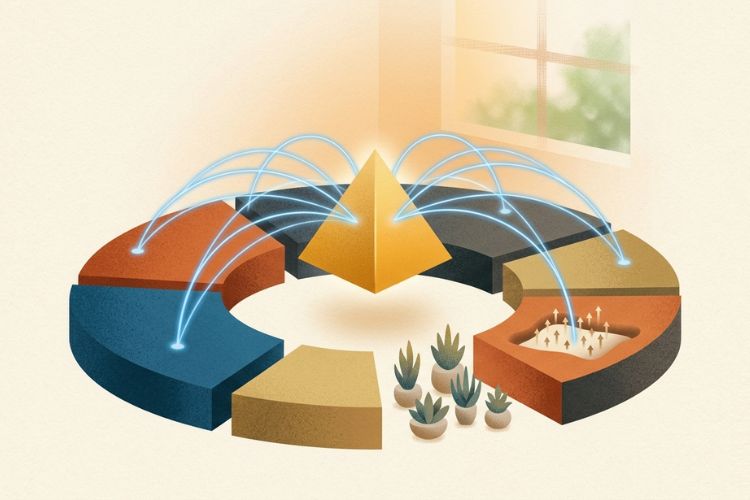
Navigating Group Dynamics: The Facilitator’s “Secret Sauce”
Facilitating a group requires a radically different skill set than private coaching. The coach’s role is to become an impartial “manager of dynamics,” balancing participation and holding space for productive friction.
Psychodynamic Awareness and the “High School” Effect
Bringing strangers together naturally triggers deep-seated psychological responses regarding belonging, worthiness, and authority—frequently referred to as the “High School Effect.” Clients may inadvertently project authority issues onto the coach or peer-rivalry issues onto other participants.
To manage this, try introducing the “Hall of Mirrors” concept early in onboarding. Teach the cohort that every person in the group is a mirror reflecting something back to them. If a participant finds themselves annoyed or triggered by another member, they are encouraged to turn the finger inward and examine their own trigger first.
Establishing Psychological Safety
At the heart of the group process is psychological safety. Without it, members will not share the vulnerabilities necessary for deep, collective problem-solving. Safety is established through:
-
Strict Confidentiality: Written agreements outlining what happens in the group stays in the group.
-
Clear Standards: Do not rely on verbal hints. Have formal agreements outlining attendance expectations, “share the air” guidelines, and no-show policies.
Managing Personalities: Conflict as an Asset
Group dynamics are inherently unpredictable. Instead of ignoring office tensions or interpersonal friction, skilled coach-facilitators view conflict as an asset. By relying on ground rules, the coach can turn friction into a deeper understanding of diverse viewpoints.
The golden rule here is Impartiality. The coach must challenge the group without taking sides, so that they do not become entangled in the very politics or interpersonal dramas they are trying to help the group navigate.
Common Pitfalls and “Silent Killers” of Group Coaching
Even well-designed programs would fail if a coach falls into the following common operational traps:
- The “People Pleaser” Trap
The biggest mistake coaches make is trying to solve every tangential problem a client brings up. If you deviate from the structured curriculum to be “helpful,” you risk confusing the group. The cohort loses sight of the original result they paid for, leading to frustration and drop-offs. Hence, do your best to stick to the agenda.
- The VIP Tier Trap
To bridge the gap for clients who want personal attention, coaches may offer “VIP Tiers” that include regular 1-on-1 check-ins. While this is a great revenue booster, it is incredibly easy to accidentally recreate the exact 1-to-1 workload you were trying to escape.
If you offer private add-ons, price them at a significant premium and strictly limit your capacity.
- The “Finish Line” Fallacy
You cannot drag participants to the finish line. In any group, commitment levels will vary, and some people will inevitably fall behind. A coach has to make peace with this reality. You are responsible for the process and the environment, but the client is responsible for their own execution.
- Technology Friction (Weak Onboarding)
For B2C clients (like life, health, or career coaching), forcing users to log into complex course platforms is an immediate engagement killer. If your users aren’t highly tech-savvy, keep the delivery simple. A robust welcome packet, a “tech test” call before week one, and delivering materials directly via email can prevent early momentum loss.

FAQs
How do you measure the success and ROI of a group coaching program?
Effective measurement requires a multi-layered approach.
- Soft metrics include 360-degree feedback, confidence scores, and employee engagement surveys taken before and after the cohort.
- Hard metrics involve tracking specific goal completions, productivity rates, and longitudinal retention studies to see if the behavioral changes stick six months post-program.
What are the most common topics covered in group coaching?
Because group coaching thrives on shared challenges, the most successful topics are universally applicable yet deeply personal. Common themes include scaling a business, transitioning into first-time management, mastering delegation, building cross-functional communication, stress management, and navigating corporate transitions.
Read more: 12 Leadership Coaching Topics to Drive Lasting Transformation
Final Thoughts: The Paradox of Structure vs. Flexibility
The ultimate success of a group coaching program lies in mastering a delicate paradox: blending a rigorously pre-planned curriculum with the flexibility to adapt to the “curriculum of life.” A coach must provide the rigid scaffolding necessary to keep the group moving forward, while simultaneously holding space for the unpredictable, human moments that drive psychological shifts.
If you are launching your first group program, try adopting the “Little Laboratory” mindset. Treat your first cohort as a live beta test. You will refine your pacing, learn how to navigate dominant personalities, and discover exactly which frameworks resonate best.
Mastering the “group mind” takes trial, error, and dedicated practice. However, once you make the transition from a traditional 1-on-1 mentor to an architect of collective conversation, the return on investment—for your clients, organizational partners, and your own business sustainability—is unparalleled.
ITD World provides specialized coaching and training solutions designed to help leaders & organizations secure a competitive advantage – and be equipped to win in today’s dynamic landscape. Contact us today to learn more about our world-class programs!
Other resources you might be interested in:
- The Future of Coaching: Tech-Driven, Human-Centered
- 10 Characteristics of a Good Coach: Moving Beyond Techniques
- Coaching Culture: Building a Blueprint for Organizational Growth
- 7 Types of Coaching in the Workplace: A Practical Guide
- 10 Common Coaching Challenges: Navigating Difficult Scenario