

More staff, or more software? That’s the basic business / HR question these days in most industries.
As AI moves beyond automation and into decision support, modern insurance brokerage software is becoming smarter, faster, and far more strategic.
The result is a fundamental shift from administrative overload to intelligent growth, where brokers spend less time processing paperwork and more time building relationships, winning business, and delivering value.
When the Real Bottleneck is not Sales but Swivel-Chair Admin
Every brokerage knows the plot: submissions arrive in five formats, loss runs hide in attachments, renewal notes live in someone’s memory, and the same facts get rekeyed into multiple systems.
AI’s first miracle is not sentience. It is paperwork.
The highest-value pattern is document extraction plus retrieval-augmented generation over carrier appetites, policy wording, and internal SOPs, wrapped in validations and AMS or CRM workflows.
That is how messy inboxes become structured tasks, cleaner submission files, and faster producer response times.
This is where the conversation gets more interesting than “let’s add a chatbot.”
As The AI Journal would appreciate, AI becomes useful when it stops performing parlor tricks and starts closing loops in real work.
In insurance terms, that means:
- Grounded answers from your own policies and data, not the open web;
- Strong audit trails, and
- Rule-based escalation when confidence is low.
The practical architecture is simple to describe and annoyingly hard to execute well: one layer for extraction and summarization, one for deterministic business rules, one for system integrations, and one for human review.
Once AI Starts Moving Work, the Next Win is Growth
Cost savings are the opening act.
Growth is the headline.
When AI flags missing submission data early, compares policy versions side by side, drafts renewal narratives, surfaces likely coverage gaps, and tees up remarketing opportunities before the sprint begins, it gives producers and account managers something more valuable than time: better timing.
That is why insurance-specific platforms are now shipping document extraction, policy comparison, cross-sell intelligence, and embedded workflow agents, while CRM vendors for agencies are positioning AI agents to take manual work off producers and account managers so they can focus on relationships and revenue.
Then governance stops being the boring section and becomes the growth lever
If AI touches coverage explanations, client communications, or recommendations that could influence a regulated decision, governance is not optional housekeeping.
NAIC’s AI principles apply beyond insurers to entities facilitating the business of insurance and emphasize fairness, accountability, compliance, transparency, and safe, secure, robust outputs.
Its adopted model bulletin adds written governance, risk management, testing, audit, and third-party due diligence expectations.
NIST pushes the same direction: define intended uses, document data quality and validation, assign human oversight roles, monitor performance, and prepare incident response.
For brokerages serving UK or EU customers, there is another bright line: people generally have protections against solely automated decisions with legal or similarly significant effects, and the EU AI Act is now in force for specific uses. Practically, that means keeping humans firmly in the loop for coverage interpretation, adverse recommendations, declinations, and anything that materially shapes a client’s options.
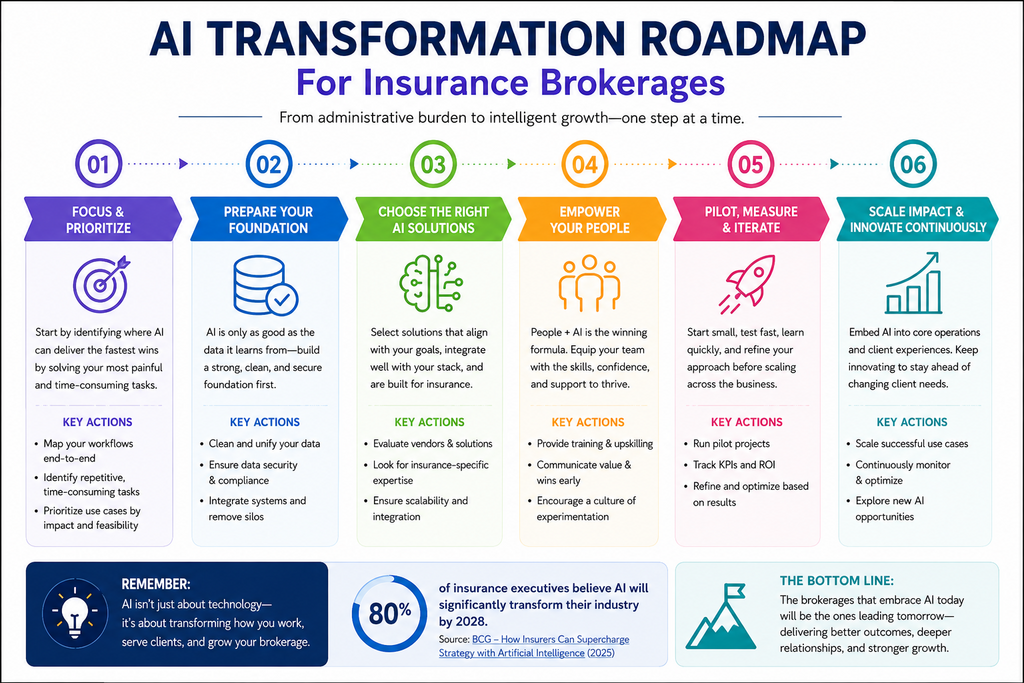
Source: https://chatgpt.com/
How to Build the Stack and Roll it Out Without Creating a Very Expensive Toy
AI automation is not a one-size fits all.
- Small brokerages can start inside the tools teams already use: secure productivity copilots, meeting notes, document summaries, and lightweight workflow automation.
- Midsize firms usually get the biggest jump when AI is grounded in the CRM or AMS and connected to service inboxes, appetite data, and renewal workflows.
- Enterprise brokers need the grown-up stack: model gateways, vector search, evaluation sets, audit logs, DLP, and vendor controls.
From the perspective of tech giants, we get a different perspective on things.
- Microsoft says Copilot inherits existing Microsoft 365 security, privacy, identity, and compliance policies.
- Google’s admin tooling exposes AI safety and compliance controls and says prompts, content, and generated responses are not used to train models outside the customer’s domain without permission.
- AWS Bedrock, meanwhile, offers secure, enterprise-grade access to multiple foundation models for firms that want more control over orchestration.
Then pilot like adults:
- Pick one workflow with high volume and visible pain, such as submission intake or renewal prep.
- Build a golden set of real cases.
- Benchmark cycle time, turnaround time, rework, hit ratio, error rate, retention, and cross-sell lift before the pilot.
- Put the human checkpoint exactly where licensed judgment matters.
- Log prompts, sources, outputs, edits, and approvals. Train a few respected internal champions first and show before-and-after dashboards to the skeptics.
The best change-management tactic is delight, not doctrine: let the team feel one process become easier, faster, and less annoying.
Three quick takeaways for brokers:
- Automate the tasks clients never wanted you doing in the first place.
- Keep humans on advice, coverage interpretation, and final recommendations.
- Measure AI like a brokerage tool, not a magic trick.
Use-case Table
The stack patterns below synthesize capabilities documented in official materials from Microsoft, Google, AWS, Salesforce, Applied, Vertafore, and Zywave. The ROI windows are editorial estimates based on implementation complexity and speed-to-value, not vendor claims.
|
Use case |
Core stack pattern |
KPI to watch |
Expected ROI window |
|
Submission intake and triage |
Email/attachment ingestion, data extraction, validation rules, AMS/CRM sync, RAG on appetites |
Turnaround time, incomplete submission rate, rework |
Fast |
|
Renewal prep and policy comparison |
Policy diffing, claims/policy summarization, market rules, proposal drafting |
Renewal cycle time, remarketing rate, retention |
Fast to medium |
|
Service knowledge assistant |
Cited search over SOPs, carrier docs, and policy wording, plus secure chat and approval routing |
First-response time, QA exceptions, training time |
Medium |
|
Book growth and cross-sell |
Book analytics, coverage-gap detection, next-best-action prompts, campaign automation |
Cross-sell rate, hit ratio, account growth |
Medium to strategic |
The smartest brokerages won’t use AI to replace human expertise. They’ll use it to amplify it.
Note: The content on this article is for informational purposes only and does not constitute professional advice. We are not responsible for any actions taken based on the information provided here.