
Modern corporations are built for predictability and scale—essentially machines designed for efficiency. And yet, the humans operating within them are driven by a volatile, deeply personal search for meaning. The result is a fundamental friction: while traditional management asks, “How do we increase retention?”, the individual wonders, “Why am I spending my finite life on this work?” When this human-centric concern is ignored, the corporate machine inevitably grinds to a halt.
As such, within recent years, a new executive archetype is emerging to fix the problem: Existential Leadership.
Highlights
- Unlike traditional management that prioritizes efficiency and output, existential leadership focuses on “curating significance.” It addresses the human need for purpose, so that employees may connect their daily tasks to a broader impact.
- The philosophy stems from the idea that freedom and responsibility are inseparable. It asks leaders to move away from micromanagement and “bad faith” (blaming external factors for choices) to empower employees as “co-authors” of their work and career sovereignty.
- Authenticity is the core requirement of existential leadership. A leader’s influence is derived from their own self-mastery and integrity—the “demand only what you manifest” rule—rather than their formal title or corporate scripts.
- The framework requires a mindset shift in which the leader is not the center of attention, but the “light” that illuminates the unique talents of the team. Success is achieved when the leader “clears the way” rather than dictating every move.
- Instead of offering false certainty or “toxic positivity,” existential leaders embrace ambiguity. They reframe anxiety as the “dizziness of freedom,” a natural byproduct of having the power to make meaningful choices in a volatile landscape.
 |
Author: Jonathan M. Pham |
What is Existential Leadership?
At its core, existential leadership is a human-centered framework built for today’s volatile markets. Rather than just managing tasks, it empowers leaders to engage with the human condition—addressing the fundamental needs for freedom, authenticity, and purpose.
Below are a few examples of how the existential leadership style manifests in real-world scenarios:
- Radical transparency over “need-to-know”: Instead of shielding the team from market volatility, the leader shares the reality of the situation. They respect the team’s agency and invite them to be co-authors of the solution.
- The “Why” over the “How”: In a project kickoff, the leader spends more time discussing the impact of the work on the end-user or society (the meaning) than the specific milestones (the tasks).
- Embracing “productive conflict”: Rather than forcing false harmony to keep things moving, the leader encourages deep, honest debate. They recognize that “freedom” in the workplace includes the freedom to disagree in pursuit of the best outcome.
- Coaching for career sovereignty: During one-on-ones, the leader asks, “Does this role still align with who you are becoming?” They prioritize the employee’s personal growth and authenticity, even if it eventually means the individual outgrows the current role.
- Holding space for ambiguity: In moments of crisis, the leader doesn’t provide “false certainty” with empty promises. Instead, they model how to remain grounded and purposeful while navigating the unknown, turning anxiety into a catalyst for creative action.
By shifting from overseeing output to curating significance, leaders transform rigid hierarchies into living ecosystems where personal meaning and organizational performance finally align.
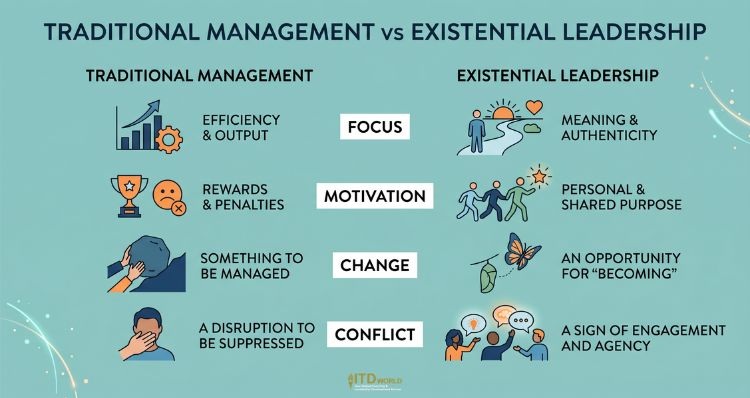
| Feature | Traditional Management |
Existential Leadership
|
| Focus | Efficiency and output |
Meaning and authenticity
|
| Motivation | Rewards and penalties |
Personal and shared purpose
|
| Change | Something to be managed |
An opportunity for “becoming”
|
| Conflict | A disruption to be suppressed |
A sign of engagement and agency
|
How existential leadership differs from traditional management theories
Demystifying Existentialism in the Boardroom
When corporate executives hear the word “existential,” many immediately associate it with a bleak, depressing worldview. To apply the philosophy effectively, it is essential that leaders first make a clear distinction between two terms: existentialism and nihilism.
Busting the Nihilism myth
Nihilism is the belief that all values and beliefs are essentially baseless. Because nothing can be objectively proven to matter, nothing should be valued.
Existentialism, conversely, is a philosophy of radical empowerment. It acknowledges that there may be no pre-determined, universal meaning to anything. However, rather than stopping at “nothing,” it places the burden of proof squarely on the individual. That we are the sole authors of our lives and work.
Far from being a dangerous or pessimistic outlook, existential leadership requires a form of “heroic” responsibility. Those who practice it do not wait for an organization to hand them a sense of purpose; they actively create it themselves.
The “professionalism” trap & “bad faith”
The modern corporate setting relies heavily on a specific social mask known as “professionalism,” which functions as a form of emotional and intellectual curation. This rigid persona demands constant certainty and “can-do” energy, leaving little room for the complex realities of the human condition.
When leaders hide behind this mask, they fall into what existential philosophers called “Bad Faith” – which occurs when individuals pretend they have no choice in a situation. In the workplace, we can see it in the manager who blames “the economy,” “company policy,” or “the board” for a poor decision, while refusing to take ownership of their own autonomy.
Existential leadership requires one to bravely tear down all masks and embrace the freedom—and responsibility—of choice.
Read more: Self-awareness in Leadership – The Foundation for Growth
Beware of “Existentialism-lite”
As the modern workforce has become more vocal about their need for purpose, many organizations have attempted to co-opt this drive through “Purpose-Driven Branding”. For example, some offer pre-packaged mission statements, such as claiming they aren’t just selling software, but “democratizing data for a better tomorrow”.
This approach is what we might call “Existentialism-Lite”. It is designed to scratch the individual’s itch for meaning without actually allowing them to question the fundamental utility of their daily work.
A true existential leader recognizes that a catchy corporate slogan cannot replace genuine, individualized meaning. The latter cannot be mandated from the top down; it must be cultivated from within.
Read more: Leading Gen Z – From Boardroom Cliché to Human-centric Management

The existential theory of leadership
The “Inside-Out” Approach: Existential Leadership Starts with Self-Leadership
While unfortunate, we have to admit that traditional leadership development is often hypocritical, focusing almost entirely on how to manage, motivate, and persuade others. With existential leadership, the framework is completely flipped though; accordingly, the extraordinary quality of a leader is not derived from how they handle other people, but rather from how they master themselves.
This is an intensely personal, practical discipline of “inside-out” self-leadership. The core premise is simple but demanding: if you have not mastered your own internal world, you have no business attempting to master an external organization. The more energy you spend on trying to control others, the more you lose influence over the one variable you actually control—yourself.
Therefore, instead of relying on traditional persuasion to push a team forward, an existential leader focuses on attraction. They aim to become a beacon of congruence, drawing followers naturally through their authentic existence and actions.
The mantra of existential leaders: “Demand only what you manifest”
At the heart of existential self-leadership is a strict ethical rule: you must “demand only what you manifest”. You have absolutely no right to expect discipline, honesty, or hard work from the workforce if you yourself are not visibly and consistently modeling those exact qualities in daily life.
Example: A vice president cannot authentically demand that their team embrace vulnerability, admit mistakes, and take innovative risks if that same vice president deflects blame whenever a quarterly target is missed.
In this framework, your corporate title or formal role does not grant you the right to lead. People will ultimately follow you for who you are—your existence and congruence—not just for what you tell them to do.
Read more: Leading by Example – Key to Truly Inspiring Action & Trust
The integrity filter
To maintain such a high standard, existential leaders run their actions through a strict “Self Filter” to guarantee integrity.
- Criticize only if you actively self-criticize.
- Inspire only if you know how to self-inspire.
- Discipline only if you practice rigorous self-discipline.
- Empathize only if you hold the capacity to self-empathize.
By winning the internal battle first, the external victory of building a high-performing, trusting team follows naturally.

6 Pillars of Existential Leadership
More than ever, leadership today needs to move beyond “managing tasks” and engage with the “human condition”. To ensure sustainable growth, organizations must recognize that their employees are not simply cogs in a machine, but individuals wrestling with profound psychological realities.
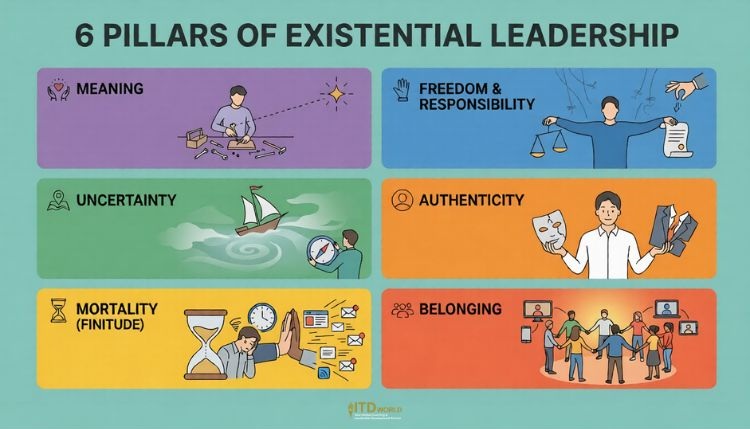
Below are six fundamental human concerns (or “givens”) that should be addressed to maintain a resilient workforce:
- Meaning
Leaders must realize the innate human quest for purpose in one’s daily labor. This involves overcoming the “existential vacuum” by helping people connect their daily, seemingly mundane tasks to a broader, impactful organizational purpose.
- Freedom & responsibility
A core existential tenet is that you cannot have freedom without taking ultimate responsibility for your choices. In a corporate setting, it means transitioning from rigid schedules and micromanagement to true autonomy and outcome-based productivity.
- Uncertainty
Today’s business owners are constantly navigating a “VUCA” (Volatile, Uncertain, Complex, Ambiguous) environment. Existential leaders thrive in ambiguity because they do not rely on pre-determined rules; instead, they adapt and make active decisions in the face of the unknown.
- Authenticity
This requires leading in a way that is true to genuine human values rather than simply reciting corporate scripts.
- Mortality (Finitude)
A core tenet of existentialism is that because our time on earth is finite, our choices carry significant weight. In the workplace, acknowledging finitude means realizing that your employees are trading their limited life-hours for the company’s mission. As such, leaders should not just respect physical limits to prevent burnout; their job is to foster an environment where individuals feel their finite time is being spent on something genuinely worthwhile, rather than squandered on busywork or toxic office politics.
Read more: Always-on Culture – How the Availability Trap Erases Profits
- Belonging
The modern workplace must combat the isolation and “disconnection” caused by remote and hybrid work environments.
Read more: Change Fatigue in the Workplace – Why Your New Initiative is Stalling
6 pillars of the existential workplace
The “John” Case Study: Existential Crisis in the Modern Matrix
To understand how the above-mentioned pillars interact in the real world, let us examine the practical friction points of the post-pandemic era through “John,” a typical project manager.
When John transitioned to remote work, he experienced what we call “The Blur”: the physical “hub” of the office was removed, which caused the boundaries between his personal life and work to dissolve and led to burnout. Without regular face-to-face interaction, John experienced a widening Culture Gap; the company’s previously vibrant culture and values became incredibly difficult to sustain. In the end, he became totally disconnected and disillusioned.
This Isolation Factor—the loneliness and lack of belonging John experienced—is more than just a personal issue; it is a critical leadership challenge that directly impacts both mental well-being and overall organizational cohesion. When leaders adopt the above existential pillars to guide their management strategy, they are better equipped to identify these struggles early and intervene with empathy, autonomy, and purpose, rather than simply demanding more output from an exhausted team member.
How an existential leader intervenes: In the case of John, instead of merely offering him a wellness day or demanding he meet his KPIs, an existential manager would step in to address the root “Culture Gap.” In their 1-on-1, they would strip away the corporate mask and ask,
“John, beyond the deliverables, what parts of this role still make you feel alive and connected to your own values?”
By acknowledging John’s isolation without judgment, the leader grants him the autonomy to redesign his workflow—perhaps shifting his focus to mentoring junior team members or leading a collaborative cross-departmental project. This moves him from a passive victim of the remote-work matrix back into the active “co-author” of his career.

The Paradox of the “Marginal Leader”
Traditional organizational charts almost always look like ladders; accordingly, people are constantly ranked and evaluated as “better” or “worse” than their peers. At the same time, the leader at the top is treated like a “Philosopher King” – one who holds the ultimate truth and issues mandates to the “lesser” ranks below.
Existential leadership realizes the limitations of the above-mentioned framework; specifically, when an individual places themselves at the absolute center of the organization, they automatically make everyone else feel marginalized. To cultivate a truly empowered team, it is essential that the management adopt a new mindset: the paradox of the “marginal leader”.
Dismantling the ladder & embracing “quiddity”
Instead of evaluating team members on a vertical ladder of worth, an existential leader focuses on what philosophers call “Quiddity”—the unique essence or “whatness” of a person.
- The mindset shift: They understand that an apple is not “better” than an orange; the two are simply incomparable. As such, rather than forcing every employee to conform to a single, centralized standard of “the perfect worker,” they are concerned with how to best utilize each individual’s distinct capabilities.
- The goal: The objective is not to dictate exactly how a team should operate, but to “clear the way”. By removing bureaucratic obstacles and hegemonic rules, the leader creates a communal space of equals where every individual’s unique existence and talent can fully unfold.
Read more: Cognitive Diversity in the Workplace – The Secret Ingredient for High-performance Teams
The leader as “light”
To understand how the above-mentioned paradox looks like in practice, let us draw upon the philosopher Maurice Blanchot’s metaphor of light. Think about walking into a brightly lit room. If the lighting is designed perfectly, you do not stare directly at the lightbulb itself. You just notice how beautifully the light illuminates the artwork, the furniture, and the architecture of the room.
Traditional “hero leaders” want to be the lightbulb—they want all eyes on them. Existential leaders, however, are aware that their leadership is most effective when they themselves go unnoticed.
Example: When a team successfully lands a massive client account, a traditional leader is likely to center themselves in the celebration, taking credit for directing the strategy. An existential leader would, however, step back, acting as the light that illuminates the brilliant data analysis of one employee, the creative design of another, and the masterful presentation skills of a third. They do not seek to be the center of attention; they exist to make the unique essence of their team visible to the rest of the organization.
Read more: Ego in Leadership – How to Tame It for the Greater Good
The Bottom-Line Impact: Why CEOs are Making the “Existential Pivot”
While existential philosophy mainly deals with the human condition, its application in the workplace is more than merely a “soft” human resources initiative. These days, top executives are increasingly recognizing that fostering meaning and authentic engagement is the primary engine of 21st-century business success. Given the current workforce’s alarmingly high risk of turnover—and one-third of those being the high-performing talent organizations cannot afford to lose—ignoring the existential needs of employees carries a massive financial cost.
Engagement as currency
When leaders cultivate an environment where individuals feel their voices genuinely matter, they are essentially building the ultimate corporate currency: trust. According to Tana Le Moigne of Google, maintaining an open, democratic dialogue connects the “hearts as well as heads” of the workforce. This emotional connection is key to the psychological safety necessary for innovation. Without it, a company inevitably enters a cultural “death spiral” of disengagement.
Read more: Employee Engagement in the Digital Age
Establishing sustainable momentum
In traditional management, the “hero leader” is expected to provide all the momentum, constantly pushing and motivating the team to hit targets. Yet this approach is inherently fragile; a company reliant on a single leader’s energy will inevitably stumble if that individual leaves.
When a team is existentially engaged and operates with freedom, the dynamic shifts. The leader no longer has to be the “engine” generating all the power. Their role is simply to “channel” the energy and passion the team already radiates, laying the foundation for a highly sustainable enterprise.
Reversing the profit formula
The traditional corporate contract operated on a straightforward assumption: people work to earn money in order to find fulfillment outside of the office. However, that mindset has, to a certain extent, become outdated in the modern technology age.
The future of high-performing businesses lies on empowerment and autonomy. By reversing the old formula, forward-thinking leaders become better equipped to embrace the new reality: employee fulfillment leads directly to productivity, which ultimately drives organizational profit.

How to Practice Existential Leadership
Understanding existential philosophy is intellectually stimulating, but its true value lies in application. Managers need practical ways to translate concepts like “finitude” and “authenticity” into their daily operations, strategic planning, and one-on-one meetings.
To bridge the gap between abstract philosophy and concrete action, leaders can equip themselves with the following existential coaching tools:
-
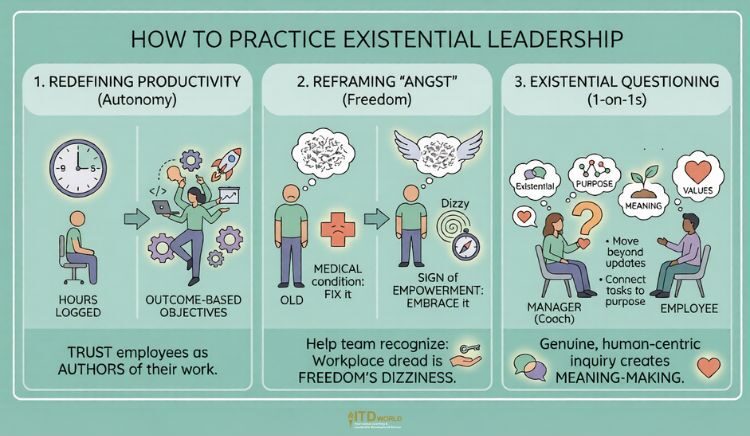
Redefining productivity (Embracing autonomy)
Traditional management relies on the old-school 9-to-5 “butt-in-seat” mentality, measuring success by hours logged. An existential approach requires redefining productivity from a static measure of time-bound tasks to a dynamic metric grounded in actual outcomes.
The Application: Instead of monitoring when an employee logs online, an existential manager sets clear, outcome-based objectives and grants the person the autonomy to achieve them. This operationalizes the concept of freedom, signaling that the organization trusts the employee to act as the author of their own work.
Read more: The Art of Delegation – Transforming from a Doer to a Multiplier
-
Reframing “angst” (Anxiety as a sign of freedom)
In volatile business environments, anxiety and the fear of failure are prevalent. The traditional corporate response is to try to “fix” it through toxic positivity or rigid procedural rules.
Existential leaders take a radically different approach: to them, anxiety should be framed not as a medical condition to be “cured”, but as a completely natural human response to freedom and the weight of choice.
The Application: Leaders can help team members recognize that their workplace dread is, many times, just the “dizziness of freedom” – the realization that they have the autonomy to make decisions. When a team member is paralyzed by the ambiguity of a new project, a leader can validate that fear as a positive sign of empowerment, saying,
“It is normal to feel anxious here because there is no predetermined playbook. You have the freedom to design the solution.”
Read more: Decision Making Framework – How to Eliminate Analysis Paralysis
-
Existential questioning in 1-on-1s
Executive coaches and HR professionals are increasingly adopting existential questioning to help professionals discover their own intrinsic values, rather than forcing them to conform to cookie-cutter business frameworks. Managers can adopt this same coaching technique during their regular check-ins.
The Application: Move beyond transactional updates. While you still need to know the status of a project, it’s important that you intentionally carve out time to connect daily tasks to a broader purpose, so that your team members are better equipped to overcome the “existential vacuum“.
- Instead of: “Are we going to hit Friday’s deadline?”
- Say something like: “How does the work you are doing on this project align with what you find most meaningful in your career?” or “Where do you feel you have the most freedom to make an impact right now?”
By replacing standard management scripts with genuine, human-centric inquiry, standard performance reviews are now transformed into profound opportunities for meaning-making.
Read more: The Player-coach Leadership Style – Mastery of Two Worlds
Existential coaching techniques for executives: How to apply the philosophy to modern management
Existential Leadership Books
- Leading Existential Change in Higher Ed: Mergers, Closures, and Other Major Institutional Restructuring – by Ricardo Azziz, Lloyd Jacobs, Bonita Jacobs, Richard Katzman
- An Existential Approach to Leadership Challenges – by Monica Hanaway
FAQs
Is “existential leadership” an oxymoron?
It is easy to assume that because existentialism champions radical individual freedom, it cannot coexist with organizational leadership. However, existential leadership is not about letting everyone do whatever they want (anarchy). Rather, its purpose is to align individual autonomy with collective goals.
An existential leader doesn’t force compliance; they curate an environment where people freely choose to commit to the organization’s mission, taking full ownership of their contributions.
How do existential leaders balance employee autonomy (freedom) with organizational accountability (responsibility)?
In existential philosophy, freedom and responsibility are two sides of the same coin. (to quote Jean-Paul Sartre, humans are “condemned to be free,” meaning we are entirely responsible for our choices) Existential leaders balance these elements by transitioning from micromanagement to outcome-based accountability. They grant team members the freedom to determine how the work gets done, but in return, they expect them to take absolute ownership of the results.
You cannot claim the freedom of self-direction without accepting the responsibility of the outcome.
What is the difference between existential leadership and authentic leadership?
While the two are closely related, “Authentic Leadership” has unfortunately devolved into a corporate buzzword that often means simply “being yourself” or “sharing your feelings.” Existentialism provides the foundational philosophy that makes true authenticity possible.
| Feature | Authentic Leadership |
Existential Leadership
|
| Core Focus | Leading with transparency, strong values, and emotional honesty. |
Leading by embracing the human condition: freedom, meaning, and finitude.
|
| View of Authenticity | A trait to be practiced and communicated to build trust. |
A state of existence achieved by actively rejecting “bad faith” and owning your choices.
|
| Approach to Conflict | Resolved through empathy and finding common ground. |
Embraced as a necessary byproduct of free-thinking individuals pursuing the “truth”.
|
What is “existential coaching” and how can it develop better leaders?
Existential coaching is a specialized developmental approach used by executive coaches and HR professionals. Instead of using cookie-cutter business frameworks or focusing solely on performance metrics, the focus is on exploring a leader’s worldview. Deep, probing questions are utilized to help executives uncover their intrinsic values, confront their own anxieties about uncertainty, and discover their purpose.
For organizations, it is one of the most effective ways to transition managers from mere task-masters into true leaders.

Final Thoughts
Existential leadership is not a soft HR initiative; it is a rigorous, “inside-out” discipline that demands radical honesty from the person at the top. By moving away from the “professional mask” and the safety of rigid hierarchies, you invite the team into a space where their unique essence—their quiddity—can finally drive organizational success.
In an age of volatility and burnout, the most effective leaders won’t be those who provide all the answers, but those who have the courage to hold space for the questions. The pivot starts with you: stop managing tasks, start curating significance, and lead from a place of authentic existence!
ITD World provides specialized coaching and training solutions designed to help leaders & organizations secure a competitive advantage – and be equipped to win in today’s dynamic landscape. Contact us today to learn more about our world-class programs!
Other resources you might be interested in:
- Ego in the Workplace: The Hidden ‘Evil’ Behind Team Dysfunctions
- Human Leadership in a Digital World: Skills & Strategies for Success
- Leader vs Boss: 11 Key Differences (Which One Are You?)
- Mindful Leadership: Slow Down to Move Forward
- Spiritual Leadership: A Remedy for Today’s Workplace Woes