

The “always-on” culture in the modern corporate ecosystem has turned the workday into a marathon of fragmented attention. Constant multitasking and back-to-back virtual meetings have fueled a global burnout epidemic, with Gallup reporting that nearly half of the workforce feels chronically stressed. More than just a wellness issue, it is the cause of a $8.9 trillion economic crisis driven by absenteeism, attrition, and lost productivity.
To combat this cognitive fatigue, organizations are pivoting to mindfulness and business strategies as a core pillar of performance. No longer a “soft perk,” mindfulness has evolved into a scientifically validated tool designed to protect mental well-being and drive sustainable corporate results.
 |
Author: Jonathan M. Pham |
Highlights
- Rather than a “new-age” trend, mindfulness in business is a secular discipline of “trained perception”—applying deliberate, non-judgmental focus to real-time tasks like deep listening or single-tasking.
- Research shows that mindfulness promotes neuroplasticity, shrinking the brain’s stress center while strengthening the areas responsible for logic and strategy. This translates to measurable business gains.
- Mindful leaders create psychological safety, which is the primary driver of innovation. By using “micro-practices” like the “Minute to Arrive” or “Box Breathing,” managers can move off autopilot, bypass cognitive biases, and respond to high-pressure situations with composure rather than reactivity.
- For a mindfulness initiative to be effective, it must be paired with structural empathy—addressing systemic issues like unrealistic workloads and ensuring communication boundaries—rather than just offering apps to overstressed staff.
- Successful corporate programs should be voluntary, secular, and data-driven. To be inclusive, companies should offer diverse modalities—such as mindful movement or focused creativity—to accommodate different neurodivergent needs and hybrid work schedules.
What is Mindfulness in Business?
In a corporate context, mindfulness is a secular, practical discipline: it refers to the ability to pay deliberate attention to the present moment—both internal thoughts and external environments—without immediate judgment. While often confused with meditation, the two are not the same.
- Meditation is the “practice facility” where you train the brain to focus
- Mindfulness, on the other hand, is the “on-field performance,” applying that focus to real-time tasks like single-tasking a report or listening deeply during a meeting.
This is not a new-age trend, but a evolution of “trained perception,” a skill Peter Drucker identified as a prerequisite for leadership decades ago. For the modern professional, mindfulness acts as a cognitive circuit breaker. By creating a “wedge of space” between a stimulus (a stressful email) and a response, leaders are better equipped to move off “autopilot” and choose intentional actions rather than reacting out of habit or frustration.
Trained perception and disciplined emotion are as pertinent to the ability to earn a livelihood as they are to the mature human personality.
Peter Drucker, ‘The Age of Discontinuity’ (1968)

Mindfulness and business
The Business Case for Mindfulness: Science and ROI
The core of mindfulness and business performance lies in neuroplasticity: the brain’s ability to physically reorganize itself. As confirmed by research, regular practice shrinks the amygdala (the “fight-or-flight” stress center) while thickening the prefrontal cortex (the seat of logic and strategic planning).
By rewiring the brain’s response to stress, mindfulness plays a crucial role in cultivating three essential workplace competencies as follows:
- Cognitive flexibility: Adapting to change without panic.
- Deep work: Faster recovery from distractions to maintain focus.
- Resilience: The capacity to bounce back quickly from setbacks or feedback.
The financial ROI is equally concrete. Some of the world’s most data-driven companies have measured the financial impact of these initiatives:
- Aetna
The US health insurer rolled out a comprehensive mindfulness program to over 13,000 employees. The results were astounding. Participants reported a 28% reduction in stress levels and a 20% improvement in sleep quality.
On the operational side, Aetna saw an average gain of 62 minutes of productivity per employee per week—an increase they valued at $3,000 per employee per year. In addition, the company experienced a 7% drop in healthcare costs, saving over $6 million in a single year.
- SAP
The global software giant appointed a Chief Mindfulness Officer and rolled out a rigorous training program. Based on internal surveys, SAP reported a 200% return on investment from their mindfulness initiatives, citing significant improvements in employee engagement, leadership trust, mental clarity, and a notable decrease in absenteeism.
When looking at these numbers, the benefits of mindfulness in the workplace clearly extend far beyond feeling good; they are a direct lever for profitability, risk mitigation, and operational excellence.
Mindfulness and business
The Mindful Manager: Leadership and EQ
Mindfulness exponentially increases leadership impact by strengthening Emotional Intelligence (EQ). Because emotions are contagious in high-pressure environments, a reactive leader breeds a culture of anxiety. Conversely, mindful leaders use self-regulation to create psychological safety—the essential belief that a team can take risks or admit mistakes without fear of retribution. This safety is the primary driver of innovation and open collaboration.
Beyond culture, mindfulness also helps enhance strategic decision-making by combating decision fatigue. It allows leaders to bypass cognitive biases using a “beginner’s mind”—approaching complex problems with curiosity rather than rigid preconceptions. When their mental slate is clear, managers become better equipped to navigate ambiguity with composure, transforming conflict resolution into creative problem-solving.
Read more: Self-awareness in Leadership – The Foundation for Growth
How to Practice Mindfulness at Work
For many professionals, finding 30 minutes to sit cross-legged in a quiet room is an impossible luxury. Fortunately, integrating mindfulness into your daily routine does not require a monk-like commitment. It all comes down to strategically deploying micro-practices throughout your day.
-
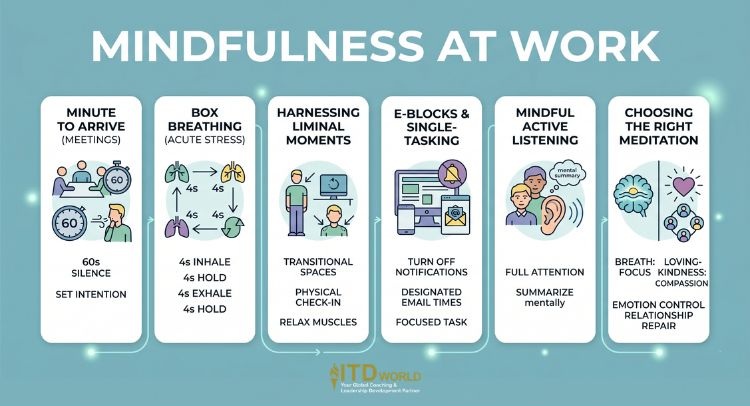
The “Minute to Arrive”
Before diving into a meeting, most participants are mentally lingering on the email they just sent or stressing about the deadline due at 5:00 PM. Companies like SAP and Verizon Media resolve this by instituting a “Minute to Arrive“. The idea is that at the start of a meeting, the team takes 60 seconds of complete silence. Participants are instructed to place their feet flat on the floor, take a few deep breaths, and set an intention for the meeting.
A simple practice, yet it is amazing for clearing residual cognitive residue and making sure everyone is mentally present.
Read more: Unnecessary Meetings – Ending the Invisible Tax on Your Team’s Performance
-
Box breathing (Tactical breathing)
When facing acute stress—such as right before a major presentation or after receiving negative feedback—your sympathetic nervous system naturally goes into overdrive. In that case, you can “hack” your nervous system using a technique popularized by Navy SEALs called “Box breathing” (4x4x4x4):
- Inhale deeply through your nose for 4 seconds.
- Hold your breath for 4 seconds.
- Exhale slowly through your mouth for 4 seconds.
- Hold your lungs empty for 4 seconds.
Repeat the cycle four times to rapidly lower your heart rate and restore calm.
-
Harnessing liminal moments
Liminal moments are the transitional spaces in your day. (e.g. waiting for a Zoom meeting to connect, waiting for your computer to reboot, or standing in line for coffee) Instead of instinctively pulling out the phone to scroll through social media or check emails, use these 30-to-60-second windows to do a physical check-in. Notice the tension in your jaw or shoulders, take a deep breath, and actively relax your muscles.
The more we are able to create space between stimulus and reaction, the more control we will have over our emotional lives.
Chade-Meng Tan, Search Inside Yourself
-
E-blocks & single-tasking
Multitasking is a myth; the human brain can only rapidly switch between tasks, burning valuable energy with every pivot. To practice mindfulness, it’s essential that you commit to single-tasking.
- Implement “E-blocks” (email blocks) by turning off all notifications and checking your inbox only during two or three designated 30-minute windows per day.
- When you are writing a report, give it your undivided attention. When your mind inevitably wanders, gently acknowledge the distraction and bring your focus back to the task.
-
Mindful active listening
During one-on-one meetings, most of us fall into the trap of formulating our response while the other person is still speaking. However, mindfulness requires you to drop all agendas and bring your full attention to the speaker’s words, tone, and body language. If you get distracted, try to mentally summarize what they are saying. This not only improves comprehension but builds profound trust and rapport.
You can make more friends in two months by becoming really interested in other people than you can in two years by trying to get other people interested in you. Which is just another way of saying that the way to make a friend is to be one.
Dale Carnegie
-
Choosing the right meditation for the right moment
It is important to note that not all mindfulness practices yield the same results. Research shows that breath-based meditation is excellent for improving focus and emotional regulation. However, because it focuses inward, it can sometimes reduce feelings of guilt, making people less likely to take accountability for a workplace mistake.
If you are a leader needing to foster empathy or repair a fractured relationship, loving-kindness meditation (which involves silently wishing well to yourself, a loved one, and even a difficult colleague) is scientifically proven to boost compassion, interpersonal connection, and collaborative behavior.
Read more: Leadership Self-reflection – Key to Leading with Clarity
Mindfulness and business
Building the Culture: Implementing a Corporate Mindfulness Program
- Secure leadership buy-in
Anchor your pitch in data—ROI, neuroscience, and retention rates. To destigmatize the practice, leadership must model the behavior; when executives participate, it creates an “umbrella of acceptance” for the entire workforce.
- Keep it voluntary and secular
Try to stay away from “mandatory wellness,” which only breeds resentment. In many cases, it is also recommended that you strip away spiritual jargon and frame the program using professional terms like “attention training” or “cognitive resilience.”
- Structured training & internal champions
The idea is to move beyond simple app subscriptions and invest in structured 8-week MBSR (Mindfulness-Based Stress Reduction) courses or workshops. To ensure longevity, you should consider empowering “mindfulness champions”—peer-level advocates who facilitate weekly sessions and maintain the program’s momentum.
- Adapt for hybrid work
In today’s distributed workforce, the boundaries between work and home have evaporated, leading to severe burnout for remote workers. Mindfulness serves as a powerful tool to restore work-life balance. Encourage teams to implement “Shut Down Routines”—a mindful end-of-day practice where employees review their achievements, write down their priorities for tomorrow, and physically close their laptops to transition mentally into personal time.
Additionally, institute “no-meeting” days to allow for deep work, and encourage employees to take mindful walks away from their screens during the day.
Read more: Spiritual Leadership – A Remedy for Today’s Workplace Woes
Avoiding “McMindfulness”: Mindfulness is Not a Band-Aid
As corporate interest grows, so does the risk of “McMindfulness”—the practice of using meditation to pacify stressed employees without fixing the root causes of their distress. Organizations must recognize a fundamental truth: Mindfulness cannot fix a toxic culture.
According to McKinsey, burnout is a systemic issue, not an individual failing. It is driven by imbalances between job demands (unrealistic workloads, toxic management) and resources. As such, offering a meditation app while maintaining a 70-hour work week is ineffective and only erodes trust.
A truly mindful organization pairs cognitive training with structural empathy, such as:
- Enforcing boundaries on after-hours communication.
- Addressing toxic behavior from high-performers.
- Ensuring manageable workloads and pay equity.
Finally, programs must be designed in a way that ensures inclusivity. Standard “sitting in silence” can be distressing for employees with ADHD, trauma, or severe anxiety. To ensure accessibility, companies should offer diverse modalities, including:
- Mindful movement: Walking or stretching.
- Focused creativity: Guided journaling or task-based presence.
- Regulation tools: Techniques tailored to different brain wirings.
The goal of mindfulness and business integration is to foster genuine regulation and presence, which requires both a healthy mind and a healthy system.
Real-World Success: Top Companies that Are Embracing Mindfulness
- Google: Perhaps the most famous pioneer in this space, Google developed the Search Inside Yourself Leadership Institute (SIYLI). Created by a Google engineer in collaboration with neuroscientists and emotional intelligence experts, this program combines mindfulness practices with EQ training. It became so popular internally that it was eventually spun off into an independent non-profit that now trains corporate leaders worldwide.
- LinkedIn: Under the guidance of compassionate leadership advocates like former CEO Jeff Weiner, LinkedIn has deeply integrated mindfulness into its culture. They utilize 30-day meditation challenges, offer peer-led community sessions, and actively encourage team members to take time out of their day for mental health.
- Intel: The tech giant’s “Awake@Intel” program is a comprehensive 10-week mindfulness course. What sets Intel apart is its rigorous approach to measurement. They track outcomes using the Mindfulness Attention Awareness Scale (MAAS), consistently reporting multi-point improvements in stress reduction, meeting engagement, and relationship quality.
To support these cultural shifts, many organizations provide access to the best mindfulness apps for employees. Enterprise partnerships with platforms like Headspace, Calm, Meditopia, and Insight Timer allow employees to access guided meditations, sleep stories, and focus music on their own terms, providing scalable support across global workforces.

Mindfulness and business
Final Thoughts
In an era of relentless volatility, an organization’s greatest asset is the focused and resilient minds of its people. Mindfulness and business integration is the ultimate antidote to digital cognitive depletion; by anchoring teams in the present, companies can slash the costs of burnout while unlocking a culture of psychological safety and agile problem-solving.
True success requires a balance of individual practice and systemic organizational support. The future does not belong to the fastest multitaskers, but to the leaders who prioritize mental clarity and adaptability to drive sustainable performance.
ITD World provides specialized coaching and training solutions designed to help leaders & organizations secure a competitive advantage – and be equipped to win in today’s dynamic landscape. Contact us today to learn more about our world-class programs!
Other resources you might be interested in:
- Resilient Leadership: The Reliable Compass Through Uncertainty
- Thoughtful Leadership: Why It Matters in Today’s Hectic World
- Authentic Leadership: Moving Beyond the Mask to Deliver Impact
- Human Centered Leadership: The Importance of a ‘People First’ Mindset
- Building a Lasting Leadership Legacy: A How-to Guide