Ever watched a dull safety training video and forgotten almost everything you saw the very next day? You are certainly not alone!
A traditional corporate training session tends to go like this: employees are either gathered in a brightly lit conference room or dialed into a mandatory Zoom call. The instructor begins clicking through a fifty-slide PowerPoint presentation filled with bullet points and dense text. Within minutes, attendees are zoning out, discreetly checking their emails, or multi-tasking in background windows. After a brief, easily guessable multiple-choice test, the training is marked complete.
Yet, the consensus among human resources (HR) and learning and development (L&D) professionals is clear: traditional online training is, many times, highly inefficient, uninspiring, and rapidly forgotten.
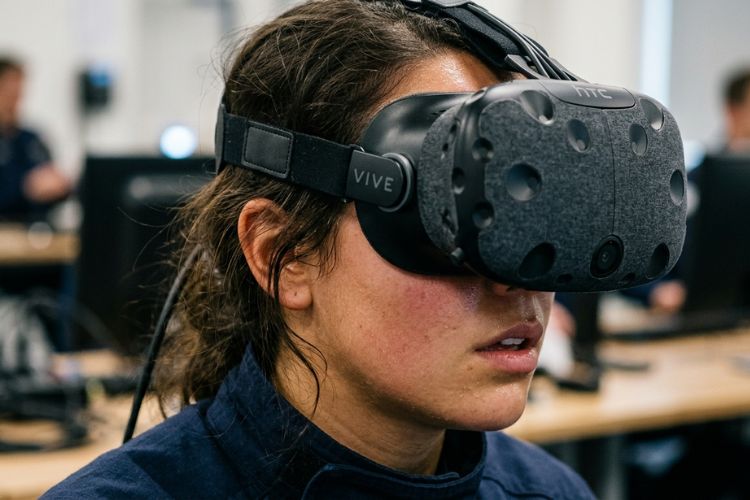
When lives are on the line, or when multi-million dollar deals hang in the balance, this “forgetting curve” has become a risk that modern businesses can no longer afford to take. And that’s where Virtual Reality (VR) comes in. Far more than a futuristic gaming gimmick, VR is widely regarded as a proven, transformative force for modern employee development.
 |
Author: Jonathan M. Pham |
Highlights
- Compared to traditional methods, VR learners train up to 4 times faster, stay 4 times more focused, and report a 275% increase in confidence when applying new skills.
- VR is being used for high-risk technical training (e.g., surgery, flight, or electrical maintenance) to allow for “safe failure,” as well as soft skills training (e.g., leadership and empathy) where managers can practice difficult conversations with realistic avatars.
- Beyond learning, VR offers standardized experiences across global teams, provides granular behavioral analytics (tracking gaze and decision-making), and supports sustainability by reducing the need for travel and physical training materials.
- The next phase of VR training is expected to involve Generative AI for unscripted, dynamic conversations and haptic feedback (gloves/suits) to allow users to physically feel virtual objects, further blurring the line between simulation and reality.
Introduction to Virtual Reality in Training and Development
To understand the current shift in corporate coaching and training, it’s helpful to briefly clarify the spectrum of immersive technologies, collectively known as Extended Reality (XR):
- Standard E-Learning / Virtual Training: Traditional web-based modules, video lectures, and digital manuals.
- Virtual Reality (VR): Fully encapsulated, computer-generated, three-dimensional simulated environments where the user is entirely immersed, often requiring a head-mounted display (HMD).
- Augmented Reality (AR) & Mixed Reality (MR): Digital overlays projected onto the physical world (frequently referred to as Spatial Computing), allowing users to interact with both physical and virtual objects simultaneously.
Virtual reality is fundamentally changing corporate development by transforming the passive consumption of information into active, experiential engagement. By bridging the gap between theoretical knowledge and practical application, VR improves knowledge retention, slashes training times, and delivers highly scalable returns on investment (ROI) across both technical “hard” skills and interpersonal “soft” skills.
Why Traditional Training is Failing (and Why VR Works)
For years, businesses have relied on conventional training methods like classroom lectures, dense manuals, and two-dimensional e-learning courses to upskill their workforce. While these have their place in foundational education, they fall dramatically short in delivering truly effective, behavior-altering learning experiences in the modern workplace.
The limitations of the status quo
Let’s face this: traditional training often feels like a bureaucratic chore rather than a developmental milestone, with various research associating it with a severe “forgetting curve”. Not to mention, traditional methods are notoriously expensive and logistically burdensome. Hiring expert trainers, booking venues, producing printed materials, and pulling employees away from their regular tasks all severely slow down productivity.
Lastly, the standard “one-size-fits-all” approach to corporate training routinely fails to accommodate neurodiversity and different learning styles. While some employees are auditory learners, others require visual aids or kinesthetic, hands-on practice to truly grasp a concept.
The science of “Learning Affordance” in VR
VR effectively disrupts these limitations by leveraging adult learning theory, which posits that adults learn best through experiential, hands-on practice. Immersive technology enables experiential learning in a completely distraction-free environment.
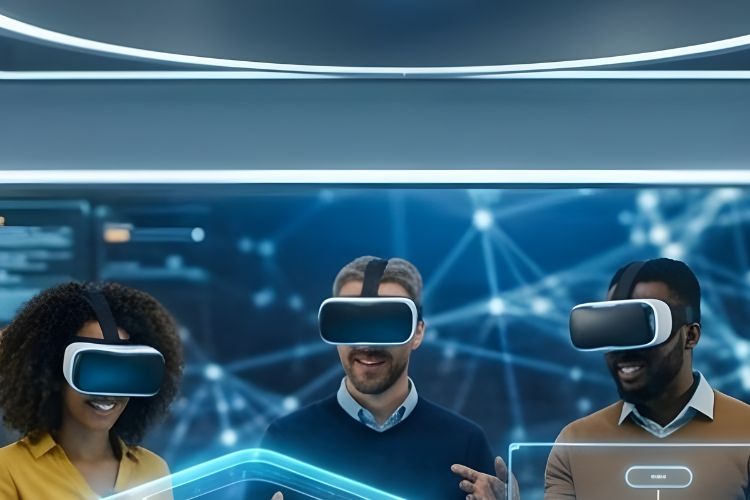
The efficacy of VR is based on a psychological concept known as “Presence“. When an individual puts on a high-quality VR headset, the visual and auditory immersion is so complete that the brain begins to treat the virtual experiences as real memories. The cognitive and behavioral learning is genuine, creating actual neural pathways and muscle memory.
No longer a passive observer, the user is now an active participant required to make decisions under pressure.
Virtual reality in training and development
The PwC Study
A landmark study conducted by PwC titled “The Effectiveness of Virtual Reality Soft Skills Training in the Enterprise” set out to measure the impact of VR against classroom and e-learning modalities. The findings were nothing short of revolutionary for the L&D sector:
- Speed to skill
Employees in VR courses can be trained up to four times faster than in traditional setups. A complex topic that took two hours to learn in a physical classroom was effectively mastered in just 30 minutes using VR. Even when accounting for the time needed to onboard a user into the headset, VR learners still completed the curriculum three times faster.
- Confidence in application
VR learners were found to be 275% more confident to act on what they learned after training—a 40% improvement over classroom learners and a 35% improvement over e-learners. By providing a low-stress, psychologically safe environment to practice high-stakes conversations, VR makes it easier for participants to cultivate genuine confidence.
- Focus & engagement
Today’s learners are frequently overwhelmed and distracted by smartphones and multitasking. VR presents a solution by commanding the individual’s complete vision and attention. As found out by PwC, VR-trained employees were up to four times more focused during training than their e-learning peers.
- Deep emotional connection
People understand and remember concepts better when their emotions are engaged. In fact, V-learners felt 3.75 times more emotionally connected to the content than classroom learners, and 2.3 times more connected than those clicking through web modules.
Benefits of Virtual Reality in Training and Development
Integrating virtual reality learning into a corporate training strategy offers measurable advantages that extend far beyond initial onboarding.
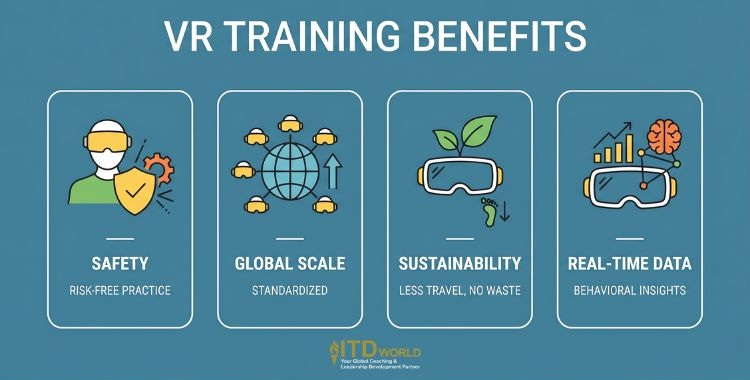
Safety & risk mitigation
For hazardous sectors like energy, construction, and healthcare, employees are expected to handle challenging, high-risk tasks daily. VR allows them to make critical mistakes safely.
For example, before handling heavy machinery in real life, a factory worker can practice Lockout/Tagout (LOTO) procedures in a virtual factory. If they fail to secure the power source, the virtual environment demonstrates the catastrophic consequences without any actual physical harm. This dramatically decreases the potential for real-world accidents, occupational injuries, and costly equipment damage.
Scalability & standardization
Traditional training results tend to vary wildly depending on the instructor’s mood, the venue, or the specific tools available that day. That’s not the case when it comes to VR training. Once a module is developed, whether for a single distribution center or fifty offices worldwide, every team member receives the exact same high-quality, standardized experience. This consistency is incredibly valuable for global teams striving to maintain uniform compliance and operational standards.
Sustainability & environmental impact
By utilizing virtual environments, companies completely remove the need for people to travel across the country for seminars, drastically cutting the organization’s carbon footprint. In addition, VR eliminates the physical material waste associated with mock-ups, disposable medical training supplies, or scrapped manufacturing materials that are typically destroyed during the physical learning process.
Real-time analytics and feedback
Traditional training evaluations are usually limited to post-session surveys or simple multiple-choice assessments. On the other hand, modern VR platforms – through the use of Experience API (xAPI or Tin Can) protocols – can integrate seamlessly with a company’s Learning Management System (LMS) or Learning Record Store (LRS).
Within a VR simulation, L&D managers can track granular performance metrics:
- How long did the employee take to identify a fire hazard?
- Did they maintain eye contact during a difficult conversation?
- What was their exact decision-making pathway through a branching scenario?
This real-time, behavioral data is infinitely more insightful than conventional test scores. Based on it, coaches may provide highly personalized feedback and precisely identify where one requires further upskilling.
Key Use Cases of Virtual Reality in Training and Development
The true value of VR is realized when the technology is applied to specific, targeted training needs within the organization.
Technical & high-risk training (Hard skills)
Historically, VR was best known for its use in flight simulation by organizations like NASA and the U.S. Air Force. These days, that same concept is applied broadly across commercial industries.
- Manufacturing & aerospace
VR is used to simulate assembly lines and intricate machinery operations. Engineers can assemble a virtual jet engine or troubleshoot equipment failures before touching real, multi-million-dollar components.
- Healthcare & emergency response
The University of Bern in Switzerland once successfully validated a VR training module aimed at teaching medical students how to treat dyspnoea (severe shortness of breath). The study proved that students significantly increased their confidence in treating acute patients without risking patient safety.
Similarly, firefighters and paramedics use VR to run through life-saving triage drills in fully simulated disaster zones.
- Utilities & construction
Many companies are utilizing VR to train workers on the maintenance of electrical grids and photovoltaic (solar) systems. For example, a VR simulator allows an electrician to assemble a solar installation step-by-step. If they make an error, the program simulates a short circuit, visually and auditorily demonstrating the consequences of the mistake. The worker then learns to respect the danger of the equipment without causing a real-world blackout or physical injury.
Leadership & empathy training (Soft skills)
It is a common misconception that VR is only useful for technical “hard” skills. In reality, it is proving to be a watershed tool for cultivating emotional intelligence, leadership, and communication skills.
Once, researchers at the Stanford Accelerator for Learning conducted a study to explore how VR may help managers develop empathetic communication. The study focused on a global corporation with 1.6 million employees. Participants, embodying a manager in VR, engaged in a performance review with a simulated, pre-recorded employee who was struggling with personal issues.
The study tested various conditions, including “perspective-taking,” where the participant actually swapped bodies and viewed the conversation from the avatar employee’s perspective, hearing their own previously recorded audio and watching their own body language.
Using natural language processing, researchers analyzed the managers’ subsequent communication styles. They found that practicing in VR significantly increased the managers’ expressions of understanding and empathy, shifting their language to be more inclusive and emotionally supportive.
Read more: Soft Skills in the Age of AI
Virtual reality in training and development
HR, onboarding & remote enablement
Onboarding is typically perceived as a tedious exercise in compliance paperwork. But with the use of VR, new hires can take virtual facility tours, meet holographic representations of key executives, and learn about company culture before they ever step foot in the physical office.
By allowing employees to “walk through” scenarios—such as dealing with a workplace harassment issue in a branching-narrative simulation—HR departments may foster a more emotionally connected onboarding process that greatly reduces new-job anxiety.
Customer service & sales enablement
Sales representatives and customer support agents often learn through trial and error—sometimes at the expense of losing a valuable client. With VR role-playing, sales teams may practice their pitch skills on virtual avatars powered by branching dialogue trees. They can learn to articulate complex value propositions and handle aggressive objections in a risk-free environment. If they say the wrong thing to a virtual CEO, they are simply asked to leave the virtual office; no real-world revenue is lost, and the person can instantly replay the scenario to correct their approach.
Read more: Employee Skill Development – Boost Your Bottom Line
Real-World Success Stories of Integrating Virtual Reality in Training and Development
- Walmart: Retail Training Excellence
As one of the earliest corporate adopters of VR, Walmart integrated the technology to train its massive workforce on everything from operating high-tech inventory equipment to handling the chaotic rush of Black Friday. By utilizing VR, the company discovered that training modules that once took 30 to 45 minutes in a classroom could be effectively condensed into 3 to 5-minute VR simulations, drastically improving operational efficiency and getting staff onto the floor faster.
- Hilton Hotels: Building Empathy Through VR
In the hospitality sector, Hilton introduced an innovative VR initiative aimed at corporate staff. Corporate employees utilized VR headsets to virtually perform the physically demanding daily tasks of the housekeeping staff. This simulation was not designed for technical proficiency, but rather to foster deep organizational empathy.
By experiencing the physical toll of the job firsthand, corporate decision-makers developed a greater appreciation for frontline workers, leading to a more cohesive and supportive workplace environment.
- Pfizer: Pharmaceutical Manufacturing
During the rapid scale-up required for the COVID-19 vaccine rollout, pharmaceutical giant Pfizer utilized immersive VR training to bring operators up to speed on sterile manufacturing processes. The experiential nature of the program resulted in a 40% reduction in training time, which allowed operators to safely and successfully manufacture billions of doses under immense global pressure.
- Maersk and Deutsche Telekom: Logistics and Collaboration
The shipping giant Maersk leverages VR to empower staff to navigate complex supply chain challenges brought on by climate change and port congestion. Meanwhile, Deutsche Telekom MMS, supporting digital transformation for over 2,100 employees, uses VR collaboration platforms (like Glue) to host remote workshops, product prototyping, and review meetings. This bridges the geographical gap, making remote workers feel as though they are sharing the same physical space as their colleagues.
- The Public Sector: NHS and Law Enforcement
The UK’s National Health Service (NHS) has deployed VR to tackle internal issues of racism and discrimination, placing staff into immersive scenarios that promote empathy and cultural awareness. Similarly, law enforcement agencies are adopting VR for police de-escalation training. Officers enter high-pressure, simulated domestic disputes or public disturbances where they are forced to practice effective communication and conflict resolution. This hands-on training emphasizes reducing the need for force and improving split-second decision-making.
Analyzing Costs & Long-Term ROI of Virtual Reality in Training and Development
For executive leadership, the transition to VR training hinges on one critical question: Is the return on investment worth the initial capital expenditure?
Implementing a VR training strategy requires an upfront investment in hardware (headsets), software licenses, and content creation. Historically, this made VR an exclusive tool for well-funded aerospace and military organizations.
However, the financial dynamics have shifted dramatically. Today, a business-grade VR headset ecosystem can be acquired for between $400 and $1,400 per unit—costs that are heavily offset by the economies of scale and long-term operational savings.
The tipping point of cost parity
The PwC study on VR efficacy highlighted the exact tipping point where VR becomes more financially viable than traditional methods. Because developing bespoke VR content requires an initial investment (often up to 48% greater than creating a standard e-learning module), a company needs a certain volume of learners to amortize the cost.
The research revealed that at exactly 375 learners, VR training achieved absolute cost parity with physical classroom training. As the program scales, the financial benefits multiply rapidly.
- At 1,950 learners, VR achieves cost parity with cheap, highly scalable e-learning web modules.
- At 3,000 learners, VR training becomes a staggering 52% more cost-effective than classroom training.
Impacting the bottom line via turnover & retention
Employee turnover is a massive financial drain on modern organizations. The average cost of replacing an employee can range from 150 to 200% of their annual salary due to recruitment fees, lost productivity, and severance packages. Replacing a $50,000-a-year employee can easily cost a company up to $100,000.
Because VR provides a highly engaging, interactive learning experience, it makes individuals feel significantly more invested in their personal development. In fact, organizations utilizing VR have reported between a 30% and 50% increase in retention rates.
By fundamentally reducing early attrition, VR pays for itself exponentially.
Hardware synergies: Laptops vs. VR headsets
When evaluating costs, business leaders should compare VR headsets to standard corporate laptops, which typically cost between $800 and $2,000. While a laptop is an indispensable tool, it is limited by its physical screen.
Modern standalone VR headsets, on the other hand, can actually serve as an extension of the laptop. Through virtual desktop applications, one wearing a VR headset can generate multiple massive, floating digital monitors in a virtual workspace. This eliminates the need to purchase physical dual-monitor setups for remote workers, effectively maximizing the utility of the hardware and turning the VR headset into a daily productivity tool, not just an occasional training device.
Challenges of Implementing Virtual Reality in Training and Development
Employee resistance & technophobia
Whenever new technology is introduced, there is natural human hesitation. Some employees, particularly industry veterans, may feel their expertise is being questioned, while others might simply be intimidated by the hardware.
Solution: HR leaders should employ Root Cause Analysis methods, such as the “5 Whys,” to understand the specific drivers of this resistance. Rather than mandating a massive, top-down VR overhaul, it’s better to ease the workforce into the technology. Start with a brief, 10-minute orientation session. Then use an entertaining “icebreaker” simulation—like virtual table tennis or a virtual museum tour—to allow team members to get comfortable with the controllers and the physical sensation of VR before introducing high-stakes compliance training.
Technical limitations & simulator sickness
A poorly optimized VR experience—characterized by latency (lag), low frame rates, or disjointed tracking—can cause “visually-induced motion sickness,” resulting in nausea, dizziness, and headaches.
Solution: Do not cut corners on hardware. Ensure the use of high-quality headsets (like the Meta Quest 3, HTC Vive, or Apple Vision Pro) that feature high refresh rates.
At the same time, instructional designers should build simulations that limit artificial locomotion (moving with a joystick rather than physical walking) and keep initial training modules short, ideally under 20 minutes, to prevent fatigue and overstraining.
Read more: Microlearning – How to Build a High-Impact, Bite-Sized L&D Strategy
Content creation costs (Bespoke vs. Off-the-shelf)
Many organizations stall their VR initiatives because they assume they must spend hundreds of thousands of dollars developing a hyper-realistic, bespoke digital twin of their exact office building.
Solution: Start with “off-the-shelf” applications. There is a growing marketplace of pre-built VR training modules for universal skills such as public speaking, active shooter response, standard safety protocols, and difficult conversations. Utilize these ready-made apps to prove the ROI to the C-suite.
Once the concept is validated internally, the organization can partner with specialized XR studios to develop custom, proprietary content tailored to specific company workflows.
A Step-by-Step Guide to Implementing Virtual Reality in Training and Development
To successfully navigate the transition to immersive learning, L&D leaders should follow a structured, framework-based approach. We highly recommend utilizing the RECIPE framework for meaningful gamification and serious game design: (developed by game design theorist Scott Nicholson)
- Reflection: Connecting the virtual training to real-life workplace events.
- Engagement: Creating interactive, non-passive learning loops.
- Choice: Allowing the learner autonomy to explore and make decisions.
- Information: Providing the underlying theoretical context.
- Play: Offering the freedom to fail in a safe boundary.
- Exposition: Wrapping the training in a meaningful, realistic narrative.
With the RECIPE framework in mind, here is a practical 5-step roadmap for corporate implementation:
-
Assess training needs and define objectives
Do not adopt VR simply for the sake of having new technology. Rather, identify the specific bottlenecks in your current organization. For example:
- Are new hires taking too long to reach full productivity?
- Are safety incident rates too high on the manufacturing floor?
Try to pinpoint the exact key performance indicators (KPIs) you intend to improve.
Read more: Training Needs Analysis (TNA) – From Insight to Impact
-
Choose the right hardware & software platforms
The next step is to evaluate the market based on your budget and IT infrastructure. Standalone headsets (like the Oculus for Business) offer mobility and ease of use for remote teams. On the other hand, PC-tethered headsets provide higher graphical fidelity necessary for incredibly complex technical simulations (like medical surgery). Decide whether your team will shoot 360-degree video (using tools like Adobe Premiere Pro and professional fisheye cameras) or build interactive 3D environments using game engines like Unity.
-
Curate or develop content
It’s recommended that you collaborate closely with subject matter experts within your company. For instance, if you are developing a safety module, involve your floor managers, safety officers, and technical developers from day one. Ensure the virtual environment’s narrative (Exposition) accurately reflects the daily reality of your workers, so as to prevent the training from feeling disconnected or overly academic.
-
Run a pilot program & gather feedback
Before launching company-wide, you should conduct a feasibility study with a small, diverse pilot group. Utilize established measurement tools like the System Usability Scale (SUS) to evaluate the interface, and the NASA-Task Load Index to ensure the cognitive workload is balanced—challenging enough to engage, but not so difficult as to frustrate.
According to usability experts, testing with just five users will typically uncover 85% of your software’s core usability problems.
Read more: Soliciting Feedback – Key to a Building a Better Workplace
-
Launch, measure & iterate
Now it’s time to roll the training out to the broader workforce, while utilizing your LMS integrations to track data rigorously. Look beyond completion rates; analyze the choices employees made within the branching scenarios. Conduct post-training surveys and track real-world performance metrics over the following months to continually refine the VR modules and prove the ongoing ROI to executive stakeholders.
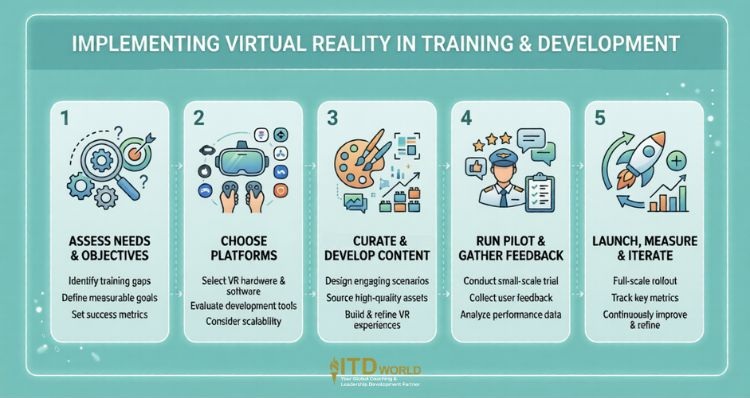
Implementing virtual reality in training and development
The Future of Virtual Reality in Training and Development
While VR is already a mature technology actively used by Fortune 500 companies, the immersive learning landscape is on the cusp of an even more radical evolution. As workplace technology advances, several emerging trends are expected to shape the future of L&D.
Generative AI meets Virtual Reality
Currently, most soft-skills VR training relies on pre-recorded video or pre-scripted dialogue trees. The integration of Generative AI (Large Language Models) into VR will revolutionize this space. Soon, employees will practice sales negotiations or conflict resolution with AI-driven, hyper-realistic avatars that react dynamically to the user’s tone of voice, pacing, and unscripted arguments. As such, every training session will be completely unique, perfectly mimicking the unpredictability of human interaction.
Haptic feedback & biometrics
To increase physical immersion, the enterprise sector is rapidly adopting haptic feedback wearables. Specialized gloves and full-body suits will allow an aerospace engineer or surgeon to actually feel the weight, resistance, and vibration of a virtual tool in their hands.
Additionally, the integration of biometric sensors inside the headsets—tracking pupil dilation, gaze duration, and heart rate variability—will allow training programs to measure a learner’s stress and cognitive load in real-time, dynamically adjusting the difficulty of the scenario based on the user’s biological responses.
Data privacy & ethical governance
With the rise of biometric tracking, data privacy will become a paramount concern for HR departments. Given that VR has the capability to collect highly intimate biological and behavioral data (exactly where an employee looked, how their hands trembled under pressure, their micro-expressions), organizations may also look to privacy-first identity tools like Private ID when thinking about how sensitive verification data should be handled. Transparent data governance policies must be implemented to ensure this data is used strictly for developmental coaching, rather than punitive surveillance.
The shift to Mixed Reality (MR) & spatial computing
The line between VR and AR is blurring into Mixed Reality (MR). Devices like the Meta Quest 3 and the Apple Vision Pro allow for full-color passthrough, meaning users can see their actual physical office while interacting with digital overlays.
In the near future, training will not just happen in an isolated simulation. A technician repairing a complex server rack will wear an MR headset that projects holographic schematics and step-by-step digital instructions directly onto the physical machinery in front of them, enabling “just-in-time” learning precisely at the point of need.
Read more: The Future of Coaching – Tech-Driven, Human-Centered

Virtual reality in training and development
Final Thoughts
Virtual reality is no longer an experimental buzzword reserved for the tech elite; it has now become a powerful tool for bridging the gap between academic knowledge and job-ready competence. By offering an immersive, scalable, and entirely risk-free environment, VR ensures that employees are not just memorizing protocols, but actually building the mental frameworks and muscle memory required to execute under pressure.
For business coaches, HR executives, and L&D leaders, the directive is clear: start small, design with intention, run a pilot, and step confidently into the immersive future of corporate development!
ITD World provides specialized coaching and training solutions designed to help leaders & organizations secure a competitive advantage – and be equipped to win in today’s dynamic landscape. Contact us today to learn more about our world-class programs!
Other resources you might be interested in:
- Employee Engagement in the Digital Age: A Holistic Guide
- AI in Leadership: Bridging the Gap Between Adoption & Maturity
- Leading Through Uncertainty: How to Navigate Turbulent Times