
The shelf life of a technical skill has never been shorter. According to recent data from the World Economic Forum and industry analysis, the “half-life” of a learned professional skill has dropped to approximately 2.5 years. In the technology sector, it is even shorter. This means that for a graduating class of engineers or marketers, nearly half of what they learned during their freshman year effectively becomes obsolete by the time they receive their diplomas.
For business leaders, HR directors, and L&D professionals, they now face a stark reality: the traditional “buy” strategy—hiring new talent to fill emerging gaps—is mathematically and financially unsustainable. The talent pool is shrinking, recruitment costs are skyrocketing, and the pace of technological change is outstripping the education system’s ability to produce “ready-made” workers.
We have entered the era of the “Build” strategy.
Upskilling and reskilling have transitioned from corporate buzzwords and nice-to-have perks into critical survival mechanisms. They are the twin engines of what is now being called “Talent Sustainability.” Organizations that master the art of internal development will navigate the Fourth Industrial Revolution with agility. On the other hand, those that do not risk being overwhelmed by what experts call the “skills tsunami.”
 |
Author: Jonathan M. Pham |
Highlights
- Upskilling focuses on deepening expertise within an existing role (vertical growth), while reskilling involves training employees for entirely new functions to prevent role obsolescence (lateral pivot).
- Investing in internal talent is significantly more cost-effective than “firing to hire,” as it avoids high recruitment fees and retains “institutional memory”—the internal cultural and product knowledge that new hires lack.
- In a shifting job market, 94% of employees state they would stay longer at a company that invests in their career; providing a clear learning path acts as a “talent magnet” and combats disengagement.
- While technical training is vital, the rise of AI makes “soft skills” like empathy, critical thinking, and resilience more valuable, as these “human-first” traits are harder for machines to replicate.
- Successful programs require a “skills audit” to identify gaps, a blend of formal and experiential learning (the 70-20-10 model), and a culture where middle managers are incentivized to develop talent rather than hoard it.
What is Upskilling and Reskilling?
While often used interchangeably, these two terms represent two distinct trajectories in an employee’s lifecycle.
Upskilling: The vertical climb
Upskilling is the process of deepening an employee’s expertise within their current domain. It involves teaching new competencies that allow a worker to perform their existing role better, faster, or with greater strategic insight.
Think of it as lengthening the vertical stem of a “T-shaped” skill set. The employee stays in the same lane but drives a faster car.
- Triggers: Gradual technological evolution or a desire for internal promotion.
- Purposes: Specialized mastery, increased productivity, and leadership preparation.
- Real-World Example: A traditional corporate accountant learns Python or Tableau to automate financial forecasting. They are still an accountant, but they have “upskilled” from manual spreadsheets to data-driven strategic analysis.
Reskilling: The lateral pivot
Reskilling is the process of training an employee for an entirely new role or function. This is a transformative shift, often necessitated because the person’s previous role has become redundant due to automation or shifting business models.
If upskilling is pruning and watering an existing tree, then reskilling is planting a new one. It requires the employee to “unlearn” old routines and acquire a completely different toolkit.
- Triggers: Role obsolescence, major organizational restructuring, or a shortage of talent in a new department.
- Purposes: Redeployment, avoiding layoffs, and retaining institutional knowledge.
- Real-World Example: A retail floor associate at a fashion brand is trained to become a logistics coordinator for the company’s growing e-commerce division. The context of their work changes from face-to-face sales to supply chain management.
The “hybrid” connector: Cross-skilling
Sitting between these two pillars is Cross-Skilling – i.e. training employees in adjacent skills that may not be core to their daily tasks but improve collaboration and agility.
Example: A UX designer learning the basics of front-end coding. They won’t become a developer, but understanding the code allows them to design products that are easier to build, bridging the gap between design and engineering.
Benefits of Upskilling and Reskilling: Why Invest Now?
For years, Learning and Development (L&D) departments have struggled to prove Return on Investment (ROI). However, in the current economic climate, the data supporting internal mobility is undeniable.
The economic imperative (Cost vs. Investment)
The most immediate argument for internal development is the bottom line; specifically, the cost of turnover is exorbitant. When you factor in recruitment fees, advertising, interviewing time, onboarding, and the “ramp-up” period where a new hire is not yet fully productive, the cost to replace an employee can range from 50% to 200% of their annual salary.
Conversely, research consistently shows that reskilling an existing employee is significantly cheaper.
- The “Knowledge Premium”: When you “fire to hire,” you lose institutional memory—the unwritten knowledge of how your company works. An existing employee already knows the culture, the stakeholders, and the product. Retraining them means retaining that asset.
- Cost Efficiency: Major corporations like Amazon and AT&T have invested billions in internal academies precisely because the math proves that upgrading a loyal employee yields a significantly higher ROI than headhunting a stranger.
The retention & brand revolution
We are living through a period of shifting workforce psychology. Today’s workers view “employability” as their new form of job security. They know their skills are degrading, and they are looking for employers who will help them stay relevant.
- The Loyalty Statistic: According to LinkedIn Learning’s comprehensive reports, 94% of employees say they would stay at a company longer if it invested in their career development.
- The Magnet Effect: High-learning cultures act as talent magnets. In a competitive market, a robust L&D program is a stronger differentiator than a ping-pong table or free snacks. Companies known for internal mobility retain employees for nearly twice as long as those that do not.
- Combating “Quiet Quitting”: Disengagement is a result of stagnation. When people see a clear path forward—whether up or across—they feel valued. Upskilling is the ultimate engagement currency.
Read more: Talent Acquisition – Strategies & Insights for Success
Agility & future-proofing
The World Economic Forum has predicted that while 85 million jobs may be displaced by the division of labor between humans and machines by 2025, 97 million new roles will emerge.
The gap between those two numbers represents the biggest opportunity—and risk—for modern business.
- The Pivot Power: Think about the COVID-19 pandemic. Companies with “agile” workforces were able to take retail staff and reskill them into customer support agents or digital fulfillment specialists literally overnight. On the other hand, those with rigid, siloed skill sets were forced to lay off staff, only to face labor shortages when the economy reopened.
- Versatility for Small Business: While giants like PwC and Amazon grab headlines, upskilling is perhaps even more vital for Small to Mid-sized Enterprises (SMEs). In a small team, a “cross-trained” employee capable of handling both social media marketing and basic data analysis is indeed invaluable.

Why upskilling and reskilling is important
Strategic Breakdown: Upskilling vs Reskilling Differences
A common mistake leaders make is viewing these strategies as interchangeable. They are not. They require different timelines, resources, and expectations.
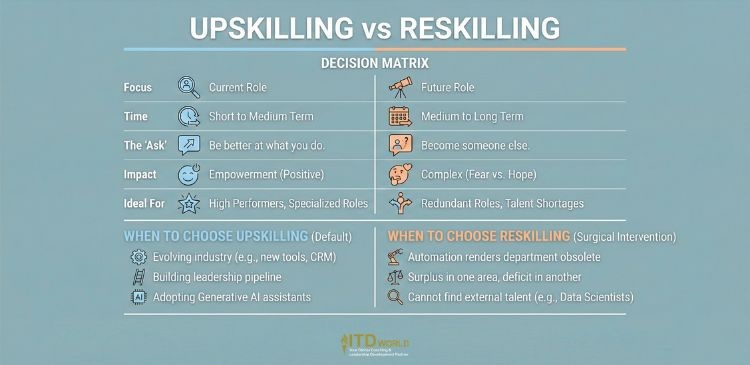
The decision matrix
| Feature | Upskilling | Reskilling |
| Primary Focus | The Current Role | A Future Role |
| Time Horizon | Short to Medium Term |
Medium to Long Term
|
| The “Ask” of the Employee | “Learn this to be better at what you do.” |
“Learn this to become someone else.”
|
| Psychological Impact | Generally Positive (Empowerment) |
Complex (Fear of change vs. Hope)
|
| Ideal For… | High Performers, Specialized Roles |
Redundant Roles, Talent Shortages
|
When to choose upskilling
Upskilling should be your default setting—a continuous hum in the background of your organization.
Use it when:
- Your industry is evolving but not disappearing (e.g., Healthcare, Law, Finance).
- You want to build a leadership pipeline. Leadership training is, by definition, upskilling—taking a good individual contributor and equipping them with the soft skills to manage others.
- You are introducing new tools (e.g., migrating to a new CRM or adopting Generative AI assistants).
When to choose reskilling
Reskilling is a surgical intervention used for major pivots.
Use it when:
- Automation renders a specific department obsolete (e.g., data entry clerks).
- You have a “surplus” in one area and a “deficit” in another. For example, if you are shrinking your brick-and-mortar footprint but expanding your cybersecurity team, reskilling allows you to move loyal employees across that divide.
- You cannot find external talent. If the market for Data Scientists is dry, you may need to look at your internal pool of mathematicians or analysts and “build” your own scientists.
The complementary approach
While distinct, these two strategies feed each other. You cannot successfully reskill a workforce that has no culture of learning. If an employee hasn’t learned a new skill in five years (lack of upskilling), asking them to suddenly pivot to a new career (reskilling) will result in failure and burnout.
A culture of continuous upskilling keeps the “learning muscle” flexible, making the organization ready for the heavier lift of reskilling when the time comes.
Upskilling vs reskilling
The “Human-First” Tech Stack
In the rush to train employees on Python, Blockchain, and AI, many organizations fall into the “Technical Trap.” They assume the future of work is entirely digital.
Paradoxically, as machines get better at being machines, the value of humans getting better at being human increases.
The rise of durable skills
Often dismissively called “soft skills,” these are better defined as “Durable” or “Power Skills.” Unlike technical code, which changes every few years, durable skills last a lifetime.
- Social Intelligence & EQ: As AI takes over routine cognitive tasks, the human ability to empathize, negotiate, and manage conflict becomes the premium asset.
- Adaptive Mindsets: One of the most critical upskilling areas today is resilience. Training employees on how to handle change, navigate ambiguity, and maintain mental wellness is essential for a workforce facing constant disruption.
- Critical Thinking: In an age of Generative AI, the ability to prompt, critique, and verify machine output is much more desirable than the ability to generate the output itself.
Read more: 3 Essential Soft Skills in the Age of AI
The role of AI in L&D
Technology is not just the subject of training; it is the vehicle for it.
- Personalization: AI-driven Learning Management Systems (LMS) can now curate “Netflix-style” learning paths. Instead of a one-size-fits-all workshop, AI can assess one’s current level and recommend specific micro-learning modules to fill their unique gaps.
- Skills Auditing: New tools can “scrape” employee profiles and project history to identify “hidden competencies” that HR didn’t know existed. That quiet project manager might be fluent in three languages or have a background in graphic design—assets you can leverage through reskilling.
- AI Literacy: Finally, every upskilling program today must include “AI Literacy.” This doesn’t mean teaching everyone to code AI, but teaching everyone how to be a “Human-in-the-loop”—using AI tools ethically and effectively to augment their daily work.
Read more: AI in Leadership – Bridging the Gap Between Adoption & Maturity
Strategies for Upskilling and Reskilling Employees: A Step-by-Step Implementation Guide
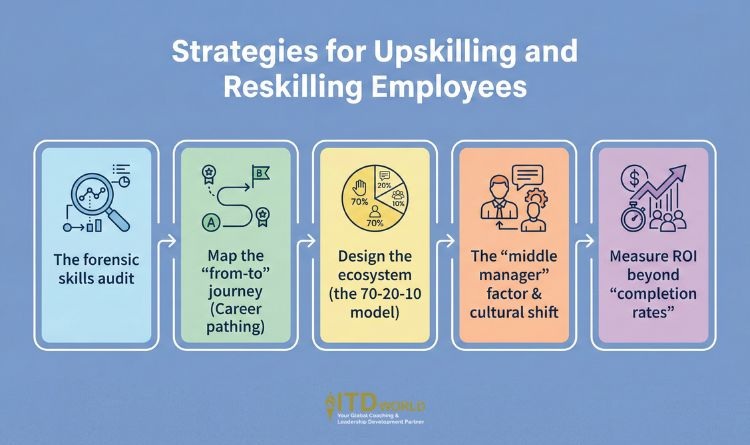
Moving from theory to execution is where most organizations stall. Many times, leaders agree on the why but get lost in the how. Below is a five-step blueprint for operationalizing a skills-first strategy.
-
The forensic skills audit
You cannot build a map if you don’t know where you are.
- Analyze Demand: Don’t guess. Survey your department heads. What business objectives are they missing because of talent gaps? What technologies are on the 18-month horizon?
- Analyze Supply: Survey your employees. What skills do they have that they aren’t using? What are their career aspirations?
- Find the Gap: Overlay these two datasets. This reveals your “build” list.
-
Map the “from-to” journey (Career pathing)
Ambiguity is the enemy of reskilling. If you want a Warehouse Associate to become an IT Support Tech, you must visualize the path.
- Create Visual Roadmaps: “If you are here, and you want to be there, these are the 5 specific badges/certifications you need.”
- Transparency: Make these paths public. When individuals see that movement is possible, they are more likely to raise their hand for training.
-
Design the ecosystem (the 70-20-10 model)
Do not rely solely on formal courses. Adult learning science suggests the 70-20-10 rule:
- 10% Formal Education: Workshops, webinars, and LMS modules for the foundational theory.
- 20% Social Exposure: Mentorship, shadowing, and peer-to-peer coaching for provides context.
- 70% Experiential Learning: Upskilling will fail without application. You need to create “Stretch Assignments”—short-term projects where employees can practice their new skills in a safe environment.
Insight on Cognitive Load: Avoid day-long seminars that overwhelm staff. Utilize micro-learning—bite-sized content (5–10 minutes) that can be consumed in the flow of work.
-
The “middle manager” factor & cultural shift
This is the hidden bottleneck. You can come up with the best L&D strategy in the world, but if a middle manager feels that training is a “distraction” from hitting this month’s targets, the program will die.
- Coach the Coaches: Managers must be upskilled in how to cultivate talent. They need to understand that “hoarding” talent hurts the company.
- Incentivize Growth: Tie manager bonuses to the number of team members they successfully promote or upskill. Make talent development a KPI, not a “nice-to-have.”
- Psychological Safety: Foster a culture where “learning from failure” is real. If an employee reskills into a new role and makes a mistake, do you punish them or coach them? Your answer defines your culture.
Read more: Succession Planning – Securing the Future of Your Business
-
Measure ROI beyond “completion rates”
Stop measuring how many people finished the course. Look at the business impact instead.
- Time-to-Productivity: Did the training reduce the time it takes for a new role to become profitable?
- Internal Hiring Ratio: What percentage of open roles are filled by internal candidates vs. external hires?
- Retention of High Potentials: Are your trained employees staying longer than your untrained ones?
Moving Beyond: New Skilling and “Outskilling”
As we look toward the future, the conversation is shifting from “one-off” training to a state of “New Skilling.” It means accepting that the finish line keeps moving. The goal is to create a workforce in “perpetual beta”—always learning, always iterating.
However, we must also address the uncomfortable reality: not everyone can be reskilled for every role. Sometimes, the gap is too wide, or the employee’s aptitude does not align with the new needs.
In these cases, forward-thinking companies practice “Outskilling” (or ethical offboarding). They provide training and career coaching to people exiting the organization, helping them find roles elsewhere.
While the idea may seem counterintuitive, it protects your employer brand. When remaining employees see that even those leaving are treated with dignity and support, trust in the organization deepens, reinforcing the psychological safety required for those who stay to take risks and learn new things.
Read more: 10 L&D Trends for the Future
Final Thoughts
The shift toward a skills-based economy is like a tsunami. Organizations have two choices: they can learn to surf it, leveraging the momentum to propel themselves forward, or they can stand still and be crushed by it.
Upskilling and reskilling are no longer HR initiatives to be delegated and forgotten. They are strategic imperatives that belong in the boardroom. They are the only viable answer to the “crisis of skill half-life.”
By shifting from a culture of “hiring and firing” to a culture of “assessing and developing,” businesses do more than just save money on recruitment. They build a workforce that is resilient, loyal, and capable of navigating whatever technological disruption comes next.
The best time to plant a tree was 20 years ago. The second best time is now.
The same applies to your workforce. Start your skills audit today, before the gap becomes a canyon!
ITD World provides specialized coaching and training solutions designed to help leaders & organizations secure a competitive advantage – and be equipped to win in today’s dynamic landscape. Contact us today to learn more about our world-class programs!
Other resources you might be interested in:
- 9 Key Leadership Skills for the Future of Work
- Skills-Based Organization: A Blueprint for Agility in a Disrupted World
- Employee Engagement in the Digital Age: Strategies for Powering Up Your Workforce