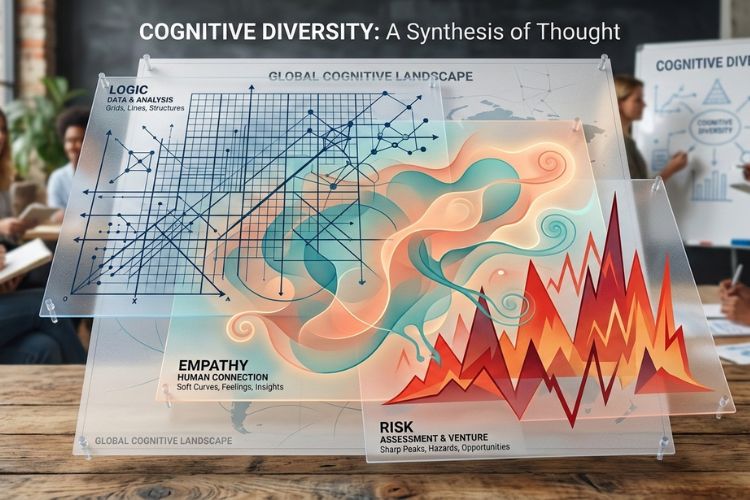
Visible diversity, while widely hailed, can lead to an “Illusion of Clarity.” When a team looks diverse on the surface but shares the same educational backgrounds, mentors, and rigid mental models, they remain vulnerable to a deceptive sense of consensus. In fact, history shows that this comfort is often a precursor to catastrophe. From major financial crashes to organizational collapses, the most devastating failures rarely stem from a lack of intelligence, but from a total lack of dissent.
In the modern business landscape, avoiding this type of Groupthink has become a competitive necessity. True high performance requires more than just surface-level representation. It demands Cognitive Diversity, a deeper layer of variety in how people process information and solve problems, ensuring that the path forward is forged through challenge rather than blind agreement.
 |
Author: Jonathan M. Pham |
Highlights
- While demographic diversity (race, gender, age) is the visible “tip of the iceberg,” cognitive diversity lies beneath the surface, encompassing how individuals process information, react to risks, and detect patterns.
- Research shows that cognitively diverse teams solve problems up to 3 times faster and can increase innovation-driven revenue by 19%, acting as a “strategic moat” against the limitations of AI and groupthink.
- Many organizations fall into the “comfort trap” of hiring people who think alike; while it feels efficient and reduces friction, it creates massive blind spots and leads to “functional fixedness.”
- To harness diversity in thinking, leaders must move from “Culture Fit” to “Culture Add,” utilizing tools like “Silent Starts” in meetings and “User Manuals” for team members to navigate the “Coordination Tax” of working with different minds.
What is Cognitive Diversity?
Cognitive diversity is defined as the inclusion of people who have different styles of problem-solving and who offer unique perspectives because they think differently.
We can better understand it by visualizing an iceberg. Above the waterline is Demographic Diversity—the visible traits such as race, gender, and age. These are critical for social equity and representation.
However, below the waterline lies Cognitive Diversity – which encompasses how individuals process information, how they react to novelty, how they detect patterns, and how they weigh risks.
The evolution of the theory
Historically, workplace diversity focused on equality (compliance) and inclusion (culture). And yet today, the conversation has shifted toward functional agility. Researchers like Matthew Syed and teams at the London School of Economics have moved the topic from a social imperative to a mathematical one: specifically, that collective intelligence increases when the “tools” used to solve a problem are varied.
Cognitive diversity in the workplace
It is not just “neurodiversity”
It is important to distinguish Cognitive Diversity from Neurodiversity.
- Neurodiversity refers to specific neurological variations such as Autism, ADHD, Dyslexia, or Dyspraxia. These are biological hard-wirings that offer immense value in pattern recognition and focus.
- Cognitive Diversity is the broader umbrella. It includes neurodivergent thinkers, but also encompasses differences driven by education, culture, and lived experience.
Think about this “PhD Paradox”. A team of five PhDs in Economics may be demographically diverse—representing different genders and nationalities—but if they all studied at the same Ivy League institutions and utilize the same economic models, they likely possess low cognitive diversity. They share the same “blind spots.”
The Neuroscience of “Differently Wired”
Social neuroscience has established that our brains are not static. Through neuroplasticity, our neural pathways are physically shaped by our experiences, languages, and emotional histories.
When two people look at a quarterly report or a product roadmap, their brains do not just “think” different thoughts; they physically “light up” in different regions.
The neurological requirements
It is helpful to view these differences not as “preferences,” but as neurological requirements. As noted by researchers in whole-brain thinking, different brains require data to be presented in specific ways to function optimally.
We can generally categorize these requirements using frameworks like the Whole Brain® Model (developed by Ned Herrmann), which identifies four quadrants of thinking as follows:
- Analytical: Requires facts, logic, and quantitative data.
- Structural: Requires order, sequence, and detailed planning.
- Relational: Requires emotional connection, empathy, and a focus on people.
- Experimental: Requires holistic views, intuition, and “big picture” synthesis.
In a high-performing team, these are not competing personalities, but complementary operating systems. The friction caused by these differences is exactly the fuel for critical analysis.
The ROI of Cognitive Diversity in the Workplace
For years, diversity initiatives were siloed in HR. Nowadays, the data proves they belong in the CFO’s office. The business case for cognitive diversity is supported by various robust financial and operational metrics.
- The innovation premium
A study by the Boston Consulting Group (BCG) found that companies with diverse management teams reported 19% higher revenues due to innovation. When teams approach a problem from multiple angles (e.g., a “Creative” thinker pairing with a “Structural” thinker), they generate products that are both novel and executable.
- Speed and efficiency
Contrary to the belief that diversity slows things down, a Harvard Business Review study revealed that cognitively diverse teams solve problems up to 3 times faster than homogenous teams. While the initial debate may take longer, the execution is faster because the team has already anticipated and mitigated risks that a “like-minded” team would have missed until it was too late.
- The AI advantage
In an era where Artificial Intelligence is commoditizing data processing, human cognitive diversity has become a strategic moat. AI is great at “convergent thinking”—predicting the next logical step based on past data. On the other hand, humans excel at “divergent thinking”—making irrational, intuitive, or contrarian leaps.
Organizations that lack cognitive diversity will merely replicate the algorithmic averages of their competitors.
Read more: 3 Essential Soft Skills in the Age of AI
- Preventing catastrophe
Beyond profit, cognitive diversity also serves as a survival mechanism. Intelligence failures in national security—such as the “blind spots” regarding Iraq’s WMDs—occurred not because the analysts were unintelligent, but because they were too similar. They reinforced each other’s biases.
In the corporate world, this same dynamic is the cause of many failed mergers and product flops.
Read more: 6 Benefits of DEI in the Workplace

Why Organizations Underestimate Cognitive Diversity
If the benefits are so clear, why do so many companies remain cognitively homogenous? The answer lies in human psychology and systemic inertia.
- The “comfort trap” (Homophily)
Humans are evolutionarily wired to trust people who look, speak, and think like them. (a phenomenon known as homophily) When we interview a candidate who “clicks” with us immediately, it is often because they mirror our own cognitive style. In other words, we mistake comfort for competence.
- The illusion of efficiency
Homogenous teams tend to reach consensus quickly. In a meeting, everyone nods, a decision is made, and the meeting ends early. However, this “efficiency” is only a mirage. The team has simply rushed toward a shared bias, ignoring the complexities that will inevitably derail the project later.
- Functional fixedness & “professionalism”
By hiring exclusively from specific “feeder” universities or industries, companies guarantee a monoculture of thought. Furthermore, rigid definitions of “professionalism”—typically coded as extraversion, polish, and quick verbal processing—filter out deep, reflective thinkers or neurodivergent individuals who may process information differently.
Types of Cognitive Diversity in the Workplace
-
The AEM-Cube (Change & Risk)
This model maps how individuals interact with change:
- Explorers: High risk appetite. They love novelty and are often the “disruptors.”
- Stabilizers: Low risk appetite. They value process, history, and incremental improvement.
- Maturity: This dimension measures the ability to contextualize; sticking to the task (Matter) versus focusing on the team (People).
-
Processing styles
- Internal Processors: These individuals need silence and time to formulate a thought. They are often drowned out in brainstorming sessions.
- External Processors: These individuals think by talking. They tend to dominate meetings, not out of malice, but out of a neurological need to vocalize to understand.
-
Reactions to novelty
- The Enthusiast: Sees a new problem and immediately sees opportunity.
- The Skeptic: Sees a new problem and immediately identifies the flaws.
Note: A team of only Enthusiasts will launch a broken product; on the other hand, one of only Skeptics will never launch anything.
3 Pillars for Establishing Cognitive Diversity in the Workplace
You cannot simply throw diverse thinkers into a room and expect magic. Without the right container, cognitive diversity leads to chaos and conflict. The following pillars, therefore, are required to make it work:
The non-negotiable foundation. If a “Structural” thinker feels they will be mocked for asking about details in a “blue-sky” meeting, they will remain silent. Leaders must create an environment where dissent is not viewed as disloyalty. As cited in various research on high-reliability organizations, the goal is to “cherish the dissenter.”
While the means of thinking should be diverse, the ends must be unified. A team with misaligned goals will tear itself apart, no matter how smart the team members are.
The leader’s role is to anchor the team in a shared “North Star,” allowing the team to debate the route while agreeing on the destination.
- Active leadership
Cognitive diversity is not self-managing. It requires a leader who acts less like a commander and more like a conductor. Such a person know when to let the “Creative” strings play and when to bring in the “Analytical” percussion. In addition, they actively solicit the opinion of the quietest person in the room to ensure the “Illusion of Clarity” is shattered.
Operationalizing Cognitive Diversity in the Workplace
-
Recruitment: Move from “Culture Fit” to “Culture Add”
Stop wondering, “Does this person fit our culture?” Such a question reinforces the status quo. Instead, ask, “What is missing from our team’s ‘collective brain,’ and does this person add it?”
-
Action: Remove strict degree requirements from job descriptions to tap into “non-traditional” educational backgrounds (e.g., bootcamp grads, self-taught experts).
-
Meeting hygiene: The “Silent Start”
To level the playing field between internal and external processors, adopt the “Silent Start” method used by companies like Amazon.
-
Action: Begin meetings with 15 minutes of silent reading of a memo. Doing so ensures that the “loudest” voice doesn’t anchor the discussion and allows reflective thinkers to formulate their insights before speaking.
Read more: Unnecessary Meetings – Ending the Invisible Tax on Your Team’s Performance
-
The “User Manual” concept
Encourage team members to write a “User Manual” for their brain.
-
Action: Have employees answer questions like: “I do my best work when…”, “I shut down when…”, and “The best way to give me feedback is…” This operationalizes the concept of neurological requirements.
-
Designated dissenter
In high-stakes decisions, assign a rotating “Devil’s Advocate.”
-
Action: By formalizing this role, you remove the social stigma of disagreement. The person is no longer being “difficult”; they are simply doing their job.

How to build a diverse team
The “Coordination Tax” of Cognitive Diversity in the Workplace
We need to be realistic here: Cognitive diversity comes with a cost, which is typically referred to as the “Coordination Tax.”
Diverse teams take longer to align. Communication, many times, can be frustrating. A “conceptual” thinker may feel bogged down by a “detailed” thinker, leading to interpersonal friction. We often see the “John vs. Rachel” dynamic: John values brevity and facts, while Rachel values context and relationship. Without understanding cognitive diversity, John views Rachel as “unfocused,” and Rachel views John as “rude.”
The Solution: “Fascinated, Not Frustrated”
The key to overcoming the problem is a mindset shift. When friction occurs, team members should be trained to be “fascinated, not frustrated.” They should be reminded that the friction is a signal that a different neurological requirement is at play.
The goal is not to eliminate the tension – but to harness it. That tension is where the “blind spots” are revealed.
FAQs about Cognitive Diversity in the Workplace
How do I measure cognitive diversity?
A: You cannot see it. It’s essential to use assessments such as the AEM-Cube, HBDI (Herrmann Brain Dominance Instrument), or DISC.
Alternatively, audit your team’s decision-making history: If you have never disagreed on a major strategic pivot, it’s very likely that you lack cognitive diversity.
Does it mean we should ignore race and gender diversity?
A: Absolutely not. Demographic diversity is often a leading indicator of cognitive diversity. Different lived experiences (based on race, gender, or class) create different neural pathways and perspectives. They are complementary forces that strengthen one another.
Can’t we just train people to think differently?
A: To a degree, yes. However, neurological requirements are deep-seated. It is far more effective (and respectful) to build a team of complementary thinkers than to force one person to twist their brain into a shape that doesn’t fit.
Final Thoughts: The 360-Degree Organization
In today’s complex, volatile business world, the “Smartest Person in the Room” is no longer a person. It is the room itself—provided that it is filled with divergent minds.
Cognitive diversity is the only proven defense against Groupthink. It transforms the workplace from a choir of echoing voices into a robust, self-correcting intelligence unit. While it requires more effort to manage – and more patience to coordinate, the payout is undeniable: faster problem solving, higher innovation revenue, and the resilience to navigate an uncertain future.
For leaders, the mandate is clear: Stop hiring your mirror image. Instead, seek out the perspective that chafes against your own.
That friction isn’t a problem; it’s the secret ingredient to your success.
ITD World provides specialized coaching and training solutions designed to help leaders & organizations secure a competitive advantage – and be equipped to win in today’s dynamic landscape. Contact us today to learn more about our world-class programs!
Other resources you might be interested in:
- Inclusive Leadership: Moving From Buzzword to Bottom Line
- 360-Degree Feedback: From Theory to Action
- The Power of Collaborative Teams in the AI Era
- Asynchronous Work: Mastering Productivity Without Constant Meetings