
The modern workplace is trapped in a paradox: despite an abundance of communication tools (e.g. Slack, Teams, Zoom, Email, WhatsApp), productivity is plummeting due to a phenomenon called Collaborative Overload. Knowledge workers are interrupted roughly 15 times per hour, and with an average of 62 meetings a month, the constant context-switching creates a massive “economic hemorrhage.”
While the last decade focused on WHERE we work (Remote vs. Office), the next true revolution is about WHEN we work. By shifting from Synchronous (real-time) to Asynchronous work, we can reclaim the deep focus necessary for complex tasks and move past the era of constant distraction.
 |
Author: Jonathan M. Pham |
Highlights
- While remote work refers to location and synchronous work refers to real-time interaction (like Zoom calls), asynchronous work uses a “store-and-forward” model (like email or recorded videos), allowing employees to review and respond to information on their own schedule.
- Moving to an async-default culture protects “Deep Work” by eliminating the “Interruption Tax” of constant notifications. It transforms fleeting verbal meetings into a “Single Source of Truth”—a searchable digital asset of recorded decisions and documentation.
- Not all tasks should be async; there should be a “litmus test” where status updates and information sharing are handled asynchronously, while complex problem solving, sensitive feedback, and team bonding remain synchronous to preserve nuance and human connection.
- Success requires moving from tracking hours to outcome-based management and treats writing as a “superpower.” Effective async communication requires “context-heavy” messages that include the background, the proposal, and a clear call to action to prevent back-and-forth delays.
- To combat the potential isolation and “ping-pong” delays of async work, organizations should implement Social Async (non-work channels), set clear Service Level Agreements (SLAs) for response times, and “Assume Positive Intent” to avoid misinterpreting the tone of written text.
What is Asynchronous Work?
To understand asynchronous work, we must first disentangle three concepts that are frequently conflated: Remote, Synchronous, and Asynchronous.
- Remote Work refers to location. It simply means you are not in the same physical room. However, you can be remote and still be tethered to your computer from 9:00 AM to 5:00 PM, responding instantly to every notification. This is often called “creating a digital office,” and it is a very common cause of burnout.
- Synchronous Work (Sync) refers to time. It requires two or more people to be present at the exact same moment to collaborate. Examples include a Zoom call, a phone conversation, or a tap on the shoulder in an open-plan office.
- Asynchronous Work (Async) is collaboration that does not happen in real-time. It relies on a “store-and-forward” model where information is documented, sent, and reviewed by the recipient on their own schedule. Examples include email, recorded video updates (Loom), and project management comments (Asana/Jira).
The relay race vs. The three-legged race
Think of your workflow as a race.
- Synchronous work is a three-legged race. You are tied to your colleague. To move forward, you must coordinate every single step simultaneously. If one person stops, everyone stops.
- Asynchronous work is a relay race. You run your lap at maximum speed and efficiency. When you are done, you hand off the baton (the project) to your colleague, who then runs their lap while you recover or move to the next event.
The spectrum of synchronicity
It is important to note that “Going Async” does not mean eliminating all meetings. The most successful companies operate on a spectrum. The goal is not 100% async; the goal is to shift the default mode of operation.
In a traditional company, the default is a meeting. In an async-first company, the default is documentation, with catch-up sessions reserved for specific, high-value interactions.
Read more: Unnecessary Meetings – Ending the Invisible Tax on Your Team’s Performance
The Business Case for Asynchronous Work
Transitioning to an asynchronous model is a significant operational shift. Why should a business undergo such a transformation? The answer is, the benefits extend far beyond simply “fewer Zoom calls.”
The productivity engine: Protecting “Deep work”
The most valuable work in the knowledge economy—coding, writing strategy, analyzing data—requires Deep Work, a state of flow where cognitive capabilities are peaked.
Every time a notification pings, that flow is shattered, (a phenomenon known as the “Interruption Tax”) By moving communication to an asynchronous model, you allow employees to batch their communication (checking messages 2–3 times a day) rather than reacting instantly. The result is the emergence of long, uninterrupted blocks of time where actual value is created.
The knowledge asset: Sync evaporates, async accumulates
When you hold a meeting to solve a problem, the solution often evaporates the moment the call ends. Unless someone takes meticulous notes, the knowledge is lost to anyone who wasn’t in the room.
Async work, by definition, is written and recorded. It creates an automatic paper trail.
- A decision made in a Slack thread becomes searchable history.
- A process explained in a Loom video becomes a training asset for future hires.
Over time, an async organization builds a massive, searchable “Single Source of Truth” (SSOT) that reduces the need for repetitive training and questions.
Global inclusivity & talent access
Synchronous work favors those in the headquarters’ time zone and those with the loudest voices.
- Time Zones: Async enables the “Follow the Sun” model. A developer in London can finish a feature and document it; a QA tester in Sydney picks it up while London sleeps. Work happens 24/7 without anyone working a night shift.
- Cognitive Diversity: In a live meeting, the quickest thinker or the most extroverted personality tends to dominates. Async allows “slow thinkers“—those who need time to process information—to formulate thoughtful, comprehensive responses. This levels the playing field and makes it more likely to result in higher-quality decision-making.
Read more: 6 Benefits of DEI in the Workplace
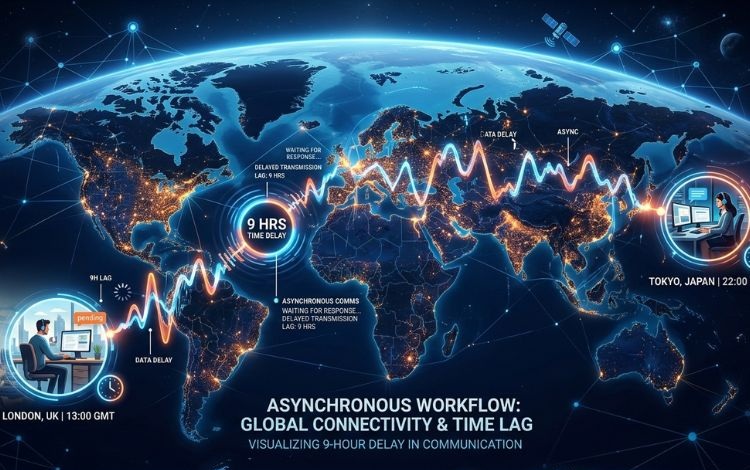
Asynchronous communication
The “Triage” Strategy—When to be Sync vs. Async
The biggest mistake leaders make is trying to force human connection into async channels, or informational updates into sync meetings. You need a triage system.
It is recommended that the following Litmus Test be taken to decide the medium:
| The Scenario | The Method | Why? |
| Status Updates | Async |
“Round-robin” updates in meetings are a waste of expensive time. Use a dashboard or a written thread.
|
| Information Sharing | Async |
If it’s a one-way broadcast (e.g., Q3 results), record a video or write a memo. Let people consume it at their own speed (2x speed).
|
| Complex Problem Solving | Sync |
If the topic has many variables and requires rapid-fire iteration, a live whiteboard session is faster than a 50-message thread.
|
| Sensitive Feedback | Sync |
Never deliver critical performance reviews or bad news via text. Tone is lost, and it can feel dehumanizing.
|
| Team Bonding | Sync |
Rapport is established through real-time laughter and interaction. Use meetings for connection, not just correction.
|
| Emergencies | Sync |
If the server is down or a PR crisis is unfolding, get on the phone immediately.
|
The Rule of Thumb: If you need an answer, go Async. If you need a discussion, consider Sync. If you need a connection, go Sync.
Asynchronous Work Implementation: Guide for Organizations
Cultivating an async culture is not about buying software; it is about changing behavior.
The cultural shift: Trust & autonomy
The foundation of asynchronous work is trust. You must move from Input-Based Management (tracking hours, green dots on Slack, time-in-seat) to Outcome-Based Management (tracking deliverables, quality, and deadlines).
To facilitate this, organizations must adopt a “Default to Action” mindset. In an async environment, you cannot wait for permission on every small step. Employees should be empowered to make decisions based on available data to keep the project moving, rather than waiting 12 hours for a manager to wake up and approve a minor detail.
The communication protocol: Writing is a superpower
In an office, you can get away with vague verbal instructions because you can clarify them with a gesture or a follow-up comment. In an async world, writing is the primary interface of collaboration.
Bad writing creates bottlenecks. To prevent the “clarification loop,” teams must be trained to send Context-Heavy Messages.
- Bad: “Can we chat about the project?”
- Good: “I’ve reviewed the Q3 project draft. I see a risk in the timeline regarding the vendor integration (Section 4). I propose we push the launch by 3 days or cut the feature. Please review the attached doc and let me know your preference by Thursday at 2 PM.”
The Async Template:
- The Context: What are we talking about? (Link to the doc).
- The Blocker/Update: What is the specific issue?
- The Proposal: What do you think we should do?
- The Call to Action: Who needs to respond, and by when?
The tech stack: The rules of engagement
Tools define the workflow. A robust async stack usually consists of three layers:
- The Hub (Communication): Slack or Microsoft Teams.
Best Practice: Use threaded conversations strictly. Avoid general channels for work requests to prevent them from being buried.
- The Truth (Documentation): Notion, Confluence, or Google Drive.
Best Practice: If a decision is made in Slack, it must be moved here. If it isn’t in the “Truth” tool, it didn’t happen.
- The Engine (Project Management): Asana, Trello, or Jira.
Best Practice: Work updates happen here, not in email. This provides visibility on progress without asking “How is it going?”
Read more: Employee Engagement in the Digital Age
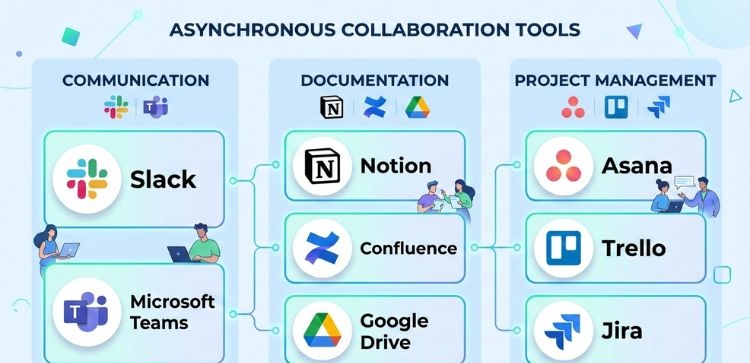
Asynchronous collaboration tools
The “Dark Side” of Asynchronous Work: Challenges & Solutions
Asynchronous work is not a magic bullet. It introduces new challenges that must be managed proactively.
Challenge 1: The loneliness epidemic
Without the casual “water cooler” chat, work can feel transactional and isolating. Data suggests over 70% of remote workers feel disconnected.
Solution:
- Social Async. Create spaces for non-work sharing. A “Pets of [Company]” Slack channel, a “What are you reading?” thread, or a weekly “weekend photo dump.”
- Intentional Sync. Since you are saving hours on status meetings, reinvest that time into social syncs—virtual coffees, team gaming hours, or annual in-person retreats.
Challenge 2: The “ping-pong” delay
A conversation that takes 5 minutes in person can drag on for 3 days in an async thread if response times are slow.
Solution:
- Service Level Agreements (SLAs). Define expectations. For example: “Urgent DMs require a 2-hour response; standard project comments require a 24-hour response.”
- Batching. Encourage team members to answer all outstanding questions in one “batch” rather than drip-feeding answers, which blocks colleagues for longer.
Challenge 3: Loss of tone & nuance
Text is notoriously bad at conveying emotion. A direct period may look like aggression; a lack of emojis like disapproval.
Solution:
- Assume Positive Intent. Train teams to read messages with the most generous interpretation possible.
- Use Video. If a message is complex or could be misinterpreted, record a 2-minute Loom video. Hearing a human voice and seeing facial expressions acts as a bridge between cold text and warm presence.
Read more: Mastering Executive Presence – Key Strategies for Professional Success
Asynchronous Work Best Practices
To succeed, everyone plays a different part in the async ecosystem.
For the individual contributor
- Protect Your Flow: Turn off non-essential notifications. Schedule “Deep Work” blocks on your calendar where you do not check communication tools.
- Be a Finisher: When you post an update, provide all the necessary links and permissions. Don’t make your colleague ask for access to the Google Doc you just shared.
- Over-communicate Status: Since your boss can’t see you working, you must make your work visible. Update your task status in the project management tool daily.
For the manager
- Stop Managing Presence: Resist the urge to check if your team is “online.” Judge them solely on their output.
- Be a Blocker-Remover: Your primary job is to ensure documentation is clear so your team doesn’t have to ask you questions.
- Create “Office Hours”: Instead of an open-door policy (which leads to constant interruptions), set specific times when you are available for live syncs, leaving the rest of the day for your own work.
For the executive leadership
- Model the Behavior: If you send emails at midnight or on weekends expecting an immediate reply, you are destroying the async culture. Schedule your messages to arrive during working hours.
- Invest in Infrastructure: You cannot expect high-quality async work if you don’t provide the tools (e.g., paid versions of Loom, Slack) and training on effective business writing.
Read more: Executive Leadership – A Guide to Developing Tomorrow’s Titans
Final Thoughts: The Future of Work is Decoupled
The shift to asynchronous work is a transition from an industrial-age mindset (where value = time spent on the assembly line) to a knowledge-age mindset (where value = ideas and execution).
By decoupling work from the rigid constraints of the 9-to-5 clock, organizations unlock a trifecta of benefits:
- Higher Productivity through sustained deep work.
- Better Retention through genuine flexibility and work-life balance.
- Greater Resilience through documented knowledge that survives staff turnover.
The transition doesn’t happen overnight. It starts with a single step. Audit your calendar for next week. Find one recurring “status update” meeting. Cancel it. Then, replace it with a collaborative document or a recorded video update.
Give your team their time back, and be prepared to watch their productivity—and satisfaction—soar!
ITD World provides specialized coaching and training solutions designed to help leaders & organizations secure a competitive advantage – and be equipped to win in today’s dynamic landscape. Contact us today to learn more about our world-class programs!
Other resources you might be interested in:
- Always-on Culture: How the Availability Trap Erases Profits
- Collaborative Leadership: Beyond Command and Control
- Employee Wellbeing in the Workplace: Practical Strategies
- The Art of Delegation: Transforming from a Doer to a Multiplier
- The Player-coach Leadership Style: Mastery of Two Worlds