

Great management ensures that things are done right, but only those with a strategic vision can make sure that the right things are done. As the gap between technological potential and human adoption widens, the demand for visionary leadership—the ability to translate complex digital futures into clear, human-centric missions—has never been higher. Unfortunately, many leaders remain trapped in operational details, reacting to change rather than driving it.
 |
Author: Jonathan M. Pham |
Highlights
- Originally described by Daniel Goleman as the “Come with me” approach, visionary leadership has evolved from a “charismatic hero” persona into a “Strategic Architect” role: synthesizing complex market signals into a clear, long-term roadmap.
- A clear vision acts as a fix for the high failure rates of AI and digital transformation projects caused by “hype-chasing” without purpose.
- More than a big imagination, success in this style demands strategic foresight to spot patterns, high emotional intelligence to turn employee anxiety into commitment, and the courage to accept short-term risks for long-term survival.
- Aspiring visionaries should adopt “Future-Back” thinking (defining an ideal future and working backward to today) and master strategic storytelling to simplify complex goals into a narrative that resonates with the entire team.
- To avoid common pitfalls like the “Execution Gap,” visionary leaders must partner with strong operators who handle the “how,” and practice “bifocal” leadership—keeping one eye on the 10-year horizon while remaining grounded in the team’s daily challenges.
What is Visionary Leadership?
Visionary leadership is a leadership style focused on creating a compelling, crystal-clear picture of the future and mobilizing people toward it. Unlike operational managers who focus on the “how” (processes, efficiency, and metrics), visionary leaders focus on the “what” and the “why.” They are less concerned with maintaining the current path and more with defining a new destination.
The origin of this style is often credited to Daniel Goleman in his seminal Harvard Business Review research, “Leadership That Gets Results” – in which he identified the “Authoritative” style (later widely termed Visionary) as the “Come with me” approach. Goleman found it to be the most effective of all six leadership styles for improving organizational climate, particularly when a business is adrift and needs a new direction.

Visionary leadership theory
Since then, the concept has evolved. In the early 2000s, it was often associated with the “charismatic hero” leader. And today, in the era of digital transformation and AI, it has matured into the role of the “Strategic Architect.” No longer just about inspiration, it is about having the intellectual agility to synthesize complex market signals—technology, demographics, economics—into a coherent roadmap for survival and growth.
Why Visionary Leadership Matters Now
The cost of short-term thinking
When leadership fails to look beyond the immediate horizon, the consequences are measurable and severe.
- Digital failure: According to studies by McKinsey, approximately 70% of digital transformation initiatives fail to meet their objectives. The root causes are rarely technological; they are human—specifically, a lack of clear vision and leadership alignment.
- The AI stagnation: A 2025 MIT study revealed that 95% of corporate AI projects fail to demonstrate a profit-and-loss impact. Similarly, researchers from the University of Queensland found that 80% of data science projects fail before deployment. Why? Because leaders often chase the “hype” of tools without understanding how those tools actually solve business problems.
- The growth gap: Accenture reports that “digital leaders” (the top 10% of innovators who look ahead) achieve 2-3x higher revenue growth than their competitors who merely react to change.
The visionary premium
Conversely, the ability to balance current performance with future transformation—typically referred to as “ambidextrous leadership”—is the biggest differentiator in organizational success.
- Flipping the odds: Research by Boston Consulting Group (BCG) indicates that having the right leadership commitments in place—specifically clear transformation goals and ownership—can flip the odds of digital transformation success from 30% to 80%.
- “Perform and Transform”: Korn Ferry analysts found that leaders who can drive current results while simultaneously reinventing the business for the future grow their organizations 6.7% faster than their peers.
- Agility & resilience: McKinsey data shows that organizations that decide “fast and well”—a hallmark of visionary leadership—are twice as likely to outperform their peers.

Visionary thinking in leadership
Impact on the individual
Visionary leadership also creates a psychological safety net that allows employees to innovate without fear.
- Engagement & retention: According to Harvard Business Review, companies led by transformational, visionary leaders experience 50% higher employee engagement.
- Trust in the AI Era: Accenture’s report highlights that 77% of executives agree that the true benefits of AI require a solid foundation of trust. Visionary leaders cultivate it by framing AI as “augmentation” rather than “replacement,” turning fear into motivation for upskilling.
- Unlocking the next generation: A McKinsey report notes that 62% of millennials report high comfort with AI (vs. 22% of baby boomers). Visionary leaders are essential to unlocking this potential, giving younger generations the autonomy and the “why” they need to lead digital changes from the ground up.
Read more: Human Centered Leadership – The Importance of a ‘People First’ Mindset
Characteristics of Visionary Leadership
Visionary leadership is often mistaken for a personality type—usually the extroverted, charismatic orator. However, in practice, it requires a specific set of cognitive and emotional competencies.
-
Strategic foresight (Pattern recognition)
While operational leaders focus on optimizing the present, visionary leaders possess the ability to “look around corners.” They are capable of synthesizing disparate signals—market trends, technological shifts, and consumer behaviors—to anticipate where the world is going before it arrives.
Example: Rather than “How do we increase sales by 10% next quarter?” they would ask, “What will our industry look like in ten years, and does our current business model even exist in that future?” They are willing to cannibalize their own successful products today to dominate the market of tomorrow.
-
Emotional intelligence (Resonance)
An idea, no matter how brilliant, is useless if it does not resonate with the people who must execute it. That’s why high Emotional Intelligence (EQ), specifically empathy, is a non-negotiable trait for such leaders. They are well aware that change generates anxiety and resistance. As such, they acknowledge those feelings and connect the vision to the personal values and aspirations of their team, thereby turning compliance into commitment.
Example: Instead of simply issuing a mandate for a digital transformation, a visionary leader takes the time to learn about the team’s fear of obsolescence. They frame the new direction not as a replacement of their skills, but as an evolution that will empower them to do more meaningful work.
Read more: EQ in the AI Age – Why It Matters for Leaders
-
Communicative clarity (The ability to simplify)
Complexity is the enemy of execution. Visionary leaders are able to take ambiguous, complex future scenarios and distill them into a clear, compelling narrative that everyone—from the C-suite to the front line—can understand and repeat.
Example: Instead of “We need to optimize our logistical throughput by 15%,” one would say, “We are going to deliver any product, anywhere in the world, in under 24 hours.”
-
Calculated risk tolerance (Courage)
Visionary leadership is inherently risky because it challenges the status quo. It requires the courage to deviate from the safe path – as well as the resilience to weather short-term failures in pursuit of long-term value.
Example: When Reed Hastings steered Netflix away from its profitable DVD-by-mail business to focus on streaming—a technology that was barely ready at the time—he faced immense backlash and a drop in stock price. A traditional manager would have protected the DVD profits; and yet, Hastings accepted the short-term pain to secure the company’s survival in the streaming era.
Read more: Leading Through Uncertainty – How to Navigate Turbulent Times
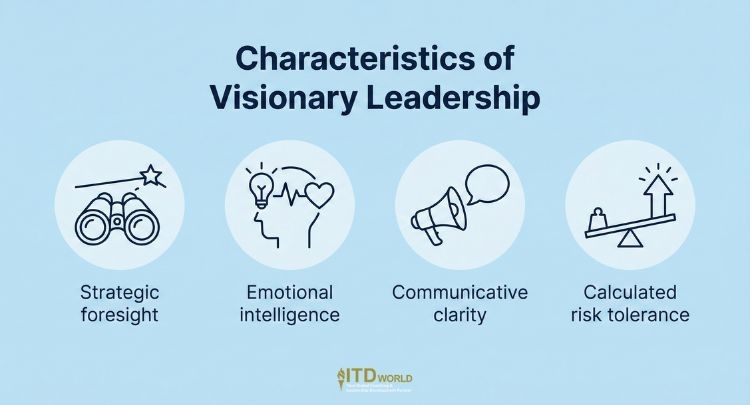
Qualities of a visionary leader
Types of Visionary Leadership (with Examples)
-
The Disruptor
The Disruptor does not seek to improve the status quo; they aim to render it obsolete. They are defined by the ability to imagine a customer need before the customer is even aware of it.
Example: Steve Jobs (Apple)
Jobs is known for rejecting the idea of reliance on focus groups, believing that “people don’t know what they want until you show it to them.” More than just better computing, he envisioned a future characterized by the intersection of technology and liberal arts. This drove Apple to create entirely new categories—the iPod, iPhone, and iPad—rather than simply iterating on existing PC designs.
Lesson: A visionary leader must sometimes trust their own conviction over market data, connecting the dots of the future where others see only the limitations of the present.
-
The Social Architect
The Social Architect knows that a company cannot succeed in a failed society. From their perspectives, financial performance and social responsibility are not competing interests, but inextricably linked drivers of long-term survival.
Example: Indra Nooyi (PepsiCo)
As CEO of PepsiCo, Nooyi pioneered the vision of “Performance with Purpose.” She foresaw a shift in consumer behavior toward health and sustainability long before it became a corporate standard. Therefore, she boldly steered the snack-and-soda giant toward healthier products and environmentally sustainable practices, arguing that the company’s license to operate in the future depended on its impact today.
Despite initial skepticism from Wall Street investors demanding short-term returns, Nooyi’s direction ended up securing PepsiCo’s future stability.
Lesson: A visionary leader must look at the “whole board,” understanding that long-term shareholder value is impossible without addressing the needs of the consumer and the planet.
Read more: Stakeholder Management – A Leader’s Engagement Playbook
-
The Transformer
When an organization has lost its way, the Transformer is required to revitalize a stagnant culture and pivot a massive ship.
Example: Satya Nadella (Microsoft)
When Nadella took the helm, Microsoft was seen as an aging giant, defensive and culturally rigid. Nadella introduced a vision centered on a “Growth Mindset”—shifting the culture from “know-it-alls” to “learn-it-alls.” He pivoted the company’s strategic focus away from the protective “Windows-first” mentality to an open “Cloud-first, Mobile-first” ecosystem.
This strategic shift didn’t just improve morale; it tripled Microsoft’s value and restored its status as a premier innovator.
Lesson: Quite often, one must demonstrate the humility to let go of past victories to seize future opportunities.
Read more: Ego in the Workplace – The Hidden ‘Evil’ Behind Team Dysfunctions

Famous visionary leaders
(Image source: Wikimedia)
Visionary leadership style
How to Become a Visionary Leader
Visionary leadership requires shifting one’s mental gears from the immediate demands of the “now” to the possibilities of the “next.” Here is a practical roadmap for practicing this management style.
-
Adopt “Future-Back” thinking
Most leaders tend to practice “Present-Forward” thinking: they look at today’s data and aim for a 10% improvement next year. Visionary leaders do the opposite: “Future-Back” thinking (a methodology championed by Mark W. Johnson and Josh Suskewicz in Lead from the Future).
How-to: Stop wondering “What can we do with our current resources?” Instead, transport yourself 5 to 10 years into the future and ask: “What does the ideal version of this industry look like? What problems have been solved?” Once that future state is clearly defined, work backward to determine what strategic moves must be made today to make it inevitable.
-
Cultivate “outside-in” curiosity
You cannot connect the dots if you don’t have enough dots to connect. Quite often, visionary insights come from the intersection of diverse fields.
How-to: Actively break your routine to escape the corporate bubble. For instance, Bill Gates is known for taking “Think Weeks”—secluded time to read papers on biology, physics, and sociology—to find patterns relevant to software. Instead of spending a whole week like him, you can consider adopting the habit of reading trade journals from industries completely unrelated to your own, or engaging with customers who rejected your product to better comprehend their reality.
-
Master strategic storytelling
To be a leader, you must transfer your vision into the hearts of the team. This requires moving beyond bullet points and learning the art of narrative.
How-to: When communicating strategy, don’t just share the metrics (the “what”); focus on the journey (the “why”) instead. Paint a vivid picture of the destination. Use sensory language to describe what success looks like, feels like, and means for the individual employee.
If your team cannot repeat the vision to a stranger in one sentence, you haven’t simplified it enough.
-
Build a “coalition of the willing”
The “Great Man” theory of leadership is dead already. To transform an organization, you need a network of champions who own the vision as much as you do.
How-to: Look for the influencers within the organization—not just those with titles, but with social capital. Invest time in aligning them personally. Give them the autonomy to interpret how the direction applies to their specific departments.
When people feel they have co-authored the roadmap, their commitment naturally shifts from passive compliance to active ownership.
Read more: 12 Golden Leadership Principles for Attaining Excellence
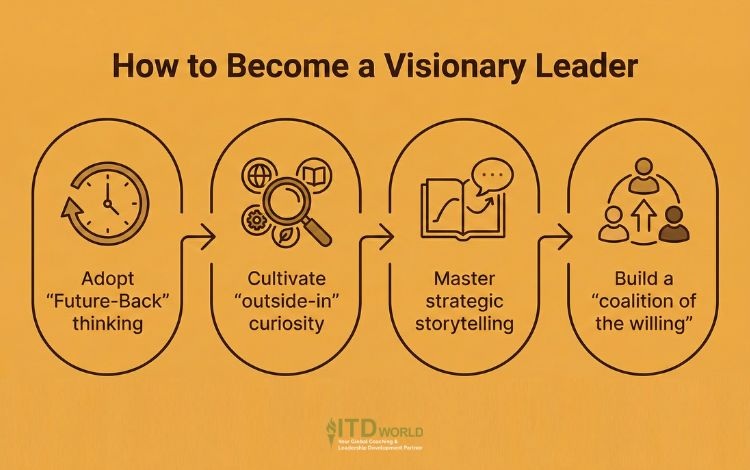
How to demonstrate visionary leadership
Challenges of Visionary Leadership
- The execution gap
Visionaries are often energized by ideas and bored by details. As such, they may underestimate the complexity of implementation, leading to a “vision-reality gap” where the destination is clear, but the vehicle is broken.
Solution: Acknowledge your blind spots. You must partner with strong “Integrators” or Operators—those who excel at process, logistics, and execution. Respecting and empowering the “how” people is key to ensuring that the “why” actually gets delivered.
- The “Ivory Tower” syndrome
When a leader is constantly focused on the horizon (5-10 years out), they may appear disconnected from the daily struggles of the team (the “now”). This breeds resentment, with employees feeling that the leader is “quixotic” or unaware of the fires burning on the ground.
Solution: Practice “bifocal” leadership. While keeping one eye on the future, you must keep the other on the present. Regularly acknowledge immediate operational wins and validate the current challenges your team faces. Show them that the vision is the solution to their current pain, not just a distraction from it.
- The authenticity trap
In the pursuit of the “next big thing,” some managers pivot their direction too frequently. If the “North Star” changes every quarter, trust will be eroded – and one will appear inauthentic or opportunistic.
Solution: Be stubborn on the direction but flexible on the details. The destination should remain constant, even if the route does not. Before announcing a shift, engage in deep self-reflection to ensure the change is driven by strategic necessity, not just boredom or the latest trend.
Read more: Leadership Philosophy – How to Define Your True North & Follow It
FAQs
What are the pros and cons of the visionary leadership style?
As discussed, visionary leadership acts as a strategic “North Star,” aligning teams toward long-term transformation while significantly boosting financial performance and employee morale. However, its effectiveness depends entirely on the leader’s ability to bridge the gap between high-level ideas and daily operational reality.
Below is a summary of its main advantages and disadvantages:
| Pros | Cons |
| Higher success rates |
The execution gap
|
| Financial growth |
Ivory tower syndrome
|
| Increased engagement |
The risk of inconsistency
|
| Future-proofing |
Operational neglect
|
Key Takeaway: The most successful visionary thinkers are those who practice “bifocal” leadership—keeping one eye on the distant horizon and the other on current operational wins.
What is the difference between Visionary and Transformational Leadership?
While often used interchangeably, they represent two distinct approaches. Visionary leadership is primarily about the destination—the ability to conceive and articulate a future state (“This is where we are going”). Transformational leadership, on the other hand, is about the process—the ability to change the organization’s culture and systems to get there. (“This is how we must change”)

Visionary Leadership Quotes
Check out more leadership quotes here!
Leadership is the capacity to translate vision into reality.
Warren Bennis
Leadership requires two things: a vision of the world that does not yet exist and the ability to communicate it.
Simon Sinek
You can’t connect the dots looking forward; you can only connect them looking backward. So you have to trust that the dots will somehow connect in your future.
Steve Jobs
Don’t be a know-it-all; be a learn-it-all. Success today requires the courage to learn and adapt.
Satya Nadella
Leadership is hard to define and good leadership even harder. But if you can get people to follow you to the ends of the earth, you are a great leader.
Indra Nooyi
Visionary Leadership Books
- “Start with Why” by Simon Sinek: The foundational text on communicating vision to inspire action.
- “The Innovator’s Dilemma” by Clayton Christensen: Explains why “good” management fails in the face of disruption and why visionary counter-intuition is necessary.
- “Lead from the Future” by Mark W. Johnson and Josh Suskewicz: Introduces “Future-Back” thinking—a specific methodology for visionary planning rather than just incremental forecasting.
- “The Coming Wave” by Mustafa Suleyman: A critical look at how AI and synthetic biology will reshape power structures and why containment/vision is needed.
Become a Visionary Leader with ITD World’s Coaching & Training Solutions
Vision without execution is just hallucination. To navigate the complexities of the modern business landscape, good ideas alone are not enough; leaders need the strategic capability to turn them into tangible results.
At ITD World, we have years of experience helping leaders and organizations bridge the gap between operational management and strategic vision. Our solutions include:
- Strategic Thinking Workshops: Facilitated sessions that give senior leadership teams the opportunity to practice “Future-Back” planning and define their organization’s “North Star.”
- Executive coaching: Personalized development for leaders to cultivate the emotional intelligence and communication skills required to unite and inspire diverse teams.
- Digital leadership programs: Training designed to equip participants with the mindset to navigate disruption and rapid change.
Ready to see beyond the horizon? Contact ITD World today to learn how we can support your leadership journey!
Other resources you might be interested in:
- Servant Leadership: For Those Who Wish to Become First
- Authentic Leadership: Moving Beyond the Mask to Deliver Impact
- Purpose-driven Leadership: Moving Beyond Profit
- Creative Leadership: Trigger Innovative Approaches for Results
- Leading With Impact: Translating Your Presence Into Performance
