
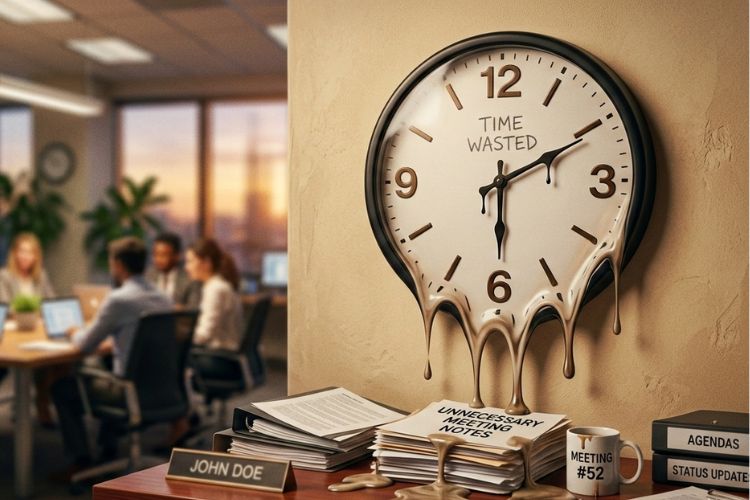
In the modern business landscape, time is the capital we claim to value most, yet it is, ironically, the asset we squander most recklessly.
Think about this: If a finance manager walked into your office and reported that the company was spending $399 billion annually on software that no one used and that actively slowed down production, you would order an immediate audit. Yet, according to recent data, this is exactly the cost businesses incur every year due to unnecessary meetings.
We are in the midst of a silent crisis. Over the last 50 years, the time employees spend in meetings has ballooned from 10 hours a week in the 1960s to nearly 23 hours today. What was once a tool for collaboration has metastasized into a systemic drain on morale, budget, and cognitive capacity.
For leaders and HR professionals, the challenge is no longer just about “time management”, but culture management. An calendar clogged with back-to-back calls is not a sign of a busy organization; it is a symptom of a fearful one. It represents a “cultural tax” paid for insecurity, unclear decision-making, and a lack of trust.
 |
Author: Jonathan M. Pham |
Highlights
- A meeting is only truly necessary if its goal is to reach a consensus or make a decision. If the objective is simply to share information, it should be handled asynchronously via email or shared documents.
- Beyond the high salary costs, unnecessary meetings impose “soft costs” like recovery time (it takes 23 minutes to regain deep focus after an interruption) and biological impacts, such as decision fatigue and reduced cognitive function.
- Organizations tend to fall into traps like “Zombie” recurring meetings (held out of habit), “Status Updates” (which should be documents), and “Hostage Situations” (where the agenda only applies to a few people in the room).
- To fix the problem, leaders should implement “Zero-based calendaring” (canceling all recurring meetings and making them “earn” their way back) and adopt the “No Agenda, No Attenda” policy to shift the burden of preparation onto organizers.
What Actually Counts as an Unnecessary Meeting?
In many organizations, the definition of a meeting has become dangerously loose. We gather together to socialize, to update, to brainstorm, and – a lot of times – simply because it is Tuesday at 10:00 AM.
A strict definition of a necessary meeting is one where consensus is required. If the goal is not to make a decision or commit to a course of action, it is likely redundant.
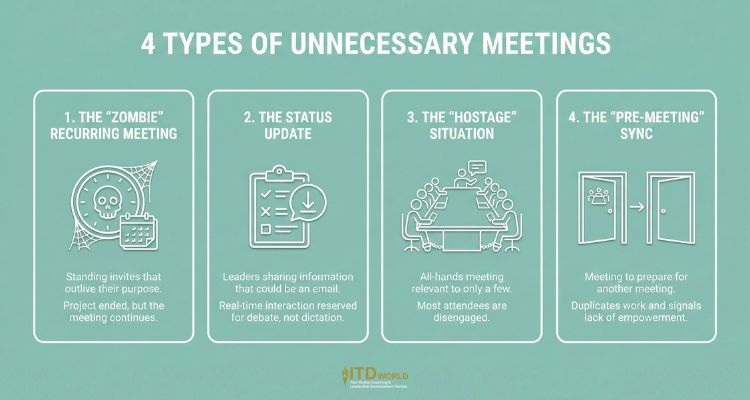
Generally speaking, unnecessary meetings can be classified into four archetypes as follows:
- The “Zombie” Recurring Meeting: These are standing calendar invites that exist solely because they always have. The original project may have ended or the crisis may have passed, yet the team continues to “catch up” out of habit.
- The Status Update: The most common offender. If the meeting consists of leaders going around the room sharing information that could have been read in a document, it is a misuse of synchronous time. Real-time interaction should be reserved for debate, not dictation.
- The “Hostage” Situation: These are all-hands or department-wide gatherings where the agenda is relevant to only a fraction of the attendees. If 15 people are in a room and only three are speaking while the rest check their email, you have created a hostage situation, not a collaboration.
- The “Pre-Meeting” Sync: A symptom of insecurity, it refers to a meeting held to prepare for another one. It duplicates work and signals that the team is not empowered to act without rehearsal.
Unproductive meetings
The Litmus Test:
To determine if a meeting is essential or not, apply the “Asynchronous Filter.” Ask: Could this objective be achieved if we were not all online at the same time?
If the answer is yes—via email, Slack, or a shared document—it is not worth it.
Read more: Leadership Self-reflection – Key to Leading with Clarity
How Prevalent Are Unnecessary Meetings at Work?
Research into employee calendars reveals a staggering commitment. The average employee now spends 18 hours per week in meetings. For managers with four or more direct reports, that number climbs to over 22 hours. The result? Only half of the workweek is left for the actual execution of tasks.
However, attendance does not equal value. In a recent study of over 600 employees across 20 industries, a massive “Value Gap” was exposed. While employees attend 18 hours of meetings, they report that only 11.9 hours are actually critical to their work. In other words, about 33% of meeting time is immediately identifiable as waste.

Useless meetings
The Generational Toll:
The issue is compounding with the entry of younger generations into the workforce. Gen Z workers, who are digital natives accustomed to asynchronous communication, report the highest levels of “meeting fatigue” (72%). For this demographic, a culture that defaults to live calls for every minor issue isn’t just inefficient—it is a primary driver of burnout and turnover.
Read more: Always-on Culture – How the Availability Trap Erases Profits
The Cost of Unnecessary Meetings: More Than Just Hourly Wages
When organizations calculate the cost of a meeting, they usually look at the “Hard Cost” (Duration × Salary). To see it in action, let us consider a standard one-hour sync:
- The Single Hour: A meeting with five mid-level executives—averaging $70/hour in total compensation—costs the company $350 in direct salary expenses for that hour alone.
- The Annual Commitment: If that session is a weekly fixture on the calendar, the annual cost balloons to over $17,500.
When you multiply that figure by the hundreds of teams found in a large enterprise, the waste quickly scales into the millions. In fact, research suggests that companies effectively “throw away” approximately $25,000 per employee, per year on meetings that add no measurable value.
However, the “Soft Costs” are often more damaging to long-term performance.
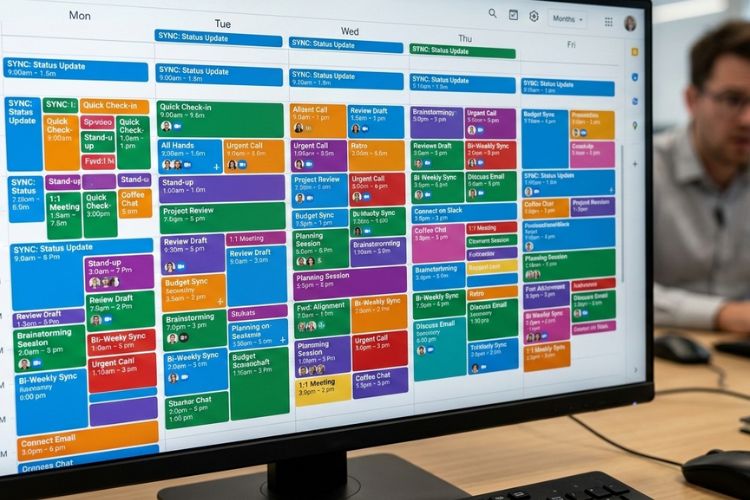
Wasteful meetings
The “liminal” & recovery cost
Productivity does not stop and start instantly. There is a “liminal” period of roughly 15 to 20 minutes before a meeting where employees stop doing deep work because they know they are about to be interrupted.
Worse is the recovery time. It takes an average of 23 minutes for one to regain a state of deep focus (or “flow”) after an interruption. If an employee has three meetings scattered throughout the day, they may never achieve peak cognitive performance.
The “Maker vs. Manager” schedule
This cost is disproportionately felt by individual contributors—developers, writers, and strategists—who operate on a “Maker Schedule.” For a manager, the day is sliced into hour-long intervals; a meeting is just another slot. For a Maker, a single session at 2:00 PM can ruin an entire afternoon of coding or creating, effectively turning a full day of work into two small, unusable chunks.
Biological impact
The cost is also physical. Crowded conference rooms (and even intense Zoom sessions) lead to decision fatigue. High concentrations of CO2 in meeting rooms have been shown to reduce cognitive function by up to 50%. By the time the third hour rolls around, the brain is simply not capable of high-level strategic thought.
Read more: Employee Wellbeing in the Workplace – Practical Strategies for Long-term Success
Too many meetings are a waste of time
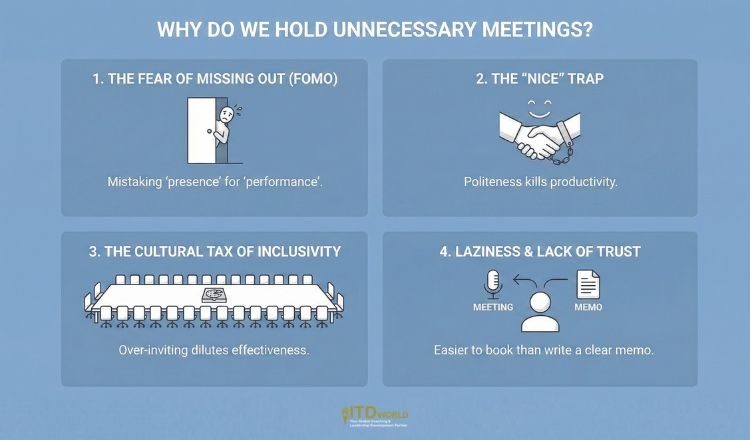
Why Do We Hold Unnecessary Meetings?
The problem’s root cause is rarely malicious; most of the time, it is psychological.
- The Fear of Missing Out (FOMO)
Almost half of employees (45%) admit to attending meetings they know will be useless simply because they don’t want to be perceived as not engaged. In competitive corporate cultures, “presence” is frequently mistaken for “performance.”
- The “nice” trap
Politeness is a productivity killer. 47% of people go to meetings because they don’t want to offend the organizer. Most of us view declining an invite as a personal rejection rather than a professional prioritization.
- The cultural tax of inclusivity
Leaders tend to over-invite to ensure no one feels left out. While well-intentioned, this “Cultural Tax” dilutes the effectiveness of the group. As the “Two Pizza Rule” suggests (attributed to Jeff Bezos), if you can’t feed the group with two pizzas, the team is too large to reach a decision.
Large groups favor the loudest voices and discourage dissent, leading to “rubber-stamping” rather than genuine collaboration.
- Laziness & lack of trust
Ironically, calling a meeting is often the lazy option. It takes significant effort to write a clear, 2-page memo outlining a problem and a proposed solution. On the other hand, it takes very little to book a room and say, “Let’s figure this out.”
As far as we can observe, organizations that lack a writing culture tend to compensate with a meeting one.
Read more: Transparent Leadership – Finding the Right Balance
Pointless meetings
How to Reduce Unnecessary Meetings in the Workplace: Guideline for Leaders
It’s impossible to solve a systemic problem with individual “time management tips.” Instead, you must treat it as an organizational restructuring.
Here is a four-step audit process to reclaim your company’s time.
-
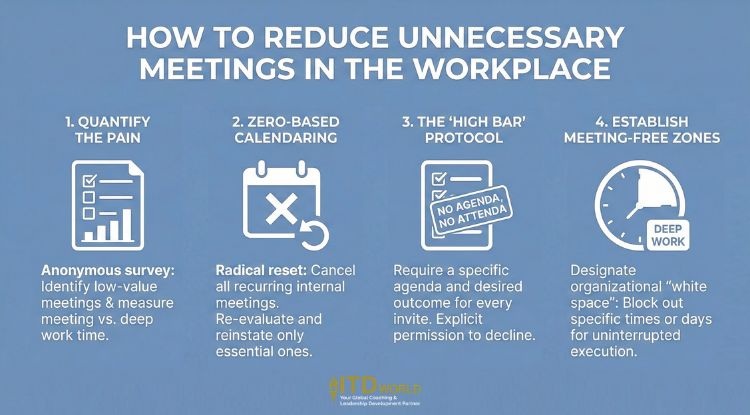
Quantify the pain
Don’t guess—ask. Distribute an anonymous survey to your teams. Ask three simple questions:
- Which recurring meeting provides the least value to you?
- How many hours a week do you spend in meetings vs. doing “deep work”?
- Do you feel empowered to decline invites?
This data will serve as your baseline and helps the team realize that the frustration is shared, not individual.
-
Zero-based calendaring
This may sound radical, but it actually serves as an effective reset. For a specific period (e.g., the start of a new quarter), cancel ALL recurring internal meetings.
Treat the calendar like a budget. Every catch-up session must “earn” its way back onto the schedule. If one was deleted and no one mentions missing it after two weeks, it was a zombie meeting. On the other hand, if the team screams for it back, reinstate it—but with clearer parameters.
-
The “high bar” protocol
The idea is to make it harder to call a meeting by implementing a “No Agenda, No Attenda” policy.
- The Rule: If a calendar invite does not have a specific agenda and a defined desired outcome (e.g., “Decide on X”), employees have explicit permission to decline it.
- The Shift: This moves the burden of preparation onto the organizer. If they cannot articulate why they need 30 minutes of five people’s time, they aren’t ready to do it.
-
Establish meeting-free zones
To protect the “Maker Schedule,” designate organizational “white space.” It could be “No-Meeting Wednesdays” or blocking out every afternoon from 1:00 PM to 5:00 PM for execution. Doing so ensures that even if a session is necessary, it are contained, leaving large blocks of uninterrupted time for deep work.
How to get rid of unnecessary meetings
What Individuals Can Do About Unnecessary Meetings in the Workplace
While leadership drives culture, individuals must protect their own capacity. Here is how to navigate the daily influx of invites without burning bridges.
- The art of the polite “No”
Declining a meeting is a skill that requires nuance. Use the “Value-Add Inquiry” to filter requests (e.g. “I’m reviewing my calendar to prioritize the Q3 launch. Could you clarify the specific decision being made in this session and my role in it?”)
If the organizer cannot answer, you can gracefully decline (e.g. “Since the agenda is information-sharing, I’ll wait for the summary notes so I can keep focused on [Project X]”)
- The delegation maneuver
If you are too senior for the details – and yet your input is needed, learn to entrust. For instance: “I can’t make this, but [Team Member] is leading the execution and would be the better person to represent our department.”
Delegation empowers junior staff – while at the same time freeing up your time.
- Consolidating cadence
If you have five different people asking for “15 minutes to chat” throughout the week, consolidate them. Propose a single “Office Hours” block or a weekly standing meeting where all non-urgent issues are addressed at once. This reduces the switching costs associated with ad-hoc interruptions.
Read more: Inspirational Leadership – Igniting Passion & Purpose in Your Team
How to get out of mandatory work meeting
Golden Rules for Meetings to Prevent Wasting Time
We will never eliminate meetings entirely, nor should we. When run well, they serve as engines of culture and innovation. When you must go to one, try to adhere to these five “Golden Rules” to ensure the time is an investment, not an expense.
- The outcome declaration
Every meeting invite title should include a verb. Change “Budget Update” to “Decision on Q3 Marketing Spend.” This primes attendees to enter the room ready to act, not just listen.
- The 25/50 rule
Parkinson’s Law states that work expands to fill the time available. Stop scheduling one-hour sessions by default.
-
- Schedule 25 minutes instead of 30.
- Schedule 50 minutes instead of 60.
Doing so “shave” creates a biological buffer, allowing people to use the restroom, grab water, or mentally reset before the next commitment.
- Silent starts (The Amazon Model)
The biggest waste of time in meetings is catching people up. One solution to the problem is to adopt the “Silent Meeting” practice popularized by Amazon. Specifically, the first 10–15 minutes are spent in silence, reading a 1–2 page briefing document (The Written Digest) prepared by the organizer.
Why it works: It guarantees everyone is prepared. Additionally, it forces the organizer to clarify their thinking in writing. The subsequent discussion is immediately deeper and more productive.
How to prevent wasting time in meetings
- The parking lot
Assign a “Facilitator” (distinct from the leader) whose job is to police the agenda. If a conversation goes off-track or dives into the weeds, the Facilitator moves it to the “Parking Lot”—a list of topics to be discussed offline or at a later date.
- End with action
Never leave the room (or the Zoom call) without the “Who, What, When” summary.
-
- Who is doing the task?
- What exactly is the deliverable?
- When is it due?
If you reach the end of a session and there are no action items, admit that it was a failure (or a status update) and adjust for next time.
Read more: 7 Leadership Mistakes to Avoid
Final Thoughts: From Activity to Impact
Conducting a Meeting Culture Audit is not about being anti-social or rigid. It is actually a sign that you respect the collective intelligence of your organization.
When companies successfully prune their meeting load, the results extend far beyond the balance sheet. In fact, studies show that reducing unnecessary meetings leads to a 42% increase in collaboration and a surge in work/life balance satisfaction. By removing the “clutter” of low-value interactions, you create space for the high-value work—strategy, creation, and genuine connection—that actually drives the business forward.
Here’s a simple challenge for you this week: Look at your calendar for tomorrow. Find one meeting that fails the “Value Test.” Cancel it, or decline it. Then, take those reclaimed 60 minutes and do the work you were hired to do!
ITD World provides specialized coaching and training solutions to help organizations maximize productivity and leadership effectiveness. Contact us today to learn more about our organizational efficiency workshops!
Other resources you might be interested in:
- Coaching People Who Don’t Want to Be Coached
- Resistance to Change in the Workplace: How Leaders May Manage & Overcome It
- Mindful Leadership: Slow Down to Move Forward
- Self-awareness in Leadership: The Foundation for Growth
- Resilience in the Workplace: Thriving in the Era of Crises
