

By 2030, Generation Z (born between 1997 and 2012) is expected to comprise over 30% of the global workforce. Simultaneously, the “Silver Tsunami” of Baby Boomer retirements is resulting in a massive leadership vacuum across industries. As such, organizations now find themselves at a critical juncture: they must either adapt to the expectations of this incoming demographic – or face a severe competitive disadvantage in the war for talent.
For many established leaders, Gen Z workers are deemed as “difficult” to manage. And yet, research has concluded that view is fundamentally flawed. Rather than a problem to be solved, they are a preview of the future of work.
 |
Author: Jonathan M. Pham |
Highlights
- Gen Z prioritizes “purpose over paycheck”; they view societal impact, diversity (DEI), and mental health support as non-negotiable requirements rather than corporate perks.
- While digitally fluent and highly confident, many Gen Z workers face an “Emotional Intelligence gap” due to entering the workforce during the pandemic – which leads to challenges with office politics, critical feedback, and in-person soft skills.
- Leading Gen Z requires moving from positional authority (the “Badge”) to relational connection (the “Bridge”), utilizing a “Collaborative Circle” where managers act as coaches rather than bosses.
- To lead successfully, managers should adopt the CALM model (focusing on Self, Team, and World) and the A-LEG strategy (Ask, Listen, Empathize, Guide) to ensure feedback feels like support rather than a personal attack.
- Despite 86% feeling ready for leadership, many Gen Z workers are “consciously unbossing”—rejecting traditional people-management roles due to burnout concerns and preferring to lead through innovation and individual contribution.
How Gen Z is Changing Leadership
“We’re not here to maintain the world—we’re here to change it.”
To understand how Gen Z is reshaping leadership, we must first reflect on the environment that shaped them. Growing up entirely in the Internet age and stepping into their formative career years during a global pandemic has equipped them with the innate ability to seamlessly navigate complex, remote, and tech-heavy environments – by utilizing AI, asynchronous communication, and digital collaboration tools as their baseline standard of operation.
However, their impact on the workplace extends far beyond technological fluency. In fact, they are redefining the very core of professional values.
Characteristics of Gen Z workers
- Purpose over paycheck: For Gen Z, work must have a societal or ethical purpose beyond mere profit generation. As revealed by a Deloitte study, a staggering 86% of this cohort ties career satisfaction to personal well-being and societal impact. If a company’s values do not align with their own, they will look elsewhere.
- The “No” factor: Unlike previous generations who were taught to endure toxic environments or unreasonable demands as a “rite of passage,” Gen Z is not afraid to walk away. They establish boundaries early, protecting their time and mental energy.
- Inclusion & mental health as baselines: Diversity, Equity, and Inclusion (DEI) and robust mental health support are not viewed as corporate “perks”—they are non-negotiable requirements. Gen Z expects leaders to be vocal advocates for social justice and mental well-being.
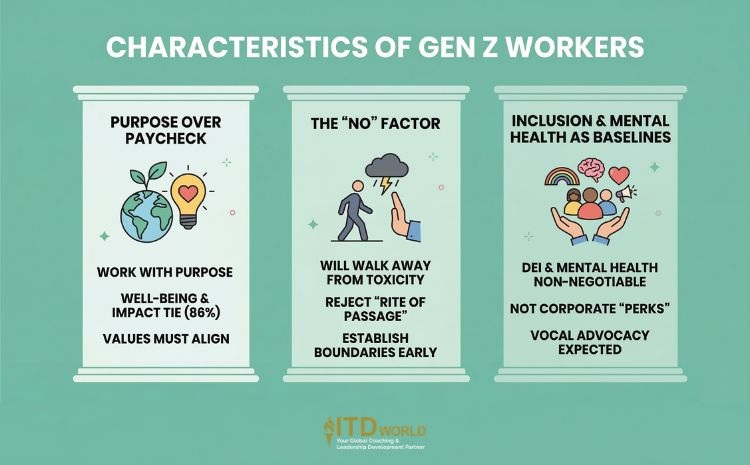
Gen Z attributes
The generational evolution of leadership
To appreciate Gen Z’s perspective, it is helpful to contrast it with the evolution of workplace mentalities over the past few decades:
- Baby Boomers mostly viewed corporate systems as necessary structures that offered order to chaos. To them, leadership was seen as a positional right; the leader was the ultimate “Gatekeeper” of knowledge and advancement.
- Generation X valued independence and self-reliance. Often latchkey kids, they leaned into a “put your head down and get the work done” mentality, trading command-and-control for a desire for autonomy.
- Millennials began the push for purpose, continuous feedback, and work-life balance. However, they largely still attempted to “fit in” to traditional corporate molds, navigating the existing system to enact gradual change.
- Generation Z, conversely, demands “belonging” over fitting in. They do not desire to change who they are to match the company; they want to be fully themselves on behalf of a larger cause. They view connection—not position—as the right to influence, expecting leaders to act as “Guides” rather than Gatekeepers. As such, they become the societal sandpaper disrupting outdated systems.
“Life isn’t perfect, but your outfit can be.”
While seemingly playful, the above-mentioned motto perfectly encapsulates Gen Z’s deep appreciation for unapologetic self-expression and authenticity. They bring their whole selves to work and expect their leaders to do the same.

Leading gen Z characteristics
Challenges (and Opportunities) of Leading Gen Z in the Workplace
Despite their immense potential, we must acknowledge the elephant in the room: approximately 3 out of 4 hiring managers report that Gen Z is the most difficult generation to lead. To resolve this friction, it’s critical we diagnose its root causes accurately.
The “old guard” mindset
Much of the current managerial frustration stems from an outdated leadership mindset. Specifically, many established leaders take positional authority for granted. They are accustomed to unquestioned compliance and measure productivity by “butts in seats” rather than actual output.
Furthermore, leaders are, many times, so obsessed with “being busy” that they forget the importance of human connection. When an older manager complains about a Gen Z employee logging off precisely at 5:00 PM, they often misinterpret efficient boundary-setting as a lack of commitment.
The pandemic effect & the human skills gap
Gen Z missed out on vital foundational experiences due to incidents like COVID-19. Unlike millennials or Gen X, many Gen Z professionals were deprived of in-person onboarding, the “osmosis-like” knowledge transfer of overhearing senior colleagues negotiate on a phone call, and early career networking.
This has resulted in a tangible Experience and Emotional Intelligence (EQ) Gap. They may be highly educated and theoretically proficient, yet they lack the practical reps of navigating complex office politics or recovering from a failed project.
The Peter Pan Paradox
The above-mentioned dynamic leads to what generational experts call the “Peter Pan Paradox.” Gen Z possesses incredible technical authority and digital maturity early on—they can automate a workflow or optimize an AI prompt in seconds. However, it’s another story when it comes to emotional maturity. A young employee might expertly build a complex data dashboard – but then freeze with anxiety when asked to present it to a critical client, or they might interpret constructive feedback on a report as a deeply personal attack.
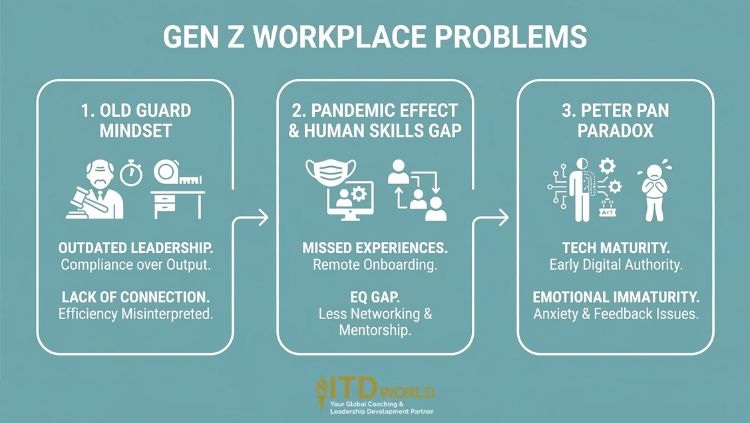
Gen Z workplace problems
Reframing the challenge into an opportunity
The key to leading Gen Z is reframing these friction points. Their pushback isn’t born of malice or laziness; it’s just the sign of a hunger for a new, more sustainable social contract.
Leaders must realize that Gen Z measures effort by outcomes, NOT hours logged. If they can finish a task in four hours using AI that used to take eight, they expect to be rewarded with autonomy, not punished with more busywork.
Organizations that invest the patience to bridge this gap—teaching the human skills Gen Z missed while embracing the technological competencies they bring—will unlock a workforce that is incredibly efficient, purpose-driven, and intensely loyal.
“If you want us to listen, talk TO us—not AT us.”
Managing gen Z in the workplace
The Ideal Gen Z Leadership Style: “The Collaborative Circle”
If command-and-control is dead, what replaces it? The answer lies in moving from a “Badge” (positional power) to a “Bridge” (relational connection). In other words, leadership must transition from a top-down pyramid to a “Collaborative Circle” – i.e. rejecting the “boss at the head of the table” trope in favor of flatter hierarchies, shared ownership, and active, empathetic listening.
To lead Gen Z effectively, it is recommended that managers synthesize the best elements of Servant and Authentic leadership—acting as coaches who prioritize individual growth and show up as real, vulnerable human beings.
The CALM Model (Connected Authentic Leadership Model)
Recent academic studies have suggested adopting the CALM framework, which organizes Gen Z’s expectations into three distinct spheres of leadership:
- The Self (Inner Identity): Focuses on authenticity and purpose. Leaders must be aware of their own values and communicate them transparently. Gen Z workers are capable of spotting a manufactured corporate persona from a mile away.
- The Team (Relational Dynamics): Focuses on service, flexibility, and inclusion. Leaders should strive to foster psychological safety, offer customized working hours where possible, and actively champion diversity.
- The World (External Engagement): Focuses on digital competency and cultural intelligence (CQ). A leader needs to demonstrate proficiency in the digital tools the team uses to maintain credibility – as well as possess the global-mindedness required to lead the most diverse generation in history.
Read more: The Power of Cross-Cultural Communication in Coaching & Leadership Development
The 3 “winning” internal qualities
To truly connect with the Gen Z worker, three specific internal traits are typically required:
- Humility: Acknowledging that you don’t have all the answers. In a world where information is universally accessible, leaders are no longer the sole purveyors of knowledge. When a leader says, “I’m not sure, what do you think?”, they instantly earn Gen Z’s respect.
- Respect: Treating employees as if they are volunteers who choose to be there every day. When you start every interaction with an authentic belief in the other person’s potential, respect acts as an accelerant for progress.
- Curiosity: Shifting from arguing to win, to arguing to learn. When leaders approach differing opinions with a hunger to understand rather than a need to correct, they build bridges where conflict would normally create walls.
“Authenticity isn’t optional—it’s the baseline.”
Working with gen Z
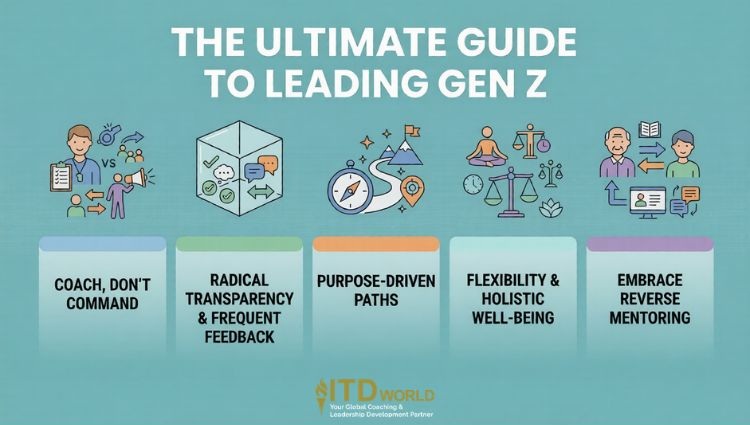
The Ultimate Guide to Leading Gen Z
Understanding the theory is only half the battle. How do coaches, managers, and executives apply this in their day-to-day operations?
Here is a tactical, actionable guide to managing the modern workforce.
-
Coach, don’t command
The traditional “boss” figure is now obsolete; the modern manager is a “coach.” Instead of dictating tasks step-by-step, effective leaders offer guidance.
When a Gen Z employee (or anyone in the team) faces a hurdle, resist the urge to solve it for them. Instead, ask reflective questions:
- “How would you approach this?” or
- “What resources do you need to figure this out?”
Give them absolute autonomy over the “how,” while working closely with them to clearly define the “what” and the “why.”
Read more: Leader vs Boss – 11 Key Differences (Which One Are You?)
-
Radical transparency & frequent feedback
Do not assume the annual performance review is enough. For a generation raised on the instant feedback loops of social media and video games, waiting a year to know how they are doing is agonizing. In fact, over 60% of Gen Z workers want to hear from their managers multiple times a week.
To deliver feedback effectively—especially when it is critical—managers should utilize what generational expert Dr. Tim Elmore’s refers to as A-LEG Strategy to ensure the person feels valued rather than attacked:
- A – Ask: Start with a question to make them feel valued. (“Can you walk me through your thought process on this client proposal?”)
- L – Listen: Practice active listening without interrupting. Let them fully explain their perspective so they feel heard.
- E – Empathize: Articulate their emotions to validate their experience. (“I can imagine managing that tight deadline felt incredibly overwhelming.”)
- G – Guide: Only after the first three steps are complete have you earned the relational right to offer correction. (“Next time, let’s try structuring the timeline this way so you aren’t scrambling at the end.”)
How to lead gen Z
-
Purpose-driven paths
Gen Z does not want a standardized corporate ladder; they desire a personalized growth roadmap. As such, managers must connect an individual’s daily, seemingly mundane tasks to a larger social or organizational “why”. For instance, if an employee is doing data entry, explain how that data directly improves the customer’s life or advances the company’s sustainability goals.
At the same time, it’s also crucial to focus on momentum through skill-building rather than just vertical promotions.
Read more: Talent Development – A Playbook for Building the Future Workforce
-
Flexibility & holistic well-being
Organizations need to move beyond treating wellness as a brochure topic – and instead normalize conversations about mental health and burnout. For this purpose, leaders are expected to model renewal. If a manager tells their team to maintain work-life balance but sends emails at 11:00 PM on a Saturday, Gen Z will inherently distrust them.
Leaders must, therefore, visibly take time off and respect asynchronous communication boundaries to prove that well-being is a genuine company value.
Read more: Always-on Culture – How the Availability Trap Erases Profits
-
Embrace reverse mentoring
One of the most powerful tools in bridging the generational divide is establishing reverse mentoring programs. Pair a Gen Z employee with a senior leader. The Gen Z employee can then mentor the executive on AI integration, digital workflow efficiency, and emerging cultural trends. In exchange, the senior leader coaches the younger team member on emotional intelligence, complex conflict resolution, and long-term strategic thinking.
This relationship creates mutual respect and dismantles hierarchical intimidation.
“Don’t tell us WHAT to do—show us WHY it matters.”
Leading gen Z without micromanaging
The “Readiness Revolution”: Preparing Gen Z for Leadership
We are currently witnessing a paradoxical shift in the workforce: Generation Z is entering management roles earlier and with more confidence than any previous generation, yet they are doing so with less formal training.
The Confidence vs. Capability Paradox
Recent data reveals a staggering “Readiness Revolution.” While only 24% of Millennials, Gen X, and Boomers felt “very ready” when they first stepped into management, a massive 86% of Gen Z feel ready for their first leadership role. For them, leadership is no longer viewed as a mid-career destination; it is the starting point of their professional journey.
However, this confidence needs to be fueled by experience to become true capability. Organizations are currently experiencing a “training dip”—meaning access to formal leadership development has actually declined just as this eager cohort steps up.
“Conscious unbossing”
The problem becomes even more complicated when we take into account a fascinating trend known as “conscious unbossing.” While highly confident in their abilities, up to 72% of Gen Z workers actually prefer individual career advancement over traditional people-management roles. Having watched older generations succumb to burnout under the weight of legacy management models, they are rejecting the stress of the traditional “boss” role. They want to lead initiatives, drive innovation, and manage projects—but they are highly skeptical of managing people within broken systems.
Strategies for “future-ready” succession planning
To establish a robust leadership pipeline and prepare Gen Z to eventually take over, it is essential that organizations rethink succession planning entirely:
- Close the “human skills” gap: Do not assume that because they are digitally brilliant, they know how to lead people. Provide intentional, structured training in conflict management, giving critical feedback, and strategic critical thinking (such as how to verify, rather than blindly trust, AI outputs).
- Accessible, micro-training: It’s time to ditch the week-long, boring corporate seminars. Gen Z learns best through bite-sized, continuous learning modules. Attach micro-habits of leadership training to their existing daily workflows.
- Provide safe failure: Confidence is fragile if it has never been tested. Give young leaders high-stakes, controlled projects where they can test their leadership wings, make mistakes, and learn from outcomes with a safety net of mentorship beneath them.
“Give us space to try, fail, and try again.”
Simon Sinek on leading gen Z & developing the next generation of leaders
Books on Leading Gen Z
⭐ Core leadership & workplace titles
- The Future Begins with Z — Tim Elmore
A practical guide outlining nine strategies to inspire and connect with Gen Z as they reshape the workforce.
- Leading Gen Z with Empathy and Resilience — Baard I.S.T. Loetvedt
A book that blends pop‑culture insights with leadership tools for navigating today’s rapidly evolving workplace.
🧠 Psychology & development (for leaders to better understand Gen Z)
- The Defining Decade — Meg Jay
A clinical psychologist’s perspective on why the twenties matter more than people think—great for managers guiding early‑career Gen Z employees.
- The Anxious Generation — Jonathan Haidt
A research‑driven look at the mental‑health crisis among Gen Z, as well as the societal forces shaping their behavior.
Looking Toward the Future
The integration of Generation Z into the workforce is not a challenge to be weathered, but an evolution to be embraced. The demands they are making—for transparency, purpose, autonomy, and mental health support—are actually the building blocks of a cultural transformation that makes the workplace better, healthier, and more efficient for all generations.
A successful relationship with Gen Z is deeply interdependent. It requires a foundational bedrock of trust, credibility, rapport, and respect. When older managers let go of the need for absolute control – and instead lean into connection, they will find that Gen Z shows up as highly engaged, loyal, and innovative team members.
As business coaches and organizational leaders, the call to action is clear: Stop complaining about the future. It’s time for us to look in the mirror and ask the hard questions: Are our values genuinely reflected in our leadership style? Are we demanding respect based on our titles, or are we earning it through our authenticity?
Gen Z is holding up a mirror to the corporate world, challenging us to be more human. The only thing worse than being uncool to this generation is being unreal.
“Your voice is your power—use it.”
For the modern leader willing to listen, empower, and authentically connect, the future is incredibly bright.
ITD World provides specialized coaching and training solutions designed to help leaders & organizations secure a competitive advantage – and be equipped to win in today’s dynamic landscape. Contact us today to learn more about our world-class programs!
Other resources you might be interested in:
- AI in Leadership: Bridging the Gap Between Adoption & Maturity
- Upskilling and Reskilling: A Sustainability Framework for the AI Era
- Cognitive Diversity in the Workplace: The Secret Ingredient for High-performance Teams
