
We’ve all been there, right? That collective groan ripples through the office when the email arrives: “Mandatory Team Building Day!” Visions of awkward icebreakers, trust falls gone wrong, and forced smiles fill our minds. The problem? Most organizations conflate Team Building (a deliberate effort to improve functional skills) with Team Bonding (a more organic effort to cultivate relational connections).
While frequently used interchangeably, these concepts represent distinct psychological interventions. One creates the “Bricks” of a solid organizational structure; the other, the “Mortar” that holds it all together. Bonding creates memories, but Building cultivates habits.
To establish a truly high-performing team, we need to stop seeing them as mutually exclusive options and start sequencing them strategically.
 |
Author: Jonathan M. Pham |
Highlights
- Team Building focuses on the “business” by sharpening professional skills, clarifying roles, and optimizing processes (the bricks). Team Bonding focuses on the “people” by building trust, psychological safety, and emotional belonging (the mortar).
- Team building creates lasting “muscle memory” by installing new habits and protocols that survive the daily grind. Team bonding provides a “sugar rush” of morale and happiness, which is vital for resilience but doesn’t fix toxic processes or skill gaps on its own.
- It’s recommended that Bonding be used to integrate new members or recover from burnout, and Building when performance lags or roles are fuzzy. Generally speaking, the most effective approach is a “Retreat Sandwich,” which starts and ends with social bonding to bookend intensive, skill-based building exercises.
- Ongoing Team Coaching acts as the “maintenance crew,” ensuring that the lessons from one-off events are actually integrated into daily culture through reflection and debriefing.
Team Building vs Team Bonding Definitions
Before going further, let’s get crystal clear on what each term actually means.
Team building (the “Head”)
Think of Team Building as focusing on “The Business.” It’s a process-driven, structural approach designed to sharpen specific skills and improve team functionality.
- Goal: To enhance how the team works. This means boosting efficiency, clarifying roles, and streamlining problem-solving processes.
- Analogy: It’s the Bricks of a house, providing the underlying structure upon which everything else is built.
Team bonding (the “Heart”)
Team Bonding, on the other hand, prioritizes “The People.” It’s a relational, emotionally intelligent approach centered on shared experiences and personal connections.
- Goal: To improve why the team wants to work together. This involves fostering trust, creating psychological safety, and nurturing a sense of belonging.
- Analogy: It’s the Mortar that binds those bricks together, providing the essential cohesion that prevents the entire structure from crumbling.
Team coaching (The “Guide”)
A crucial and often overlooked element is Team Coaching. Unlike one-off Building or Bonding exercises, Team Coaching involves a systemic, ongoing partnership designed to help the team reflect on its behaviors, identify patterns, and drive continuous improvement over time. It’s the maintenance crew that ensures the bricks and mortar remain strong and aligned.
The “Fluff” Factor: Do Team Building & Team Bonding Actually Work?
Let’s be honest: The phrase “team building” can elicit eye-rolls. So, is it all just mandatory fun, or is there a real business case to be made for these interventions?
The business case for building (Engagement)
Engagement, driven by effective Team Building, directly impacts the bottom line. Research consistently demonstrates that highly engaged teams are more productive, innovative, and profitable. For example, a Willis Towers Watson study found that companies with high employee engagement boast significantly higher operating margins—up to three times higher, in some cases.
Furthermore, research also highlights the importance of “Task Cohesion.” Specifically, studies demonstrate that high task cohesion correlates more strongly with performance (with an effect size of 0.25-0.30) compared to social cohesion alone. In short, when team members are aligned around shared goals and understand their roles, performance soars.
The business case for bonding(Happiness & trust)
Bonding, when done right, fosters a positive and supportive work environment that translates into tangible results. In fact, research consistently concludes that happy employees take fewer sick days and generate higher sales.
Moreover, strong interpersonal relationships lay the foundation for psychological safety—a critical ingredient for innovation. When team members feel safe to express ideas, take risks, and challenge the status quo without fear of judgment, creativity flourishes.
Moving to a synthesized approach
As discussed, neither Team Building nor Team Bonding is “fluff” if implemented strategically and with clear objectives. The former creates competence; the latter creates resilience. When combined effectively, they form the bedrock of a thriving and high-performing team.
Team Building vs Team Bonding Differences
-
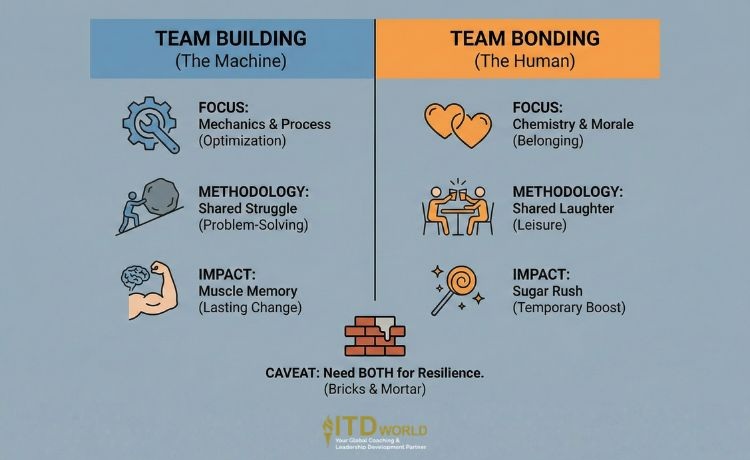
Focus: Mechanics vs. Chemistry
- Building: Focuses on the “Machine.” It’s about optimizing processes, clarifying roles, and eliminating communication breakdowns. The key question is: “Does everyone know what to do, and how to do it effectively?”
- Bonding: Focuses on the “Human” element. It addresses loneliness, friction, and low morale. The driving question here is: “Does everyone feel valued, supported, and a sense of belonging?”
Imagine a sales team struggling to meet its targets. Team Building might involve sales training workshops, process optimization exercises, or role-playing scenarios. Team Bonding, on the other hand, might involve a team-building retreat, a shared volunteer activity, or simply scheduling regular team lunches.
-
Methodology: Shared struggle vs. Shared laughter
- Building (Shared struggle): Team Building often involves tackling challenging tasks that require collaboration, problem-solving, and a willingness to push beyond comfort zones. This approach embraces the “One Thousand Balls” principle: True cohesion arises from surviving difficult tasks together, not just playing games. It requires skill-based vulnerability, as team members openly acknowledge areas where they need to improve.
- Bonding (Shared experience): Bonding focuses on lowering defenses through shared leisure activities and experiences. It requires personality-based vulnerability, encouraging team members to share personal stories, connect on common interests, and reveal aspects of their lives outside of work.
-
Duration & impact
- The “sugar rush” of bonding: Let’s face it – Bonding events tend to provide a temporary dopamine rush. While a team dinner or karaoke night is a potentially great morale booster, the positive effects tend to fade quickly once team members return to the daily grind. The “fun” doesn’t magically fix a toxic process or address underlying skill gaps.
- The “muscle memory” of building: In contrast, Team Building installs new protocols, processes, and habits. It’s about building “muscle memory” that persists long after the training session ends. While these interventions may be more challenging to implement initially, they are key to lasting, sustainable change.
- The caveat: Team Building without Bonding leads to a cold, mechanical team that may achieve its goals but ultimately lacks the emotional resilience needed to thrive under pressure. You need the mortar to make the bricks stick.
| Feature | Team Building | Team Bonding |
| Core Goal | Optimizing processes & roles |
Improving morale & belonging
|
| Key Question | “Do we know how to work?” |
“Do we care about each other?”
|
| Methodology | Shared Struggle: Tackling challenges |
Shared Laughter: Leisure & stories
|
| Vulnerability | Skill-based: Admitting weaknesses |
Personality-based: Being yourself
|
| Impact | Muscle Memory: Lasting habits |
Sugar Rush: Immediate morale boost
|
| If missing… | The team is happy but unproductive. |
The team is efficient but “cold.”
|
Team building vs team bonding differences
Team Building vs Team Bonding: When to Choose Which?
Now, let’s get practical. When should you prioritize Team Building, and when should you focus on Team Bonding? Here’s a diagnostic guide to help you make the right call:
Choose team bonding when
- The team is new: To break the ice, reduce social anxiety, and foster initial connections.
- Post-crisis/burnout: When the team is exhausted, morale is low, and stress levels are high.
- Silos are forming: To encourage cross-departmental empathy and collaboration.
- Celebrating milestones: To acknowledge achievements, recognize contributions, and foster a sense of shared success.
Choose team building when
- Performance is lagging: Missed KPIs, declining productivity, or recurring errors.
- New leadership: A new manager needs to set expectations, establish clear communication channels, and build credibility.
- Role ambiguity: Team members are unclear about their responsibilities, leading to confusion and duplication of effort.
- Conflict is high: Interpersonal conflicts are hindering productivity, damaging relationships, and resulting in a negative work environment.
Choose team coaching when
- The plateau: The team is performing well but has reached a plateau, struggling to break through to the next level.
- Sustainability: You want to ensure that the insights and skills gained during off-site retreats are well implemented and sustained back in the office.
The “Retreat Sandwich”: How to Structure Activities
The most effective approach to team development isn’t about choosing one over the other. It’s about strategically sequencing Team Building and Team Bonding activities to create a holistic and impactful experience. We call this the “Retreat Sandwich” strategy.
The “sandwich” strategy
- Step 1 – The top bun (Bonding/kickoff): Start with low-stakes activities that promote relaxation and encourage social interaction. Think icebreakers, team-building games, or even a casual coffee break. This phase sets the stage for deeper, more authentic connections and prepares the team for more challenging work.
- Step 2 – The meat (Building/The core): Now it’s time to dive into the core content – skill-building workshops, problem-solving exercises, or strategic planning sessions. These activities should be designed to address specific performance gaps and enhance the team’s collective capabilities.
- Step 3 – The bottom bun (Bonding/Closing): Conclude the session with a relaxing and enjoyable activity that allows everyone to decompress, reflect on what they’ve learned, and solidify the bonds they’ve forged. This might involve a team dinner, a social outing, or a celebratory event.
Types of activities
- Building: Simulations, Escape Rooms (with a focus on debriefing and applying lessons learned), Personality Assessments (DiSC/Myers-Briggs)
- Bonding: Happy Hours, Volunteer Activities, Team Sports, Trivia Nights
Best Practices for Making Team Building and Team Bonding Stick
To maximize the impact of your team development efforts, try to keep these best practices in mind:
- Avoid “forced fun” & prioritize inclusivity
Not everyone enjoys the same activities. As such, you should avoid putting team members on the spot or forcing them to participate in activities that make them uncomfortable. Ensure that the “quiet voice” has a seat at the table.
Read more: 6 Benefits of DEI in the Workplace
- Intentionality is key
Don’t just book a venue and hope for the best. Instead, define clear, measurable objectives for each activity. Are you trying to improve communication, boost morale, or enhance problem-solving skills?
- The crucial debrief
An activity without a debrief is just a game. Take the time to reflect on what happened during the activity and how it relates to the team’s everyday work. This is where Team Coaching shines—facilitating meaningful discussions and helping team members connect the dots.
- Daily culture vs. One-off events
Culture is not something that happens within in a day; it’s cultivated through consistent behaviors, habits, and interactions. Focus on creating a supportive and inclusive work environment where team members feel valued, respected, and empowered to contribute their best work every day.
Read more: 45 Team Building Quotes
Final Thoughts
To sum it up, Team Bonding is the invitation to the party, Team Building is the dance steps, and Team Coaching is the rhythm that keeps everyone moving in sync.
To build a team that truly lasts, leaders must shift away from the outdated notion of searching for a “quick fix” in an afternoon of bowling. Instead, they must embrace the role of architects—carefully laying the bricks of competence, applying the mortar of connection, and ensuring that the entire structure stands strong against the pressures and challenges of the modern business world.
ITD World provides specialized coaching and training solutions designed to help leaders & organizations secure a competitive advantage – and be equipped to win in today’s dynamic landscape. Contact us today to learn more about our world-class programs!
Other resources you might be interested in:
- Diversity in the Workplace: Leveraging Differences to Fuel Innovation & Success
- Coaching Culture: Building a Blueprint for Organizational Growth
- Fish Philosophy: Creating a Joyful & Productive Workplace
