You can schedule time. You cannot schedule capacity.
Most leaders run the day by running the calendar, which quietly assumes an hour is an hour and that you are the constant across all of them. You are not.
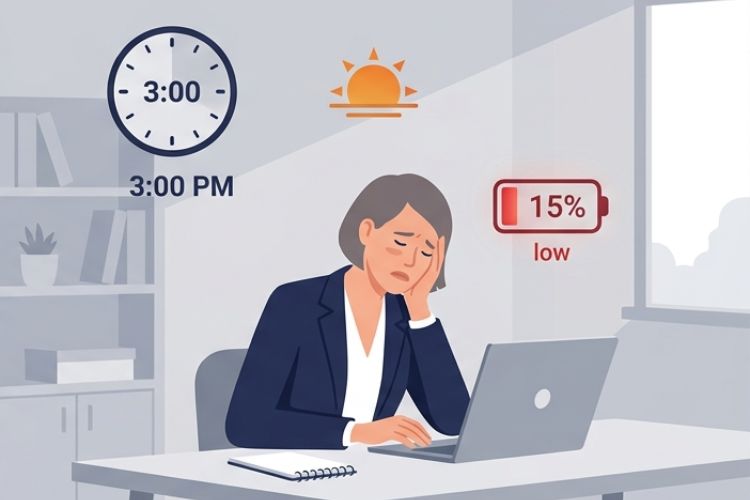
The same meeting at ten in the morning and at three in the afternoon can be two very different meetings because the person sitting in your chair is operating under different conditions. Attention, hydration, fatigue, and the structure of the day can all influence how demanding the same work feels.
Yet almost none of this shows up in how organizations design a working day.
Why does the same decision feel harder after lunch?
Tony Schwartz and Catherine McCarthy made an influential distinction in Harvard Business Review in 2007 in Manage Your Energy, Not Your Time. Time is finite and fixed. Energy, by contrast, can fluctuate and be renewed.
The distinction matters because most calendars are designed almost entirely around availability.
The most consequential conversation of the week might happen at 9:30 in the morning or at 4:30 in the afternoon for no reason other than that the latter happened to be the open slot. Three demanding meetings might be followed immediately by a strategy session because nobody blocked the calendar first.
The schedule accounts for time. It rarely accounts for the condition of the person using it.
The mechanics behind that difference are more specific than the slogan suggests. Two are particularly useful because they can be influenced without redesigning an entire organization.
How much of it is simply fluid?
Start with one of the least glamorous variables in leadership performance: hydration.
Matthew Ganio and colleagues, publishing in the British Journal of Nutrition, dehydrated 26 young men by roughly 1.6 percent of body mass through walking while controlling conditions to avoid excessive heat stress.
The researchers observed adverse changes in vigilance and working memory, along with increased tension, anxiety, and fatigue.
A companion study led by Lawrence Armstrong and published in the Journal of Nutrition in 2012 examined 25 women under similar conditions at approximately 1.36 percent dehydration. Researchers found degraded mood, reduced concentration, headache symptoms, and an increased perception of task difficulty.
That last finding is particularly interesting for anyone whose job revolves around judgment.
The work itself has not necessarily become more difficult. Your experience of doing it can change.
In a leadership setting, that increased sense of difficulty may show up in familiar ways. A decision gets pushed to the next meeting. A recommendation becomes more cautious. A difficult conversation gets shortened. The easiest option becomes more attractive simply because it requires less effort to process and explain.
Those behaviors were not what the dehydration studies measured. But they illustrate why even relatively ordinary physical conditions deserve attention when the quality of judgment matters.
The practical lesson is equally ordinary: hydration should not be something you remember only when the day slows down. Making water consistently accessible removes one small variable from an already demanding schedule.
Is the afternoon fade actually an energy problem?
Not entirely, and this is where the typical calendar may be built around an incomplete model of attention.
Atsunori Ariga and Alejandro Lleras at the University of Illinois examined what happens during prolonged, monotonous tasks.
Participants performed a repetitive visual task requiring sustained attention. As expected, performance declined over time for most participants. But one group was occasionally interrupted with a brief, unrelated task.
Their performance did not show the same decline.
The researchers argued that what we often describe as attention becoming “depleted” may partly reflect habituation. When the same stimulus remains constant for long enough, the mind becomes less responsive to it. Briefly switching attention can help reactivate the original goal.
That has an obvious parallel in the modern executive calendar.
Consider six consecutive video calls from the same chair, facing the same screen, using essentially the same meeting format. Even when the subject changes, much of the environment does not.
This also helps explain why some supposed breaks do not feel particularly restorative.
A longer lunch spent answering email at the same desk still involves the same chair, the same screen, and many of the same cognitive demands. The calendar may say “lunch,” but very little about the experience has actually changed.
A better break does not necessarily need to be long. The research suggests that even brief diversions from a sustained task can matter.
What does a leader actually control?
More than the calendar initially suggests, and much of it costs nothing.
-
Sequence deliberately. When possible, put conversations requiring significant judgment and concentration during periods when you know you tend to be sharper rather than automatically accepting whichever slot is available.
-
Create real breaks between demanding blocks. A brief diversion from the task can be more useful than simply replacing one screen-based activity with another.
-
Make hydration easy. Keep water readily available instead of relying on remembering to get it once you are already deep into the day.
-
Protect one genuine diversion in the afternoon. It does not need to consume an hour. The research on sustained attention suggests that brief, unrelated breaks can help interrupt habituation.
-
Group similar work when practical. Constantly bouncing between strategy, email, meetings, creative work, and administrative decisions creates unnecessary transitions. A calendar does not need to eliminate switching entirely, but it does not need to manufacture more of it either.
None of these changes is dramatic. That is part of the point.
Energy management is often discussed as though it requires a completely different lifestyle. In practice, some of the useful interventions are simply changes to how ordinary work is arranged.
Why knowing all this changes nothing on its own
Here is the part that decides whether any of it actually happens.
The problem is rarely a lack of information.
Most leaders already know they should drink water. They know six consecutive calls are tiring. They know staring at a screen through lunch probably does not qualify as much of a break.
Knowing something and designing the environment around it are different things.
Nobody wants to interrupt a meeting because they forgot to get water. A glass poured at the beginning of a long session can be empty by the second agenda item and remain empty because refilling it means getting up and breaking the flow of the conversation.
The easier a behavior is, the less attention it requires.
So remove the decision before the day starts. Fill your Polar Camel in the morning, leave it where you actually work, and move on with your day. At 3:00 p.m., when your attention is already being pulled in six directions, staying hydrated should not require another decision.
That principle extends well beyond water.
The more demanding the day, the less you should rely on remembering small things at exactly the right moment. Set up the environment beforehand, remove the unnecessary decisions, and save your attention for the ones that actually require it.
The version of yourself that shows up
We often treat capacity as a fixed property of a person, with commitment as the primary variable.
Someone is sharp or they are not. Someone brings energy into the room or they do not. Someone makes good decisions or they do not.
But a meaningful part of performance is also a property of conditions.
Those conditions include the sequence of the day, the amount of uninterrupted attention a task demands, whether basic physical needs have been ignored, and whether every available space on the calendar has been filled simply because it was available.
Those conditions are designed by somebody, often unintentionally, usually by whoever filled the calendar.
That is a more useful way to think about your own schedule.
You are not simply allocating hours.
You are deciding which version of yourself will be present for each thing you have agreed to do.
Note: The content on this article is for informational purposes only and does not constitute professional advice. We are not responsible for any actions taken based on the information provided here.