

Understanding residual value on a car lease is one of the more overlooked variables in business fleet and asset management – and one of the more consequential. Most executives think about lease costs in terms of monthly payments.
The residual value sitting inside that contract shapes the total cost, the flexibility at end-of-term, and the strategic options available when business needs change.
This isn’t only a finance department concern. How an organization handles leased assets – vehicles, equipment, technology – shows up in the balance sheet faster than most executives expect. Cash flow, planning cycles, and the flexibility to pivot when conditions change all run through these decisions.
What Residual Value Actually Means in a Business Context

Residual value is the projected worth of a leased asset at contract end. In a vehicle lease, the lessor sets it at signing – and it determines what share of the asset’s total depreciation lands in your monthly payment. A high residual means lower payments.
You’re only financing the depreciation the vehicle is expected to experience during the term, not its full value. A low residual flips that: higher payments, but often a more attractive buyout number when the lease expires.
Run that across a fleet of five vehicles and the difference is noticeable. Run it across fifteen or fifty and it becomes a budget line worth managing deliberately. Small residual value differences compound – monthly outlay, end-of-term options, and total cost of ownership all shift with them.
Key factors that directly affect residual value on business leases:
- Vehicle make and model – brands with strong resale histories command higher residuals, pulling monthly costs down
- Lease term length – shorter terms carry higher residuals; longer terms front-load more depreciation into the payment structure
- Mileage allowances – higher annual caps reduce the residual, since projected wear lowers the expected end-of-term value
- Market conditions at signing – residuals are forecasts, and actual market prices at term end can diverge from them significantly in either direction
The Strategic Decision at the End of Term
Most businesses treat a lease expiration as an administrative task. It’s a strategic one. Three paths exist: return the vehicle, renew, or buy out at the contractual residual price. The buyout is where residual value becomes most consequential – and where the most money is either captured or left on the table.
If the vehicle’s actual market value at the end-of-term exceeds the contractual residual price, buying out the lease is the financially sound move. The business acquires an asset below current market value – capturing the gap between what was forecast at signing and what the market delivered.
Shifts in the used vehicle market have made this calculation more relevant. When residuals were set several years ago on vehicles now coming off lease, the market value in many categories has moved significantly from the forecast.
Businesses that understand this dynamic can make end-of-term decisions that generate real value rather than simply close a contract.
Factors that influence the buyout decision:
- Current market value vs. residual price – if the gap is substantial, buyout is worth evaluating seriously
- Condition and mileage of the specific asset – a well-maintained vehicle with low mileage relative to its cap has better buyout economics
- Future operational need – buying out a vehicle the business will use for several more years avoids re-leasing costs and term risk
- Capital availability – buyout requires upfront or financed capital; the decision needs to fit within the broader cash flow picture
Fleet Management as a Strategic Function
Organizations that treat fleet management as a strategic function rather than a procurement task make consistently better decisions across the lease lifecycle.
That means understanding residual values at signing, tracking market conditions through the term, and approaching end-of-term with a clear framework rather than defaulting to return.
The same logic extends beyond vehicles. Equipment leases in manufacturing, technology hardware leases in professional services, and real estate arrangements with residual or buyout provisions all involve the same underlying dynamic: a contractual value set at one point in time that may diverge from actual market conditions by the time the decision arrives.
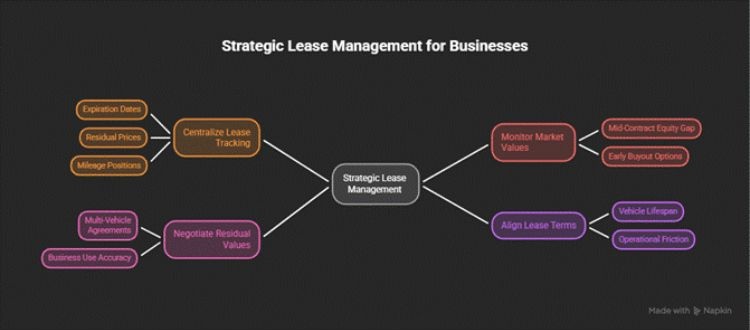
Strategic considerations for businesses managing leased assets:
- Centralize lease tracking – knowing expiration dates, residual prices, and mileage positions across the fleet prevents reactive end-of-term decisions
- Monitor market values through the lease term – not just at end-of-term; early buyout options can make sense when the equity gap develops mid-contract
- Negotiate residual values at signing – particularly on multi-vehicle fleet agreements, there is often room to negotiate terms that reflect business use more accurately
- Align lease terms with operational cycles – a vehicle needed for three years shouldn’t be on a four-year lease; misaligned terms create unnecessary end-of-term friction
What This Means for Executive Decision-Making
The leaders who manage organizational resources well tend to look past the headline number. A monthly lease payment is visible and easy to compare across contracts.
The residual value embedded in that payment, the flexibility it creates or removes at term end, and the strategic optionality it affects are less visible but often more consequential over the life of the agreement.
Building financial literacy around leased assets into the management culture – so that the people responsible for fleet, facilities, and equipment understand not just what things cost but how the contracts are actually structured – is the kind of capability that pays off steadily over time.
It’s not a dramatic intervention. It’s the unglamorous difference between managing contracts and genuinely managing assets.
Note: The content on this article is for informational purposes only and does not constitute professional advice. We are not responsible for any actions taken based on the information provided here.