The promise of digital liberation has devolved into the “Infinite Workday,” where remote tools have permanently blurred the line between office and home. This always-on culture prioritizes “visible busyness” over actual impact, rewarding employees for 8:00 PM responsiveness rather than strategic results.
With three out of four workers facing burnout, the cost to innovation and engagement is unsustainable. To protect the bottom line, we must move beyond surface-level wellness tips and dismantle the structural flaws that keep this availability trap alive.
 |
Author: Jonathan M. Pham |
Highlights
- The “always-on” culture is driven by “telepressure”—the internal urge to respond to messages immediately—and “status surveillance,” where employees feel monitored by their digital presence (e.g., green Slack icons) rather than their output.
- While managers intellectually value well-rested staff, they subconsciously penalize them. Research shows managers rate “unplugged” workers as more productive but lower in commitment and promotability, creating a “prisoner’s dilemma” where employees feel forced to perform “productivity theater.”
- Constant connectivity leads to “digital sprawl,” preventing deep, concentrated work. It also creates a “phubbing” effect that damages home lives and fuels a retention crisis, particularly among younger workers.
- Reclaiming balance requires a shift from “ideal worker” (available 24/7) to “ideal workplace” (sustainable) values. Solutions include “Right to Disconnect” policies, leaders “walking the walk” by scheduling emails for work hours, and teams defining clear boundaries for what constitutes a true emergency.
What is Always-on Culture?
An “always-on” culture is an environment where responsiveness is prioritized over impact, and where “visible busyness” becomes the primary proxy for dedication. It is a culture where a quick message from a manager at 8:00 PM triggers a cascade of anxiety and immediate action, regardless of its urgency.
“Always-on” is not merely the act of checking email at night; at its core, it involves a psychological state known as Telepressure—the internal urge and preoccupation with responding to messages immediately. It is the belief that one’s self-worth and professional identity are tied exclusively to 24/7 availability.
Generally speaking, it affects employees in two distinct, equally damaging ways:
- Hyperconnectivity (the “Overwhelmed”)
At one end of the spectrum are knowledge workers suffering from “digital sprawl.” As reported by Microsoft, the average worker now receives roughly 275 combined Teams messages and emails daily. These employees are driven by FOMO (Fear Of Missing Out) and “performative busyness.” They live in a state of constant partial attention, rapidly switching apps and losing the ability to perform deep, concentrated work.
- Hypoconnectivity (the “Left Behind”)
At the other end—often overlooked by management—are workers who face exclusion. As identified in recent research on the “digital divide,” frontline staff (such as cleaners, porters, or junior logistics staff) tend to lack the “digital capital” or hardware to access basic work functions like payslips or leave requests. For them, an “always-on” culture is alienating because they are structurally disconnected from the organization’s pulse, threatening their sense of competence and autonomy.
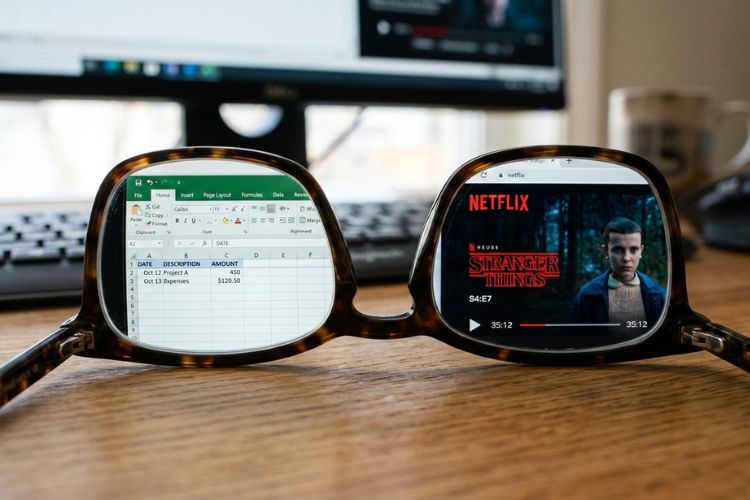
Connecting these groups is the modern digital panopticon: the “Status Light.” Platforms like Slack and Teams have weaponized presence. The pressure to keep a status icon green (“Available”) rather than yellow (“Away”) creates a culture of Status Surveillance, where employees feel monitored not by their output, but by their digital heartbeat.
The “Detachment Paradox”: Why We Can’t Log Off
If the data proves that rest improves performance, why do managers continue to drive their teams into the ground? And why do employees comply, even when they know it hurts their health?
The answer lies in the Detachment Paradox.
Research reveals a startling contradiction in how leadership views “unplugged” versus “always-on” employees. Managers logically acknowledge that well-rested employees are more effective—rating them roughly 8% higher on productivity. And yet, subconsciously, those same managers penalize exactly those workers, rating them 12% lower on “perceived commitment” and promotability.
The above-mentioned paradox is driven by three psychological traps as follows:
The visibility bias & availability heuristic
In the absence of clear output metrics, managers rely on mental shortcuts. The “Availability Heuristic” leads them to assume that the most reachable person is the most reliable one.
Late-night emails serve as a visual cue for dedication. If an employee is online at 10:00 PM, the manager’s brain registers “hard worker,” regardless of whether that individual is actually producing value or simply fixing a mistake they made earlier in the day.
Defensive promotion
Toxic cultures are self-perpetuating, as leaders tend to promote those who mimic their own behaviors. If a Director rose to power by answering emails at 5:00 AM, they are likely to view a subordinate who does the same as “leadership material.” This results in a cycle where the “always-on” trait is selected for, eventually filling the upper ranks with leaders who are incapable of modeling balance.
The employee’s prisoner’s dilemma
From the employee’s perspective, the always-on culture creates a game-theory trap. As highlighted in many raw anecdotal accounts from the workforce, even employees who despise the culture feel forced to participate in “Virtue Signaling.” If they see a colleague sending emails on a Sunday, they feel a competitive pressure to do the same to avoid looking “lazy” by comparison. Professionalism devolves into a farcical endurance test to see who can remain the most reachable for the longest duration.
The True Cost of Always-On Culture
The “always-on” model is not just inhumane; it is inefficient. The belief that more hours equal more output is a fallacy that results in serious organizational damages.
Productivity theater
When responsiveness is the metric, people are prompted to engage in “Productivity Theater.” They perform shallow, visible tasks—like sending delayed emails or chiming in on unnecessary chat threads—solely to appear busy. This comes at the expense of “Deep Work,” the distraction-free concentration required for complex problem-solving and innovation.
As ironic as it may seem, taking time to turn off notifications to actually do work can cause one to be misinterpreted by leadership as being “unresponsive.”
The “phubbing” effect & family conflict
The damage spills over into the home, creating a feedback loop that further erodes work performance. The phenomenon of “Phubbing” (phone snubbing)—constantly checking mobile devices during non-work hours—damages communication with spouses and family.
Research on “Work-Life Harmony” shows that a supportive home life is a performance enhancer; it replenishes the cognitive resources needed for creativity. When work invades the home, it severs this lifeline. Employees who cannot detach are not only less happy at home; they are less proactive and energized when they return to the office.
The health & retention crisis
With burnout cited as the primary reason roughly 70% of Gen Z and Millennials are looking to change jobs, the “always-on” culture is a retention disaster. The lack of “psychological detachment” prevents the recovery processes essential for sleep and stress regulation, leading to a workforce that is perpetually exhausted, risk-averse, and prone to costly errors.
The Solution to Always-On Culture: Shifting the Organization
Combating the always-on culture requires more than a yoga seminar. It starts with a fundamental shift from an “Ideal Worker” culture (valuing availability) to an “Ideal Workplace” one (valuing sustainability).
-
From “Big-C” to “Small-c” culture
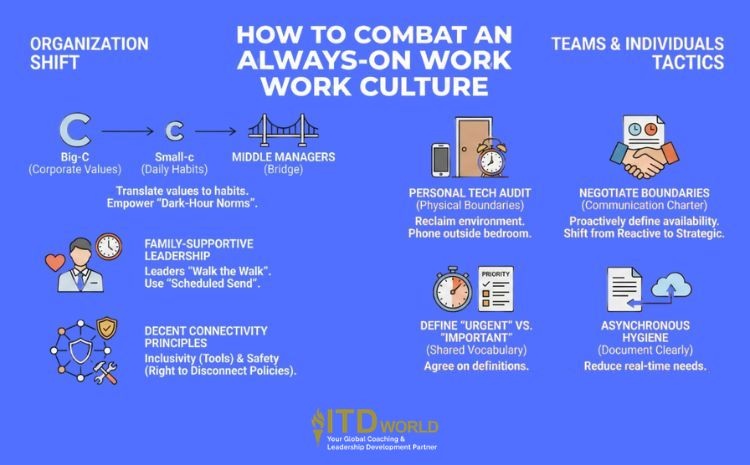
Researchers have made a distinction between “Big-C culture” (official corporate values) and “Small-c culture” (daily team habits). The breakdown often happens in the middle. Middle managers are the bridge; they must be trained to translate the company’s wellness values into daily reality.
How-to: Empower them to experiment with “Dark-Hour Norms” (e.g., no internal meetings on Fridays) and reassure them that their team’s output, not their green status lights, is how they will be evaluated.
Read more: Unnecessary Meetings – Ending the Invisible Tax on Your Team’s Performance
-
Family-supportive leadership
Organizations need to train leaders to view empathy as a productivity tool. “Family-Supportive Leadership” is a specific management style that minimizes work-family conflict.
How-to: Leaders must “Walk the Walk.” If a VP sends an email at midnight, they have implicitly set a policy, regardless of what the Employee Handbook says. Leaders must use “Scheduled Send” to ensure emails arrive during working hours, giving their teams “permission” to disconnect.
-
Decent connectivity principles
Adopting standards similar to the International Labour Organization’s framework for “Decent Connectivity” can help bridge the gap between the hyper-connected and the hypo-connected.
How-to: Ensure inclusivity by providing digital tools to frontline workers, while simultaneously providing safety by establishing clear “Right to Disconnect” policies that protect knowledge workers from digital intrusion.
Read more: 6 Benefits of DEI in the Workplace
How to Combat an Always on Work Culture: Tactics for Teams & Individuals
While leadership sets the tone, individuals and teams should take agency to reclaim their time. Waiting for permission to switch off may lead to permanent burnout.
-
The personal tech audit
Employees must reclaim their physical environment. One simple way to do it is to perform a “Tech Audit.”
How-to: Do you sleep with your phone? The simple act of buying a standard alarm clock and leaving the phone outside the bedroom should drastically improve sleep quality and psychological detachment.
-
Negotiate boundaries (rather than just setting them)
One of the biggest fears employees have is that setting boundaries will look like a lack of commitment. The solution is communication.
How-to: Instead of simply vanishing, you can proactively negotiate availability. Use a “Communication Charter” to define expectations. Explicitly state: “I check emails at 9 AM, 1 PM, and 4 PM. If a matter is truly urgent, please call my cell.” Doing so shifts the dynamic from reactive (responding to every ping) to strategic (choosing when to engage).
-
Define “Urgent” vs. “Important”
The “always-on” culture thrives on false urgency. As such, it is critical that teams agree on a shared vocabulary.
How-to: Does “ASAP” mean “drop everything,” or does it mean “as soon as you are back at your desk”? By formally defining what constitutes an emergency, you can eliminate the low-level anxiety that compels people to check their phones during dinner.
-
Asynchronous hygiene
To reduce the need for constant real-time responsiveness, teams must get better at asynchronous work.
How-to: Document work clearly so that colleagues don’t need to ping you for basic information. When information is accessible, the “quick question” that interrupts your evening becomes unnecessary.
Final Thoughts
The always-on culture is a relic of an era that conflated presence with productivity. It is a system that is failing both the businesses that enforce it and the human beings who endure it.
Organizations now face a choice: they can either continue to reward the appearance of dedication—the late-night emails, the instant replies, the frantic busyness—or they can start rewarding actual results.
Those that treat their employees like 24/7 machines will eventually find themselves with broken machinery. Conversely, leaders who have the courage to hit the “pause button,” who respect the boundary between work and life, and who judge performance based on outcomes rather than timestamps, will cultivate a workforce that is not only healthier but significantly more innovative, resilient, and profitable.
Legislation and policies provide the framework, but culture provides the permission. It is time to grant that permission!
ITD World provides specialized coaching and training solutions designed to help leaders & organizations secure a competitive advantage – and be equipped to win in today’s dynamic landscape. Contact us today to learn more about our world-class programs!
Other resources you might be interested in:
- Employee Engagement in the Digital Age: A Holistic Guide
- Leadership Culture: The DNA of Organizational Success
- Human Centered Leadership: The Importance of a ‘People First’ Mindset