
We are witnessing a paradoxical moment in business history. According to the 2025 Stanford HAI report, AI adoption has become near-universal, with 78% of organizations integrating the technology into their operations. Yet, a stark “maturity gap” remains: as found out by McKinsey, only 1% of leaders classify their companies as truly “mature” in AI deployment. This disconnect reveals a critical truth—the barrier to AI success is no longer access to technology, but the leadership capability to wield it strategically.
As AI evolves from a tactical tool to a core business driver, the definition of leadership itself is being rewritten. It is no longer enough to simply “do digital”; today’s executives must embody AI-First Leadership—a discipline that balances the transformative power of algorithms with the irreplaceable nuance of human judgment.
 |
Author: Jonathan M. Pham |
Highlights
- AI is being integrated into the core business strategy, which leads to the need to reimagine how work is done.
- A significant “overconfidence trap” exists where many executives claim AI expertise, yet only a few possess substantial conceptual knowledge; closing this gap is critical to avoid expensive, failed initiatives and misaligned strategies.
- AI is becoming a “force multiplier” for leaders by handling tactical drudgery and data validation, while humans retain a 9-to-1 dominance in high-stakes strategic planning and ethical oversight.
- As AI handles logic, the value of human leadership shifts toward Emotional Intelligence (EQ); leaders must act as “Chief Trust Officers” to bridge the gap between executive enthusiasm and employee anxiety regarding displacement and surveillance.
- Success requires a new “Leadership DNA” defined by an experimental mindset and “tinkering.” Scaling this culture involves empowering middle management, using “reverse mentoring” to bridge generational tech gaps, and preparing for “Agentic AI” that moves from simple prompts to autonomous goal pursuit.
The Paradigm Shift: From “Doing Digital” to “Being AI-First”
For the last decade, “digital transformation” was the mandate. Leaders focused on digitizing analog processes—moving from paper to cloud, from handshake to Zoom. However, we have now crossed a threshold. The goal is no longer just to use digital tools to do things faster, but to build an AI-First organization where algorithms and human intelligence collaborate to do things entirely differently.
AI as a core strategy, not a tactical tool
In the early stages, AI was frequently treated as an IT experiment or a productivity hack for specific tasks. Today, it has ascended to the boardroom. According to the PwC 2025 Global Digital Trust Insights report, nearly 49% of technology leaders now state that AI is fully integrated into their core business strategy.
This signals a fundamental shift in mindset. “Doing Digital” meant scanning an invoice into a PDF. On the other hand, “Being AI-First” means deploying an autonomous agent that not only reads the invoice but validates it against the contract, detects anomalies, and schedules the payment without human intervention.
In other words, the focus has moved from efficiency (doing the same work faster) to reimagination (redefining what work actually needs to be done).
The leadership literacy gap
Despite the above-mentioned strategic urgency, a dangerous paradox has emerged in the C-suite. Leaders are projecting confidence, yet the data suggests a significant “literacy gap” that threatens effective decision-making.
- The illusion of competence: A May 2025 MIT Sloan Management Review study found that 94% of C-suite executives describe themselves as having “intermediate to expert” knowledge of AI. However, a separate assessment revealed that only 8% of board-level executives actually possess “substantial conceptual knowledge” of the technology.
- The reality check: As the complexity of scaling AI becomes apparent, this bravado is starting to crack. The Akkodis Global Smart Industry Survey notes that executive confidence in their own AI strategies has actually fallen from 69% to 58% over the last year.
This “overconfidence trap” is a critical risk. When leaders believe they understand AI but lack deep conceptual literacy, they are prone to approving expensive, flashy initiatives that lack viable business cases, or conversely, rejecting transformative projects because they misunderstand the potential.
The transition to an AI-First world requires leaders to close this gap—moving from surface-level buzzwords to a true understanding of capabilities and constraints.

AI-driven leadership
The Role of AI in Leadership and Management
As AI matures, its role in leadership has shifted from a novel curiosity to a critical force multiplier. The strategic value of AI lies not in its ability to replace human leaders, but in its capacity to elevate them.
By offloading cognitive drudgery and analyzing vast datasets, AI allows leaders to reclaim their most valuable asset: time for deep, strategic thinking.
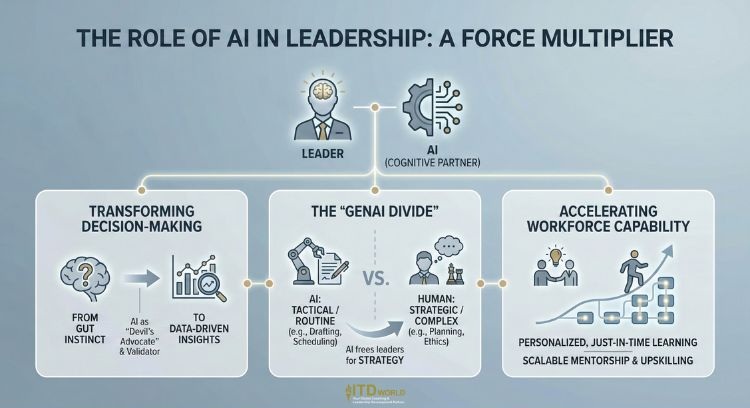
Transformation of decision-making
Leadership has traditionally been defined by “gut instinct”—the ability to make high-stakes calls based on experience and intuition. AI is fundamentally altering this dynamic, moving decision-making from an art to a science.
- The “Trust Shift”: Leaders are increasingly relying on algorithmic validation to navigate uncertainty. In a startling discovery regarding decision-making psychology, SAP’s “AI Has a Seat in the C-Suite” survey found that 74% of executives now place more confidence in AI-generated advice than in advice from friends or family. Additionally, 44% admitted they would override their own intuition if AI data contradicted it.
- The strategic implication: This does not mean leaders are abdicating responsibility. Rather, they are using AI as a “Devil’s Advocate”—a tool to challenge biases, model complex scenarios, and predict outcomes with a precision that human cognition alone cannot match. The leader’s role shifts from being the sole “decision maker” to being the “interpreter and overseer” of data-driven insights.
Read more: Decision Making Framework – How to Eliminate Analysis Paralysis
The “GenAI divide”
A common fear is that AI will render leadership roles obsolete. However, recent data suggests a clear division of labor—a “GenAI Divide”—where AI handles the tactical while humans dominate the strategic.
- Clearing the noise: According to a July 2025 study by MIT Sloan & BCG, while AI is preferred by 70% of leaders for drafting emails and routine communications, humans still dominate complex, long-term strategic planning by a 9-to-1 margin.
- The strategic implication: AI acts as a cognitive partner, automating the routine tasks that used to bog down senior executives (scheduling, reporting, initial drafting). Now, leaders are free to focus on what algorithms cannot do: negotiating sensitive partnerships, defining the organizational mission, and navigating complex ethical dilemmas.
Accelerating workforce capability
Finally, AI is reshaping how leaders develop their people. In a talent-scarce market, the ability to “build” talent internally has become a competitive advantage. AI enables this by moving learning from a “one-size-fits-all” classroom model to a “just-in-time” personalized journey.
- The “Force Multiplier” effect: AI-driven platforms can analyze an individual’s performance in real-time and serve up micro-learning modules to close skill gaps instantly. This allows leaders to scale their mentorship, providing customized guidance to hundreds of employees simultaneously.
- Future-proofing: By integrating AI into the workflow, leaders appeal to a younger, tech-savvy generation that expects digital fluency. It creates a culture of continuous “on-the-job” evolution, ensuring the workforce adapts at the speed of the market rather than the speed of an annual training calendar.
Importance of AI in leadership development
The Human-Centric Core: Ethics, Trust, and Culture
While algorithms process data, it is humans who must act on it. The greatest challenge of AI in leadership is not technical implementation; it is navigating the psychological and cultural tremors that accompany it.
As AI becomes deeply embedded in the workplace, leaders must pivot from being purely operational managers to becoming the “Chief Trust Officers” of their organizations.
Bridging the “trust gap”
There is a significant disconnect between how leaders view AI and how their teams experience it. While the former see efficiency and innovation, the latter see surveillance and displacement.
This divide is highlghted in a Global AI Trust Gap Survey: While 62% of C-suite executives welcome AI in the workplace, only 52% of employees share that enthusiasm. More critically, only 23% are confident that their organization puts people’s interests above the company’s bottom line when implementing AI.
Transparency, therefore, is the new currency of trust. Leaders cannot simply mandate adoption; they must clearly articulate the “why” behind the technology. This means holding open, vulnerable conversations about how AI decisions are made and explicitly defining the boundaries of its use. Otherwise, organizations risk a culture of covert resistance.
Ethical guardianship: The human in the loop
As AI models grow more autonomous, the risk of “black box” decision-making increases. An algorithm can optimize for efficiency, but it cannot for morality. It is the leader’s responsibility to act as the ethical guardrail.
- Managing risk: Leaders must remain vigilant against hallucinations (where AI confidently presents false data) and algorithmic bias (where historical data reinforces prejudice).
- New responsibility: The leader’s role shifts from “decision maker” to “auditor.” They must ensure that every AI-generated output—whether it is a hiring recommendation or a financial forecast—passes the “humanity test.” They must champion data privacy and ensure that the pursuit of automation never comes at the cost of the organization’s core values.
Addressing the “existential crisis”
Perhaps the most sensitive challenge is the loss of professional identity. For decades, many knowledge workers defined their value by their ability to process information or produce technical outputs—tasks that AI now performs instantly.
- Shared anxiety: This existential fear is not limited to the frontline. A Boston Consulting Group (BCG) report found that 43% of leaders and managers worry about losing their own jobs to AI in the next ten years—actually higher than the percentage of frontline employees (36%) who feel the same way.
- Reframing the narrative: Leaders must proactively reframe AI not as a replacement for human intelligence, but as a liberator of human potential. The narrative must shift from “AI will do your job” to “AI will free you from the drudgery of your job.” By positioning AI as a tool for augmentation rather than automation, leaders can help their teams find new meaning in higher-level creative, empathetic, and strategic work that machines cannot replicate.
Read more: Existential Leadership – From Managing Tasks to Curating Significance
The New Leadership DNA: Essential Skills for AI Adoption
As AI commoditizes technical execution and information processing, the specific skills that define “great leadership” are being rewritten. The leader of the future is no longer just a manager of people; they are an architect of human-machine collaboration.
To thrive in this environment, executives must cultivate a new “DNA”—a specific blend of mindset and capability.
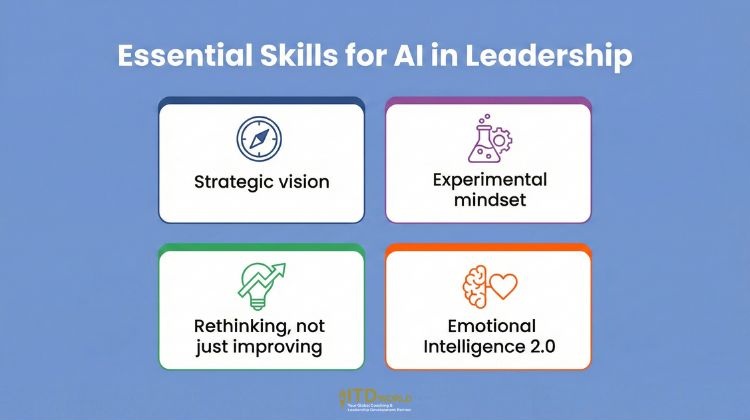
Strategic vision
As Bill Gates once noted, “Most people overestimate what they can achieve in a year and underestimate what they can achieve in ten years.” In an age of hype, the ability to discern lasting value from fleeting trends is critical. Leaders must balance immediate implementation with long-term transformation.
This applies directly to AI in leadership. A “Present Futurist” avoids the trap of expecting AI to fix everything next quarter (overestimation) while failing to prepare for how it will fundamentally rewrite their business model in five years (underestimation). They practice “Future-Back” thinking: visualizing the organization’s state in 2030 and working backward to make the necessary structural changes today.
An experimental mindset
You cannot lead a revolution from the sidelines. The most effective AI leaders are those who get their “hands dirty.”
Why: AI is not a static software update; it is an evolving capability that is best learned through play and experimentation.
How-to: Leaders must cultivate a culture of “tinkering.” This means personally using the tools—not just delegating them to IT. A leader might share the specific prompts they used to analyze a report, or openly discuss a time the AI gave them a “hallucination” (error). By modeling curiosity and transparency about their own learning curve, they signal to the organization that it is safe to experiment and fail.
Rethinking, not just improving
A common pitfall is using AI to simply speed up broken processes—”paving the cow path.” The goal isn’t just to make current tasks faster; it is to use AI to completely reimagine how value is created.
How-to: Leaders need the courage to abandon legacy processes that, while functional, are obsolete in an AI context. For example, instead of using AI to write faster marketing emails (improvement), a visionary leader asks if AI allows them to generate hyper-personalized video content for every single customer (rethinking). This requires a shift from “efficiency” (doing things right) to “effectiveness” (doing the right things).
Emotional Intelligence (EQ) 2.0
As machines take over the domain of logic, data analysis, and pattern recognition (IQ), the unique value of human leadership shifts almost entirely to Emotional Intelligence (EQ). In an AI-driven world, empathy is not a “soft skill“—it is the ultimate competitive advantage.
How-to: Leaders must double down on the human elements that AI cannot replicate: coaching, conflict resolution, cultural alignment, and complex negotiation. As algorithms handle the “science” of business, leaders must master the “art” of connection, ensuring that the workforce remains motivated and psychologically safe amidst constant disruption.
Read more: EQ in the AI Age – Why It Matters for Leaders
Essential skills for AI in leadership and management
Building the Pipeline: How to Scale AI in Leadership
It is one thing for a CEO to be an AI visionary, but another to mobilize an entire organization. To move beyond isolated pilot projects and create a truly AI-first culture, organizations must democratize leadership capability across all levels.
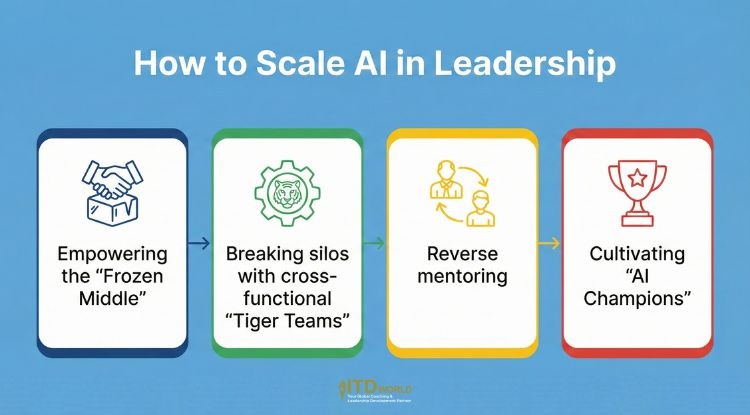
Empowering the “Frozen Middle” (middle management)
Middle managers are typically the bottleneck in digital transformation—not because they are resistant, but because they are overwhelmed. They are squeezed between strategic mandates from above and operational realities from below.
Strategy: Stop viewing middle managers as obstacles and start treating them as the bridge. They are the ones who must translate high-level AI strategy into daily workflows.
Action: Invest heavily in upskilling this layer first. Don’t just teach them how to use the tools; teach them how to lead teams that use the tools. Help them redesign their team’s workflows to accommodate AI augmentation, ensuring they feel like architects of the change rather than victims of it.
Breaking silos with cross-functional “Tiger Teams”
AI implementation rarely fits neatly into one department. It requires data from IT, process knowledge from Operations, and customer insight from Marketing.
Strategy: Move away from rigid hierarchies. Create agile, cross-functional “Tiger Teams” that bring together technical experts (data scientists) with business strategists and domain experts.
Action: Empower these teams to tackle specific business problems with AI (e.g., “Reduce customer churn by 10%”). This forces collaboration and ensures that AI solutions are grounded in real business needs, not just technical novelty.
Reverse mentoring
There is often an inverse relationship between seniority and digital literacy. Younger employees may be fluent in Generative AI tools like ChatGPT or Midjourney, while senior leaders struggle with basic prompts.
Strategy: Flip the traditional mentorship model. Pair senior executives with junior, tech-savvy employees for Reverse Mentoring.
Action: The junior mentor guides the executive through new tools and trends, while the executive provides context on strategy and governance. This not only upskills the leadership team but also empowers younger talent, making them feel valued and heard.
Cultivating “AI Champions”
You cannot be everywhere at once. To scale culture, you need evangelists.
Strategy: Identify early adopters within the organization—those who are already experimenting with AI on their own initiative.
Action: Formalize their role as “AI Champions.” Give them the resources, training, and platform to share their successes (and failures) with their peers. When employees see a colleague in a similar role using AI to save five hours a week, adoption becomes viral rather than mandated.
Transforming leadership practices through Artificial Intelligence
Navigating the Minefield: Challenges & Pitfalls of AI in Leadership
The “Shadow AI” phenomenon
One of the most immediate risks is the invisibility of AI adoption. When organizations move too slowly, employees take matters into their own hands, using unapproved tools to get their work done.
According to data by McKinsey, C-suite leaders estimate that only 4% of their employees use GenAI for significant work. In reality, 13% of employees self-report doing so—usage is three times higher than leaders realize. This “Shadow AI” creates significant risks, from data privacy leaks (e.g., pasting proprietary code into a public chatbot) to fragmented workflows where critical business knowledge is trapped in personal accounts rather than institutional systems.
The efficiency paradox (the “hustle culture” trap)
There is a dangerous temptation to view AI solely as a tool for squeezing more output out of fewer people. If AI saves an employee five hours of work a week, and leadership simply fills that time with five more hours of the same busy work, the result is not innovation—it is burnout. This “hustle culture” approach leads to a workforce that is exhausted rather than empowered.
Solution: Leaders must fundamentally redefine productivity. The goal of AI should not be to produce more volume, but to produce higher value. The time saved by automation must be reinvested in strategic thinking, creativity, and rest, ensuring the workforce remains resilient for the long haul.
“Shiny Object” Syndrome
In the rush to “stay in the game,” many organizations fall victim to the Fear of Missing Out (FOMO). Specifically, leaders launch disjointed pilot programs or purchase expensive enterprise licenses without a clear business case, simply to appear innovative. They end up with a “solution in search of a problem.”
Solution: Maintain a healthy skepticism. Before approving any AI initiative, ask: “What specific business problem does this solve?” and “How will we measure success beyond just adoption rates?” Innovation must be disciplined; unconnected experiments rarely scale into competitive advantage.
The legacy mindset
The most stubborn barrier is often the organization’s own history. Established companies tend to have a “cultural immune system” that attacks new ways of working. Senior leaders who built their careers on traditional metrics of command-and-control may subconsciously sabotage AI initiatives that threaten their perceived authority or expertise.
Solution: Acknowledge the fear. Change management cannot be a memo; it must be a campaign. Leaders must explicitly validate the past successes of the organization while clearly articulating why the old methods are insufficient for the future.
Read more: Building KPIs & Metrics that Truly Matter & Drive High Performance
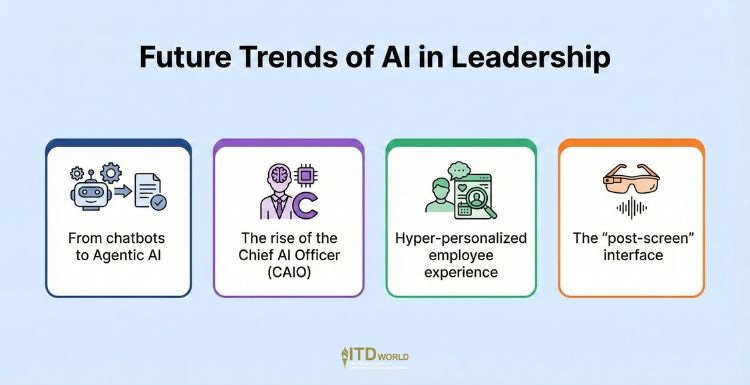
Future Trends of AI in Leadership
Leadership is about anticipation. While generative AI (like ChatGPT or Midjourney) has dominated recent headlines, the technology is evolving rapidly. As such, leaders must prepare not just for the tools of today, but for the transformative shifts arriving tomorrow.
From chatbots to Agentic AI
We are moving from “passive” AI—which waits for a human prompt to generate text or code—to “Agentic” AI. These are autonomous agents capable of pursuing complex goals with minimal supervision.
How it looks like: Instead of asking a chatbot to “Write an email to a vendor,” a leader will instruct an AI agent to “Negotiate a 5% discount with our top three suppliers and update the contracts.” The agent will research pricing, draft emails, interpret replies, and only involve the human for final approval.
Implication: This shifts the leader’s role from “manager of tasks” to “orchestrator of outcomes.” Leaders will need to become experts in defining clear strategic intent and setting guardrails for autonomous systems.
The rise of the Chief AI Officer (CAIO)
As AI becomes central to strategy, it can no longer be a side project for the CTO or CIO. We are seeing the emergence of the Chief AI Officer (CAIO)—a board-level role dedicated to bridging the gap between technical capability and business value. The CAIO is responsible for AI governance, ethical compliance, and ensuring that AI investments align with the company’s long-term vision.
Implication: Even without this specific title, every member of the C-suite must develop “AI fluency.” Governance is no longer an IT issue; it is a fiduciary responsibility.
Hyper-personalized employee experience
Just as Netflix personalizes entertainment, AI will personalize the employee lifecycle. In other words, “one-size-fits-all” HR policies will vanish. AI will analyze individual work patterns to suggest optimal meeting times, recommend specific mentors, and curate personalized learning paths that adapt daily.
Implication: Leaders will need to manage a workforce where every employee has a bespoke experience. The challenge will be maintaining a cohesive corporate culture when the “employee journey” is unique for everyone.
The “post-screen” interface
The way leaders interact with data is changing. We are moving toward multimodal interfaces—voice, gesture, and spatial computing (AR/VR). Instead of staring at dashboards, leaders might walk through a virtual factory floor overlayed with real-time efficiency data or query their AI assistant via voice during a commute.
Implication: This reduces the friction between thought and action. Those who are comfortable with these immersive tools will have faster access to insights and greater agility in decision-making.
Read more: 10 L&D Trends to Expect for the New Era
AI in business & thought leadership
Developing AI-Ready Leaders with ITD World
The transition to an AI-first organization involves a fundamental rewiring of your leadership DNA. As the “Maturity Gap” widens, the organizations that thrive will not be those with the most expensive software, but those with the most capable leaders—those who can bridge the divide between algorithmic power and human potential.
At ITD World, we understand that while AI transforms the nature of work, it is your people who drive the value of that work. As such, we partner with global organizations to equip their executives and managers with the mindset, agility, and human-centric skills required to lead in the age of algorithms.
Our solutions for the AI Era:
- Strategic Visioning Workshops: Facilitated sessions for C-suite and senior leaders to define their “AI North Star,” moving beyond hype to identify specific, high-value strategic applications.
- Adaptive Mindset & Agility Coaching: Helping leaders overcome the “fear of the new” and cultivate the psychological safety required for a culture of experimentation and rapid pivoting.
- Human-Centric Leadership Programs: Deep-dive training in Emotional Intelligence (EQ), empathy, and coaching skills—ensuring the management team can manage workforce anxiety, promote trust, and amplify the unique human value that AI cannot replicate.
- Change Management for Digital Transformation: Equipping managers with the tools to navigate the “Shadow AI” phenomenon, break down silos, and lead cross-functional teams through complex transitions.
e
The future belongs to the agile. Don’t let your leadership capability lag behind your technological capacity!
Contact ITD World today to discuss how we can help future-proof your organization!
Other resources you might be interested in:
- Skills-Based Organization: Promoting Agility in a Disrupted World
- High-performance Culture: A Blueprint for Driving Excellence
- Building High-performing Teams: Power Up Your People for Success
- Employee Engagement in the Digital Age: Strategies for Powering Up Your Workforce