

In the late 1990s, Harvard Business School researcher Amy Edmondson set out to study clinical teams in hospitals, expecting to find that the highest-performing teams made the fewest errors. Instead, she discovered a paradox: the best teams appeared to be making more mistakes than their lower-performing counterparts.
Upon closer inspection, the reality became clear. The top teams weren’t actually failing more often; they were simply more willing to report, discuss, and learn from their errors. The lower-performing ones, on the other hand, were hiding problems out of fear.
This groundbreaking revelation introduced the corporate world to a concept that has since become the bedrock of modern organizational success: psychological safety.
 |
Author: Jonathan M. Pham |
Highlights
- Psychological safety is frequently misunderstood as “being nice” or lowering standards; in reality, it is about candid feedback and cognitive conflict. Only when high psychological safety is paired with high accountability may learning flourish.
- Research shows that psychological safety in the workplace is the top predictor of team success, leading to higher revenue, increased productivity, and significantly lower employee turnover.
- Humans naturally stay silent to avoid looking ignorant, incompetent, or negative. While this protects an individual’s image in the short term, it robs the organization of innovation and prevents critical interventions in high-stakes situations.
- A lack of safety doesn’t always look like toxic behavior. Common red flags include “echo chamber” meetings where everyone agrees, a culture of blaming individuals for process failures, and “toxic positivity” that masks burnout.
- To build safety, leaders must shift from an “execution” mindset to a “learning” mindset. This involves framing work as an uncertain challenge, publicly modeling their own fallibility, and actively rewarding those who have the courage to challenge the status quo.
What is Psychological Safety in the Workplace?
Coined by Amy Edmondson herself, psychological safety is defined as “a shared belief held by members of a team that the team is safe for interpersonal risk-taking.” In a corporate setting, “interpersonal risk” takes many forms:
- It is the junior analyst raising their hand in a meeting to point out a flaw in the financial projection.
- It is the marketing director admitting that a highly funded campaign is failing and needs to be pulled.
- It is the team member who feels comfortable asking for help when they are overwhelmed, rather than suffering in silence.
- etc.
In a psychologically safe environment, employees know they will not be punished, humiliated, or marginalized for speaking up.
Busting the myths: What psychological safety is not
One of the greatest barriers to creating psychological safety in the workplace is that leaders often misinterpret the concept, confusing it with a lowering of standards. To build a high-performing culture, we must dismantle the following common myths:
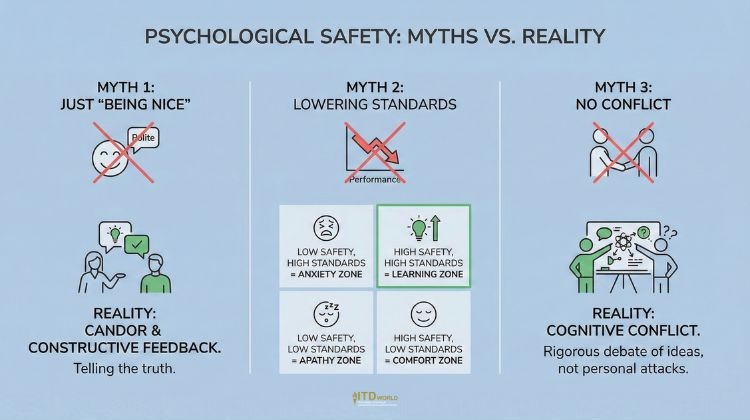
- Myth 1: It is just about “being nice”
The reality: Psychological safety is about candor, NOT merely politeness. In workplaces that over-index on “being nice,” employees are likely to withhold vital constructive feedback to avoid hurting a colleague’s feelings. True psychological safety, therefore, means you respect your peers enough to tell them the truth, even when it is difficult to receive.
- Myth 2: It means lowering performance standards
The reality: Safety and accountability are not mutually exclusive – quite the opposite. If you have high safety but low performance standards, you create a “Comfort Zone” where people are happy but complacent. If you have high standards but low safety, the result is an “Anxiety Zone” prone to burnout. Only when the two are combined together may organizations have a “Learning Zone”—the exact environment required for winning.
- Myth 3: It means a workplace free of conflict
The reality: A psychologically safe team actually experiences more conflict, but it is cognitive, not personal. Because team members feel secure, they are willing to rigorously debate ideas, challenge assumptions, and stress-test strategies. The friction is directed at the problem, never at the person.
By separating the reality of psychological safety from these misconceptions, leaders can begin to see it for what it truly is: a catalyst for accountability, innovation, and continuous learning.
The Importance of Creating Psychological Safety in the Workplace
For years, psychological safety was viewed primarily through the lens of employee wellbeing—a commendable, yet seemingly intangible HR goal. Today, hard data has unequivocally proven that it is the most critical lever for organizational performance.
The ultimate predictor of team success
Perhaps the most famous validation comes from Google’s “Project Aristotle” (2012–2016). In a massive internal study of over 180 teams, Google sought to uncover the secret formula for the perfect team. They analyzed individual intelligence, personality traits, and skill levels, expecting to find an optimal mix of top-tier talent.
Instead, they discovered that psychological safety was the single most important factor in predicting team success. Specifically:
- Sales teams with high psychological safety exceeded their revenue targets by 17%, while those with low safety missed their targets by 19%.
- Furthermore, teams with high safety were rated as “effective” twice as often as those without it.
The study concluded that “who is on a team matters less than how the team members interact, structure their work, and view their contributions.“
The productivity & retention multiplier
When individuals feel their voices do not matter, most do not just stay quiet—they either leave, or worse, disengage while staying on the payroll. According to a 2017 Gallup report, only 3 in 10 employees strongly agree that their opinions seem to count at work.
The opportunity cost is massive. Gallup found that moving a team’s psychological safety levels from the bottom 30% to the top 30% can result in a 27% reduction in turnover, a 40% drop in safety incidents, and a 12% increase in productivity.
Research from Accenture also confirms this, showing that teams with high psychological safety are 76% more engaged and 50% more productive. Crucially, for organizations investing in learning and development, employees in safe environments are 67% more likely to apply a newly learned skill on the job. Without safety, training investments are largely wasted.
When employees don’t feel psychologically safe, they naturally question whether the environment truly supports their growth and well-being. In fact, many professionals point to workplace culture and a lack of support as reasons for moving on. This topic is explored further in OhBeJay’s guide on good reasons for leaving a job.
A buffer against burnout in a VUCA world
We are operating in a Volatile, Uncertain, Complex, and Ambiguous (VUCA) landscape. The pressure to innovate and adapt is relentless. Simultaneously, the workforce is undergoing a massive demographic shift. The rising generations of workers—Millennials and Gen Z—place a premium on authenticity, purpose, and mental wellbeing. They will simply not remain in toxic environments where they cannot speak their minds.
In this high-stress context, psychological safety acts as a critical buffer. Research by the Center for Neuroeconomics Studies reveals that individuals at companies with high trust—a core component of psychological safety—report 74% less stress, 106% more energy at work, and 40% less burnout.
By creating a transparent environment where employees feel secure, organizations can protect their talent from the exhaustion of the modern workplace, ensuring they have the resilience needed to tackle tomorrow’s challenges.

Building psychological safety at work
The Cost of Silence: The “Impression Management” Trap
If psychological safety is so critical to business success, why is it so rare?
The answer lies in basic human psychology and a phenomenon known as “Impression Management.”
From a very young age, human beings are conditioned to protect their social standing. In the workplace, this translates to a deep-seated desire to manage how others perceive us.
We inherently understand that speaking up carries interpersonal risk. As Amy Edmondson has noted in her research, individuals – consciously or subconsciously – run through a quick risk-assessment before they open their mouths. We stay silent because we want to avoid four specific labels:
- Ignorant: So we don’t ask questions.
- Incompetent: So we don’t admit mistakes or ask for help.
- Intrusive: So we don’t offer ideas outside our direct scope of work.
- Negative: So we don’t critique the status quo.
Short-term protection, long-term failure
This behavioral reflex is an excellent strategy for short-term self-protection. By remaining quiet, one ensures they will not be mocked, reprimanded, or viewed as a bottleneck. However, the reward comes at a massive cost to the organization – which Edmondson has demonstrated through the following classic examples:
- The Nurse: A junior nurse suspects a senior doctor has prescribed the wrong dosage of medication. Fearful of appearing intrusive or questioning the expert’s authority, she stays silent.
- The Co-Pilot: A co-pilot notices a subtle dashboard anomaly but defers to the seasoned captain’s judgment, not wanting to look incompetent or alarmist.
- The Executive: A mid-level executive spots a glaring flaw in a proposed merger. But because the CEO is highly enthusiastic about the deal, the executive stays quiet to avoid being labeled as “negative” or not being a “team player.”
In each scenario, the individual successfully protected their image in the moment. Yet, they simultaneously robbed the organization of critical interventions, continuous learning, and necessary innovation.
Read more: The Player-coach Leadership Style – Mastery of Two Worlds
The innovation & trust gap
When impression management dictates company culture, innovation grinds to a halt. You cannot innovate without taking risks, and you will not take risks if you are terrified of looking foolish.
At the same time, it also breeds what Microsoft’s Work Trend Index identified as a phenomenon of “productivity paranoia“. Specifically, while 87% of employees report they are highly productive at work, only 12% of leaders say they have full confidence that their team is productive.
When people do not feel safe enough to speak candidly about their challenges, roadblocks, or mistakes, leadership operates in the dark, leading to micromanagement and widening the trust gap even further.
Signs of a Lack of Psychological Safety in the Workplace
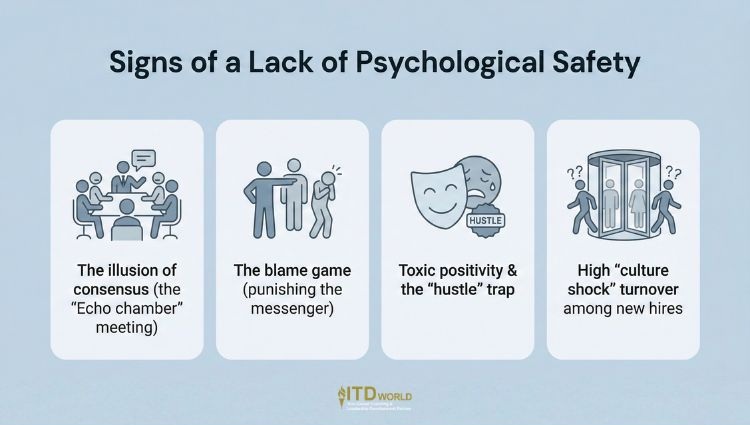
A lack of psychological safety rarely looks like a dramatic movie scene with a toxic boss yelling in a boardroom. More often, it manifests quietly as the absence of pushback, the lack of difficult questions, and a pervasive, uncomfortable silence.
Because it is difficult to measure what people are not saying, leaders must learn to identify the behavioral symptoms of a fearful culture.
-
The illusion of consensus (the “Echo chamber” meeting)
If every meeting ends in rapid agreement, it’s likely you do NOT have perfect alignment – only a fear of dissent. In psychologically unsafe environments, meetings are typically dominated by the highest-ranking person in the room, while everyone else simply nods along.
Example: You present a new, highly complex strategic pivot to your team. Instead of asking probing questions or highlighting potential operational roadblocks, the team immediately agrees and the meeting ends early.
When the Q&A segment of a town hall consistently features dead silence, your team is practicing self-protection, not active listening.
-
The blame game (punishing the messenger)
How an organization reacts to failure is the ultimate litmus test for psychological safety. In a toxic environment, a missed target or a delayed project is likely to immediately trigger a witch hunt.
Example: When a client deliverable falls through, the immediate leadership response is, “Who dropped the ball?” rather than, “Where did our process break down, and how do we fix it?”
If mistakes are treated as fatal career flaws rather than data points for improvement, employees will inevitably hide their errors, sweep risks under the rug, and point fingers at colleagues to survive.
Read more: Ego in the Workplace – The Hidden ‘Evil’ Behind Team Dysfunctions
-
Toxic positivity and the “hustle” trap
A culture that demands relentless optimism is just as damaging as one that is overtly negative. If individuals feel they must constantly project a “crushing it” persona, there is no room to express genuine concerns about bandwidth, mental health, or unrealistic timelines.
Example: An employee mentions they are overwhelmed by their current workload, and a manager responds with, “We just need team players who are willing to go the extra mile right now.”
Such a response shuts down honest communication, masking burnout under the guise of “hustle” and ensuring that the management are completely blindsided when that employee eventually resigns.
-
High “culture shock” turnover among new hires
Tenured employees often learn to survive in a low-safety environment by keeping their heads down and adapting to the unwritten rules of silence. New hires, however, have not yet developed this defensive armor.
Example: You successfully recruit top-tier, innovative talent, but they consistently leave within the first 6 to 12 months.
If new employees arrive eager to contribute fresh ideas, only to find their suggestions ignored or subtly punished, they will experience a severe culture shock and quickly exit to find an organization that actually values their voice.
Read more: Mastering Talent Management – Strategies for Organizational Success
The Leadership Playbook: How to Create Psychological Safety at Work
Psychological safety is not a policy to be drafted – nor a switch you can flip during a single team-building retreat. It involves an ecosystem built drop by drop through daily interactions, yet it can be lost in buckets with a single poor reaction.
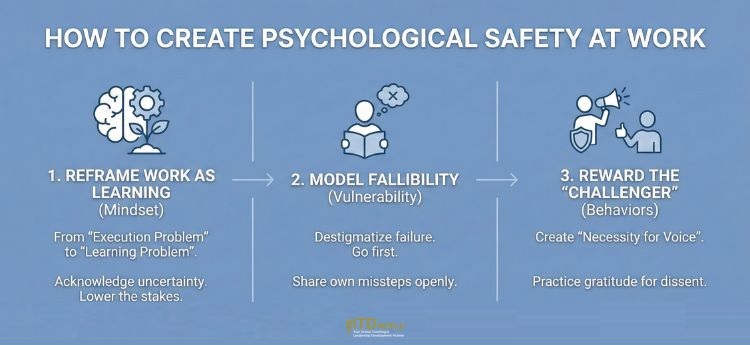
To transition from a culture of silence to one of candor, leaders must fundamentally change how they engage with their teams. This transformation requires three critical shifts in their mindset and behavior.
-
Frame the work as a learning problem (Mindset)
In traditional management, work is framed purely as an “execution problem.” The boss sets the strategy, and the team simply needs to execute the steps perfectly. And yet in today’s complex business landscape, it is a dangerous illusion.
To start with, leaders must explicitly reframe the work as a “learning problem” – i.e. acknowledge the uncertainty of the environment. By openly admitting that the path forward is ambiguous, you lower the stakes for not having all the answers.
How-to: Use inclusive, leveling language. At the kickoff of a new project, a leader should say, “We are entering a market we’ve never been in before. There is no perfect playbook for this, which means I am going to miss things. I absolutely need everyone’s unique perspective to navigate this successfully.”
Framing work around learning also means prioritizing sustainable performance over toxic hustle. When you focus on learning, you recognize that exhausted individuals cannot think critically or innovate.
-
Model fallibility (Vulnerability)
The fastest way to eliminate the “Impression Management” trap is to stop managing your own impression. The myth of the “hero leader” who never makes a mistake creates an impossible standard that terrifies people.
If you want your team to be comfortable admitting when they are wrong or overwhelmed, you must go first. You have to actively destigmatize failure.
How-to: Make it a habit to openly share your own missteps. During a team meeting, you might say, “My initial projection on that Q3 timeline was completely off the mark. Here is what I learned from that miscalculation…”
Read more: Humble Leadership – The Quiet, Often Forgotten Powerhouse
-
Reward the “Challenger” (Behaviors)
It takes immense courage for an employee to bring bad news, challenge your idea, or pitch a wildly unconventional solution. If your immediate reaction is defensiveness, irritation, or dismissal, that person—and everyone watching—will never take that risk again. As such, you must proactively create a “necessity for voice” by asking direct, probing questions – and then reward the courage it takes to answer them honestly.
How-to:
- Practice gratitude: When someone points out a flaw in the plan, your first words must always be, “Thank you for spotting that,” or “I appreciate you bringing that to my attention.”
- Incorporate coaching & DEI: Use your regular 1-on-1s as a dedicated space for psychological safety. Move beyond status updates to ask questions like, “What is the hardest part of your job right now?” or “Do you feel you have the space to bring your full, authentic self to work?”
Read more: Compassionate Leadership – Beyond Simply ‘Being Nice’
Creating psychological safety in the workplace
Psychological Safety in the Workplace Training: How ITD World Can Help
Understanding the ROI of psychological safety in the workplace is only the first step. The true challenge lies in execution – which, many times, requires deliberate practice and systemic change. The stakes are even higher if one takes into account years of ingrained “impression management” and people’s natural resistance against change.
At ITD World, we understand that culture is never shifted by mandate—it is only transformed through continuous, intentional leadership development. For long, we have partnered with global organizations to turn the theory of psychological safety into a tangible operational advantage.
Our solutions for building high-trust teams:
- Coaching culture implementation: We help businesses transition their leaders from “command and control” directors into empathetic coaches. By equipping managers with advanced coaching skills, we empower them to foster candor, ask better questions, and unlock their team’s potential.
- Agile & mindset training: We train executives to navigate VUCA environments with resilience. Our programs focus on cultivating the mental flexibility required to model vulnerability, dismantle toxic hustle culture, and reframe inevitable failures as learning opportunities.
- Customized in-house workshops: We design highly interactive, secure environments where teams may practice interpersonal risk-taking in real time. These tailored interventions are meant to break down departmental silos, establish new norms for healthy conflict, and promote the deep interpersonal trust required for exponential innovation.
Do not let silence become the hidden tax on your organization’s potential. Contact ITD World today to discuss how we can help create an environment where people feel safe enough to do their best work!
Other resources you might be interested in:
- Leadership Culture: The DNA of Organizational Success
- Human Centered Leadership: The Importance of a ‘People First’ Mindset
- Ego in Leadership: How to Tame It for the Greater Good
- Talent Development: Guide to Building Your Future Workforce
- Building KPIs & Metrics that Truly Matter & Drive High Performance