

In an era where artificial intelligence can write code, analyze complex datasets, and automate technical workflows in seconds, a counterintuitive reality has emerged: the most valuable assets in the modern workforce are the ones machines cannot replicate. As the cost of technical execution drops to near zero, the premium on human connection, strategic judgment, and emotional intelligence skyrockets. Far from being a secondary “nice-to-have,” these human capabilities—often diminished as “soft skills”—have become the new hard currency of business longevity.
Recent research from Harvard Business School has revealed that workers with strong social and critical thinking skills now command significantly higher wages than their purely technical counterparts. While technical proficiency remains the entry ticket to the workforce, it is the “durable skills”—empathy, adaptability, and communication—that determine who leads, who innovates, and who thrives in an unpredictable future.
 |
Author: Jonathan M. Pham |
Highlights
- While technical skills are becoming “perishable” with a short shelf-life, soft skills are durable assets that compound in value as AI commoditizes technical execution.
- AI can efficiently generate outputs (like data reports or code), yet humans are essential for driving outcomes—interpreting results, navigating ethical gray areas, and communicating strategic implications to stakeholders.
- Rather than being innate or unmeasurable, soft skills are learned behaviors that can yield a significantly high Return on Investment (ROI) when properly trained.
- To thrive alongside AI, workers need a triad of essential capabilities, namely Cognitive agility, Interpersonal resonance, and Self-leadership.
- For these skills to stick, individuals must move beyond textbooks to “on-the-job” friction and micro-habits, while organizations must shift to skills-based hiring and include “Human KPIs” in performance reviews to reward how work is done, not just what is achieved.
The Importance of Soft Skills in the Age of AI
For decades, the corporate world operated on a hierarchy of value: “hard” technical skills (coding, accounting, engineering) were the engine of progress, while “soft” ones were merely the lubrication—useful, but secondary. And yet that hierarchy has completely inverted. As AI commoditizes technical execution, the human element has shifted from a “nice-to-have” to a critical business imperative.
The “half-life” argument: Durable vs. Perishable
Technical competencies are becoming perishable assets. With the rapid pace of technological change, a specific coding language or software proficiency learned today may be obsolete in three years. On the other hand, soft skills are classified as “Durable” or “Power Skills” – because they compound in value over time and remain relevant regardless of the technological landscape.
According to a study by Boston Consulting Group, “future-built” companies—those successfully integrating AI—plan to upskill over 50% of their workforce on human skills, compared to only 20% of lagging companies. They recognize that while the tools of work change annually, the nature of collaboration, leadership, and problem-solving remains constant.
The economic imperative
The market is no longer paying a premium just for WHAT you know; it is looking for HOW you apply it. As found out in a LinkedIn Global Talent Trends survey, 9 out of 10 global executives agree that soft skills are more important than ever. Furthermore, 92% of talent professionals report that soft skills are now equally or more important to hire for than hard ones.
This demand is reflected in compensation. Research by Harvard Business School professor Letian Zhang reveals that workers with strong “nested” social and critical thinking capabilities report significantly higher wages.
While technical skills might get you in the door, it is the foundational human skills that determine career longevity and pay trajectory.
From “soft” to “power” skills
For a while, the term “soft skills” has been a misnomer, implying they are easy to acquire or optional to possess. Yet in the age of AI, such a framing is dangerous. In fact, various leading organizations are rebranding these capabilities as “Human” or “Power Skills.”
In a world where an AI agent can generate a financial report in seconds, the “Power Skill” is the ability to interpret that report, communicate its strategic implications to a non-financial stakeholder, and navigate the ethical considerations of the data.
To put it simply, the machine provides the output; while the human is in charge of the outcome.
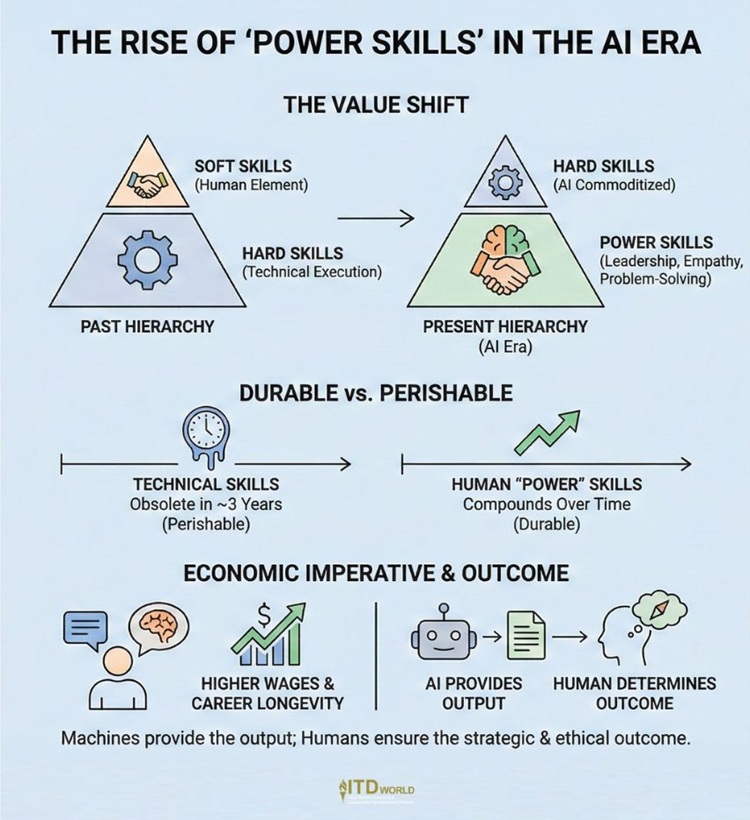
Why soft skills matter in the age of AI
3 Common Myths about Soft Skills in the Age of AI
Despite the overwhelming evidence supporting the value of human skills, many organizations still struggle to operationalize them. Usually, it has to do with deep-seated misconceptions that treat these capabilities as elusive or secondary.
To establish a resilient workforce, leaders must first dismantle the following pervasive myths.
Myth 1: “You are born with it” (the Innate Trap)
There is a lingering belief that qualities like empathy, charisma, and leadership are genetic lottery tickets—you either have them, or you don’t. This fatalistic view gives employees a pass to avoid development and managers an excuse to ignore coaching.
In reality, soft skills are learned behaviors. Just as one learns a new language or a sport, excellence in communication and emotional regulation boils down to exposure, habit formation, conscious repetition, and feedback loops.
Myth 2: “They can’t be measured” (the ROI Trap)
In a data-driven business environment, soft skills are frequently deprioritized because they feel “fluffy” or intangible compared to a coding certification or a sales target. But that is far from the truth.
While it’s true that nobody can measure empathy with a ruler, its impact is definitely assessable. Retention rates, error reduction, conflict frequency, and speed of innovation – these are just among the many tangible outputs that can be put into consideration.
Evidence: The ROI Institute reports that soft skills training programs usually deliver a higher Return on Investment than technical training. In one leadership case study, improved communication protocols drastically reduced turnover and internal conflict, yielding an ROI of over 5,000%.
Myth 3: “Technical skills are king” (the Budget Trap)
While executives publicly extoll the virtues of culture and communication, the training budget often tells a different story. According to the Achievers Workforce Institute, 87% of learning leaders admit that while executives claim to value soft skills, they still prioritize hard ones in budget allocations. This “Budget Trap” leaves organizations with a workforce that is technically competent but culturally fragile.
We need to confront the truth: technical competencies are the “baseline”—the entry ticket required to get the job; but human skills serve as the “differentiator”—the capabilities that determine promotion and leadership potential. Relying solely on the former creates a “Leadership Gap,” where technically brilliant employees are promoted to management but lack the ability to motivate or retain their teams.
Soft skills in the age of AI | TED Talk by Emily Gill
List of Essential Soft Skills in the Age of AI
To navigate the AI era, the essential skill set can be broadly categorized into three distinct domains of intelligence: Cognitive agility, Interpersonal resonance, and Self-leadership.
-
Cognitive agility (the Head)
As AI takes over information processing and data analysis, human cognition must shift from finding answers to curating them.
- Critical thinking & judgment
AI models are prediction engines, not truth engines. They are adept at processing millions of data points, but they lack context. As such, humans must act as the final arbiter, evaluating AI outputs for accuracy, relevance, and bias.
Example: An AI tool recommends a cost-cutting measure based on financial data; however, a leader with strong judgment rejects it, recognizing that it would irreparably damage employee morale or brand reputation.
- Strategic reasoning (lateral thinking)
AI is typically “narrow”—it excels at specific tasks (vertical expertise). Humans, on the other hand, excel at “horizontal” thinking—connecting dots between unrelated fields (e.g., applying a biological concept to a supply chain problem). The ability to see the “whole board” rather than just the next move is a unique humane trait that machines have not been able to replicate yet.
- Ethical thinking
Algorithms optimize for efficiency, which – many times – comes at the expense of ethics. As decision-making becomes automated, the ability to navigate moral grey areas—privacy, fairness, and social impact—becomes a critical safeguard.
-
Interpersonal resonance (the Heart)
Machines are capable of simulating conversation, but establishing authentic connection is another story. As digital interfaces multiply, the premium on genuine human interaction increases.
- Radical empathy
More than simple politeness, it is the ability to “read the room” and interpret the unspoken emotions behind the data. While AI can perform sentiment analysis on text, it cannot detect the hesitation in a client’s voice or the burnout in a team member’s eyes.
- Communication & storytelling
Data without a narrative is just noise. The most valuable employees will be those who can translate complex AI-generated insights into compelling stories that inspire action and align diverse stakeholders.
Example: A data scientist who is able to explain why an algorithm matters to a non-technical CEO is far more valuable than one who can simply write the code.
- Collaboration (fusion skills)
The future of work is not human vs. machine; it is human plus machine. Collaboration now includes the ability to work effectively within “hybrid teams” of people and AI agents, knowing when to delegate to the tool and when to intervene.
Read more: 9 Key Leadership Skills for the Future of Work
-
Self-leadership (the Gut)
In an environment of constant flux, the most difficult person to manage is, ironically, oneself. As a result, the following intrapersonal skills are non-negotiable.
- Adaptability & AQ (Adaptability Quotient)
The ability to “unlearn and relearn“. Given the very short half-life of skills these days, the capacity to pivot without resistance is arguably the ultimate competitive advantage.
In an era of deepfakes and algorithmic opacity, trust is a scarce resource. Integrity—being a reliable “store of truth” and following through on commitments—becomes a primary currency for leadership.
The pace of AI-driven change can lead to “change fatigue.” To grow sustainably requires one to demonstrate the mental fortitude to remain grounded and focused amidst disruption – viewing change as an opportunity for growth rather than a threat to stability.
Read more: EQ in the AI Age – Why It Matters for Leaders
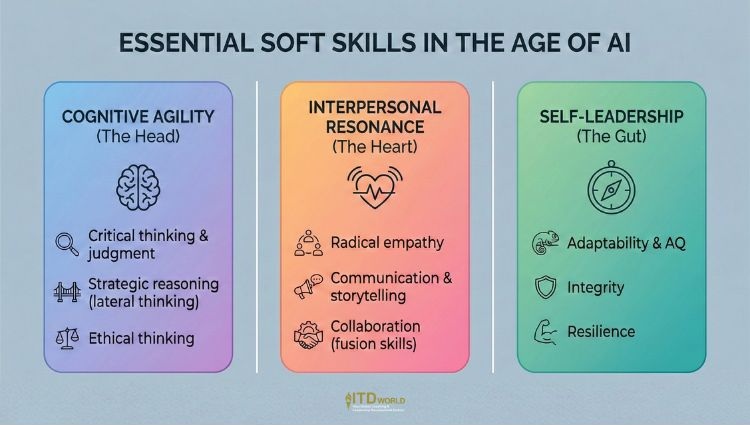
List of soft skills in the digital age
How to Build Soft Skills in the Age of AI
Unlike technical competencies, which can be mastered simply through self-paced study or certification exams, “power skills” require behavioral change, emotional labor, and real-world friction. To bridge the gap between intent and capability, both individuals and organizations need a deliberate strategy.
For individuals: The art of deliberate practice
You cannot learn empathy from a textbook, nor adaptability from a webinar. These qualities are “forged in the fires of daily interaction”.
- Adopt the 70-20-10 model: Shift your learning mindset. Only 10% of soft skill acquisition comes from formal coursework. 20% is from feedback and mentorship, while 70% from on-the-job challenges.
How-to: Don’t just read about “conflict resolution.” Volunteer for a high-stakes cross-functional project where conflicting priorities are guaranteed. View the friction as a “dojo” for practicing negotiation.
- Install “micro-habits”: Instead of grand transformations (which are likely to fail), focus on small, repeatable behaviors.
Example: If you set the goal of becoming a more active listener, commit to the “Two-Second Pause.” In every meeting this week, wait two full seconds after someone finishes speaking before you respond. This simple mechanical constraint forces you to digest their words rather than formulating your rebuttal while they are still talking.
- Close the feedback loop: We are, ironically, poor judges of our own soft skills. Specifically, we tend to view ourselves by our intent, while others judge us by our impact.
How-to: Establish a “truth channel.” Ask a trusted colleague for specific, behavioral feedback immediately after a presentation or meeting. Don’t say, “How did I do?” (which invites politeness). Say something like, “Did I come across as defensive when the client pushed back on the budget?”
Read more: Intent vs Impact in the Workplace – How to Close the Gap
For organizations: Systemic integration
A company cannot expect a culture of collaboration if it hires for individual brilliance and promotes based on ruthlessness. As such, organizations must operationalize soft skills into their structural DNA.
- Move to skills-based hiring: Stop using degrees and previous job titles as proxies for capability.
How-to: During the interview process, rather than the “resume walk-through”, use behavioral simulations. Have the candidate role-play a difficult feedback session or lead a mock brainstorming meeting. Assess them not on the technical solution they provide, but on how they navigated the interpersonal dynamics of the simulation.
Read more: Skills-Based Organization – A Blueprint for Agility in a Disrupted World
- Redefine performance metrics (the “How” matters)
If you only measure what an employee achieves (e.g., hitting a sales target), you implicitly tell them that empathy and collaboration are optional.
How-to: Introduce “Human KPIs” into performance reviews. A high performer who hits their numbers but leaves a trail of burnt-out colleagues in their wake should not be promoted. Weighing “culture contribution” equally with “technical output” is key to aligning incentives with the qualities you claim to value.
- Create psychological safety: Soft skills like creativity and critical thinking wither in environments of fear.
How-to: Leaders must model vulnerability. When a manager admits, “I don’t know the answer to that, let’s figure it out together,” they signal that humility and curiosity are valued over posturing. This safety is the soil in which human intelligence grows.
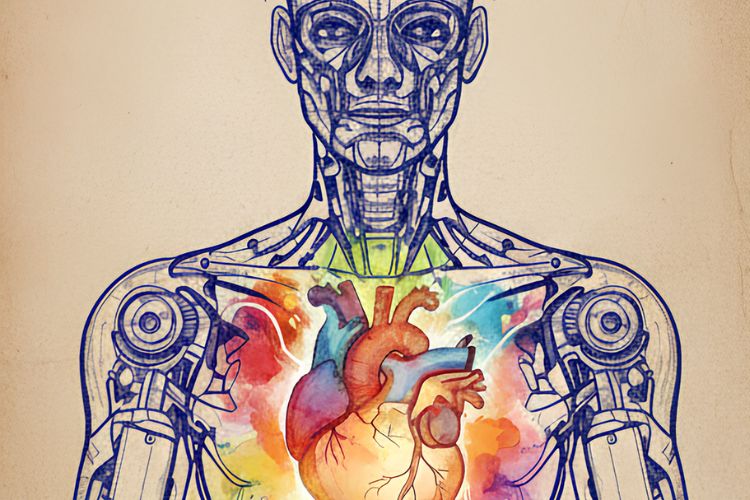
Developing essential soft skills in the age of AI
FAQs
Can AI ever replace soft skills?
AI can simulate empathy (e.g., a customer service chatbot using polite language), but it cannot feel it. In high-stakes situations—such as managing a crisis, delivering bad news, or negotiating a complex merger—humans crave genuine connection and trust, which algorithms cannot provide.
What soft skills can AI not replace?
When it comes to “future-proof” competencies, Adaptability (AQ) is arguably the most critical. Because the future technological landscape is unknown, the ability to unlearn old methods and pivot to new ones without resistance is the “meta-skill” that enables all others.
How do I demonstrate soft skills on a CV or in an interview?
Don’t just present a list of qualities (e.g., “I am a good communicator”); prove them with outcomes. Instead of “Strong leadership skills,” write something like: “Led a cross-functional team of 10 through a restructure, resulting in a 15% increase in retention.”
Cultivate the “Human Advantage” with ITD World’s Training Solutions
The “AI Paradox” is clear: as technology advances, the premium on human connection rises. While your competitors race to adopt the latest software, the true competitive advantage lies in building a workforce that can think, connect, and lead in ways that machines cannot.
At ITD World, we specialize in transforming “soft skills” into hard business results. We partner with global organizations to equip their leaders and teams with the qualities required to thrive in the 21st century.
Our solutions for the human-centric workplace include:
- Emotional Intelligence (EQ) Coaching: Deep-dive programs to help leaders master self-regulation, empathy, and influence.
- Critical Thinking & Innovation Workshops: Practical training on how to question assumptions, navigate bias, and leverage AI for strategic problem-solving.
- Agile Leadership Certification: Equipping managers with the Adaptability Quotient (AQ) needed to lead teams through constant disruption.
Soft skill training for the 21st century
Don’t let your technology outpace your humanity. Contact ITD World today to discuss how we can help you build a future-proof workforce!
Other resources you might be interested in:
- 10 L&D Trends to Expect for the New Era
- Employee Engagement in the Digital Age: Strategies for Powering Up Your Workforce
- AI in Leadership: Bridging the Gap Between Adoption & Maturity
- Future Ready Organization: 11 Tips to Building One
