
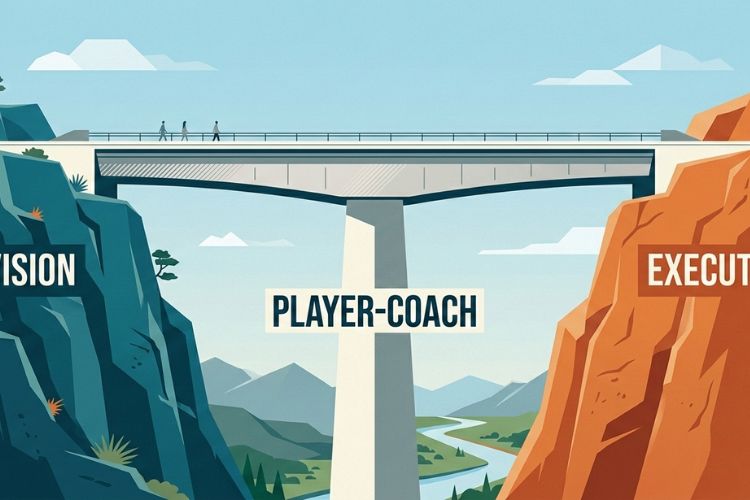
In the modern business landscape, a peculiar paradox has emerged. An employee performs exceptionally well—closing the biggest deals, writing the cleanest code, or diagnosing the most complex clinical cases. As a reward for their individual brilliance, they are promoted. Suddenly, they are no longer just a “doer”; they are a manager. Yet, the organization—and the individual’s own instincts—often demands they keep “doing.” Hence the emergence of this thing called the player-coach leadership style.
 |
Author: Jonathan M. Pham |
Highlights
- While the model builds immediate credibility and saves costs for lean teams, leaders often fall into a “dopamine trap” by prioritizing familiar technical tasks (Playing) over the ambiguous, long-term work of developing people (Coaching).
- Constant switching between deep, focused “Maker” tasks and interrupt-driven “Manager” tasks causes “attention residue,” which reduces creativity and leads to burnout unless leaders use strict calendar hygiene and time blocking.
- The role is a temporary transition state rather than a permanent destination; once a leader has more than 4–8 reports, it becomes mathematically impossible to maintain high individual output without becoming an organizational bottleneck.
- To succeed, leaders must shift from “doing” to “teaching” by utilizing the “First Version” rule (letting the team draft while the leader polishes) and ruthlessly delegating low-leverage tasks to focus on high-impact pathfinding.
What is the Player-coach Leadership Style?
This hybrid model, blending active tactical contribution (the Player) with team management and mentorship (the Coach), has become the default operating system for high-growth startups, agile tech firms, and lean organizations. It promises the best of both worlds: a leader who commands respect by “getting their hands dirty” and a manager who drives strategy.
However, without deliberate design, this dual role is often a recipe for burnout, micromanagement, and organizational stagnation.
The Appeal and The Trap of the Player-coach Leadership Style
The Player-Coach model is not merely a cost-saving measure; it is often a cultural necessity. In the early stages of a company, or within small, specialized teams (typically under four people), this role is vital.
Strategic advantages
The benefits of a leader who can execute are tangible:
- Credibility & Trust: There is no faster way to earn the respect of a team than by demonstrating you can do the job yourself. When a leader steps in during a crisis—”mucking in” to meet a deadline—it builds a form of camaraderie that hierarchy alone cannot buy.
- Speed & Agility: A leader with a ground-level view of the work can make decisions significantly faster than a distant executive who relies on PowerPoint summaries. They spot technical debt or deal risks immediately.
- Cost Efficiency: For startups, the “two-for-the-price-of-one” model is often the only way to survive the runway.
The “hero” trap
However, there is a psychological shadow to this role. Many new managers suffer from the “Hero Syndrome.” Solving a technical problem provides a dopamine hit of instant gratification. It is concrete, binary (fixed or not fixed), and familiar.
Coaching, conversely, is ambiguous. Cultivating a subordinate’s soft skills takes months, and the results are rarely immediate. Consequently, when stress rises, Player-Coaches retreat to their “comfort zone” of doing the work themselves. They tell themselves they are “saving the day,” but in reality, they are competing with their own team and robbing them of growth opportunities.
The Neuroscience of the Split Role
To understand why this role is so difficult, we must look beyond job descriptions and into the brain. The fundamental conflict of the Player-Coach is one of cognitive switching.
Research indicates it takes an average of 23 minutes to regain deep focus after a distraction. A “Player” requires long, uninterrupted blocks of time to achieve “flow”—the state necessary for complex coding, writing, or strategic planning. A “Coach,” however, lives in a world of constant interruption—approving requests, answering Slack messages, and putting out fires.
The “Maker vs. Manager” conflict
Computer scientist Paul Graham distinguished between the “Maker’s Schedule” (needing 4-hour blocks) and the “Manager’s Schedule” (sliced into 30-minute intervals).
When a Player-Coach tries to operate on both schedules simultaneously, they suffer from what researcher Sophie Leroy calls “Attention Residue.” When you switch from a complex task to a management meeting, your brain remains partially stuck on the previous task. This cognitive drag reduces your IQ, kills creativity, and leads to the exhaustion commonly described as “mental gymnastics.”
Without strict calendar hygiene, the Player-Coach becomes a mediocre player and an absent coach.
The “Math of Management”: Knowing When to Stop Playing
The most critical insight for any organization utilizing this model is that it is not infinitely scalable. There is a mathematical limit to how much a human being can do.
The tipping point
Industry analysis suggests the “tipping point” for a Player-Coach occurs when they have between 4 to 8 direct reports.
- 2-3 Reports: You can comfortably spend 50% of your time strictly on individual contribution.
- 4-6 Reports: Management overhead (1:1s, performance reviews, hiring) consumes 20-50% of the week. “Player” work must be reduced to high-leverage tasks only.
- 8+ Reports: It is mathematically impossible to be a serious individual contributor without neglecting the team. At this stage, if you are still coding or closing deals, you are likely the bottleneck.
The lifecycle of the role
Successful organizations view the Player-Coach not as a permanent destination, but as a transition state:
- Early Stage (The Sprinter): The leader is 70% player, 30% coach. The goal is survival and establishing market fit.
- Growth Stage (The Architect): The leader shifts to 30% player, 70% coach. They focus on standardizing processes so others can do the work.
- Maturity (The Visionary): The leader steps off the field entirely. Their value is no longer in doing the work, but in seeing the field and directing the plays.
Strategies for Practicing the Player-coach Leadership Style
If you find yourself in the Player-Coach role, or if you are training one, “trying harder” is not a strategy. You need a framework to manage the tension.
-
The “First version” rule
One of the greatest risks is micromanagement—correcting work before it’s even finished. To combat this, adopt the “First Version” rule.
- The Rule: The Player-Coach never creates the first draft (v1) of a standard task. The team member must produce the v1.
- The Coaching: The leader then steps in to review, refine, and “polish” the work (v2).
- The Result: This forces the employee to do the heavy lifting of creation while allowing the leader to apply their expertise for quality control. It shifts the dynamic from “doing it for them” to “showing them how to improve.”
-
High-leverage vs. Low-leverage play
Not all “playing” is created equal. A Player-Coach must ruthlessly curate their task list.
- Stop Doing: Routine maintenance, low-stakes client calls, administrative reporting. (Delegate these immediately).
- Keep Doing: Tasks that require high-level intuition, “pathfinding” (solving a problem the company hasn’t faced before), or emergency crisis management.
-
Operating rhythms & time blocking
You cannot switch hats every 10 minutes. You must batch your identities.
- Protective Blocking: Schedule specific days or half-days as “No Meeting Zones” where you are strictly a Player. Communicate to the team that you are unavailable during this time unless the building is on fire.
- Office Hours: conversely, have set times where you are purely a Coach—open for interruptions, quick questions, and unblocking the team.
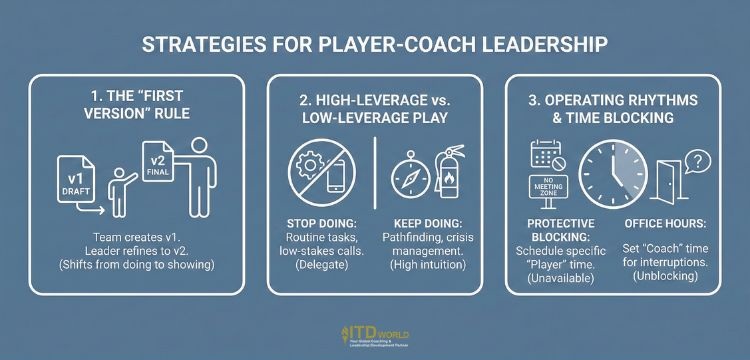
Strategies for practicing the player-coach leadership style
Transferring Brilliance: From Doing to Teaching
The ultimate goal of the Player-Coach is to make themselves obsolete as a player. This requires a shift from demonstrating excellence to transferring it.
Teaching the “Why,” not just the “How”
When a senior physician at the Mayo Clinic treats a patient while residents watch, they are doing more than healing; they are narrating their thought process.
- The Wrong Way: “Move aside, I’ll fix this code.”
- The Right Way: “I noticed this code might cause latency. Here is how I look for those risks. Now, you try finding the next one.”
The power of storytelling
Great leaders like Steve Jobs or Thomas Edison didn’t just tinker; they used their deep understanding of the work to tell stories that aligned the team. When you have “done the reps,” you have the authority to explain the narrative of the project—the “before and after.” Use your technical background to translate the team’s struggles into a story that upper management understands, and translate the company’s vision into technical reality for your team.
Organizational Architecture: Support Systems for the Player-coach Leadership Style
A Player-Coach cannot succeed in a vacuum. The organization often sets these individuals up for failure by piling administrative bloat on top of full-time quotas.
- Hiring for Empathy: The best “Player” is often the worst “Coach” because they lack the patience for those who aren’t as fast as they are. Organizations must screen for empathy and communication skills, not just technical output.
- Customized Metrics: You cannot evaluate a Player-Coach solely on individual output (e.g., lines of code) OR solely on team retention. The scorecard must be a hybrid. If their team fails, they fail—regardless of their personal brilliance.
- Aggressive Distraction Management: Companies must protect these leaders. Standardizing processes (like expense reports or leave requests) reduces the mental load, freeing up energy for the complex task of leadership.
Final Thoughts
The Player-Coach model is a powerful engine for growth, but it is fragile. It relies on a delicate balance of ego and humility—the ego to believe you are the best person to do the work, and the humility to realize you must eventually stop doing it.
For the leader, the journey is one of letting go. You must accept that your team might do the task 80% as well as you can initially. But if you intervene to do it 100% perfectly yourself, they will never reach 100% themselves.
The true measure of a successful Player-Coach is not the work they produce, but the work they inspire. When you can step off the field and watch your team win the game without you, you have finally mastered the role.
ITD World provides specialized coaching and training solutions designed to help leaders & organizations secure a competitive advantage – and be equipped to win in today’s dynamic landscape. Contact us today to learn more about our world-class programs!
Other resources you might be interested in:
- Human Centered Leadership: The Importance of a ‘People First’ Mindset
- Coaching Philosophy: How to Craft One That Defines Your Impact
- Coaching People Who Don’t Want to Be Coached: A How-to Guide
- Influential Leadership: Influence to Inspire, Lead, and Succeed
- Leading With Impact: Translating Your Presence Into Performance
