
For over a century, the “job”—a static set of responsibilities tied to a specific title—was the fundamental atomic unit of the workplace. However, in today’s era of relentless disruption and AI-driven change, this rigid approach is rapidly becoming a liability. When the half-life of a learned skill drops to fewer than five years, organizations that continue to hire and manage based on fixed roles will find themselves perpetually behind the curve, unable to pivot fast enough to meet market demands. To retain their competitive advantage, more and more businesses are gradually switching to the Skills-Based Organization (SBO) model.
 |
Author: Jonathan M. Pham |
Highlights
- In an SBO, work is broken down into specific tasks or projects, and talent is pulled from a “dynamic pool” based on verified skills and interests rather than hierarchy or tenure.
- By treating talent as a shared enterprise resource, organizations can redeploy employees instantly to high-priority areas, leading to higher productivity and faster adaptation to market changes.
- SBOs move away from “proxies” like university degrees or past titles, focusing instead on hard skills, human capabilities (soft skills), and potential.
- Success relies on a digital “Talent Marketplace” where projects are posted and employees can apply for “gigs” to stretch their skills, effectively merging daily work with continuous learning.
- Transitioning requires moving away from “talent hoarding” (managers keeping top performers to themselves) and implementing AI-driven skills data to ensure pay and promotions are based on objective capability rather than subjective preference.
What is a Skills-Based Organization (SBO)?
A skills-based organization (SBO) is a new operating model that decouples “work” from the rigid confines of the traditional “job.” Instead of defining an employee solely by their title and a fixed list of duties, it views the workforce as a dynamic pool of capabilities.
In this model, the skill—not the job—is the primary currency of the organization. Work is deconstructed into specific projects or tasks, and talent is matched to that work based on verified capabilities and interests, regardless of where that person sits in the hierarchy.
In other words, the question has changed from “What job were you hired to do?” to “What problems are you capable of solving?“
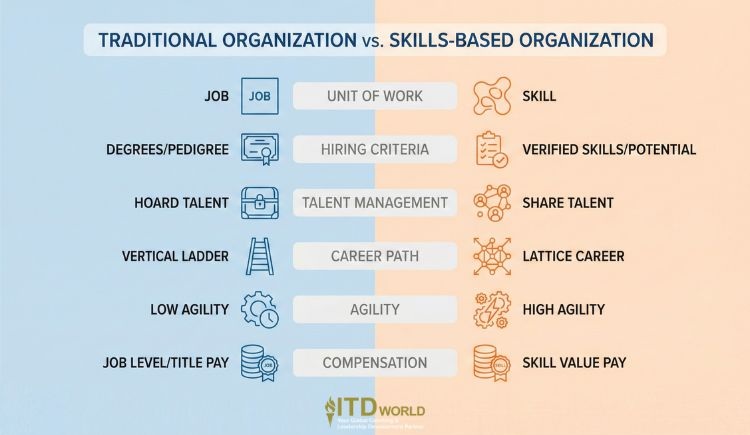
Traditional vs. skills-based organization
To better visualize the whole picture, it is helpful to contrast the SBO model with the traditional structure that has dominated business for the last century.
| Feature | Traditional Organization |
Skills-Based Organization
|
| Unit of Work | The Job (Fixed Role) |
The Skill (Fluid Capability)
|
| Hiring Criteria | Degrees, Pedigree, and Previous Titles |
Verified Skills, Potential, and “Can Do”
|
| Talent Management | Managers “hoard” talent within their silo |
Managers “share” talent across the enterprise
|
| Career Path | Vertical: The “Corporate Ladder” |
Lattice: Flexible movement (sideways, project-based)
|
| Agility | Low: Reorganizing takes months |
High: Teams assemble and dissolve as needed
|
| Compensation | Based on Job Level/Title |
Based on Skill Value and Contribution
|
A comparison between the traditional & skills-based approach to organizational development
Redefining “skills”
A common misconception is that a “skills-based” approach applies only to technical roles (like software engineering or data science). However, in a mature SBO, the definition of a “skill” is much broader, encompassing:
- Hard skills: Technical competencies (e.g., Financial Modeling, Python, SEO).
- Human capabilities: Enduring behavioral traits (e.g., Empathy, Critical Thinking, Resilience).
- Potential: The latent capacity to acquire new competencies quickly.
An SBO does not just optimize for what an employee knows today; its main concern is what they can achieve tomorrow.
Why Moving to a Skills-based Organization
Radical agility & adaptability
In the traditional model, adapting to a new market threat typically involves a slow process of restructuring or hiring new roles. But in an SBO, the response is immediate: talent is simply redeployed based on capability.
Research from Josh Bersin has indicated that “Dynamic Organizations”—those operating based on skills rather than rigid roles—are 17x more likely to adapt well to change and 3x more likely to exceed financial targets compared to their peers. Similarly, Deloitte found that SBOs are 107% more likely to place talent effectively and 57% more likely to be agile.
Unilever case study: The power of such agility was demonstrated by Unilever during the COVID-19 pandemic. By utilizing their internal talent marketplace, “Flex Experiences,” they were able to redeploy 9,000+ employees from low-demand areas (like food service) to high-demand areas (like hygiene product packaging) based solely on transferrable skills. The result? They unlocked over 500,000 hours of productivity that would have otherwise been lost to downtime or external contracting costs.
The AI imperative
We are entering an era where technical knowledge expires faster than ever before. As AI automates routine tasks, the value shifts from “knowing facts” to “applying judgment,” making continuous upskilling the only viable strategy.
As estimated by IBM, the “half-life” of a learned professional skill is now just 2.5 to 5 years. Additionally, the World Economic Forum (WEF) reports that 39% of workers’ core competencies are expected to change in the next five years.
The implication: There’s no way to “hire one’s way out” of this problem; the talent supply simply doesn’t exist yet. According to Microsoft’s Work Trend Index, 82% of leaders say employees need new skills for the AI era. SBO addresses this by establishing a culture of perpetual learning, where the organization focuses on cultivating the necessary competencies internally rather than hunting for them externally.
Unlocking hidden talent
Traditional hiring relies on proxies for ability—degrees, previous job titles, and pedigree. These proxies tend to exclude high-potential candidates who have the skills but lack the “correct” background. SBOs, fortunately, remove these barriers, widening the aperture for talent.
According to an article on Fortune, removing degree requirements and focusing on skills can increase the talent pool of eligible candidates by 19x. This statement is also supported by LinkedIn data, which show that skills-based hiring is much more effective at identifying talent than relying on degree requirements alone.
IBM case study: Facing a shortage of cyber-security talent that universities couldn’t fill, IBM launched their “New Collar” initiative, removing degree requirements from over 50% of U.S. job postings. By focusing on verified skills (badges) rather than diplomas, they successfully tapped into diverse, overlooked talent pools—including veterans and self-taught coders—filling critical gaps faster than competitors.
Read more: Talent Development – How to Build Your Future Workforce

Characteristics of a Skills-based Organization
-
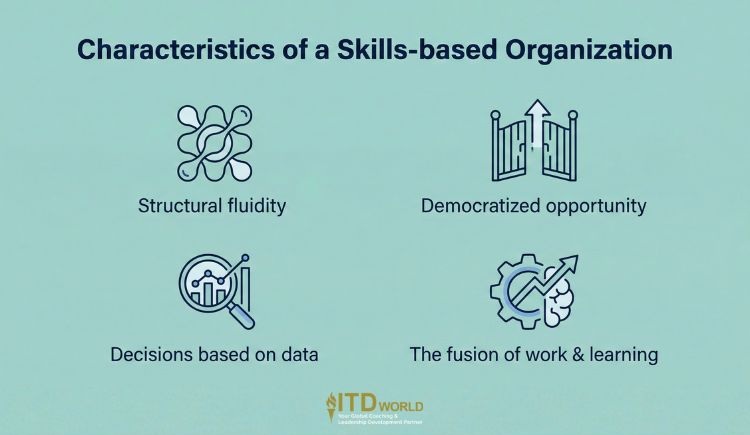
Structural fluidity
In a traditional company, employees “belong” to a department. But in an SBO, they are viewed as a shared resource. To a certain extent, the organizational structure resembles a Hollywood movie production: diverse teams assemble rapidly to solve a specific problem (shoot the movie), and once the project is complete, they disband and move on to the next assignment.
Example: A data analyst from Marketing, a UX designer from Product, and a behavioral scientist from HR may be pulled together to form a “tiger team” for a three-month customer experience project. Once finished, they return to the talent pool, ready for deployment elsewhere.
-
Democratized opportunity
Access to career opportunities in a traditional firm is typically dictated by “who you know” or whether your manager is willing to let you go. But with the SBO model, this gatekeeping is replaced with an Internal Talent Marketplace – i.e. a transparent digital platform where projects (“gigs”) are posted, and any individual with the matching competencies is free to apply, regardless of their current job title or location.
Example: A junior accountant with a hidden talent for video editing can apply for a short-term gig to help the communications team produce a launch video. This breaks down silos and uncovers hidden value within the workforce.
-
Decisions based on verified data, not tenure
In many organizations, promotions and project assignments are based on tenure (“It’s her turn”) or subjective manager preference. On the other hand, an SBO operates on evidence. Specifically, it relies on a rich ecosystem of data regarding what skills employees possess, their proficiency levels, and their potential to learn.
Example: When selecting a lead for a new AI initiative, the organization doesn’t automatically pick the most senior IT director. Instead, it queries its skills database to find the individual—for instance, a mid-level engineer—who has the most current, verified credentials in generative AI and prompt engineering.
-
The fusion of work and learning
Unlike the old model, where “learning” was something that happened away from work (e.g., in a classroom or an LMS), an SBO integrates learning directly into the flow of work. Because the organization prioritizes potential, it deliberately assigns people to projects that stretch their capabilities, viewing the work itself as the primary vehicle for upskilling.
Example: A manager might assign a project to an employee who only has 70% of the required skills, explicitly identifying the remaining 30% as a “stretch opportunity” to be learned on the job, supported by mentorship or micro-learning resources.
The “Skills Portfolio”: What Actually Matters?
A robust SBO views an employee not just as a collection of technical certifications, but as an evolving portfolio of assets. To cultivate a resilient workforce, organizations must invest in three distinct categories of capability. (which we have covered briefly above)
Technical & hard skills
These are the specific, teachable abilities required to perform a task. They are often binary (you either know how to use the software, or you don’t) and are easily verified through testing or credentials.
While essential, these competencies usually have the shortest “shelf-life.” In a rapidly changing technological landscape, what is cutting-edge today may become obsolete in three years.
Examples: Python programming, GAAP accounting, Search Engine Optimization (SEO), Forklift operation.
Human capabilities
Formerly minimized as “soft skills,” these are now widely recognized as the durable currency of the future workplace. As AI automates technical execution, the value of human judgment, connection, and creativity has been rising.
Unlike the technical skills mentioned above, these capabilities are transferable across almost any role and do not expire. As such, they are the ones that allow an organization to navigate ambiguity and drive collaboration in fluid teams.
Examples: Critical thinking, emotional intelligence (EQ), complex negotiation, storytelling, and resilience.
Potential & adjacent skills
The most advanced metric in an SBO, it measures not just what an individual can do, but what they could do. By understanding “skill adjacencies”—competencies that are closely related—organizations may better predict learning velocity.
The idea: If an employee possesses Skill A, how likely are they to master Skill B?
Examples: A recruiter looking for a “Data Scientist” has been struggling to find a perfect match. However, looking at potential, they notice a “Financial Analyst” who already possesses strong statistical knowledge and Excel proficiency (adjacent skills). With a short upskilling sprint in Python, this internal candidate is capable of filling the role faster and more effectively than an external hire.
A Skills-based Framework for Establishing the System
To establish a functioning SBO, it is recommended that organizations follow the framework below.
A dynamic skills taxonomy
The first step is creating a common language. You cannot match talent supply with business demand if they describe capabilities differently.
Historically, HR departments spent years building static “competency frameworks” that were outdated by the time they were published. Instead of manually cataloging every possible competency, organizations nowadays should use AI to infer skills from employee profiles and external market data. This creates a “living” library that evolves in real-time as new technologies (like “Generative AI”) emerge in the market.
Skills-based workforce planning
Traditional workforce planning is a headcount exercise: “We need to hire five Project Managers next year.” Within an SBO, the approach should be changed to Skills-Based Workforce Planning. Instead of counting heads, the organization quantifies capability clusters. The question becomes: “How many hours of ‘agile project management’ and ‘data visualization’ do we need to execute our strategy?”
Why it matters: This shift allows for more precise resource allocation. You may discover you don’t need five full-time hires; you just need to upskill your current analysts in data visualization and borrow project management hours from another department. This is the difference between “buying talent” (expensive) and “optimizing capacity” (efficient).
Read more: Employee Development Plan – Fueling Future Success

Skills-based organization maturity model
Validation & credentialing
A skills marketplace only works if the data is trusted. If a manager requests a Python expert, they need assurance that the assigned individual is actually proficient.
Solution: SBOs move away from self-reported skills (“I think I’m good at this”) toward verified credentials.
Examples:
- Digital badges: Micro-credentials issued after completing a specific project or course (e.g., IBM’s Open Badges).
- Peer validation: A “LinkedIn-style” endorsement system where colleagues verify each other’s contributions on recent gigs.
- AI inference: Using algorithms to analyze an employee’s code commits or project documentation to objectively rate proficiency.
The internal talent marketplace
Finally, you need a technology layer to facilitate the movement of talent. The Internal Talent Marketplace is the matchmaking engine that connects the “seller” of the skill (the employee) with the “buyer” (the project lead).
What it does: It creates visibility. Now, an employee in the London finance team can see—and apply for—a short-term marketing project in the Singapore office. In other words, it democratizes access to growth and ensuring the organization’s best skills flow to its biggest opportunities.
How to Build a Skills-based Organization
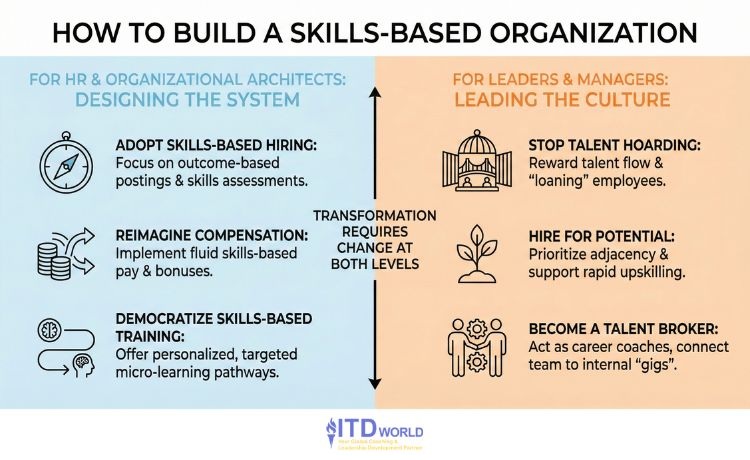
For the SBO model to work, behaviors must change at both the systemic level (HR) and the daily operational level (Leadership). Here is how different stakeholders play a role in this transformation.
For HR & organizational architects: Designing the system
HR must evolve from being the “gatekeepers of roles” to the “architects of work.”
- Adopt skills-based hiring: Stop writing job descriptions that read like a wish list of degrees and years of experience. Instead, go with outcome-based postings. Define the specific tasks the person needs to do and the competencies required to do them.
Example: Remove “Bachelor’s degree required” from roles where it is not legally necessary. Shift interview protocols from behavioral questions (“Tell me about a time…”) to skills assessments (“Here is a sample problem; show us how you would solve it”).
- Reimagine compensation: In a traditional model, pay is tied to job level. But for SBO, compensation models must become more fluid to reward skill acquisition.
Example: Implement “skills-based pay” or bonuses for those who acquire critical, high-value capabilities (e.g., a premium for mastering a new AI tool), regardless of their seniority.
- Democratize skills-based training: Move away from generic “one-size-fits-all” training catalogs. Use your data to offer personalized skills-based training pathways rather.
Example: If the data shows a gap in “Data Literacy” across the marketing function, deploy a targeted micro-learning sprint specifically for that cohort, rather than a broad organizational mandate.
Read more: Training Needs Analysis (TNA) – From Insight to Impact
For leaders & managers: Leading the culture
The biggest barrier to an SBO is the “middle management freeze.” Leaders must unlearn the habits of command-and-control to embrace a more fluid style of talent orchestration.
- Stop “talent hoarding”: In the old world, a manager’s power was defined by the size of their team. But these days, success is defined by the flow of talent. Managers must be rewarded for “loaning” their best people to cross-functional projects, not for keeping them locked in a silo.
Example: “I don’t own this employee; I steward their career. If I let them work on a high-impact project elsewhere, they bring back new skills that benefit my team.”
- Hire for potential, not just proven experience: When filling a gap, most leaders tend to prioritize a “plug-and-play” candidate who has done the exact job before. An SBO leader, on the other hand, would looks for adjacency.
Example: If you need a Project Manager but can’t find one, don’t be afraid to pick a Senior Administrator with high organizational skills and emotional intelligence. Choose them for their potential and support them with rapid upskilling.
- Become a “talent broker”: Instead of just managing tasks, managers should act as career coaches. They should actively assist their team members in identifying “gigs” in the internal marketplace that align with their development goals.
Example: Make “skill development” a standing agenda item in one-on-ones, asking, “What project outside of our team would help you learn the next skill on your list?”
Read more: Leadership Development – A Mission-critical Strategic Function
Challenges of Building a Skills-based Organization
Analysis paralysis
The most common stumbling block occurs right at the start. Specifically, HR teams often fall into the trap of trying to build the “perfect” global skills library before launching.
Example: Spending two years manually defining 50,000 unique skills and proficiency levels. By the time the framework is finalized, the market has shifted, and the identified competencies have gone obsolete.
Solution: Aim for “minimum viable data.” Start with a lightweight taxonomy focused on the critical 20% of skills that drive 80% of value. In addition, leverage AI-driven platforms that can infer and update skills automatically, rather than relying on manual data entry.
Cultural resistance
Another big barrier to fluidity has to do with the middle manager who fears losing control – i.e. one who refuses to release a high-performer for a cross-functional “gig” because they are afraid that their own department’s productivity will drop. This effectively kills the internal marketplace, turning it into a “job board” that no one uses.
Solution: You must change the incentive structure. Managers should be evaluated not just on their team’s output, but on their contribution to the wider enterprise—including metrics on “talent export” and internal mobility.
The “tech-first” fallacy
Many organizations mistake purchasing a platform for solving a problem. (e.g. buying a sophisticated “Talent Marketplace” software suite without first doing the cultural groundwork) Employees are asked to fill out skills profiles, but because there are no real opportunities or rewards attached, engagement drops off after the first month.
Solution: Culture first, tech second. Before launching the tool, run a manual pilot (e.g., using a spreadsheet or simple portal) to prove the concept. Ensure there are actual projects to work on and that leadership is visibly supporting the new way of working.
Bias in the algorithm
If the AI models used to validate skills or match candidates are trained on historical data from the “old way” of hiring, they may inadvertently replicate past biases (e.g., undervaluing skills obtained from non-traditional education paths).
Solution: Maintain “human-in-the-loop” oversight. Regularly audit the matching algorithms to ensure they are prioritizing capability over pedigree and are surfacing diverse candidates effectively.
FAQs
What is the difference between skills-based organization and competency-based organization?
While related, they operate at different altitudes. Competencies are broad, role-specific behaviors (e.g., “Strategic Leadership”) typically used for annual reviews. Skills, on the other hand, are granular, verifiable abilities (e.g., “Python Programming” or “Conflict Resolution”) used to get work done. An SBO focuses on the latter to enable rapid, task-level matching.
Do job titles disappear in a skills-based organization?
Not necessarily. In most SBOs, job titles remain useful for administrative purposes (payroll, external benchmarking) and providing a sense of “home base.” However, the title no longer restricts the work one does. For instance, a “Marketing Manager” can still hold that title while spending 20% of their time on a cross-functional data analytics project.
How does AI support a skills-based approach?
AI serves as the accelerator. It enables Skills-Based Workforce Planning by analyzing vast amounts of data to infer skills from resumes, match employees to open “gigs” instantly, and predict future skill gaps. Without AI, maintaining a dynamic skills inventory at scale is nearly impossible.
Read more: AI in Leadership – Bridging the Gap Between Adoption & Maturity

Building a Skills-based Organization with ITD World’s Training Solutions
Transitioning to a Skills-Based Organization requires a fundamental rewiring of your corporate DNA – i.e. moving from a culture of “ownership” to a culture of “access,” and from valuing pedigree to valuing potential.
At ITD World, we understand that while technology enables this shift, it is leadership who drives it. As such, we partner with global organizations to cultivate the mindsets and capabilities required to thrive in this new operating model.
Our Solutions for the skills-based era include:
- Transformational leadership coaching: Helping managers unlearn “talent hoarding” and embrace their new role as talent brokers and coaches.
- Upskilling & reskilling programs: Custom-designed learning journeys to rapidly build high-demand “Power Skills” (like Emotional Intelligence, Resilience, and Critical Thinking) across your workforce.
- Change management workshops: Facilitating the cultural shift required to get buy-in for internal mobility and dynamic teaming.
Contact ITD World today to discuss how we can help you build a workforce that is ready for anything!
Other resources you might be interested in:
- 9 Key Leadership Skills for the Future of Work
- Future Ready Organization: 11 Tips to Building One
- Talent Transformation: Establishing a Future-ready Workforce
- Aligning Individual Goals With Organizational Goals: A How-to Guide

