
There is a specific kind of frustration that comes with designing a compact device and realizing your connector choice is going to fight you every step of the way. Too bulky for the housing. Too many pins for what is essentially a charging-only application. Too fragile for users who will connect and disconnect the thing thirty times a day without thinking about it.
Most designers end up discovering 1 pin magnetic connectors as the answer. One pin, magnets that do the alignment work for you, a spring inside that keeps the contact solid even when the device bounces around. It solves most of that, not elegantly in a marketing sense, but practically in a way that actually holds up on the production floor and in users’ hands.
Understanding 1 Pin Magnetic Connectors
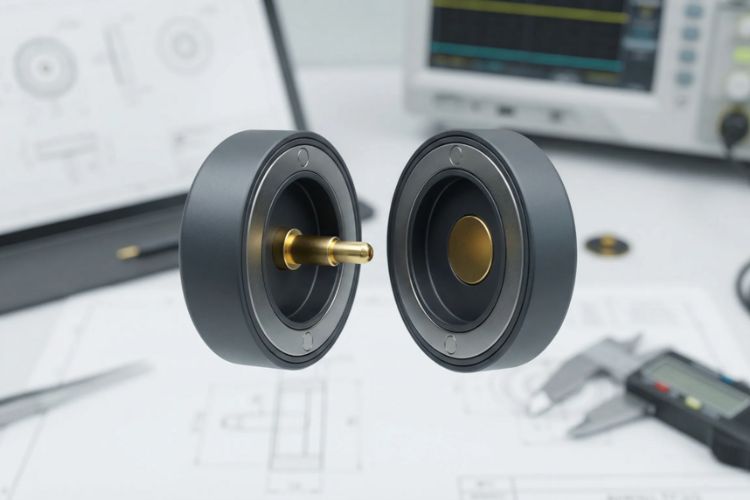
Forget the spec sheet for a second. What these connectors actually are is two halves that want to stick together, and when they do, electricity flows. One half sits in the device or dock. The other is on the cable or charger. Both have neodymium magnets buried inside them, N52 grade usually, which is basically the strongest permanent magnet you can practically embed in something this small.
When the two halves get close enough, the magnets take over. They pull, they self-correct, they snap together without the user doing anything deliberate. That is the part people underestimate when they first look at these things. You are not relying on the user to line anything up. The connector does it.
In the center of that connection sits a single spring-loaded pogo pin. That pin is the part that actually carries the current. It has a plunger pressing against a contact surface, a barrel keeping everything in place, and a spring inside maintaining constant pressure regardless of what the device is doing. That spring is what sets these apart from a fixed pin in any environment where movement, vibration, or even just daily handling is part of the picture.
The housing wraps around all of this in the smallest footprint the design allows, usually circular or rectangular, shaped to slide into a product without burning through PCB space the designer was already fighting to protect. That combination, tiny footprint plus hands-free alignment, is why these ended up in wearables and medical gear instead of staying in niche industrial parts.
Key Components and Design Features
From the outside, a 1 pin magnetic connector looks dead simple to build. Anyone who has tried sourcing a decent one knows that is not quite true.
-
Magnets: Neodymium magnets handle alignment, mating speed, and polarity protection, not just attraction. Good placement means the connector physically cannot attach backwards, which in medical and industrial settings is a safety matter, not just a convenience one. Promax invests heavily here because correct magnet positioning is what makes IP67 and IP68 sealing actually hold. Get the magnets wrong and the seal fails regardless of what the datasheet claims.
-
Pogo Pin: About 1 newton of spring pressure keeps the contact alive through vibration, knocks, and daily movement. That small, constant force is what separates a reliable connection from an intermittent one. Current capacity runs 1A to 10A depending on configuration, which covers most portable charging needs without any complexity.
-
Design Features: Electromagnetic shielding gets built in by serious manufacturers because motors, wireless hardware, and nearby electronics are real-world realities. Magnetic force calibration matters just as much. Too strong and users fight the connector to unplug. Too weak and it falls out on its own. That middle ground is narrower than it looks and getting it wrong shows up fast in user complaints.
How the Connection Mechanism Operates
What actually happens when these two halves come together is one of those things that is easier to appreciate once you walk through it step by step.
The magnets start working before the connector even makes contact. As the plug gets close to the socket, the pull begins, and it starts correcting for angle and position automatically. A user bringing the cable in slightly off-center does not miss. The magnets adjust. By the time physical contact happens, the pogo pin is already aligned with its landing pad, which is gold-plated in quality connectors specifically to minimize resistance and slow down the corrosion that would otherwise creep in after hundreds or thousands of cycles.
Then the spring compresses. That compression is what creates a reliable, consistent connection rather than a loose or intermittent one. The spring is always pushing the plunger against that landing pad. If the device gets knocked, the spring absorbs it. If it gets set down harder than expected, same thing. The electrical path stays intact because the spring does not care about movement. It just keeps pressing.
Continuous current in the 6A to 10A range is typical for this type, enough for portable electronics and small robotics without heat becoming a problem. Pulling the two halves apart is just a tug. The magnetic connection releases cleanly and nothing in the device port takes any stress from it.
Promax carries this same mechanism into custom work, which means manufacturers can actually dial in the holding force, pin type, and housing geometry rather than adapting their product around whatever standard part is available.
Advantages of 1 Pin Magnetic Connectors in Compact Devices
-
Ease and Safety: Think about the difference between handing a device to someone and telling them to find the charging port and insert the cable carefully, versus handing them a device where the charger just snaps on when it gets near. For consumer products, that gap in user experience is the difference between a five-star review and a support ticket. For medical devices used by patients with tremors or limited hand strength, it stops being about convenience and starts being about whether the device actually gets used properly. The quick-release side of it matters too. In any environment where a cable underfoot is a realistic scenario, a connector that pops free under load instead of dragging the device off a surface is a legitimate safety feature, not just a selling point.
-
Compact and Reliable: Most small devices doing power-only over a dock or charge cable do not need data pins. They just need juice. One pin covers that, and the housing around it takes up a fraction of the space a multi-pin connector would need on the PCB and in the mechanical design. The spring-loaded contact also handles the kind of constant movement that kills fixed connectors over time. Handheld scanners that get banged around in warehouses, wearables that get twisted and compressed during use, these are environments where a fixed pin gradually works loose and a spring-loaded one just keeps going.
-
Durability and Waterproof Performance: Getting past 10,000 mating cycles without meaningful degradation is the benchmark for quality magnetic connectors built with the right materials and tolerances. Promax hits IP67 and IP68 on their sealed versions, which covers the kind of abuse that medical devices go through during sterilization and the daily sweat and rain exposure that outdoor wearables deal with. That environmental protection in a package this small is something multi-pin connectors in the same footprint typically cannot match.
Common Applications in Modern Electronics
Smartwatches put these connectors on most people’s radar but that was just the beginning. Wireless earbud charging cases, handheld barcode scanners, headset cradles, all of them have landed on magnetic single-pin connections for the same basic reasons. Promax ships into a lot of these categories, with customers building everything from wrist health monitors to retail scanning hardware where the connector gets used dozens of times a day by people who are not thinking carefully about how they plug things in.
Robotics is one of the less obvious applications but it is a real one. End-of-arm tooling on robotic arms needs power connections that swap fast. A technician swapping a tool attachment does not want to spend time carefully threading pins. The magnetic connector snaps on, the tool has power, the arm runs. Swapping out takes seconds and there is no guesswork about whether the connection actually seated properly.
Medical teams building wearable monitors and portable imaging equipment have gravititated toward these specifically because of what IP67 and IP68 ratings mean in clinical settings, and because a connector that nurses and patients can detach with minimal force is genuinely better than one that requires a deliberate pull. Small usability wins in medical environments add up in ways that matter.
The 2-in-1 laptop space has its own version of this in the form of magnetic power ports, something Apple demonstrated works with MagSafe and other manufacturers have followed. A cable that releases instead of yanking a laptop off a desk is something users notice immediately and appreciate every time it happens. That value does not diminish with familiarity.
Challenges and Limitations
Worth being upfront about this: these connectors are well suited to specific situations and genuinely poorly suited to others. Using one outside its strengths creates predictable problems.
-
Magnetic Balance: Dialing in the right holding force sounds like something you could estimate from a datasheet and be done with. In practice it is not. The weight of the device matters. How users interact with it matters. Whether it sits in a dock most of the time or gets carried around constantly matters. A force that feels secure on a heavier handheld device feels stubborn and annoying on a lightweight wearable where the same pull is disproportionate. This calibration is real work that needs to happen for each specific application, not once and then assumed to transfer.
-
Interference: Neodymium magnets are strong, and strong magnets in environments full of other magnetic fields or sensitive electronics create problems that range from annoying to serious. Equipment near MRI machines, audio gear with precision components, industrial machinery with large motors. These are environments where dropping a magnetic connector in without evaluating the electromagnetic situation first is a mistake. Shielding helps but adds cost and design complexity. Assuming the environment is benign without checking is how you end up with a connector that performs differently in the real installation than it did on the bench.
-
Single-Pin Functionality: One pin is one electrical path. That is the constraint and it does not flex much. Power transfer, maybe a low-bandwidth signal in some setups, that is what you get. The moment a device needs USB data, audio, multi-channel signals, or any kind of real communication through the connector, a single pin cannot do it. Engineers occasionally try to make this work through workarounds and usually end up with something that is more complicated and less reliable than just using the right connector from the start. Being clear about what the device actually needs before the connector gets specified saves a lot of backtracking later.
About Promax Pogo Pin
Business: Promax Pogo Pin
Spokesperson: Gavin
Position: Manager
Phone: (765) 705-7361
Email: tonyhoo@promaxpogopin.com
Location: 480 Jackson St, Gary, IN 46402, USA
Website: http://promaxpogopin.com/
Frequently Asked Questions
How does a 1 pin magnetic connector work in compact devices?
Magnets in both halves pull together and self-align, while a spring-loaded pogo pin in the center maintains constant contact pressure. Get the cable close to the port and it snaps on by itself.
What are the main advantages of using a 1 pin magnetic connector in wearable or handheld devices?
Tiny footprint, hands-free connection, vibration-resistant spring contact, waterproof sealing up to IP68, and a quick-release that protects the device if the cable gets caught or pulled.
Can a 1 pin magnetic connector transmit data as well as power?
Simple low-bandwidth signals sometimes, but real data transfer is off the table. One pin means one path, so anything beyond basic charging needs more pins or a different connector entirely.
How durable and waterproof are 1 pin magnetic connectors?
Good ones like Promax’s handle 10,000-plus mating cycles and carry IP67 or IP68 ratings, making them solid for medical sterilization, outdoor use, and daily sweat exposure.
What should engineers consider when choosing a 1 pin magnetic connector for compact electronic devices?
Nail down current draw, holding force calibration, and the electromagnetic environment early. Also confirm upfront that a single pin actually covers everything the device needs, because discovering it does not after prototyping is painful.
What limitations exist for 1 pin magnetic connectors in device design?
One pin handles power only, not real data or multi-channel signals. Magnetic force needs proper calibration per application, and strong external magnetic fields nearby can cause interference issues.
Note: The content on this article is for informational purposes only and does not constitute professional advice. We are not responsible for any actions taken based on the information provided here.