

Organizations keep hearing they need to do more with less. Margins get tighter, competitors move faster, and customers want everything yesterday. Most leaders understand efficiency matters. What trips them up is diagnosing why operations actually lag in the first place.
The real culprits aren’t lazy workers or insufficient effort. Problems trace back to disconnected systems, processes nobody bothered updating in years, and teams burning themselves out trying to compensate for broken infrastructure. Fixing these issues requires leaders who take genuine ownership of operational outcomes rather than simply managing around them.
Where Technology Meets Human Performance
The strongest improvements happen when technology and workflow design actually work together. Take warehouse operations. Manual picking means workers spend their days hunting for items, double-checking orders, and catching mistakes before they ship. Replace that with automated picking systems and watch what happens: accuracy goes up, speed increases, people go home less exhausted.
Technology isn’t replacing judgment. It’s eliminating the soul-crushing parts of the job – the searching, the repetitive checking, the physical strain that turns experienced workers into error-prone zombies by hour six of their shift.
This plays out everywhere. Manufacturing plants catch defects with automated quality control that human eyes miss after staring at parts all day. Customer service reps find information in seconds instead of clicking through five different databases while customers wait on hold. What is the thread that connects these? Systems that remove the tedious cognitive load free people up to use their actual expertise.
The Hidden Cost of Operational Drag
Leadership teams obsess over revenue per employee and customer acquisition costs. Meanwhile, they ignore the stuff actually killing productivity: workers spending 20 minutes finding inventory that should take two, manual data entry creating errors that cascade through the system, meetings convened to solve problems that shouldn’t exist.
A warehouse worker wasting 15 minutes per shift on misplaced items loses 60 hours a year. Twenty workers? That’s 1,200 hours the company pays for while getting nothing back. Modern warehouse technology addresses these inefficiencies by organizing inventory more intelligently. One fixable problem, massive ongoing cost.
Treating these as isolated annoyances instead of symptoms of systemic failure means putting band-aids on bullet wounds. Real improvement requires looking at how work actually moves through the organization and fixing the places where it breaks down.
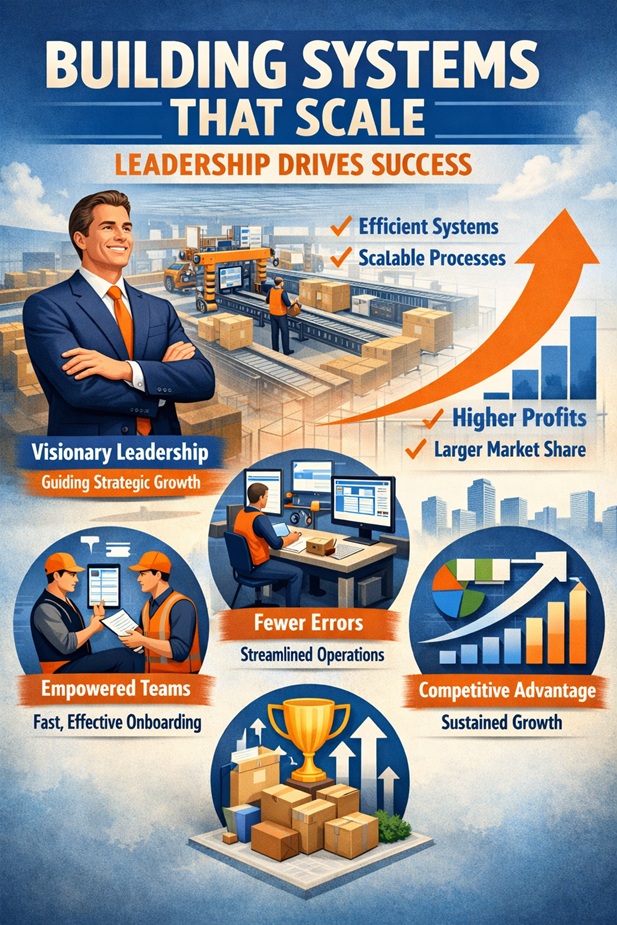
Building Systems That Scale
Processes that work fine at small scale collapse when volume grows. Handling 50 orders daily is one thing. Five hundred is something else entirely. Leaders chasing growth often learn this the hard way; their infrastructure can’t support the volume without doubling headcount and watching overhead explode.
Companies that invest in scalable infrastructure avoid this trap. McKinsey research found that organizations with digital supply chains boost EBITDA by 3.2% while simultaneously cutting costs. Their systems handle growth because they built flexibility in from the start.
Watch distribution centers during holiday rushes. The ones relying on manual processes hire temps, spend three weeks training them, and still ship wrong orders. The ones using scalable technology get new people productive in days because the system guides them through complex tasks.
The real question isn’t whether to invest in better systems. It’s whether you can afford not to while competitors gain efficiency advantages that translate straight into better pricing and larger market share.
Leadership’s Role in Driving Change
Operational excellence requires leaders who see system design as strategy, not something to delegate and forget. The useful questions: What frustrates frontline workers most? Where do errors cluster? Which manual tasks eat time without creating value?
A manufacturing exec who spends a day watching the production floor sees things no consultant report will capture. Workers routing around broken processes, informal workarounds that barely keep things running, friction points that slow everything down.
Companies where leadership actively champions operational improvement see results. Organizations with strong leadership development programs report 20% increased productivity. The difference is in the leaders who understand that sustained performance requires ongoing attention to how work happens, not just what gets produced.
Connecting Strategy to Daily Execution
Operational reality kills strategic plans. Assuming that current processes can accommodate triple the volume and planning it out prepares everyone for chaos. Starting cross-functional programs in an organization where your systems are painful to work with is a sure way of failure.
Smart leaders test strategic assumptions against operational capacity. Do we have infrastructure to execute this? If not, what needs changing? What will be the period of changes, and what resources are required? Companies are reconsidering the way they use talent to align capabilities that are with their strategic priorities.
Making Efficiency Sustainable
Process improvements disappear unless people actually use them daily. A change that saves 100 hours monthly only works if teams stick with the new approach instead of reverting to familiar patterns.
Real efficiency comes from making the better way the easier way. When processes make sense, when technology helps instead of creating headaches, when problems get caught early—efficiency takes care of itself.
The organizations winning on operations didn’t get there through some big initiative. They built environments where people naturally look for better methods, where questioning wasteful processes is normal, and where investing in smarter systems is obvious rather than debatable.
Sustained success depends on leaders seeing this as perpetual work, not a project to finish.
Note: The content on this article is for informational purposes only and does not constitute professional advice. We are not responsible for any actions taken based on the information provided here.