

In today’s hyper-connected global economy, a crisis is no longer a rare anomaly; it is an operational guarantee. Whether it is a sudden supply chain collapse, a cybersecurity breach, a global health emergency, or a catastrophic PR misstep, the question is not if your organization will face a severe disruption, but when.
 |
Author: Jonathan M. Pham |
Highlights
- Crisis acts as a revealer of a leader’s pre-existing foundation of integrity and competence. Success depends on proactive “Phase 0” preparation, such as using digital wargaming to simulate interconnected “polycrisises” and building a support circle of “Grounded Anchors” to provide emotional stability.
- Under extreme stress, people often fall into a “Crisis Reflex” of rigidity caused by cortisol buildup. Effective leaders combat this by prioritizing self-care as a strategic requirement and utilizing “Lincoln’s Rule”—taking a small pause before reacting to ensure decisions are made from a strategic, rather than a reactive, state.
- Because information is never 100% complete during a crisis, leaders need be comfortable making swift decisions with an “information deficit” and breaking overwhelming challenges into micro-goals. Communication should be frequent and honest, following a predictable “What we know / What we don’t / What we’re doing next” framework to prevent a leadership vacuum.
- A leader is expected to act as a “thermostat” that regulates the room’s temperature rather than a thermometer that merely reflects the heat. This involves practicing the “Stockdale Paradox”—confronting brutal current facts while maintaining unwavering faith in the final outcome—and using the “Listen, Validate, Steer” model to manage team emotions.
- Once a crisis moves into the aftermath, structured “After-Action Reviews” are essential to harvest lessons and build “Trust Equity.” A well-managed crisis serves as a catalyst for innovation, allowing leaders to make necessary structural changes and pivot business models that would have been ignored during “peacetime.”
Are Crisis Leaders Born or Made?
For executives, founders, and HR professionals, navigating the above-mentioned disruptions is the ultimate test of capability. Yet, a pervasive myth persists in the corporate world: the idea of the “natural-born” crisis leader.
The reality is that crises do not magically forge leaders out of thin air. Instead, they expose the foundation of integrity, competence, and commitment that one has established during times of calm. If you have not established a baseline of trust before disaster strikes, you will not suddenly manifest it amid chaos.
Phases of Leading through Crisis (plus Strategies)
Phase 0: Preparation and the Proactive Mindset
The psychological impact of a business crisis begins long before the actual event. It begins with the anxiety of unpreparedness. While no executive can predict every specific disaster, effective leaders prepare the organizational framework and mental fortitude required to adapt when the unexpected occurs.
Bridging the “Adaptability Gap”
Most enterprise organizations have a crisis plan on paper. However, the difference between a strong and weak leader is their relationship with that plan – which is known as the “Adaptability Gap.” A rigid leader will follow an obsolete script as the environment changes; an agile one knows exactly when to abandon or modify the plan based on new, real-time data.
In a crisis, agility and adaptability are your primary survival metrics.
Scenario Prioritization and Whole Brain® Thinking
To proactively prepare, leaders should engage in contingency planning that goes beyond basic logistics. Utilizing the Whole Brain® Thinking framework ensures that your risk management strategy is viewed holistically:
-
Blue (Analytical): What logic and data will we need? How will we secure cash flow?
-
Green (Structural): What processes, checklists, and safety protocols must be activated?
-
Red (Relational): How will we manage the emotional toll on our employees and customers?
-
Yellow (Experimental): What out-of-the-box solutions can we pivot to if our primary business model fails?
The Modern Mandate: Digital Wargaming for the “Polycrisis”
In the digital era, we rarely face one isolated issue. We face the “Polycrisis”—multiple, interconnected crises happening concurrently. For instance, a natural disaster might trigger a supply chain failure, which in turn causes severe financial distress. To prepare, it’s essential to include the implementation of digital “wargaming.” By running routine simulation drills—sometimes utilizing AI predictive models to brainstorm worst-case scenarios—leaders can pressure-test their decision-making frameworks before the stakes are real.
Establishing “Grounded Anchors”
Leadership is never a solo endeavor. High-level executives must build a support system of advisors who act as Emotional Intelligence (EQ) filters. Do not just hire advisors for their intellect; hire them for their strength of character. If your advisors panic, you will panic. Cultivate a circle of “Grounded Anchors” who possess the temperament to maintain equanimity under pressure.

Leading through crisis
Phase 1: The Onset (Triage and Stabilization)
When the storm hits, the first ten minutes dictate the trajectory of the next ten months. This phase is not meant to solve the overarching problem; its focus is on triage, stabilization, and managing the human reaction.
Overcoming the “Crisis Reflex” and the Toxicity of Cortisol
Research highlights a dangerous trend: under extreme pressure, leaders rarely become more heroic. Instead, the “Crisis Reflex” kicks in, with over 53% of leaders becoming more closed-minded, controlling, and rigid.
This is a biological response. Intense stress creates a massive buildup of cortisol in the body. If one does not manage this biological reality through basic self-care—such as brief exercise, hydration, and sleep—cortisol becomes a literal toxin, shutting down the brain’s capacity for creative problem-solving.
How do leaders stay calm and manage their own stress during a crisis? By recognizing that taking five-minute sanity breaks is not a luxury; it is a strategic requirement. A physically or mentally compromised leader cannot effectively be in charge of others.
The Power of “Doing Nothing” (Lincoln’s Rule)
In an age of instant digital communication and 24/7 pings, executives feel immense pressure to react immediately. Yet, one of the most counterintuitive strategies is to Wait to Act. Inspired by Abraham Lincoln, the rule is simple: The higher the stakes, the less likely you should be to do anything in the immediate moment.
Taking the “smallest pause” allows your brain to shift from a reactive state to a strategic one. It prevents the impulsive, knee-jerk reactions that often trigger stakeholder panic and internal chaos.
Read more: Brilliant Jerks – How to Handle Toxic “High Performers” in the Workplace
Setting the Emotional Tone: The Thermostat Metaphor
During a crisis, a leader’s role is to act as a thermostat, not a thermometer. The latter merely reflects the heat and stress of the room; the former has the power to dial it down.
Your team will look to your body language, tone of voice, and micro-expressions for cues on how to feel. Because leadership is a “contagious” force, you need to maintain calm under pressure. This concept, often called Intentional Energetic Presence (IEP), posits that the energy you bring into a room (or a Zoom call) sets the operational baseline for your entire staff. Even if you are internally anxious, projecting a steady, familiar composure prevents panic and anxiety from spreading like a contagion.
Prudent Micromanagement and Defining Reality
While micromanagement is heavily discouraged in day-to-day operations, the onset of a crisis is the one exception. In the initial moments, it is highly appropriate to exercise tighter control to ensure people do not stray out of their lanes and make the situation worse.
Your immediate job is to establish situational awareness and close the “Expectation Gap”—the space between how the world used to be and your current reality. Engage in fact-checking to dispel rumors, and utilize brutal honesty. People appreciate the harsh truth about a dire situation far more than they appreciate false optimism.

Leading through crisis
Phase 2: The Middle (Navigation, Communication, and Execution)
Once the initial shock has passed, organizations enter the longest and most grueling phase of a crisis. Success here relies on decisive action, transparent communication, and an unwavering commitment to psychological safety.
Action-Oriented Decision Making
- Decisiveness with an Information Deficit
In a crisis, you will never have 100% of the facts. Waiting for a perfect roadmap will result in paralysis, and paralysis is vastly more dangerous than a mistake.
Decisiveness is the foundational skill of this phase. Be comfortable making high-stakes decisions with an information deficit. Act swiftly, monitor the results, and maintain the radical flexibility to course-correct when new data emerges.
- Strategic Delegation and Micro-Goals
Nobody is capable of managing an emergency 24/7. Attempting to do so leads directly to burnout—both for yourself and your executive team. You must treat your human resources as “Relief Capital.” Delegate execution to trusted managers so you can maintain a high-level view of the strategy.
Simultaneously, the sheer scale of a crisis may feel paralyzing for the broader team. Effective leaders break massive, overwhelming challenges down into micro-goals (e.g., “Let’s just secure the inventory for the next 48 hours”). Celebrating these small wins creates positive momentum and replaces organizational helplessness with a sense of agency.
- Navigating Financial Distress: Cash is Oxygen
If the crisis is economic, understand bluntly that cash is oxygen. Do whatever is necessary to free up capital and act conservatively. However, the golden rule is that leaders must sacrifice first. If pay cuts or eliminated bonuses are required to save the business, the executive suite should take the biggest and earliest hit. Behavioral consistency—where your actions match your words—is the only way to maintain trust when livelihoods are on the line.
High-Stakes Crisis Communication
- The Danger of the Leadership Vacuum
A crisis rarely starts with an explosion; it starts with whispers, supply delays, or a departing client. If leaders go silent during this period, offering only vague reassurances, they create a “Leadership Vacuum.” In the absence of verified news, employees will invent their own stories, usually assuming the worst-case scenario.
Silence is a decision, and it is almost always the wrong one.
- Communicating Effectively During a Corporate Crisis
The purpose of communication is not to deliver a perfect, cinematic speech, but to establish a predictable structure. Use the following three-part communication lifeline:
-
What we know: State the clear, verified facts.
-
What we are still learning: Embrace vulnerability and transparency. It is highly recommended to say, “I don’t know yet, but here is how we are trying to find out.”
-
What we’re doing next: Provide immediate, actionable steps.
- The 3 R’s and The Goldilocks Diet
During high-stress periods, people suffer from cognitive overload and struggle to retain information. Therefore, communication must follow the 3 R’s: Review, Repeat, and Reinforce. Utilize every channel possible—email, town halls, direct manager 1-on-1s. Research notes that organizations with highly transparent communication channels cycle through recovery phases 25% faster than those without.
However, be mindful of the “Goldilocks Information Diet.” Provide enough numbers and data to correct misperceptions and prevent people from overestimating risk, but do the “mental math” for them. Pre-calculate the data and use simple visual aids to reduce the cognitive tax on your stressed audience.
The Human Element and Psychological Safety
- Empathy vs. Strength (Listen, Validate, Steer)
Empathy and compassion do not mean being “soft” or lowering your business standards; they mean validating your team’s emotions without getting stuck in them.
Follow the “Listen, Validate, Steer” model. Acknowledge the fear and difficulty of the situation, validate those feelings as rational responses to a highly irrational event, and then immediately steer the conversation back toward practical next steps.
- The Stockdale Paradox
While maintaining employee morale during difficult times is critical, leaders must avoid “blind optimism” (e.g., “Everything will be back to normal by next month!”). Blind positivity destroys credibility when deadlines are missed. Instead, embrace the Stockdale Paradox: Confront the brutal facts of your current reality while maintaining an unwavering faith that you will ultimately prevail.
- Leading Remote or Distributed Teams Through a Crisis
Specific intentionality is key here. Remote employees cannot read the subtle body language of executives in the hallway, making them highly susceptible to rumors. Create “digital watercoolers” to foster psychological safety and check in on mental well-being. Prioritize asynchronous video updates over lengthy text memos; hearing the leader’s actual voice and tone is vastly more effective at shutting down the brain’s fear center than reading text on a screen.

Leading through crisis
Phase 3: The Aftermath (Recovery, Learning, and Catalyst for Change)
A crisis is not truly over the day operations resume. The aftermath is where the most critical leadership work takes place. It is the transition phase from survival back to growth.
The “Post-Crisis” Value and Structured Reflection
Post-crisis recovery requires a formal, military-style After-Action Review (AAR). Gather your team to conduct a thorough post-mortem on what worked, what failed, and where the blind spots were. Do not allow the excuse that “things were just moving too fast.” Readiness is the fundamental job description of an executive; an inability to respond is a failure of preparation, not an inevitability.
This structured reflection is how you harvest the lessons learned and build institutional knowledge to prevent or mitigate the next disaster.
Crisis as a Refocusing Tool
How can an organization use a crisis as a catalyst for positive change and innovation? By recognizing that it creates unprecedented clarity. What is confusing during good times often becomes crystal clear during hard times.
Use this period as an “excuse” to make the tough decisions you have been putting off. If a specific department was underperforming, restructure it. If your primary product line failed during a supply chain bottleneck, turn it into the catalyst to launch a new, more resilient digital strategy. Crises activate “latent greatness” within organizations, forcing outside-the-box thinking and turnaround strategy execution that would never have emerged during peacetime.
Building Long-Term Trust Equity
Successfully navigating a difficult period builds a profound level of long-term loyalty from employees and customers—often referred to as “Trust Equity.”
There’s a well-documented case study of a major advertising agency that lost its largest client overnight. Instead of hiding the truth, leadership practiced radical transparency. They shared the financial reality, implemented a human-centric strategy that avoided layoffs through shared sacrifices, and pivoted their entire business model. Within 18 months, not only did their finances stabilize, but employee engagement actually jumped by 47%.
This proves that a well-managed crisis can leave a team more unified, innovative, and happier than they were before the storm. It creates a “Tough Team” whose foundation of trust endures permanently.
Failure is an Event, Not a Person
Sometimes, despite executing excellent strategies, a product line, a division, or even an entire company may not survive. Remember that failure is an event, not a person. It is the end of a chapter, not the end of the book.
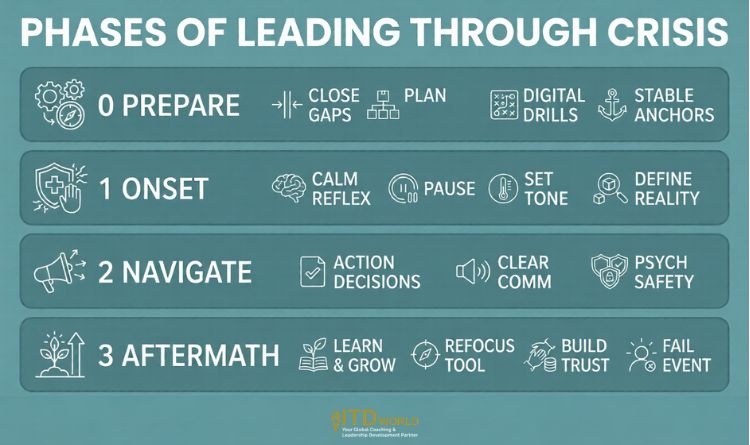
Summary: A Checklist for Leading Through Crisis
-
Strategy (Simplify the Math): Make fast decisions with limited data. When communicating those decisions, provide the necessary numbers but simplify the mental math for your stressed audience.
-
Visibility (The Proximity Principle): Do not hide behind corporate emails. Implement brief morning huddles to set daily goals and kill rumors. Let people know exactly when and how they can reach you.
-
Consistency (Tone from the Top): Your actions must match your words. Projecting “justness” is vital; any perceived double standard (e.g., executives keeping bonuses while laying off staff) destroys the control environment and internal trust.
-
Self-Care (Flush the Cortisol): Monitor your own physiological stress levels. Take 10 minutes to recharge daily; “locked in fear” equates to limited creativity.
-
Future-Proofing (The One-Year Rule): To avoid the “tunnel vision” of a disaster, consciously ask yourself and your team: Where do we want to be one year from now? This mental time-travel maintains perspective and informs long-term recovery.
Read more: Future Ready Organization – 11 Tips to Building One
FAQs about Leading Through Crisis
What is the difference between crisis management and crisis leadership?
Crisis management is inherently reactive; it involves process, logistics, and mitigating immediate damage.
Crisis leadership, on the other hand, is proactive and human-centric. It is the act of guiding, inspiring, and supporting the people executing those processes. While management focuses on controlling the uncontrollable, leadership focuses on providing a vision for the “day after.”
What are the primary stages of leading through a crisis?
While every situation is unique, leading through crisis generally follows a five-stage lifecycle:
-
Preparation (Contingency planning and wargaming)
-
Onset/Triage (Stabilizing the environment and setting the emotional tone)
-
Navigation (Executing decisions with incomplete data)
-
Recovery (Transitioning out of survival mode)
-
Reflection (Conducting a post-mortem to cultivate future resilience).
How can a leader support employees who are experiencing crisis fatigue?
Crisis fatigue occurs when an emergency transitions into a prolonged state of operational stress. Leaders can support their teams by enforcing strict boundaries around working hours, celebrating “micro-wins” to restore a sense of momentum, and actively modeling self-care.
How do you rebuild culture while leading through crisis recovery?
Rebuilding culture requires transforming the shared trauma into shared triumph. It is highly recommended that you conduct a highly transparent After-Action Review where leadership openly owns their mistakes. Publicly acknowledge the resilience and sacrifices of the staff, and clearly articulate how the lessons learned have fundamentally improved the company’s future operating procedures.

Final Thoughts on Leading Through Crisis
Leading through a crisis is not about managing your way out of it or motivating your way around it. It is about stepping into the ambiguity, providing a vision for the future, and leading your people directly through it. By embracing transparency, maintaining your composure, and prioritizing the human element, you can transform your organization’s greatest threats into its most defining moments of growth.
ITD World provides specialized coaching and training solutions designed to help leaders & organizations secure a competitive advantage – and be equipped to win in today’s dynamic landscape. Contact us today to learn more about our world-class programs!
Other resources you might be interested in:
- Existential Leadership: From Managing Tasks to Curating Significance
- Resilient Leadership: The Reliable Compass Through Uncertainty
- Ego in Leadership: How to Tame It for the Greater Good