

The “Productivity Paradox” haunts almost every high-performing manager: to get more done, you must personally do less. While it may feel like idleness to the untrained eye, true leadership is a sophisticated system of scaling influence. Your value is no longer defined by the manual work you can produce, but by the decisions you empower others to execute. To scale and establish a high-performing organization, you must move beyond personal output and master the art of delegation.
 |
Author: Jonathan M. Pham |
Highlights
- True delegation involves a supportive partnership where a manager transfers responsibility for a task and the authority to make decisions, while still retaining ultimate accountability for the outcome. It differs from abdication, which is the negligent act of “dumping” work without providing context or a safety net.
- Effective delegation benefits three levels of an organization: it frees the manager for high-level strategy, acts as a growth engine for the employee’s career, and increases the organization’s agility and revenue by removing decision-making bottlenecks.
- To practice the art of delegation, leaders must shift from a “Doer” mindset to a “Multiplier” mindset. They need to move past the “Control Trap” (perfectionism) and the “Time Fallacy” (the belief that doing it yourself is faster), recognizing that investing time in training others saves weeks of work in the long run.
- Delegation is a spectrum rather than a binary choice. Successful leaders match the level of autonomy to the employee’s experience—ranging from Level 1 (Task-Based) for new hires to Level 5 (Clairvoyant) for trusted, long-term partners.
- The process requires high “upstream clarity” (defining what “done” looks like), matching authority to the level of responsibility, and using the 70% Rule – if someone can do a task 70% as well as you, you should delegate it to foster their growth.
What is Delegating?
Before we can master the art of delegation, it’s necessary to strip away the misconceptions that surround it. Many leaders hesitate to assign tasks because they view it as a binary choice: either they do the work themselves (control) or they dump it on someone else and hope for the best (chaos).
True delegation lies in the middle. It is the transfer of responsibility for specific tasks from a manager to a subordinate, while the manager retains the ultimate accountability for the outcome. It is a specific act of trust where authority is shared, but the “buck” still stops with you.
To practice it effectively, we must distinguish it from two related concepts: Abdication and Empowerment.
Delegation vs. Abdication
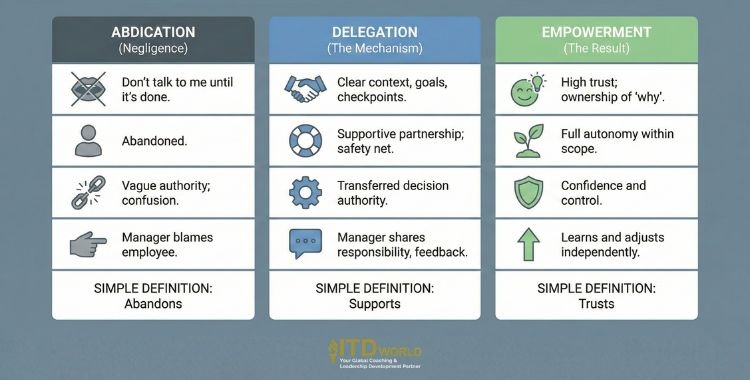
Abdication is often mistaken for “hands-off” leadership, but it is actually negligence. Abdication sounds like: “Here, you handle this project. Don’t talk to me until it’s done.”
In this scenario, the manager provides no context, no support, and no checkpoints. When the project inevitably fails or goes off-track, the manager blames the employee.
Effective delegation, by contrast, is a supportive partnership. It involves setting a clear direction, agreeing on checkpoints, and remaining available as a safety net.
To put it simply, abdication abandons the employee; delegation supports them.
Delegation vs. Empowerment
These terms are frequently used interchangeably, but there is a nuance. The former is the mechanism; the latter is the result.
You cannot simply “empower” someone by wishing it so. Empowerment is a psychological state—a feeling of ownership, autonomy, and confidence—that an employee achieves when they are trusted with meaningful work. Delegation is the tool you use to achieve that state.
However, you cannot have empowerment without the authority to act. If you assign a task but require the employee to ask for permission for every minor decision, you have not delegated; you have merely assigned a chore.
True delegation transfers the authority to make decisions within the scope of the task.
| Feature | Abdication (Negligence) | Delegation (The Mechanism) |
Empowerment (The Result)
|
| Communication | “Don’t talk to me until it’s done.” | Clear context, goals, and agreed-upon checkpoints. |
High trust; the employee feels ownership of the “why.”
|
| Support Level | None. The employee is abandoned. | Supportive partnership; manager is a safety net. |
Full autonomy within the defined scope.
|
| Authority | Vague; usually leads to confusion. | Transferred authority to make decisions. |
Psychological state of confidence and control.
|
| Outcome of Failure | Manager blames the employee. | Manager shares responsibility and provides feedback. |
Employee learns and adjusts independently.
|
| Simple Definition | Abandons the employee. | Supports the employee. |
Trusts the employee.
|
The art of delegation
The Strategic Importance of Delegation in Management
Why is delegation considered a “non-negotiable” skill for modern executives? The benefits extend far beyond simply freeing up your schedule. When executed correctly, it serves three distinct stakeholders: the manager, the employee, and the organization.
For the manager: The “captain” analogy
Imagine a ship captain who is so busy scrubbing the deck and polishing the brass that they forget to steer the ship. This is the reality for managers who refuse to trust others. They are so consumed by the daily grind that they become bottlenecks for their own teams.
Delegation allows you to elevate your focus. By offloading routine or specialized tasks, you reclaim the mental bandwidth required for high-stakes decisions, strategic planning, and crisis management—the work that only you can do.
For the employee: The growth engine
Delegation is the most impactful form of on-the-job training. It serves as a practical classroom where team members build confidence and new competencies.
When you withhold work, you unintentionally stifle your team’s growth. Conversely, when you assign a “stretch goal”—a task slightly above their current capability—you provide them with a platform to prove themselves.
Delegation is essentially project management for careers; it helps employees build a portfolio of wins that prepares them for future leadership roles.
For the organization: The multiplier effect
An organization where only the managers can make decisions is slow, fragile, and uncompetitive.
- Agility: When authority is distributed, decisions are made faster because they don’t have to travel up and down the chain of command.
- Revenue: Research suggests that effective delegators can drive up to 33% higher revenue by focusing their energy on high-impact activities rather than administrative maintenance.
- Risk Management: Delegation reduces the “Bus Factor.” If a manager falls ill or leaves the company, the people who stay can continue to function. On the other hand, a team that relies on the manager for every instruction grinds to a halt.
Read more: Organization Development – Guide to Sustainable OD Practices & Strategies

Why is delegation important in leadership
The Art of Delegation: The Psychology of Letting Go
If the benefits are so clear, why is delegation so difficult? The barriers are rarely logistical; they are almost always psychological.
To become a Multiplier, you must first confront the internal narratives that keep you trapped in the “Doer” role.
The control trap & perfectionism
The most common resistance is the belief: “No one can do this as well as me.”
This may be factually true. You likely are better at the task than your subordinate—that is why you were promoted. However, perfectionism is a math problem. If you do the task yourself, it is done 100% perfectly, but you can only do one thing at a time. If you delegate it to three people who do it 80% as well, you have achieved 240% output.
The goal of management is not individual perfection; it is collective efficacy. You must accept that “done well” is often better than “done perfectly by me.”
The “time fallacy”
Many managers tend to say, “It’s faster if I just do it myself than to explain it to someone else.”
In the short term (Crisis Mode), this is true. It takes 30 minutes to do the task and two hours to teach it. However, it will become a trap if you continue sticking with it for long.
If you do it yourself, you spend 30 minutes every time the task arises. If you invest the two hours to train someone, you save those 30 minutes forever. You must apply the “Take Time to Save Time” rule: invest hours upfront to save weeks of work later.
The guilt factor
Some empathetic managers fear that delegating work makes them look lazy or that they are “dumping” on their team. This stems from a misunderstanding of what employees want.
High performers generally crave autonomy and challenge. By hoarding work, you aren’t protecting them; you are blocking them from the opportunities they need to shine.
The shift from “Product” to “People”
Overcoming these barriers requires a fundamental mindset shift. You must move from being a High Achiever to a Multiplier.
- Old Thought: “My job is to produce the best results.”
- New Goal: “My job is to find and develop their ‘native genius’.”
A great leader’s primary metric for success is people development. You must have a higher belief in your employees’ potential than they might have in themselves.
It starts with fostering psychological safety—an environment where failure is viewed as part of the learning curve. If you punish the first mistake an employee makes on a delegated task, you confirm their fear that they should have just let you do it. You must make your team more excited to try than they are scared to fail.
Read more: Leader vs Boss – 11 Key Differences (Which One Are You?)

The art of delegation
The Principles: Golden Rules of Delegation
Effective delegation is a nuanced skill that must be adapted to the situation. Here are a few core principles:
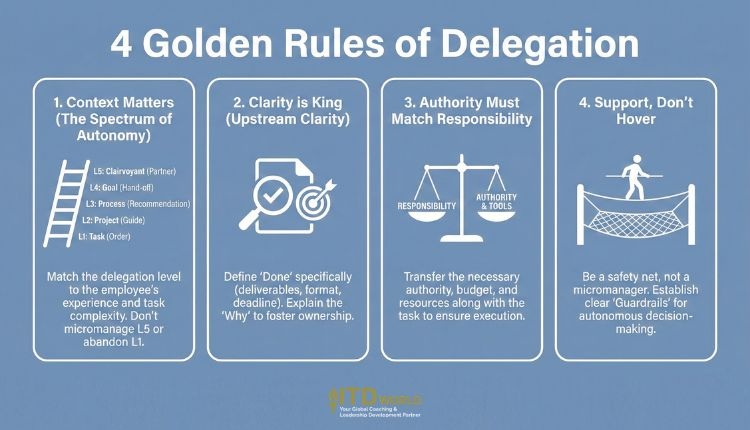
Rule 1: Context matters (The spectrum of autonomy)
Delegation is not a binary switch; it is a spectrum. One of the biggest mistakes leaders make is treating a junior intern the same way they treat a senior director.
We can view the art of delegation through a 5-Level Framework. You must choose the right level based on the employee’s experience and the task’s complexity.
-
Level 1: Task-Based (The Order). “Do exactly what I say.”
-
Best for: New hires or crisis situations. The manager decides; the employee executes.
-
-
Level 2: Project-Based (The Guide). “Here is the goal; look into it and tell me what you find.”
-
Best for: Cultivating initial trust. The employee researches, but the manager decides.
-
-
Level 3: Process-Based (The Recommendations). “Give me your recommendation, and I will approve it.”
-
Best for: Collaborative decision-making. The employee analyses and decides, but the manager validates.
-
-
Level 4: Goal-Based (The Hand-off). “Here is the objective. You decide how to do it.”
-
Best for: Senior employees. The manager sets the “what,” the employee owns the “how.”
-
-
Level 5: Clairvoyant (The Partner). The employee anticipates the need and acts before being asked.
-
Best for: Long-term partners who can “read your mind.”
-
The Principle: Match the level to the person. Do not micromanage a Level 5 employee, and do not abandon a Level 1 employee.
Rule 2: Clarity is king (Upstream clarity)
Ambiguity is the ultimate enemy. Most delegation failures occur because the manager had a clear picture in their head but communicated a vague request.
- Define “Done”: Be specific about deliverables. Instead of saying, “Look into the sales data,” say, “I need a 5-page report comparing Q1 and Q2 sales by region, in PDF format, by Friday at noon.”
- Explain the “Why”: Ownership follows understanding. When people see how a task contributes to the larger mission, they transition from “task-takers” to “owners.”
Read more: Leading Through Uncertainty – How to Navigate Turbulent Times
Rule 3: Authority must match responsibility
You cannot hold someone responsible for a result if you haven’t given them the tools to achieve it. If you ask an employee to organize a client dinner but don’t give them a budget or the authority to sign the check, you are setting them up for failure. When you assign the task, explicitly transfer the authority required to execute it.
Rule 4: Support, don’t hover
Be a safety net, not a hovering pilot. This means establishing “Guardrails”—constraints within which the employee can operate freely. For example, “You can make any decision up to $1,000 without asking me. Above that, let’s discuss.” This gives them freedom while protecting the organization from critical risk.
Read more: 12 Golden Leadership Principles for Attaining Excellence
Principles of delegation
How to Practice the Art of Delegation
Step 1: The selection (What to delegate)
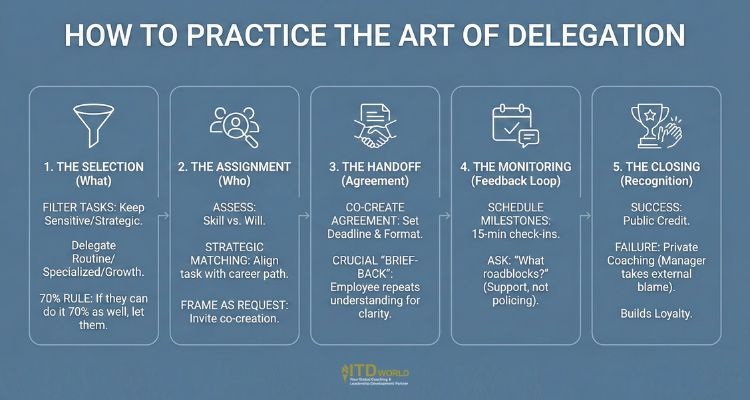
Not every task should be handed off. Use a filter to decide:
- Keep: Sensitive personnel issues, high-stakes crisis management, and strategic planning that requires your specific executive authority.
- Delegate: Routine tasks (reports, scheduling), specialized tasks (where someone else is the expert), and developmental tasks (opportunities for team growth).
- The 70% Rule: A helpful heuristic is that if someone can do the task 70% as well as you can, let them do it. Their growth will eventually bridge the 30% gap, and your time is better spent elsewhere.
Step 2: The assignment (Who to delegate to)
Once you have the task, assess your team. Look at Skill vs. Will.
- Strategic Matching: Don’t just give work to whoever is free. Use Pathboarding—align the task with where the employee wants to go in their career.
- The Conversation: When assigning the work, change your language. Instead of issuing a command (“I need you to do this”), frame it as a request for help (“I’m struggling with this project and I think your skills in X would really help solve it”). This invites co-creation and buy-in.
Step 3: The handoff (The agreement)
This is arguably the most critical step. You must co-create the agreement.
- Set Expectations: Agree on the deadline and the format of the result.
- The “Brief-Back”: To ensure clarity, ask the employee to repeat their understanding of the task back to you. You will be surprised how often their interpretation differs from your intent. Catching this mismatch now saves days of rework later.
Step 4: The monitoring (The feedback loop)
Delegation requires maintenance.
- Milestones: Schedule 15-minute check-ins to monitor progress. If the project is due in two weeks, check in after three days.
- Bi-Directional Feedback: Ask, “What roadblocks are you facing?” and “do you have the resources you need?” This shows you are supporting them, not just policing them.
Step 5: The closing (Recognition)
When the task is done, it’s time to “close the loop.”
- Public Credit: If the project is a success, the employee gets the credit. Publicly acknowledge their work.
- Private Accountability: If the project fails, you as the manager take the blame externally (for not supporting them enough), and then you coach the employee privately. The result is immense loyalty.
The art of delegation
Delegation Problems to Watch Out For
Micromanagement
This is the quickest way to destroy trust. Micromanagement usually stems from the manager’s anxiety, not the employee’s incompetence.
If you find yourself checking in every hour, you have either chosen the wrong person (a selection error) or you are failing to let go (a psychological error). Return to the “Levels of Delegation” and ask if you are operating at the appropriate level.
Reverse delegation (The “monkey on the back”)
This occurs when an employee encounters a problem and brings the task back to you to solve. If you solve it for them, you have just taken the task back.
-
The Fix: When an employee brings you a problem, ask: “What do you think we should do?” Require them to bring a suggested solution along with the problem. This keeps the “monkey” on their back and encourages problem-solving.
Overloading the “stars”
It is tempting to give all the important work to your highest performer because you know they will get it done. However, doing so leads to resentment and burnout for the star, and a lack of development for the rest of the team. You must distribute the load. Sometimes, you must go with a B-player to help them become an A-player, even if it takes more of your time initially.
The “dumping” effect
If you only give away the chores you hate—the grunt work, the data entry, the scheduling—your team will feel undervalued. As such, it’s necessary to balance administrative tasks with interesting, high-visibility projects.
If you have to assign a tedious task, be honest about it. Don’t try to sell data entry as an “exciting opportunity.” Admit it’s a grind, explain why it’s necessary, and appreciate them for doing it.
Final Thoughts on the Art of Delegation
Delegation is not a sign of weakness or laziness; it is the ultimate sign of leadership maturity. It is the shift from being the player who takes the winning shot to being the coach who ensures the team has the skills to win the game.
As you move forward, treat it like a muscle. Start small. Identify one task on your to-do list today that doesn’t require your unique authority. Find a team member who is ready for a challenge. Hand it off with clarity, trust, and support!
By doing so, you aren’t just saving yourself an hour of work; you are investing in the future leaders of your organization. That is the true art of delegation.
ITD World provides specialized coaching and training solutions designed to help leaders & organizations secure a competitive advantage – and be equipped to win in today’s dynamic landscape. Contact us today to learn more about our world-class programs!
Delegation skills training courses
Other resources you might be interested in:
- Leadership Effectiveness: From Intent to Impact
- Leadership Development: A Mission-critical Strategic Function
- Inspirational Leadership: Igniting Passion & Purpose in Your Team
- Leadership Journey: How to Grow as a Leader at Every Stage
- The Player-coach Leadership Style: Mastery of Two Worlds
