

We have all seen the “Dump and Run” employee, right? They finish their tasks, throw the incomplete project over the departmental wall, and say, “I did my part; it’s not my problem anymore.” In today’s hyper-connected, fast-paced business environment, such a mindset is not merely frustrating—it is a real liability. To drive sustainable growth, companies don’t need people who merely do things, but those who take complete responsibility for the final outcome. In other words, those who can demonstrate ownership at work.
 |
Author: Jonathan M. Pham |
Highlights
- While accountability is an external, backward-looking check on results, true ownership represents an internal, forward-looking commitment to ensuring success from the start.
- Employees with an ownership mindset are proactive and outcome-oriented; they don’t just “check boxes” or wait for instructions, but instead anticipate roadblocks and take “end-to-end” responsibility for the team’s victory.
- In toxic environments, ownership can be weaponized as a tool for exploitation (demanding “owner” effort without “owner” authority or reward) or used to find a scapegoat when things go wrong.
- Cultivating ownership in the workplace can boost performance in complex tasks by up to 35% and serves as a powerful antidote to “quiet quitting” and high turnover by linking an employee’s professional identity to the company’s success.
- To foster true ownership at work, leaders must provide “the why” (clarity), delegate actual decision-making power (agency), and ensure that proactive effort is met with rewards rather than just more work.
What Does Ownership at Work Mean?
Before moving further, we must first settle on this one premise: true ownership cannot be assigned. It is not a job title, a policy, or a directive handed down from human resources.
In academic and organizational psychology, the concept is known as “Psychological Ownership.” According to researchers Pierce, Kostova, and Dirks (2001), it is defined as the state in which an individual feels as though the target of their work—whether it is a specific project, a client relationship, or the entire organization—is fundamentally “theirs.” It involves a mental and emotional shift from seeing a task as “the company’s problem” to seeing it as “my responsibility.”
When an individual exhibits a high degree of ownership at work, it manifests in several key behavioral shifts:
- Proactive, not Reactive: An “owner” does not wait to be told what to do or wait for a roadblock to derail a project. They anticipate challenges and arrive with solutions.
- Outcome-Oriented, not Task-Oriented: They understand the “why” behind the “what.” Instead of being satisfied with merely checking a box on a to-do list, they are driven by the ultimate success of the initiative.
- End-to-End Responsibility: The person does not let a project fail simply because a colleague dropped the ball. They follow through beyond their personal boundaries so that the team may win.

Examples of taking ownership at work
Ownership vs. Accountability
One common trap many leaders fall into is using the terms “ownership” and “accountability” interchangeably. While related, these two represent very different psychological states.
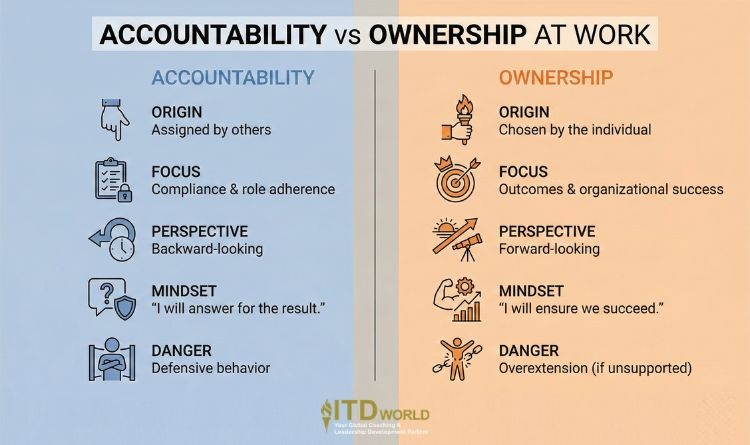
Accountability is typically external and backward-looking; it is about holding someone liable for a result after the fact. Ownership, on the other hand, is internal and forward-looking; it is the result of one’s drive to make sure the outcome is successful from the very beginning.
| Feature | Accountability | Ownership |
| Origin | Assigned by others. (external) |
Chosen by the individual. (internal)
|
| Focus | Compliance and adherence to a role. |
Outcomes and broader organizational success.
|
| Perspective | Backward-looking. (“Who is responsible for this result?”) |
Forward-looking. (“How do I ensure this succeeds?”)
|
| Mindset | “I will answer for the result.” |
“I will ensure we succeed.”
|
| Danger | Can lead to defensive behavior. (“I did my part”) |
Can lead to overextension if not supported.
|
Accountability and ownership in the workplace
While organizations absolutely need accountability structures to function, it’s impossible to audit your way to high performance. You can mandate that an employee is accountable for a task, but you must cultivate the environment that makes them want to own it.
The Importance of Ownership in the Workplace
For many leaders, “taking ownership at work” sounds like a qualitative, cultural goal—something nice to have, but difficult to measure. However, modern organizational research paints a very different picture.
- Increased performance & productivity
A 2021 study published in the Journal of Organizational Behavior found a strong positive correlation between psychological ownership and job performance. Specifically, teams that exhibited high psychological ownership produced significantly better results in creative and complex tasks, with analyses indicating a performance boost of up to 35% compared to others.
When one transitions from a “task-taker” to an “outcome-owner,” their fundamental approach to work changes. No longer simply fulfilling a job description, they now actively drive results. They will voluntarily put in the discretionary effort to help a colleague, optimize a broken process, or double-check a deliverable—actions that a disengaged employee would ignore, simply because it is “not their job.”
- The antidote to “Quiet quitting” and turnover
We are currently facing a global engagement crisis. According to Gallup’s State of the Global Workplace Report, only 21% of the global workforce is highly engaged. The rest are either actively looking for new work or “quiet quitting”—doing the bare minimum required to collect a paycheck.
Ownership is the ultimate talent retention tool. It establishes a sense of “burden-sharing” where the individual views the organization’s success—and its challenges—as a reflection of their own professional identity.
- Driving innovation through citizenship
Innovation rarely happens by mandate; it is only possible if people care enough to challenge the status quo. When employees feel empowered to change their jobs for the better, the entire organization innovates from the bottom up.
Read more: Purpose-driven Leadership – Moving Beyond Profit
What Happens When There is No Ownership at Work?
A landmark Workplace Accountability Study revealed that 82% of managers admit they have limited to no ability to successfully hold others accountable. Furthermore, 85% of employees indicated they were not even sure what their organization was trying to achieve.
When goals are unclear and ownership is absent, companies suffer from the “Dump and Run” phenomenon—stalled progress, duplication of effort, and endless finger-pointing. The financial toll of this disengagement is staggering, with Gallup estimating the global cost at $8.9 trillion, or approximately 9% of global GDP.
Read more: Leadership Accountability – Key to Driving Results & Autonomy
Ownership and the Broader Team
There is a common misconception that “taking ownership” means putting your head down, working in a silo, and ignoring everyone else until your specific part of a project is finished. In reality, you cannot truly own an outcome without engaging the broader ecosystem that makes that outcome possible.
The shift from tasks to outcomes
When you transition from a task mindset to an ownership one, the boundary of personal responsibility expands. You are no longer just responsible for your own checklist – but also for how what you do impacts the next person in the chain.
- The “Task” Mindset: “I finished writing the code for the new feature. If it crashes the servers when it goes live, that is the IT department’s problem.”
- The “Ownership” Mindset: “I finished writing the code, but I am going to meet with the IT team before launch to ensure they have the documentation they need to support it if something goes wrong.”
To put it simply, one’s individual success is irrelevant if the broader team fails.
Fueling high-trust environments
Ownership cannot exist in a vacuum. For an individual to act like an owner, the broader team must let them make decisions.
Because individuals are proactively solving problems rather than waiting for permission, the need for micromanagement disappears. Now, leadership can step back from the daily friction of operations and focus on high-level strategy, trusting that the team is driving the right outcomes.
Cross-functional impact
If the sales team is failing to sell the product the engineering team built, a true owner does not blame the sales team for being incompetent. Instead, they ask: “Did I do a poor job of explaining the product’s value proposition to them?” This level of radical responsibility—which leadership expert Jocko Willink referred to as “Extreme Ownership”—eliminates departmental friction and unites the entire organization around a shared goal.

Team ownership
The Psychological Shadow Side of Ownership at Work
As we have discussed, ownership at work is a superpower. And yet, the term itself is frequently viewed with skepticism by the modern workforce.
Why then?
Because in toxic environments, “taking ownership” is frequently weaponized.
For a true ownership culture to thrive, leaders must acknowledge its psychological shadow side. Employees will actively resist taking responsibility if they feel the system is rigged against them.
Here are the three major red flags to watch out for:
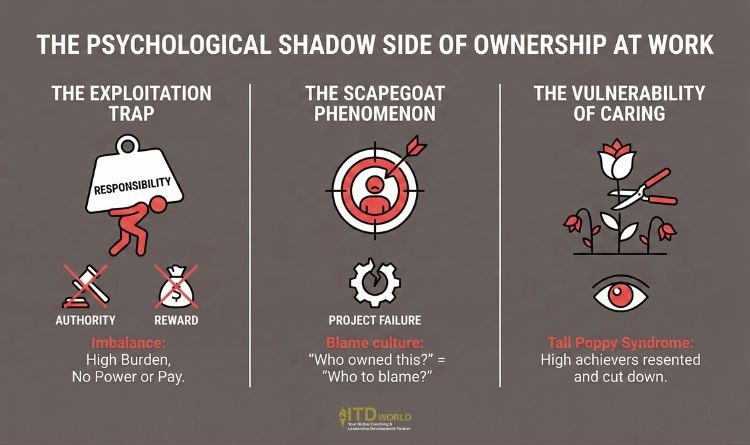
The exploitation trap (“hustle culture”)
“Ownership” is often used by poor management as a buzzword to squeeze more hours out of people for the same pay. If a company demands that you “own” a massive new initiative, but refuses to give you the authority to make decisions, the budget to execute it, or the financial reward for its success, they are only looking for a highly functioning servant.
True ownership at work requires a balance of three things: Responsibility, Authority, and Reward. You cannot burden an employee with the responsibility of an owner while restricting them to the agency of an intern.
Read more: Human Centered Leadership – The Importance of a ‘People First’ Mindset
The scapegoat phenomenon (Accountability vs. Blame)
In a healthy culture, individuals take responsibility for outcomes and learn from mistakes. And yet in a toxic one, “ownership” simply means establishing a clear line of fire when things go wrong.
Example: If a project fails, the management’s immediate response is, “Who owned this?” What they really mean as they say so is “Who can we blame for this?”
In such a psychologically unsafe environment, it’s just natural that self-preservation becomes the norm. Employees will refuse to lead projects, point fingers, and practice the “Dump and Run” method simply to survive.
Read more: Leader vs Boss – 11 Key Differences
The vulnerability of caring (the “Tall Poppy” syndrome)
When you take risks, propose new ideas, and drive outcomes, you make yourself visible. In some organizational cultures, this triggers “Tall Poppy Syndrome”—a phenomenon where high achievers are cut down or resented by peers and insecure managers.
If your proactive nature is consistently met with hostility or micro-management, you are facing a massive red flag. High-ownership individuals must, therefore, protect themselves by documenting their wins, aligning their efforts strictly with documented KPIs, and—most importantly—knowing when to “disown” a toxic situation by looking for a company that actually values their drive.
Read more: Integrity in Leadership – Without It, Nothing Matters
A How-To Guide to Fostering an Ownership Culture
Transitioning from a culture of compliance to one of true autonomy requires a dual approach. On one hand, organizations must build an environment that safely allows for ownership. At the same time, individuals must adopt the mindset and behaviors necessary to seize it.
Here is the playbook for both leaders and employees to bridge the accountability gap.
For organizations & leaders
It’s impossible to command an individual to care. However, it’s completely possible to design a system where caring is the most logical and rewarding choice.
-
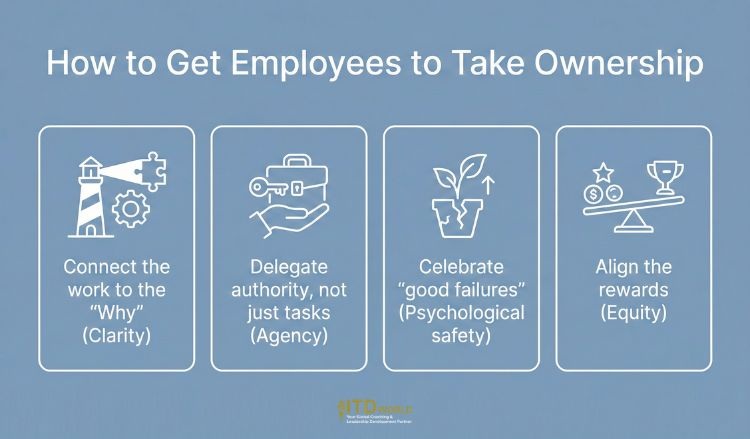
Connect the work to the “Why” (Clarity)
As mentioned above, about 85% of employees have no idea about what their organization is trying to achieve. If a team member only sees their isolated task, they cannot own the outcome. Leaders must, as a result, draw a clear line of sight between daily operations and the company’s strategic vision. Show them exactly how their work impacts the end user.
Example: Instead of telling a software QA tester to “find bugs in the checkout module,” a leader should explain: “If this payment button lags for even two seconds, a single parent trying to buy groceries during their lunch break might miss their window and go without essentials today. You aren’t just checking code; you’re ensuring their day stays on track.”
-
Delegate authority, not just tasks (Agency)
Micromanagement is the ultimate killer of autonomy. If you tell an employee they “own” a project but require them to get your approval for every minor decision, they are merely a project manager. Instead, give them the budget, the resources, and the authority to make the calls.
-
Celebrate “good failures” (Psychological safety)
Ownership inherently involves taking calculated risks. If every misstep is met with a harsh reprimand, people will retreat to the safety of doing only exactly what they are told.
Leaders must publicly differentiate between sloppy execution (which requires coaching) and a well-thought-out risk that simply did not pan out (which should be celebrated as a learning opportunity).
-
Align the rewards (Equity)
When an employee takes initiative and drives a massive win for the company, how are they rewarded? If what they get for their excellent, proactive work is simply more work, it will quickly lead to burnout. As such, it’s vital that you align your recognition, career progression pathways, and financial incentives to reward such people.
Read more: Fish Philosophy – Creating a Joyful & Productive Workplace
How to get employees to take ownership
For individuals
For professionals looking to accelerate their careers, demonstrating an ownership mindset is the single most effective way to stand out and become indispensable.
-
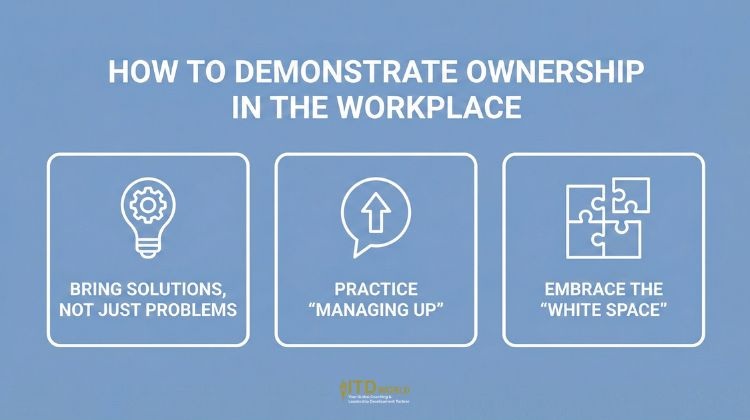
Bring solutions, not just problems (the “Bucket of water” mindset)
A task-taker would walk into a manager’s office and say, “The client is upset, and the project is delayed.” An owner, on the other hand, would come with a message like this, “The client is upset because of the delay. I’ve drafted an apology email, outlined a revised timeline that gets us back on track by Friday, and I plan to call them this afternoon. Do you agree with this approach?”
The idea is simple: don’t just point out the fire. Bring a bucket of water.
-
Practice “managing up”
Ownership means proactively communicating status before being asked. If you know a deadline is at risk, you should aim to communicate the delay immediately, explains why it happened, and provides the revised plan.
By anticipating the manager’s needs and questions, you build the trust required for them to grant you more autonomy.
-
Embrace the “white space”
In every organization, there are tasks and problems that fall into the “white space”—the grey areas between job descriptions that no one wants to touch. Those who step into that space, figure out a solution, and claim responsibility for it are the ones who ultimately get promoted to leadership.
Example: A marketing coordinator notices that while the sales team closes deals and the product team builds features, no one is actually sending a “Welcome” guide to new clients, leading to early confusion. Rather than saying “that’s not my job,” the coordinator drafts a standard onboarding packet, sets up an automated email trigger, and takes charge of the new client experience.
Read more: Leading by Example – Key to Truly Inspiring Action & Trust
How to demonstrate ownership in the workplace
Quotes on Ownership at Work
Owners think long term and don’t sacrifice long-term value for short-term results. They act on behalf of the entire company, beyond just their own team. They never say ‘that’s not my job’.
Amazon Leadership Principles (Jeff Bezos)
Responsibility equals accountability equals ownership. And a sense of ownership is the most powerful weapon a team or organization can have.
Pat Summitt
Most people have a very strong sense of organizational ownership, but I think what people have to own is an innovation agenda… You have to be able to say, ‘I am not just here to do a job, I am here to change the job.’
Satya Nadella
Accountability breeds response-ability.
Stephen Covey
Empowering True Ownership at Work with ITD World
Declaring that your organization needs “more ownership” is one thing; actually building the infrastructure to support it is another. Moving a workforce from a mindset of basic compliance to one of deep, psychological commitment requires more than just a motivational speech. What it needs is a fundamental shift in leadership behavior, organizational design, and company culture.
At ITD World, we understand that true ownership at work cannot be mandated—it must be cultivated. For years, we have been partnering with global organizations to equip their leaders with the precise skills needed to bridge the accountability gap and empower their teams to drive exceptional outcomes.
Our solutions for fostering an ownership culture:
- Coaching culture implementation: We help transition your managers from traditional “command and control” directors into effective coaches. By learning to ask the right questions, they can empower their people to discover solutions and take full responsibility for the results.
- Agile leadership development: In a fast-paced business environment, leaders must know how to navigate ambiguity while fostering psychological safety. Our programs equip participants with the tools to delegate authority effectively, celebrate “good failures,” and promote the trust required for people to take calculated risks.
- Accountability & execution workshops: We provide practical, systemic frameworks to align responsibility, authority, and reward. These tailored workshops help break down departmental silos, eliminate the “Dump and Run” mentality, and unite cross-functional teams around shared, clearly defined strategic goals.
Do not let the “accountability gap” drain your organization’s potential. Contact ITD World today to see how we can help you transform your workforce from passive task-takers into empowered outcome-owners!
Other resources you might be interested in:
- Skills-Based Organization: A Blueprint for Agility in a Disrupted World
- Leadership Journey: How to Grow as a Leader at Every Stage
- Love Leadership: More Than an Abstract Philosophical Idea
- Transformational Leadership: Inspiring Change & Growth
- Leadership Potential: How to Spot & Cultivate Future Leaders
