

Some companies treat digital strategy as a shorthand for all the stuff IT is working on, but that framing is a fast way to fall behind. Even if you’re benchmarking partners or browsing resources like DesignRush insights into US-based digital strategy agencies, the real question is which leadership decisions to make so the tools actually move the business.
Because digital strategy is your ability to set direction amid change and build an operating model that can adapt faster than the market shifts.
Digital is how the business works
When digital touches every customer journey and every internal workflow, it becomes the business itself. That’s why the conversation has moved from which platform you’re on to what you want to be known for and what capabilities make that true.
This also explains why investment keeps growing. Worldwide digital transformation spending is forecast to reach nearly $3.9 trillion by 2027, which is a scale that makes thinking of digital strategy as simply an “IT project” an obviously insufficient mental model.
What happens when digital strategy is delegated to the tech team
Here’s the common failure pattern:
- Leadership agrees that digital is important.
- The work gets handed to IT (or a transformation office) to figure out.
- The organization gets new systems, while incentives, processes, and decision rights stay the same.
- Everyone wonders why it feels like a lot of activity with not much impact.
A frequently cited benchmark is that only 31% of transformations succeed, often because the organization treats transformation as execution instead of leadership and capability-building.
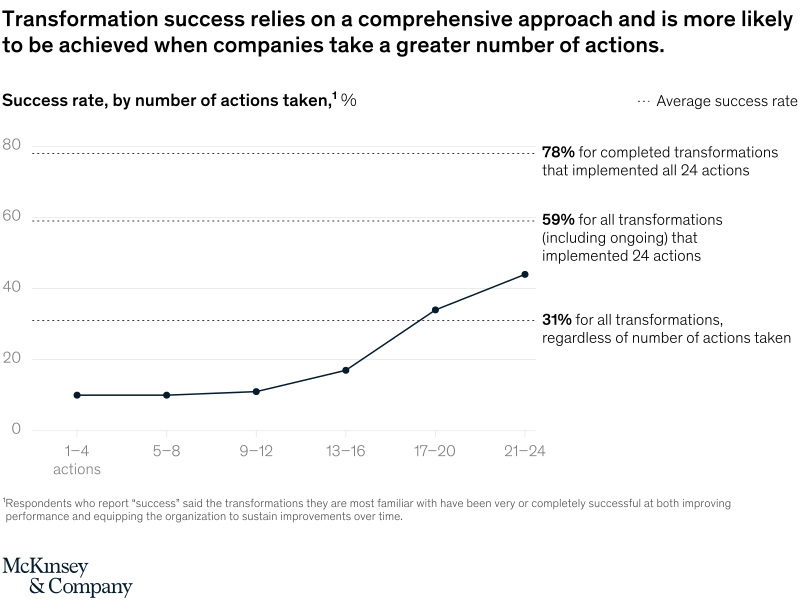
Source: https://www.mckinsey.com/capabilities/people-and-organizational-performance/our-insights/successful-transformations
When strategy isn’t owned at the top, teams default to local optimization. That means marketing chases better leads, product ships features, operations automates tasks, and IT modernizes infrastructure. Each of these actions is valuable, but they’re not always aligned.
The result is patchwork, rather than a coherent direction.
What leadership-owned digital strategy actually looks like
A leadership-owned digital strategy comes down to a set of choices communicated clearly and reinforced consistently:
- Clear direction tied to business value: This means replacing a goal like “move to the cloud,” with something more specific and clearly valuable like “launch in two new markets without doubling headcount.”
- Capability map rather than a tool list: Tools come and go and capabilities endure. To gain a competitive advantage, focus on data quality, experimentation, personalization, and supply chain visibility.
- Decision rights and governance: Clarify who decides and who is accountable when tradeoffs show up.
- Portfolio approach to bets: Balance the portfolio and protect long-term moves from short-term noise.
- Talent and behavior plan: Incentives, skills, adoption, and day-to-day behaviors determine whether new capabilities stick.
Digital literacy is becoming a core leadership skill
If you want proof that this has moved to the top of the house, look at how CEOs describe the skills they need. A significant share of them prioritize AI investment and faster time-to-value, and 23% single out AI and broader digital literacy as essential leadership skills.

Source: https://kpmg.com/xx/en/our-insights/value-creation/global-ceo-outlook-survey.html
That doesn’t mean every executive needs to code or architect systems, but leadership teams are increasingly expected to ask sharper questions, set measurable outcomes, understand risk and governance, and create an environment where teams can execute.
Digital strategy as a leadership muscle
If you treat digital strategy as a capability, you can build it with repeatable routines, the same way you build any muscle.
Here’s a simple operating cadence that works in many organizations:
Quarterly: outcome review + portfolio reset
- What did we ship, and what changed because of it?
- Which bets delivered? Which didn’t, and what did we learn?
- What do we double down on next quarter?
Monthly: cross-functional delivery review
- What’s blocked?
- What tradeoffs need an executive decision?
- Are we learning fast enough (or just building)?
Weekly: frontline feedback loop
- Where are customers getting stuck?
- Where are employees creating workarounds?
- What’s breaking in the real world?
These routines work because they keep the organization aligned on outcomes, rather than focusing on output.
Where external partners fit, and where they don’t
A common misconception is that hiring the right agency is all the strategy you need. In reality, partners typically accelerate whatever direction leadership chooses to take.
So, a strong agency like Disruptive Advertising can help you validate assumptions with research, design journeys and prototypes, stand up measurement, run experiments, and build momentum quickly. They are widely recognized for their expert insights, execution, and performance discipline, which is exactly what leadership teams often need once direction is clear.
You can think of outside help as a force multiplier. If your internal direction is fuzzy, outside help typically only multiplies the fuzz. But if you’re clear on what you want, a strong partner can propel you to the stars.
Bottom line
Digital strategy belongs to leadership because it is fundamentally about choices on where to compete, how to win, what to build, what to stop, and how to align the organization around outcomes.
Technology is part of it, but only as an enabler. The differentiator is whether leaders treat digital as an owned capability, reinforced through governance, metrics, and the operating model. When they do, digital becomes what it should have been all along: the way the business learns and grows.
Note: The content on this article is for informational purposes only and does not constitute professional advice. We are not responsible for any actions taken based on the information provided here.
